
- Release Year: 2005
- Platforms: Macintosh, Windows
- Publisher: ak tronic Software & Services GmbH, Electronic Arts, Inc., Feral Interactive Ltd.
- Developer: Lionhead Studios Ltd.
- Genre: Strategy, Tactics
- Perspective: Diagonal-down
- Game Mode: Single-player
- Gameplay: City building, construction simulation, Real-time strategy (RTS), RPG elements
- Setting: Fantasy
- Average Score: 79/100
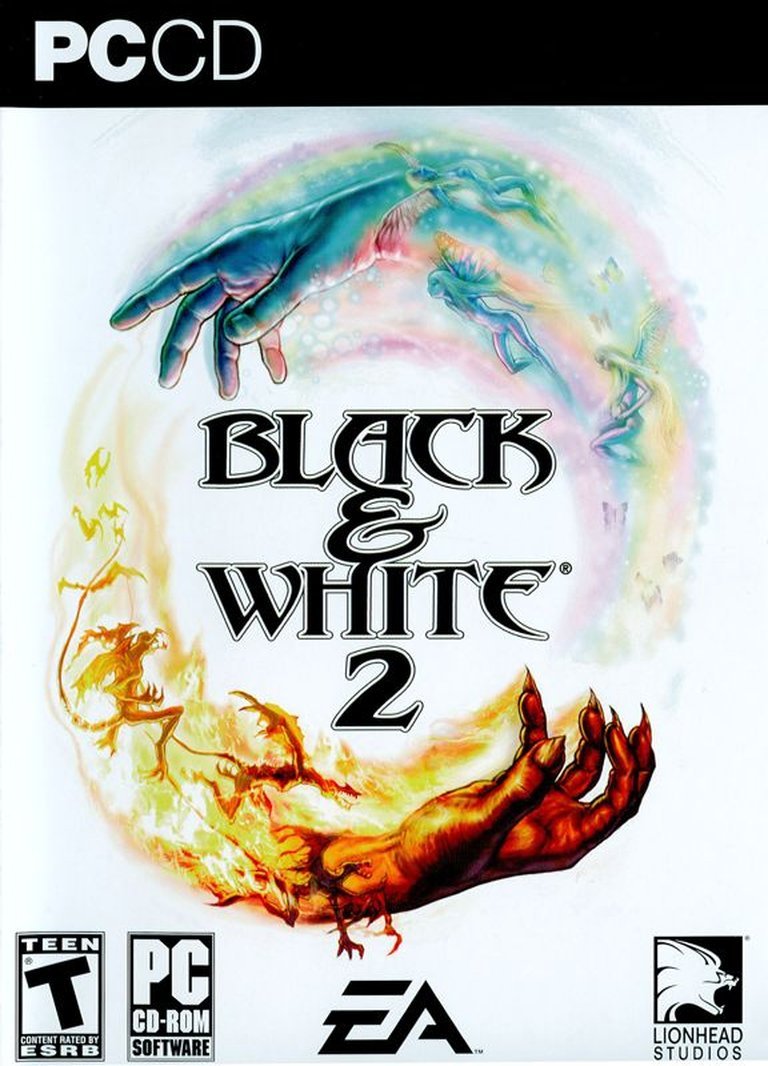
Description
Black & White 2 is a god simulation game where players embody a deity aiding Greek followers in a mythical fantasy world, choosing to be benevolent by building prosperous cities and attracting allies, or malevolent by raising armies for conquest. Players train a customizable creature companion (such as a lion, ape, wolf, or cow) through encouragement or punishment, cast faith-powered miracles, and pursue victory over the Aztecs by befriending or subjugating Norse and Japanese civilizations in a blend of real-time strategy, city-building, and RPG elements.
Gameplay Videos
Black & White 2 Free Download
Black & White 2 Cracks & Fixes
Black & White 2 Patches & Updates
Black & White 2 Mods
Black & White 2 Guides & Walkthroughs
Black & White 2 Reviews & Reception
metacritic.com (75/100): Generally Favorable Based on 50 Critic Reviews
trustedreviews.com : Black & White 2 is a disappointment.
gamespot.com : Black & White 2 tinkers with the original’s formula by adding more structure and story, though at the expense of its open-ended nature.
ign.com (88/100): Sequel to Peter Molyneux’s god game. The world of Eden is now at war.
mobygames.com (76/100): From God game to city builder, with a very unpleasant transition
Black & White 2: Review
Introduction
In the pantheon of god games, few titles loom as large as Black & White (2001), Peter Molyneux’s audacious experiment in divine simulation that let players wield godlike powers through a massive hand cursor and a trainable creature companion. Four years later, Black & White 2 arrived like a thunderbolt from the heavens—or perhaps a misguided meteor—refining the formula with sprawling city-building, real-time strategy battles, and moral choices that reshaped entire islands. Released in October 2005 by Lionhead Studios and published by Electronic Arts, it promised a more structured path to godhood amid a mythical world of Greeks, Norse, Japanese, and ruthless Aztecs. Yet, as our divine hand plucks villages from the earth, this sequel reveals a bittersweet truth: in striving to fix the original’s frustrations, it sacrificed much of its chaotic, emergent soul. Black & White 2 is a monumental achievement in ambition and spectacle, but a cautionary tale of how fan feedback can steer a visionary series toward safer, shallower shores—ultimately earning it a place as a cult classic flawed by its own godly hubris.
Development History & Context
Lionhead Studios, founded by Molyneux after his Bullfrog days on Populous, entered Black & White 2‘s development on December 2, 2002, wrapping after 1,254 grueling days—and over 20,000 takeout dinners, as Molyneux cheekily noted in the game’s readme. Co-designer Ron Millar, fresh from Blizzard’s Warcraft II and StarCraft, infused RTS rigor into the god-game whimsy, while a 490-person credit list (413 developers, 77 thanks) underscored the scale. Peter Molyneux served as lead designer, channeling his signature hype—promising “anything you can think of, within reason”—into a sequel addressing Black & White‘s chief sins: micromanagement-heavy villager AI, scaffold-based building tedium, and creature unpredictability.
The 2005 gaming landscape was RTS-saturated (Age of Empires III, Rise of Nations) and city-builder rich (Caesar IV looming), with god games scarce post-Populous: The Beginning. Mid-2000s PC hardware pushed graphical boundaries—think NVIDIA GeForce FX series—but Black & White 2‘s demands (Pentium 4 2.2GHz min, 512MB RAM, Pixel Shader 2.0) alienated budget gamers, as player reviews lamented. EA’s publishing muscle ensured wide release (Windows first, Mac port by Feral Interactive in 2009), including a Collector’s Edition with the tiger creature. Technological feats like Bink Video middleware, GameCODA, and amBX haptics aimed for immersion, but development felt rushed: no multiplayer, absent skirmish mode, and gesture controls that frustrated despite Lionhead’s “perfect” original interface claims. Molyneux’s one-shot philosophy—no iterative sequels like Sid Meier’s—meant this was Lionhead’s divine intervention on their formula, born amid 2000s PC gaming’s shift from experimental sandboxes to structured epics.
Narrative & Thematic Deep Dive
Black & White 2‘s story unfolds as a prophecy-fueled epic: summoned from the void by a “pure prayer,” you rescue a Greek city from Aztec devastation, then ferry survivors to new lands for a crusade against Norse, Japanese, and ultimately Aztec overlords. Gold scrolls drive the plot across nine islands, silver ones offer side quests for tribute (unlocking features), and bronze tutorials gatekeep progress. Dialogue crackles via returning consciences—Blackie (evil, gravelly) and Whitie (good, posh)—voiced by Marc Silk, bantering with improved wit: “Not those hairy nipples again!” quips one Swedish reviewer. Emissaries narrate with gravitas, while enemy leaders’ inner thoughts add flavor.
Thematically, it’s a meditation on power’s corrupting allure. Good gods foster utopias—fountains, universities, taverns—drawing migrants via prosperity; evil ones erect torture pits, spikes, and prisons, fueling conquest. Alignment morphs your city: lush gardens for benevolence, fiery skulls for malice. Creatures evolve similarly, pooping helpfully or devouring villagers based on training. Yet, the narrative falters in depth—no nuanced characters beyond tribal archetypes, and the “prophecy” (your tribe’s destined dominance) feels tacked-on. Player reviews decry lost “godliness”: influence now ties to buildings, not worship or miracles, diluting the original’s emergent morality. Dialogues shine in humor—villagers named uniquely, consciences’ in-jokes—but the plot’s linearity (build, conquer, repeat) undermines themes of free will, echoing Molyneux’s Fable-era promises of reactivity unmet. It’s a divine parable where choice matters visually and mechanically, but narratively, it’s more diorama than scripture.
Gameplay Mechanics & Systems
At its core, Black & White 2 fuses god sim, RTS, and city builder into real-time loops of expansion, conquest, and moral calibration. Your hand—minimalist UI’s star—gestures miracles (fire, lightning, water, shield, heal, meteor; epics like earthquake, volcano via wonders). Prayer power fuels them, drawn from believers. City-building evolves dramatically: ditch scaffolds for menu-plopped structures (housing, farms, barracks), plotted via paths for villager flow. Good: meadows boost land value, avoiding “slums”; evil: barracks spawn swordsmen, archers, siege engines. Research via tribute unlocks units/tech, but ore/wood scarcity demands balance.
Villager AI soars—self-assigning jobs, tavern revelry, graveyard mourning, university study—creating SimCity-plus life simulation. Migrants form ethnic enclaves (e.g., Japanese districts), dogs roam, statues proliferate. Armies enable RTS sieges: lead masses with your creature (now army commander), breach walls/gates. Creature training innovates via “lessons”—pet/slap to set frequencies (always/rarely poop on trees? Eat lambs?)—purchasable miracles bypass repetition. Choose ape (versatile), lion/wolf (combat), cow (builder); tiger exclusive to editions.
Flaws abound: controls glitch (gesture fails, wall placement hell), enemy AI simplistic/repetitive. Good play skews easy (build big, migrants flock); evil demands micromanagement. No impressing—towns convert via city size—inverts BW1’s core, birthing repetition: “build, migrate, win.” Absent multiplayer/skirmish limits replayability; high sys reqs crash alt-tabbing. UI notifications aid (creature mood, village status), but HUD-less purity yields to toolbars. Expansive yet unbalanced, it’s godhood streamlined for accessibility, at emergence’s expense.
Core Gameplay Loops
- Expansion: Plant buildings, manage resources, expand influence ring.
- Conquest: Good: outbuild foes; Evil: army assaults, creature-led charges.
- Creature Nurture: Lessons menu + pet/slap; specialize (fighter, builder).
- Miracles/Wonders: Gesture-cast for spectacle; epics raze landscapes.
Innovative/Flawed Systems
| System | Innovation | Flaw |
|---|---|---|
| Creature AI | Frequency-based lessons; army leader | Menu-driven robs surprise; feels robotic vs. BW1 mimicry |
| City Sim | Dynamic villagers use buildings; ethnic quarters | Overabundant resources trivialize |
| Alignment | Morphs city/creature; dual paths viable | Good too passive, evil micromanagement-heavy |
| RTS Combat | Mass battles, siege tech | Dumb AI; armies underused in good play |
| Scrolls | Gold (story), silver (tribute), bronze (tutorial) | Linear progression feels hand-holdy |
World-Building, Art & Sound
Nine islands evoke fantasy splendor: sun-drenched Greek shores, misty Norse fjords, cherry-blossom Japanese peaks, volcanic Aztec hells. Free camera sweeps colossal scales—your creature towers like Godzilla—while weather (rain, snow, fog) enhances immersion. Art direction dazzles: dynamic lighting, water effects, particle miracles (lava rivers from volcanoes). Cities pulse alive—villagers bustle day/night, lean on walls, climb balconies—outshining SimCity’s abstraction. Evil metropolises bristle with skulls; good ones gleam with fountains. Creature animations shine: expressive faces, alignment-shifting fur (angelic glow vs. demonic horns).
Sound design elevates: orchestral score (Craig Beattie) swells somber/divine, ambient life hums—children laughing, tavern ditties, dogs barking. Voices charm: consciences’ banter, villager chatter. Yet, graphical bloat overwhelms lesser rigs (e.g., ATI 9500 struggles), detail clutters visibility, and rushed polish shows in bugs/controls. These elements forge hypnotic atmosphere—you’ll linger watching your utopia thrive—but hardware demands gatekeep the awe.
Reception & Legacy
Critics averaged 76% (MobyGames; Metacritic 75/100): highs like Doupe.cz (92%: “shining light”) praised creature AI, visuals; IGN (88%) lauded ambition. Lows (e.g., MacLife 40%: “dull march”) hit repetition, RTS shallowness. Players scored 3.7/5: Kain Ceverus hailed “BE GOD”; Matt Neuteboom lamented city-builder devolution. ELSPA Silver (100k+ UK sales), but no blockbuster. Expansion Battle of the Gods (2006) added tiger, new lands/miracles, but series ended—no BW3.
Legacy endures as Lionhead’s boldest (post-Fable flop?), influencing god sims (From Dust, Godus) with creature training, moral duality. Pulled from digital stores, it’s preserved via abandonware communities. Reputation evolved: original fans decry “fan-requested fixes ruining magic”; newcomers adore sim depth. Molyneux’s overpromise (no multiplayer) tarnished trust, but it pioneered HUD-minimalism, living cities. In history, a pivot from sandbox divinity to structured empire-building—flawed, yet eternally replayable for its spectacle.
Conclusion
Black & White 2 towers as a paradoxical god: refining Black & White‘s pains (villager drudgery, building slog) birthed peerless city sim and creature bonding, yet excised the original’s heart—emergent miracles, worship conquest—for RTS repetition and menu-driven order. Lionhead delivered visual feasts, living worlds, and choice’s tangible weight, but rushed execution, hardware barriers, and fan-pandering (per reviewers) dulled its edge. Not the sequel BW1 deserved, but a worthy historical artifact—8/10 for ambition, replay via expansions/mods. Amid god-game droughts, it reminds: true divinity thrives in chaos, not checklists. Boot it on a beefy rig, pet your ape, and reclaim your throne—flaws and all.