
- Release Year: 2022
- Platforms: Nintendo Switch, PlayStation 4, Windows, Xbox One, Xbox Series
- Publisher: Nightdive Studios, LLC
- Developer: Nightdive Studios, LLC
- Genre: Adventure
- Perspective: 3rd-person (Other)
- Game Mode: Single-player
- Gameplay: Graphic adventure, Puzzle elements
- Setting: Cyberpunk, dark sci-fi
Description
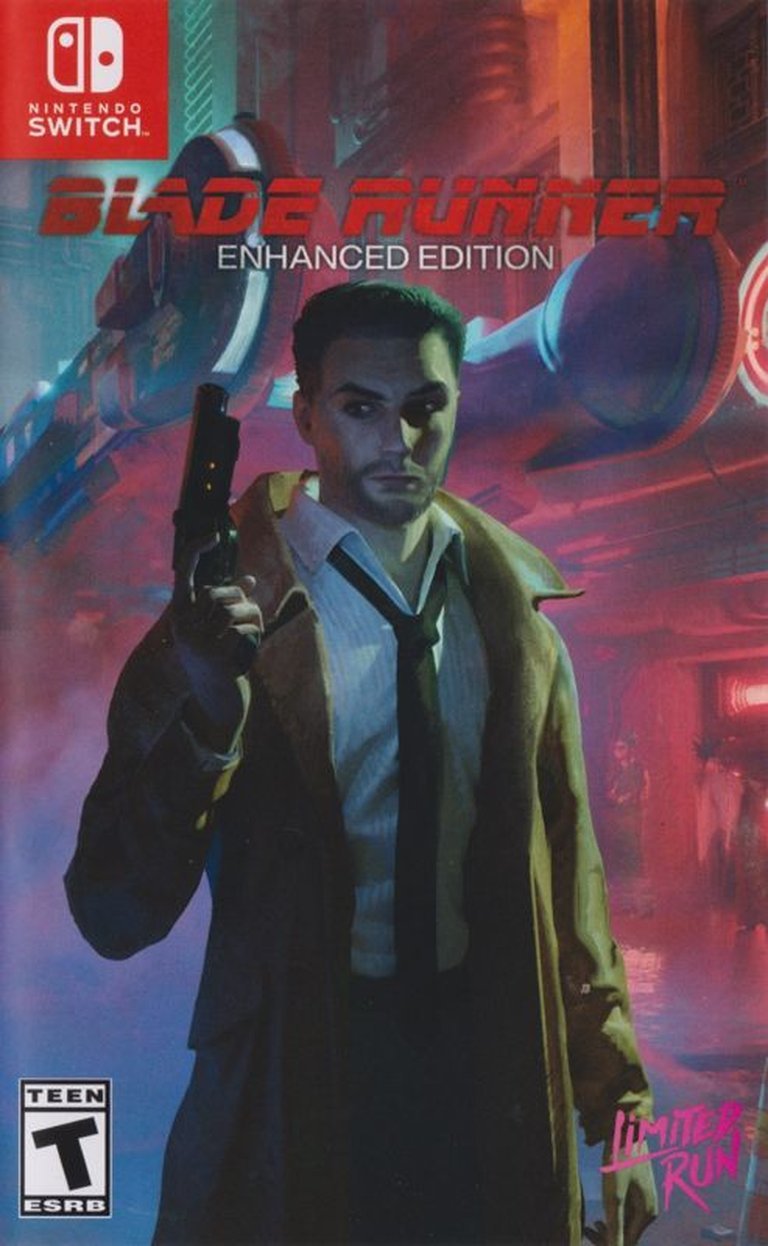
Blade Runner: Enhanced Edition is a remastered version of the classic 1997 graphic adventure game, set in the dystopian cyberpunk world of Los Angeles where players assume the role of a rookie Blade Runner hunting down replicants. As a detective navigating rain-soaked streets and neon-lit cityscapes, players solve puzzles, interrogate suspects, and make critical choices that shape the narrative’s multiple endings. Developed by Nightdive Studios, this enhanced edition preserves the original’s dark sci-fi atmosphere while offering improved visuals and modern platform compatibility.
Gameplay Videos
Where to Buy Blade Runner: Enhanced Edition
Blade Runner: Enhanced Edition Free Download
Blade Runner: Enhanced Edition Cracks & Fixes
Blade Runner: Enhanced Edition Mods
Blade Runner: Enhanced Edition Guides & Walkthroughs
Blade Runner: Enhanced Edition Reviews & Reception
nintendolife.com : Blade Runner: Enhanced Edition is one of the pellets of barely nutritional crud said Corp scatters into the storm drains for us to stay just alive enough that we can be leeched of blood to lubricate the cyborgs that drive the pellet-scattering hover trucks.
waytoomany.games : If you want to take a classic and make it new, you need to do something truly spectacular, otherwise leave it alone.
keengamer.com : The writing and voice acting are absolutely stellar, especially when considering the era this game came from.
thegamer.com : Westwood’s forgotten classic is now playable on PlayStation and Switch, making it more accessible than it’s ever been before.
Blade Runner: Enhanced Edition: Review
Introduction
Deckard, pal… I’ve got a case for you. Few licenses have inspired gaming as profoundly as Ridley Scott’s Blade Runner, a film that redefined cyberpunk and existential dread. Yet, its 1997 video game adaptation—developed by Westwood Studios, the creators of Command & Conquer—remained a cult classic shrouded in licensing limbo for decades. Now, Nightdive Studios’ Blade Runner: Enhanced Edition resurrects this neo-noir detective odyssey for modern consoles, promising a bridge to a lost masterpiece. This review posits that while the Enhanced Edition successfully preserves the original’s groundbreaking narrative and atmosphere, its technical shortcomings and questionable “enhancements” transform a timeless classic into a fractured artifact—a replicant of itself, hauntingly close to retirement.
Development History & Context
Westwood Studios approached Blade Runner not as a simple tie-in, but as a parallel narrative expansion. Set in 2019 alongside the film’s events, it allowed players to live in its rain-slicked dystopia as rookie Blade Runner Ray McCoy. The team’s vision was audacious: a “real-time” adventure where the world evolved independently of player actions, featuring over 70 motion-captured characters with AI-driven agendas and voice work from original film actors (Sean Young, James Hong). Yet, this ambition collided with 1997’s technological constraints. Pre-rendered backgrounds, voxel-based character models, and proprietary VQA video formats pushed CD-ROM capacities to their limits.
The game’s legacy faded due to licensing purgatory—its source code lost during Westwood’s acquisition by EA and subsequent studio closures. Nightdive Studios faced a Sisyphean task: reverse-engineering a 25-year-old game from the original assets alone. Without the source, they relied on the KEX engine for ports, leading to compromises in visuals, UI, and performance. The gaming landscape of 2022, however, was primed for this revival: a resurgence of cyberpunk (Cyberpunk 2077) and nostalgia-driven remasters created ideal conditions for Blade Runner’s return.
Narrative & Thematic Deep Dive
Blade Runner’s genius lies in its narrative flexibility. McCoy’s investigation into replicant-related animal murders unravels a conspiracy involving Tyrell Corporation, rogue replicants, and his own ambiguous origins. Each playthrough randomizes key characters’ humanity—Is Clovis a replicant seeking to extend his four-year lifespan? Is your McCoy a replicant? This nonlinearity, paired with 13 possible endings, creates a web of moral ambiguity. The script excels in mirroring the film’s themes: what defines humanity? McCoy’s journey forces players to confront replicants as sympathetic beings, blurring the line between hunter and hunted.
Lore expansions deepen the universe. The game introduces “Terra” as Earth’s designation for off-world colonizers, the ostracized “Specials” (radiation-affected humans confined to Earth), and a bone marrow test replicant-identification method—ironically more practical than the Voight-Kampff machine. Dialogue choices, influenced by player personality settings (e.g., “User Choice” vs. “Normal”), reflect McCoy’s ethics: spare replicants or “retire” them? This mirrors Deckard’s crisis, making McCoy a thematic counterpoint: idealistic yet haunted by doubt.
Gameplay Mechanics & Systems
Blade Runner’s core loop is a detective simulator: navigate pre-rendered locations, gather clues, interrogate NPCs, and use tools like the ESPER (photo analysis) and Voight-Kampff (emotional resonance testing). Innovation lay in its “real-time” elements—characters move, clues spawn, and events unfold irrespective of player input, creating urgency. However, this design also leads to frustration: miss a timed interaction with Tyrell, and critical story branches vanish.
Combat is rudimentary, relegated to point-and-click shooting during scripted chases or replicant confrontations. Aiming is finicky, and consequences for killing humans (e.g., derailing investigations) add weight but feel underdeveloped. The Enhanced Edition’s UI overhaul is catastrophic: the original KIA clue interface—a text-based dossier—is replaced by a clunky, controller-unfriendly overlay. Navigation menus resemble placeholder assets, with no tooltips or tutorials. Worse, personality settings default to “Normal,” which locks out critical dialogue paths—forcing players to manually select “User Choice” for full agency.
World-Building, Art & Sound
Nightdive’s greatest preservation effort is the atmosphere. Pre-rendered backgrounds—the Tyrell Corporation’s golden spires, Chinatown’s neon alleys—are faithfully upscaled, albeit with AI smoothing that erodes film grain and rain texture details. Voxel characters, low-resolution even in 1997, now clash jarringly against backdrops. Yet, the noir essence endures: rain-streaked streets, flickering holographic ads, and Syd Mead’s conceptual art in motion.
Sound design elevates the experience. Frank Klepacki’s Vangelis-inspired score swells with melancholic synth, while voice acting remains stellar—Sean Young’s Rachael and Joe Turkel’s Tyrell anchor the narrative. But technical flaws plague the Enhanced Edition: audio desynchronization plagues cutscenes, and sound effects cut abruptly. The original game’s ambient city hum is often replaced by silence, breaking immersion. These flaws are particularly acute on Switch, where handheld mode exacerbates pixelation and performance hitches.
Reception & Legacy
Upon release, Blade Runner: Enhanced Edition polarized critics. Metacritic’s 52% score reflects a divide: some praised its faithful narrative (e.g., COGConnected’s 75%), while others condemned its technical flaws (e.g., PlayStation Universe’s 40%). Common complaints included stuttering frame rates, broken menus, and visuals deemed “worse than the original.” Nintendo Life encapsulated the sentiment: “Something genuinely brilliant is buried beneath painful enhancements.”
Commercially, the game found modest success on Switch and Xbox, priced at $9.99. Its legacy, however, is one of duality. The original 1997 game—a masterpiece of licensed storytelling—inspired detective games like L.A. Noire and its non-linear structure presaged modern RPGs. The Enhanced Edition’s lasting impact lies in accessibility: it introduced Blade Runner to a new generation, albeit through a flawed prism. Purists advocate for the ScummVM version (bundled with PC releases), which restores lost content and fixes glitches. Yet, for console players, this port remains the only viable option—a digital ghost in the machine.
Conclusion
Blade Runner: Enhanced Edition is a paradox: a digital resurrection that simultaneously honors and betrays its progenitor. Nightdive Studios’ dedication to preserving Westwood’s vision is commendable, but the game’s technical failings—ugly upscales, broken UI, and audio glitches—transform a landmark experience into a frustrating artifact. For fans of the film, McCoy’s story remains essential, a noir-drenched exploration of identity that still resonates. Yet, the Enhanced Edition’s “enhancements” are more nostalgic than revolutionary.
Ultimately, this game’s place in history is secured not by its remaster, but by its original design. Blade Runner’s true legacy is its fearless embrace of narrative complexity, proving that licensed games could transcend movie tie-ins to become artistic statements. The Enhanced Edition, for all its flaws, ensures this legacy endures. As McCoy might say: “I’ve seen things you people wouldn’t believe… but this version? It’s like tears in rain.”
Verdict: A flawed but vital artifact for cyberpunk pilgrims. 6.5/10.