
- Release Year: 2002
- Platforms: Windows
- Publisher: WildTangent, Inc.
- Developer: WildTangent, Inc.
- Genre: Action
- Perspective: Top-down
- Game Mode: Single-player
- Gameplay: Paddle, Pong
- Average Score: 80/100
Description
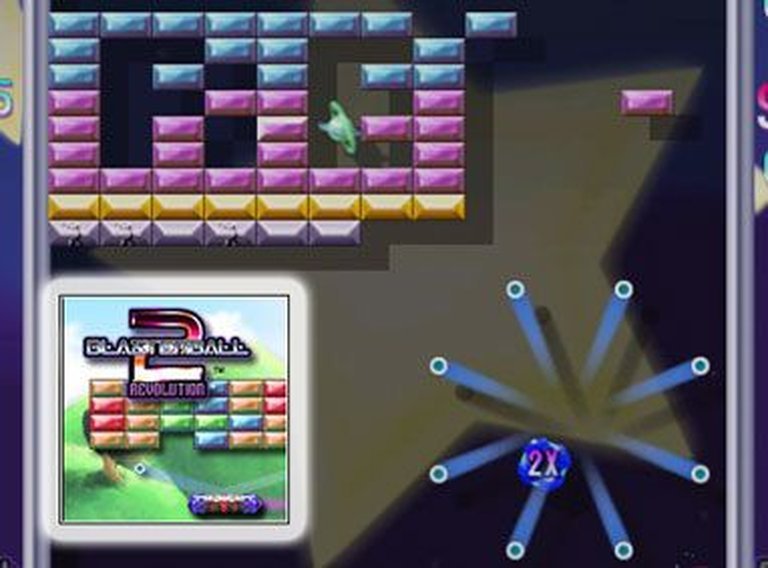
Blasterball 2: Revolution is a top-down arcade remake of the classic Breakout game where players control a paddle to bounce a ball and destroy colorful bricks across two worlds containing 100 levels each. The game features seven types of bricks with unique properties, including normal, 2-hit, indestructible, phantom, exploding, plague, and secret bricks, each requiring different strategies to defeat. Players navigate through increasingly challenging levels while facing powerful guardians every 20 stages, utilizing a variety of power-ups that enhance their paddle abilities, modify ball behavior, or provide special effects. With four difficulty settings affecting ball speed, a life system that rewards skilled play, and bonus levels accessible through secret bricks, Blasterball 2: Revolution offers a modern twist on the classic brick-breaking formula with enhanced gameplay mechanics and visual effects.
Gameplay Videos
Blasterball 2: Revolution Free Download
Blasterball 2: Revolution Mods
Blasterball 2: Revolution Reviews & Reception
metacritic.com : it’s worth giving Revolution a shot first.
retro-replay.com : Blasterball 2: Revolution delivers relentless arcade fun and replayability for players of all ages.
Blasterball 2: Revolution: Review
Introduction
In the pantheon of arcade reinventions, few genres have seen as many permutations as the brick-breaker. Yet, Blasterball 2: Revolution stands as a towering achievement in this lineage—a 2002 Windows release by WildTangent that transformed the Breakout formula into a symphony of explosive chaos. While its predecessors laid the groundwork for paddle-and-ball mechanics, Revolution injected unprecedented depth through its labyrinthine power-up systems, boss guardians, and emergent chaos. This review dissects how Revolution not only honored its arcade roots but also redefined the genre, cementing its legacy as a masterclass in accessible-yet-deep arcade design. Its enduring appeal lies in a deceptively simple premise: shatter every brick, survive the guardians, and embrace the glorious, unpredictable mayhem of cumulative power-ups.
Development History & Context
Blasterball 2: Revolution emerged from WildTangent, a studio synonymous with early-2000s downloadable casual games, operating in an era where shareware and browser-based platforms dominated the PC landscape. Released in December 2002, the game arrived amid a surge of nostalgia-driven remakes and arcade revivals, competing with titles like Arkanoid derivatives while carving its own niche. The core team, spearheaded by Director of Development David Schwartz and producer Travis Baldree (who also handled programming, art, and sound), achieved remarkable cohesion with just nine contributors. Daniel Bernstein’s musical compositions rounded out the experience, complementing Cathy Philips’ QA oversight. Technologically, Revolution was constrained by Windows’ 2002 capabilities, yet its sprite-based visuals and dynamic particle effects maximized the era’s hardware. Crucially, the game’s Java-based iteration initially supported gamepads—including Xbox 360 controllers via Xinput—though later Windows builds omitted this feature, hinting at shifting priorities toward broader accessibility. The title’s “Revolution” moniker was apt: it revolutionized the Breakout template by layering modern RPG-like complexity onto arcade simplicity.
Narrative & Thematic Deep Dive
Though devoid of traditional cutscenes, Revolution weaves a minimalist narrative through its structure. Players embark on a liberation campaign across two digital “worlds,” each housing 100 levels, with every 20th stage culminating in a guardian—a sentient boss entity acting as a gatekeeper. These guardians escalate in threat, from passive obstacles to aggressive foes capable of destroying your paddle, symbolizing escalating opposition. The narrative impetus is one of progression: clearing bricks to dismantle an unseen “brick overlord,” with the guardians embodying localized tyrants. Thematically, the game explores agency within chaos. Power-ups and critters embody duality—tools of salvation or destruction—mirroring the player’s own role as both liberator and agent of mayhem. Secret levels and time-sensitive bricks add a layer of mystery, rewarding curiosity over brute force. While light on explicit storytelling, Revolution’s world is defined by its mechanics: a universe where bricks are dominions, balls are weapons, and the paddle is the sole instrument of revolution.
Gameplay Mechanics & Systems
Revolution’s genius lies in its meticulously layered mechanics, transforming a single paddle-and-ball dynamic into a system of near-infinite variability.
- Core Loop: Players control a paddle to bounce a ball, obliterating bricks to clear levels. Starting with three lives, extra lives are earned via high scores or rare 1-UP power-ups.
- Progression & Difficulty: Two worlds of 100 levels each, with checkpoints every 10 levels allowing menu-based access to level 1, 11, 21, etc. Four difficulty settings (“Leisurely” to “Lightning”) adjust ball speed, offering scalable challenge.
- Brick Types: Seven varieties introduce strategic depth:
- Normal: One-hit destruction.
- 2-Hit: Requires two hits.
- Indestructible: Immovable obstacles.
- Phantom: Reappears seconds after destruction.
- Exploding: Destroys adjacent bricks.
- Plague: Spawns new bricks when hit.
- Secret: Vanishes if not destroyed quickly.
- Power-Ups: The game’s centerpiece, categorized into three mutually exclusive or cumulative types:
- Paddle-Based: Mini (shrinks paddle), Grow (enlarges), Laser (shoots bricks), Attach (ball sticks), Phantom (ghostly extension), Twin (dual paddles). These cannot be combined.
- Ball-Based: Slower, Faster, Divide (splits into three balls), 8-Ball (explodes into eight), Blasterball (destroys all bricks on contact). These stack multiplicatively—e.g., Divide + 8-Ball + Blasterball creates 24 blasterballs.
- Surrounding-Based: 1-UP, Flash (destroys critters), Catcher (saves a missed ball), Score Multipliers (2x, 3x).
- Critters: Animated “enemies” that ricochet the ball, act as destructible obstacles, or even aid/hinder gameplay. The Bricklayer morphs into a brick, while others demolish bricks on impact.
- Boss Guardians: Every 20th level features a guardian, escalating in complexity with projectiles, self-repair, and paddle-destroying attacks.
This synergy of systems—brick variety, power-ups, and critters—ensures no two levels feel alike. Revolution’s design brilliance lies in balancing chaos with control: while power-up combinations can flood the screen with 24 balls, paddle mechanics demand precision. However, bugs like balls passing through bricks or fullscreen glitches occasionally mar the experience, relics of its rapid development cycle.
World-Building, Art & Sound
Revolution’s visual identity is a vibrant explosion of color and motion, rendered in a crisp, sprite-based style. Each brick type is distinctively designed: phantom bricks shimmer with ethereal opacity, exploding bricks pulse ominously, and the Blasterball itself burns a trail of red fury. Backgrounds shift subtly between worlds, though stage background #4 notably reuses the hi-score screen’s motif—a cost-saving choice that adds nostalgic cohesion. Particle effects amplify power-up impacts: laser beams spark, blasterballs illuminate dark corners, and explosions shatter bricks in satisfying cascades. Critters and guardians animate with personality, from the centipede-like first guardian to later, more aggressive bosses.
Sound design complements the chaos perfectly. Daniel Bernstein’s soundtrack blends chiptune melodies with driving percussion, evoking both retro charm and modern energy. Sound effects are equally tactile: the thwack of paddle contact, the shatter of bricks, and the distinct ping of power-up pickups create a responsive auditory landscape. Even the absence of sound—a rare bug—underscores how integral audio is to the game’s rhythm. Together, art and sound forge an immersive arcade atmosphere, proving that even top-down simplicity can evoke a world of vibrant, kinetic energy.
Reception & Legacy
Upon release in December 2002, Revolution garnered modest acclaim. Softonic awarded it 80% in 2005, praising its “mesmerizing patterns” and “bursting… fun” but noting its niche appeal. Player ratings on MobyGames averaged 3.0/5, reflecting its cult status. WildTangent’s platform boasted a healthier 4.4/5, highlighting its popularity among casual audiences. Commercially, it thrived as shareware, though a planned 2010 physical release by Mumbo Jumbo never materialized.
Legacy-wise, Revolution influenced brick-breaker design by popularizing cumulative power-ups and boss encounters. Its DNA is evident in later titles like Breakquest and Shatter, which similarly layered RPG mechanics onto arcade foundations. Culturally, it remains a beloved relic of early PC gaming, fondly remembered for its emergent chaos—especially the thrill of triggering 24 blasterballs. Trivia from its fandom notes its appropriation of Arkanoid Returns assets and the Java version’s pioneering gamepad support, underscoring its technical ambition. While overshadowed by mainstream franchises, Revolution’s design philosophy—simplicity layered with complexity—echoes in modern indie games, proving its revolutionary impact endures.
Conclusion
Blasterball 2: Revolution is more than a Breakout clone; it is a masterful distillation of arcade philosophy—simple to learn, endlessly complex to master. Its fusion of strategic depth (brick types, guardians), emergent chaos (power-up stacking), and tactile satisfaction (controls, sound) created a blueprint for the genre. While technical hiccups and a lack of traditional narrative hold it back from perfection, its 200 levels and relentless replayability cement it as a timeless experience. In the annals of gaming history, Revolution stands as a testament to WildTangent’s vision: a game where every brick shattered, every power-up collected, and every guardian defeated is a pixel in a larger revolution. For players seeking pure, unadulterated arcade joy, it remains not just a game, but a vital artifact of digital rebellion.