
- Release Year: 2020
- Platforms: PlayStation 4, Windows, Xbox One
- Publisher: Bandai Namco Entertainment America Inc., Neowiz Games Corporation
- Developer: Round 8 Studio
- Genre: Action, RPG
- Perspective: Behind view
- Game Mode: MMO
- Setting: Fantasy
- Average Score: 58/100
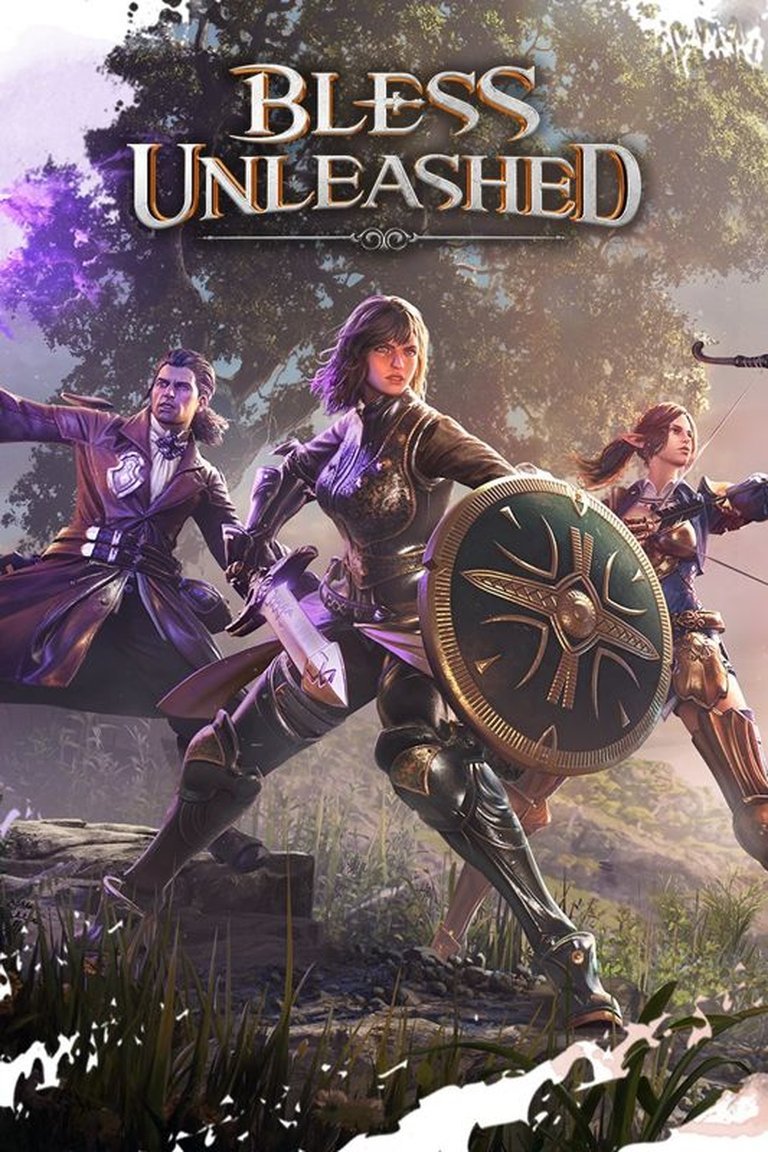
Description
Bless Unleashed is a free-to-play fantasy massively multiplayer online role-playing game (MMORPG) set in a vibrant, persistent world where players engage in action-oriented combat, complete quests, and participate in large-scale events like dungeons and world boss battles. Developed by Round 8 Studio and published by Bandai Namco, it emphasizes exploration, community interaction, and continuous updates within a richly detailed fantasy setting.
Gameplay Videos
Where to Buy Bless Unleashed
Bless Unleashed Mods
Bless Unleashed Guides & Walkthroughs
Bless Unleashed Reviews & Reception
metacritic.com (57/100): I can certainly recommend giving Bless Unleashed a shot.
imdb.com (60/100): the game isn’t even finished.
confreaksandgeeks.com : the options were lacking.
Bless Unleashed Cheats & Codes
PC
| Code | Effect |
|---|---|
| BUPC-TOP8-THAN-KYOU | Increases Bless Pass Tier by 4 |
| 0TL7-2021-BUPC-XYAZ | Purple Dye x5 & White Dye x5 |
Bless Unleashed: A Monumental Ambition, A Troubled Legacy
Introduction: The Phantom of the Console MMO
In the vast, often barren landscape of console-exclusive MMORPGs, Bless Unleashed stands as a spectral titan—a game of breathtaking ambition, profound missteps, and a legacy tragically cut short. Announced with the promise of bringing a premium, action-focused MMO experience to Xbox One and later PlayStation 4, it entered a genre dominated by PC giants like World of Warcraft and Final Fantasy XIV. Its thesis was audacious: to translate the intricate, button-heavy tapestry of the MMORPG into a fluid, combo-driven, controller-friendly action game without sacrificing the scale and social depth of its progenitors. Yet, what followed was a tumultuous five-year journey marked by soaring visions, crippling technical debt, a dedicated but dwindling community, and ultimately, server shutdown. This review argues that Bless Unleashed is not merely a failed game, but a critical case study in the perils of live-service development, the unique challenges of console MMORPG design, and the heartbreaking fragility of digital worlds. It is a game that consistently reached for greatness but was repeatedly pulled back by a tangled web of bugs, balance issues, and operational decisions that eroded player trust until its eventual, though not final, demise.
Development History & Context: From PC Collapse to Console Salvation
The story of Bless Unleashed is inextricably linked to the catastrophic launch of its predecessor, Bless Online. Developed by Neowiz’s internal studio, Bless Online (2017-2018) was a visually stunning, traditional tab-targeting MMORPG built on the Bless IP. However, it was immediately beset by game-breaking exploits, a nebulous economy, and a rapid exodus of players, leading to its shutdown in September 2019. This failure provided the catalyst and the lessons for Bless Unleashed.
A Reboot, Not a Sequel: Head of Development at Round 8 Studios, Jason Park, was unequivocal in a 2018 interview with GamingBolt: “Bless Online and Bless Unleashed are two different games, with different goals.” While Bless Online targeted “classic MMORPG PC fans,” Bless Unleashed aimed for “users who enjoy action RPG but have not experienced (or have little experience) MMO.” This was a fundamental philosophical shift. The team, Round 8 Studio under Neowiz, but with the heavyweight publishing clout of Bandai Namco Entertainment America, essentially started from scratch. The only shared element was the core world lore; the storyline was set in a parallel universe. Practically everything else—the engine (upgraded to Unreal Engine 4), UI, gameplay, combat, control scheme, and monster AI—was rebuilt from the ground up for a controller-centric, console-first experience.
The Console Imperative: Park identified the core challenge: “Fundamentally, the traditional MMORPG genre is not suitable to play with a controller.” The team had to “verify and improve basic MMORPG systems to work in a console setting.” This led to the adoption of a non-targeting, action-combat system where positioning, dodging, and intuitive combo strings (initiated with X or Y buttons, growing with level) replaced tab-targeting and ability bars. This was a direct response to the perceived complexity of PC MMOs and a bid to capture the audience of action RPGs like Monster Hunter.
A Rocky Path to Launch: The development cycle was protracted and public. Closed betas ran in April and July 2019, followed by an open beta in November 2019 and a stress test in January 2020. The Xbox One version launched on March 12, 2020, via the Microsoft Store with paid Founder’s Packs offering early access. A PlayStation 4 version followed on October 22, 2020, after a period of Xbox exclusivity. The Windows PC port, handled by Neowiz and later VALOFE, arrived last on Steam on August 6, 2021—a reversal of the typical PC-first model. This顺序 itself was a statement of intent: this was a console game first.
The Inevitable Shutdown and Rebirth: Despite its ambitions, Bless Unleashed struggled. On December 20, 2022, Bandai Namco announced the closure of its servers for Xbox One and PlayStation 4 on November 30, 2022, citing a “struggling user base size.” This mirrored the fate of Bless Online. However, in a twist of fate, the game was “rebooted” and resurrected by VALOFE (a Korean publisher with suspected ties to Neowiz) in late 2022/early 2023, taking over server management and continuing operations on PC. This second life, however, was fraught with its own controversies, particularly regarding persistent, unpatched game-breaking bugs, as documented on Korean community wikis like NamuWiki.
Narrative & Thematic Deep Dive: A prophecy Unfulfilled
Bless Unleashed‘s narrative is its most consistently criticized aspect, often described as formulaic, disjointed, and ultimately incomplete—a fitting metaphor for the game itself.
Plot Synopsis: Players assume the role of the “Hero of Lumios,” awakening from a prophetic dream battle with the Archon of Fire. They begin on the idyllic, neutral island of Telarion, a bustling hub of trade and festivity centered around a magical lighthouse. This peace is shattered when the powerful mage Gideon and his cult, the Faceless, launch a demonic invasion during the annual festival. Rescued by the griffin-riding Don Diego, the hero embarks on a journey across the continent of Arden to stop Gideon and prevent a cataclysmic event known as “the Breaking.”
Themes and Execution: The plot grapples with classic fantasy themes: the struggle between light and shadow, the weight of prophecy, and the cost of power. The “Breaking” suggests a cyclical apocalypse, hinting at deeper lore. However, the execution is where it falters. Reviewers and players alike noted a “dull,” “cookie-cutter” story with a “lazy” reliance on fetch quests. The IMDb user review eloquently captures the sentiment: the campaign builds to a climax after the Gideon fight but then abruptly ends in the Beoran/Ostium region, with storylines left unresolved. Players were even forced to purchase subsequent “campaign packs” with a scarce in-game currency to continue, a monetization decision that felt exploitative given the incomplete base narrative.
Parallel Universe, Diminished Impact: While the decision to set the story in a parallel universe allowed for familiar regions and NPCs from Bless Online, it also severed any emotional continuity for returning fans. For newcomers, the world lacked the deep, established history of giants like Warcraft or Final Fantasy. The narrative was a vessel for gameplay—a means to guide players through regions and boss fights—but never a compelling reason to stay. The tragic irony is that a game with such a rich-sounding backdrop (the Lighthouse of Telarion, the Faceless cult, the Breaking) failed to weave these elements into a cohesive, engaging tapestry, leaving players more invested in gear scores than the fate of Arden.
Gameplay Mechanics & Systems: Innovation Marred by Inconsistency
This is where Bless Unleashed‘s vision is most apparent and its failures most painful. The core design philosophy was to create an accessible, action-oriented MMO for console, and in pockets, it succeeded brilliantly.
Combat: The Beacon of Potential: The non-targeting, action-combat system was the game’s crown jewel. Inspired by Monster Hunter and Dark Souls, it demanded spatial awareness, timing, and mastery of class-specific combo chains. As Park stated, the goal was to “emphasize the value of health as a resource,” eliminating passive HP regeneration. This created a tense, rewarding loop where a perfectly timed dodge felt immensely satisfying. Each of the five core classes—Berserker (melee DPS), Crusader (tank), Mage (ranged magic), Priest (support/tank), and Ranger (ranged physical)—had distinct feels and combo progressions that unlocked with skill points. The combat was “impactful” and “tactical,” as noted by many user reviews.
However, this system was undermined by technical flaws. The most infamous were “wall-pass” bugs, extensively documented on NamuWiki, which allowed players to skip entire dungeon sequences and cheat progression. For months, despite player reports, the developers were either unable or unwilling to fix these exploits, creating a two-tier community of legitimate players and exploiters. Furthermore, input lag and clunkiness were common complaints. Dodges would not register, animations would lock players in place, and hit feedback was often unsatisfying—a fatal flaw in a game where precision is paramount.
Progression: The Grind and The “Blessing” System: Character progression was a dual track of leveling (max 45) and gear score (GS). The end-game loop, as Park described, involved completing “campaigns” (episodic story updates), then farming materials, upgrading estates, and participating in Crusades (world events) and Regional quests. The core economic and progression mechanic was item enhancement. Gear could be upgraded using in-game gold (risky, could break or downgrade) or “Star Seeds” (safer, daily-bounded currency). The intent was to create a long-term investment loop.
Park introduced the “Blessing” system to mitigate the gap between new and veteran players: “high level users are guaranteed rewards, and at the same time maintains a reasonable balance.” In practice, this system was obscure and often felt insufficient. The grind to max level and competitive GS was described as “draconic” and “long and arduous,” exacerbated by repetitive quests and a lack of meaningful EXP rewards from high-level content. The user review from “RobertDirk” on Metacritic is a stark counterpoint to Park’s vision, labeling it “textbook Pay-to-Win” due to the ability to buy high-tier gear from the player-driven marketplace (the Auction House) with Star Seeds, creating a severe power imbalance.
UI and Console Adaptation: For its time, the UI was a notable success in translating MMO complexity to a controller. Menus were navigable, combo indicators clear, and quest tracking functional. The Xbox One X enhancements (4K, dynamic resolution) were technically impressive. However, the later PC port suffered from a UI that felt “uncomfortable” and explicitly designed for gamepads, a point of friction for keyboard/mouse users.
Other Systems: The game featured the expected suite: crafting, gathering, housing (estates), PvP arenas (3v3), large-scale Battlefields (15v15), and world boss events. Guilds were present but “lackluster,” serving primarily as chat channels. A notable, controversial design was the complete absence of player-to-player trading, a decision likely made to control the economy but severely limiting social and economic interaction.
World-Building, Art & Sound: A Gorgeous, Empty Shell
Bless Unleashed presented a world of striking, if derivative, beauty. Built in Unreal Engine 4, its greatest strength was its art direction and scale.
Visuals and Atmosphere: The world of Arden was vast and varied, comprising regions like the starting Telarion, the Campani Plains, the volcanic Nolando Wasteland, the icy Cornus Mountains, and the ominous Spirit Forest. The landscapes were often stunning, with draw distances that impressed on the Xbox One X. Character models, particularly in character creation (though simplified from Bless Online), were detailed and realistic, leaning into a more mature, “Western” fantasy aesthetic compared to the anime styles of Genshin Impact or Black Desert. However, this beauty was inconsistently applied. Players reported significant texture pop-in (“slow texture load in”), recycled NPC models, and occasional environmental glitches. The world felt large but could also feel samey, with “copy-paste” areas diminishing the sense of unique discovery.
Sound Design: The soundtrack was serviceable fantasy orchestral fare, never particularly memorable but suitably epic in boss fights and town hubs. The major audio failing was the near-total lack of voice acting. Beyond the initial trailer and a Few grunts, the world was silent. Dialogue was presented in text boxes with occasional non-verbal NPC exclamations. In an era where even free-to-play MMOs like Star Wars: The Old Republic had full voice acting, this was a jarring omission that made the already weak narrative feel even more hollow and cheap. As one reviewer noted, coming from ESO, “the lack of voice dialogue here is quite jarring.”
The Felt Disconnect: The ultimate problem was the disconnect between the promising world and the gameplay within it. The beautiful landscapes were populated by repetitive quest-givers and mobs. The potential for epic discovery was often reduced to following a quest marker to kill ten of the same creature. The world-building was superficial, lacks the deep lore integration seen in Elder Scrolls Online or Final Fantasy XIV. It was a gorgeous stage with a sparse, uninspired script.
Reception & Legacy: A Story of Squandered Potential
Bless Unleashed‘s reception was a study in contradiction, mirroring its own unstable development.
Critical Reception: Aggregate scores were middling to poor. Metacritic (Xbox One) holds a 57/100 based on 6 critic reviews, categorizing it as “Mixed or Average.” MobyGames records a 74% average from 4 critics, but this masks a wide range: Generación Xbox praised it (82%), calling it a “great MMORPG” and a celebration for console fans. XboxAddict was cautiously positive (78%), acknowledging its serviceability but warning of the “long and arduous grind.” TheXboxHub (70%) called it a “no-brainer to play” due to being free. MMORPG.com on PC was far more negative (65%), worrying about server population and lack of long-term hooks against competing MMOs with expansions.
User scores were even more polarized. Steam reviews (after the VALOFE reboot) sit at a “Mixed” 53/100 from over 31,000 reviews. Metacritic user scores average 5.9/10. The divide is stark: passionate defenders praise its “impactful” combat, lack of pay-to-win (a claim hotly contested by others), and friendly community. Detractors cite “clunky” combat, “dull” story, pervasive bugs, server instability, and a “boring, frustrating grind.” The IMDb review is a poignant, bittersweet account from a player who started late, logging 194 hours to experience the game before its first shutdown, lamenting the unfinished story and lost time.
Commercial and Operational Failure: The “struggling user base size” cited by Bandai Namco was a direct result of the very issues plaguing the game. Persistent bugs (especially wall-pass exploits), a reputation for a punishing grind, slow content updates, and a feeling of an incomplete package turned away all but the most dedicated. The server shutdown in November 2022 was the final, official verdict on Bandai Namco’s stewardship. The VALOFE reboot has stabilized a niche player base but is forever stained by the same core bugs that went unpatched for over half a year under the previous management, as chronicled on NamuWiki. The perception of a developer that “knows” about game-breaking exploits but “cannot fix it” or “connives” with bug-users (a claim in the NamuWiki) destroyed credibility.
Legacy and Influence: Bless Unleashed‘s legacy is a cautionary tale. It demonstrated the viability and extreme difficulty of a console-focused, action-MMO. Its combo-based combat influenced a design space, proving that active combat could work in an MMO context outside of Tera or Vindictus. However, its failure underscored the non-negotiable need for polish, stability, and live-service competence. An MMO lives or dies on player trust; Bless Unleashed repeatedly violated that trust through broken promises (unfixed bugs), incomplete stories (abrupt campaign end), and perceived monetization unfairness. It showed that a beautiful world and innovative combat are insufficient foundations without robust engineering, consistent content, and transparent communication. For every player who finds a home in its VALOFE-run second life, there are dozens who remember it as a beautiful ghost, a promise of what could have been.
Conclusion: The Unfinished Symphony
Bless Unleashed is a tragedy of monumental proportions. It was a game that understood the yearning for a deep, social, persistent world on a console and crafted a combat system that was, at its best, sublime. It took risks—ditching traditional targeting, eliminating passive healing, aiming for an action-RPG crowd—and in doing so, carved out a unique, if flawed, identity.
Yet, it was ultimately undone by the very nature of the live-service model it embraced. It launched before it was ready, burdened by technical debt that became systemic. Its narrative was anemic, its economy fragile, and its progression a grind without meaningful reward structures for many. The management, first by Bandai Namco and then by VALOFE, failed to nurture its community, letting critical bugs fester and allowing the perception of complacency and incompetence to take root. The shutdown was not a surprise; it was an inevitability born of a thousand small cuts.
In the pantheon of video game history, Bless Unleashed will not be remembered as a classic. It will be remembered as a textbook example of squandered potential. It is the game that proved you could build a gorgeous, action-packed console MMO, but also that you cannot sustain one without the pillars of stability, fairness, and committed stewardship. Its servers may rise and fall, but its lesson endures: ambition without execution is merely a beautiful, empty world. The Hero of Lumios never got to finish their quest, and for the players who invested in their journey, that remains the most profound and lasting wound.