
- Release Year: 2002
- Platforms: Windows
- Publisher: eGames, Inc.
- Genre: Puzzle
- Perspective: Side view
- Game Mode: Single-player
- Gameplay: Falling block puzzle, Tile matching puzzle
Description
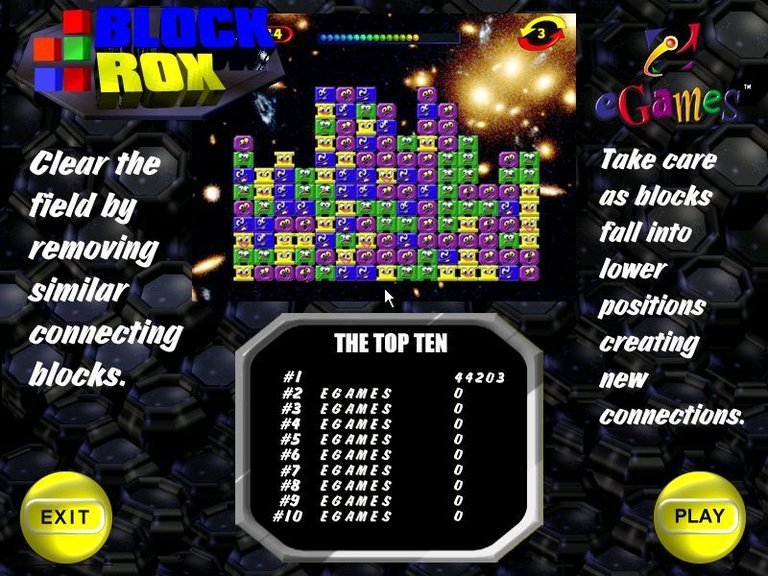
Block Rox is a single-player tile-matching puzzle game released in 2002 for Windows, where players use mouse controls to click on connected groups of colored bricks to remove them and clear timed levels. The game features animated bricks in two or more colors, with levels becoming progressively more complex as additional colors are introduced, and includes music, sound effects, and a high score table.
Block Rox: Review
Introduction
In the crowded landscape of early 2000s puzzle games, where titans like Tetris and Bejeweled reigned supreme, a humble yet enigmatic entry emerged: Block Rox. Debuting in 2002 on Windows, this tile-matching puzzle title from publisher eGames, Inc. offered a deceptively simple premise: click connected groups of colored bricks to clear them from a grid. Yet, beneath its minimalist veneer lies a product deeply rooted in a lineage of obscure puzzle games dating back to the 1980s. Block Rox is not merely a standalone release but a modern scion of the “ROX” series—a lineage tracing its origins to the ZX Spectrum and Commodore 64. This review dissects Block Rox as both a standalone experience and a cultural artifact, examining its mechanics, design philosophy, and place in the evolution of puzzle gaming. While it may never have achieved mainstream acclaim, Block Rox represents a fascinating microcosm of early PC puzzle gaming’s quirks, constraints, and enduring appeal.
Development History & Context
Block Rox was developed during a pivotal moment in gaming history: the early 2000s, when Windows-based casual games were flourishing, but technological and market constraints shaped their design. Published by eGames, Inc.—a company known for budget titles and compilations—the game arrived in an era dominated by console behemoths like the PlayStation 2 and Xbox, yet also amid a burgeoning PC puzzle scene. The developer remains uncredited in available sources, a common trait for smaller-budget titles of the time, suggesting a lean, possibly independent team.
The game’s lineage is undeniable. Block Rox is part of the “ROX” family, a puzzle subgenre with roots stretching back to 1982. Its forebears include ROX III (ZX Spectrum), Deflex / ROX (VIC-20), and a 1993 DOS iteration. By 2002, the core “click connected groups of same-colored tiles” formula had been refined over nearly two decades, but Block Rox adapted it for Windows with mouse-centric controls—a nod to contemporary trends favoring accessibility. Technologically, the game operated within the limitations of early 2000s PCs: simple 2D sprites, rudimentary sound design, and a fixed-screen layout. Its reliance on CD-ROM and download distribution channels reflected the era’s shift toward digital delivery, though it lacked the polish of AAA titles.
Narrative & Thematic Deep Dive
Block Rox is devoid of overt narrative, characters, or dialogue—a deliberate choice aligning with the abstract nature of puzzle games. Yet, its design implicitly explores themes of order versus chaos and the satisfaction of pattern recognition. The grid of animated bricks initially appears as a chaotic mosaic, but the player’s actions impose structure. Removing connected groups creates cascading effects, where adjacent bricks shift to fill voids, mimicking entropy and reorganization. This dynamic mirrors real-world systems—think of sorting debris or solving spatial puzzles—where order emerges from deliberate action.
The absence of a story emphasizes gameplay purity. Without cutscenes or lore, the game’s “narrative” is one of escalating challenge. Levels introduce more colors, turning a simple binary choice (red vs. blue) into a complex calculus of strategy. The timer adds tension, framing each level as a race against entropy. Thematically, Block Rox embodies the minimalist ethos of early puzzle games: meaning derived not from storytelling, but from interaction and mastery.
Gameplay Mechanics & Systems
At its core, Block Rox is a masterclass in accessible complexity. The gameplay loop is intuitive: click a connected group of ≥2 bricks of the same color to clear them. The bricks vanish, and gravity pulls remaining blocks downward, potentially creating new matches. This “match-3 adjacent” mechanic predates mainstream titles like Bejeweled but shares their DNA of emergent strategy.
Key systems include:
– Progressive Difficulty: Levels start with two colors, expanding to three or more as the game advances. Each new color exponentially increases complexity, demanding foresight and efficiency.
– Timer Pressure: Each level restricts players to a time limit, forcing quick decisions. This turns puzzle-solving into a high-stakes balancing act between speed and accuracy.
– High Score Table: A staple of arcade-style puzzles, it incentivizes replayability. Players compete for optimal brick-clearing strategies and faster times.
– Mouse Controls: Precision is paramount. A misclick can break a large group prematurely, wasting scoring potential. The cursor’s feedback—highlighting connected groups—ensures clarity.
The game’s greatest strength is its elegant simplicity. Yet, it also reveals subtle depth: clearing smaller groups early risks isolating bricks later, while over-reliance on large combos may leave behind unmatchable “islands.” This duality—immediate accessibility with hidden depth—defines Block Rox’s design.
World-Building, Art & Sound
Block Rox eschews traditional world-building for a self-contained, abstract arena. The grid of bricks serves as the entire “world,” with no backstory or environmental lore. This abstraction is functional: it focuses attention on mechanics, not narrative.
Artistically, the game embraces minimalist charm. Bricks are rendered as simple, 2D sprites with solid colors and subtle animations—like a gentle shift when clicked. The fixed-screen layout evokes classic arcade puzzles, with no scrolling or perspective shifts. Visual feedback is immediate: cleared groups vanish with a satisfying “pop,” while isolated bricks pulse to signal their isolation.
Sound design is similarly utilitarian. Chiptune-style background music loops during gameplay, while sound effects—like clicks, pops, and a low “thud” as bricks fall—reinforce tactile feedback. This audio landscape is unremarkable but effective, creating a calm yet focused atmosphere. Together, the art and sound design prioritize clarity over flair, ensuring the player’s focus remains on the puzzle at hand.
Reception & Legacy
Block Rox left faint ripples in the gaming landscape. Contemporary records show no major reviews or awards, suggesting it flew under the radar of critics and players alike. Its publisher, eGames, specialized in budget titles, likely limiting its distribution and marketing impact. Yet, its legacy endures through its lineage. As the latest entry in the “ROX” series—spanning 20 years and multiple platforms—it exemplifies the endurance of puzzle mechanics across eras.
Post-2002, Block Rox became a footnote in puzzle gaming history. It never spawned sequels or imitators, unlike its peers. However, its core mechanic—clicking connected groups—resonates in modern titles like Mahjong solitaire or Hex FRVR. Its place in the “ROX” lineage highlights the genre’s evolution: from 1980s home-computer obscurity to streamlined, mouse-driven accessibility.
Ironically, Block Rox shares its release year (2002) with landmark games like Metroid Prime and Grand Theft Auto: Vice City. While those titles redefined their genres, Block Rox remained a niche curiosity—a quiet testament to the enduring appeal of simple, well-executed puzzles.
Conclusion
Block Rox is not a revolutionary game, nor is it a flawed relic. It is a competent, focused puzzle title that distills decades of design wisdom into a compact Windows experience. Its strengths lie in its elegant mechanics, progressive difficulty, and adherence to the “ROX” lineage. While it lacks the narrative depth or visual flair of contemporaries, its pure puzzle gameplay offers a satisfying challenge for those who crave accessible strategy.
In the grand tapestry of video game history, Block Rox occupies a humble but meaningful thread. It represents the unsung heroes of gaming: titles that prioritize playability over spectacle, legacy over innovation. For enthusiasts of puzzle history or 2000s PC gaming, Block Rox is a worthwhile artifact—a time capsule of a bygone era where simplicity reigned supreme. Its legacy is not in revolutionizing the industry, but in embodying the timeless appeal of a well-crafted match. Verdict: A solid, if unheralded, entry in the pantheon of puzzle games.