
- Release Year: 2008
- Platforms: Macintosh, Windows
- Publisher: Cactus Software
- Developer: Cactus Software
- Genre: Action, Puzzle
- Perspective: Side view
- Game Mode: Single-player
- Gameplay: Platform
- Average Score: 92/100
Description
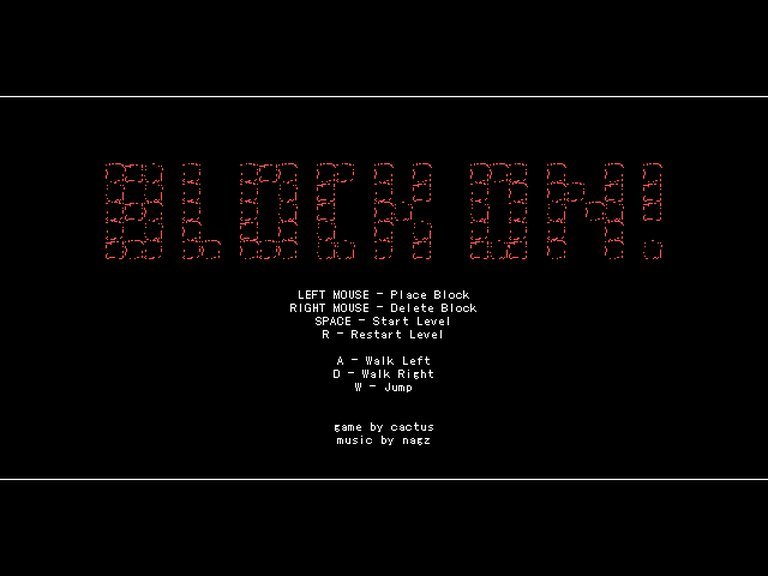
BlockOn! is an experimental indie platformer where players design their own levels by placing blocks to navigate, collect red items, and reach exits. The twist? The game counters with randomly generated hazards like spike traps, guards, and lasers after your layout is set. Created in just three hours by developer Cactus, it features minimalist 4-color graphics with a distinctive fuzzy aesthetic and emphasizes a dynamic interplay between player creativity and unpredictable challenges. Players can refine their designs after failures, adapting to the game’s chaotic additions.
BlockOn! Guides & Walkthroughs
BlockOn! Reviews & Reception
mobygames.com (92/100): A creative approach to platforming.
retro-replay.com : BlockOn! promises endless replayability and unpredictable thrills.
BlockOn!: A Masterclass in Minimalist Emergence – Deconstructing Cactus’ Three-Hour Wonder
How a lightning-fast development cycle birthed an enduring lesson in collaborative level design
Introduction
In the annals of indie gaming history, few experiments encapsulate the raw ethos of prototyping-as-art like BlockOn!. Released quietly in 2008 by Swedish developer Jonatan “Cactus” Söderström, this three-hour creation stands as a revelatory case study in procedural antagonism and player authorship. At first glance, a rudimentary platformer with mouse-drawn blocks; beneath its four-color facade lies a radical inversion of player/developer dynamics. BlockOn! is not merely played—it’s a tense negotiation between creator and chaos, a showcase of how constraints breed innovation. This review argues that Söderström’s micro-masterpiece transcends its superficial brevity, pioneering a human-AI co-design paradigm that foreshadowed modern rogue-lites and generative gaming.
Development History & Context
The Cactus Crucible
Emerging during the late-2000s indie explosion, Söderström’s studio Cactus (later renowned for Hotline Miami contributions) operated as a relentless idea forge. Between 2007-2009 alone, Cactus released 27 experimental titles — BlockOn! was entry #17. The studio mantra: “Quantity enables accidental genius.” As Söderström confessed in a 2011 interview, “Game jamming reveals truths pre-production obscures.”
The Three-Hour Alchemy
Developed using GameMaker 7 on May 14, 2008, BlockOn!’s entire lifecycle—coding, asset creation, music integration—spanned 180 minutes. This velocity was no gimmick but a philosophical stance: polish often sandblazes serendipitous brilliance. Technological constraints became virtues—the 4-color palette (black, white, red, blue) and 640×480 resolution focused the design on combinatorial depth over fidelity.
2008’s Gaming Landscape
BlockOn! debuted amidst seismic shifts: Braid redefined narrative puzzles, World of Goo elevated physics-based whimsy. Yet Söderström’s work channeled a purer lineage—the Lode Runner level editor meets Spelunky’s emergent sadism. Crucially, it predated mainstream “procedural death labyrinths” (Binding of Isaac, Dead Cells) by years, offering rogue-lite tension without algorithms—only human/machine improvisation.
Narrative & Thematic Deep Dive
BlockOn!’s brilliance lies in its narrative vacuum—there’s no lore beyond player-generated struggle. Unlike Mass Effect’s codified histories or Scorn’s environmental storytelling, this is existential gameplay. The “plot” is your battle against entropy:
-
The Absurdist Canvas
Floating in void-space, red pickups and an exit door mock your hubris. You conjure platforms ex nihilo—a metaphysical punchline echoing Camus’ myth of Sisyphus. Each death underscores creation’s futility… until it doesn’t. -
Deceptive Depth via Repetition
Early cycles feel arbitrary—guard placement ruining your architecture. But replay reveals poetic rhythms: when laser grids bisect your staircases, you pivot into parkour. The sparse fiction emerges from adaptation. -
Thematic Machinery
Every randomized hazard interrogates agency. Are you a god or janitor? The game’s textless commentary on authorship resonates deeper than any expository codex. Ultimately, BlockOn! argues that meaning isn’t found—it’s forged through iterative failure.
Gameplay Mechanics & Systems
Core Loop: Co-Creation’s Calculus
-
Edit Phase
- Mouse-placed blocks morph empty space into scaffolds. Freedom feels limitless—until physics intervenes.
- Anticipatory strategy emerges: “If I skip this platform, will spikes make the jump impossible?”
-
Chaos Injection
- Hitting [Space] unleashes Cactus’ sabotage: 5-7 randomly placed hazards (patrolling guards, horizontal lasers, spike tiles).
- Two “seed variants” exist per level—dying reloads a potentially altered permutation.
-
Iterative Refinement
- After deaths, editing resumes—now haunted by prior traps. Players toggle between architect/spelunker brains.
Critical insight: Restarting doesn’t reset trap RNG. Mastery requires adapting, not savescumming.
- After deaths, editing resumes—now haunted by prior traps. Players toggle between architect/spelunker brains.
Movement Physics: Jazz in Jumps
Xroox’s review praises how the protagonist “wheels arms mid-air” with “parkour fluidity.” Unlike floaty contemporaries (Knytt), momentum is deliberate—jumps arc with parabolic heft, demanding precision. Landing on a block narrower than your sprite triggers comedic stumbles—a slapstick counterpoint to the tension.
Meta-Design Tutelage
By forcing players to fix their flawed layouts, BlockOn! inadvertently tutors level-design fundamentals:
– Flow Testing: Does uninterrupted sprinting require backtracking?
– Risk-Reward: Traps placed near collectibles amplify drama.
– Signposting (anti-): Opaque hazards punish hubris, teaching attentiveness.
World-Building, Art & Sound
The Aesthetic of Static
Screenshots betray BlockOn!’s secret: static-like visual noise. Blocks vibrate subtly; backgrounds flicker with CRT-esque decay. This isn’t nostalgia-bait but systemic storytelling—the world itself feels unstable, echoing the gameplay’s unpredictability. Retro Replay’s analysis nails it: “Pixels hum with latent menace.”
Nagz’ Hypnotic Score
David Halmi’s lone soundtrack loop—a melancholic synth-wave dirge—functions as meditative anchor. Its cyclical structure mirrors the gameplay loop, transforming frustration into flow. Notably, encountering hazards doesn’t alter the track; dread stems purely from action.
Diegetic Minimalism
No UI clutters the screen—lives, items, even timers vanish. You intuit mechanics through animation languages:
– Guards pivot with robotic menace.
– Lasers cycle with Tesla-coil crackles (implied via visuals).
– Death triggers a Commodore 64-style particle burst.
Reception & Legacy
2008: Obscured Gem
Lacking marketing, BlockOn! floated under radars. Yet player reviews glowed—MobyGames’ 4.6/5 average (based on 2 ratings) praised its “unique satisfaction.” Critics overlooked it, but its DNA resurfaced in surprising places.
Indie Progeny
- Spelunky’s Ghosts: Derek Yu’s dynamic traps mirror Cactus’ antagonistic RNG.
- Super Mario Maker’s “Devilish” Modes: Auto-generated enemy placements recall BlockOn!’s sabotages.
- Baba Is You’s Meta-Logic: Both games make players confront rule authorship.
Speedrun Cult
Despite brief runtime (15-minute playthroughs), speedrunners dissect BlockOn!’s seed algorithms on Retro Replay forums, competing for “least edits” records. A testament to hidden depths.
Conclusion
BlockOn! is a paradox—a “disposable” prototype that endures as essential curriculum for designers. Söderström’s three-hour sprint birthed an ouroboros of creation and subversion, where players aren’t just fighting guards or spikes but the limits of their own imagination. Its fuzzy viscera and randomized betrayals predicted gaming’s AI-driven future, yet its purity remains unmatched. In an era bloated with “live-service” leviathans, BlockOn! reminds us that brevity isn’t poverty—it’s potency. Free, fierce, and philosophically rich, this isn’t a game to complete—it’s one to metabolize. Five stars out of five; a desert rose in the indie wilderness.
Final Verdict: BlockOn! belongs in MoMA’s digital archives—not for technical grandeur, but as proof that brilliance blooms when creators embrace constraints. Play it. Study it. Then go make something in three hours.
BlockOn! is available for free via MyAbandonware and Retro Replay. Tested on Windows 11 via emulation; runs flawlessly at 60fps.