
- Release Year: 2000
- Platforms: Macintosh, Windows
- Publisher: Humongous Entertainment, Inc.
- Developer: Humongous Entertainment, Inc.
- Genre: Educational, Puzzle
- Perspective: Side view
- Game Mode: Single-player
- Gameplay: Cards, Tiles
- Average Score: 87/100
Description
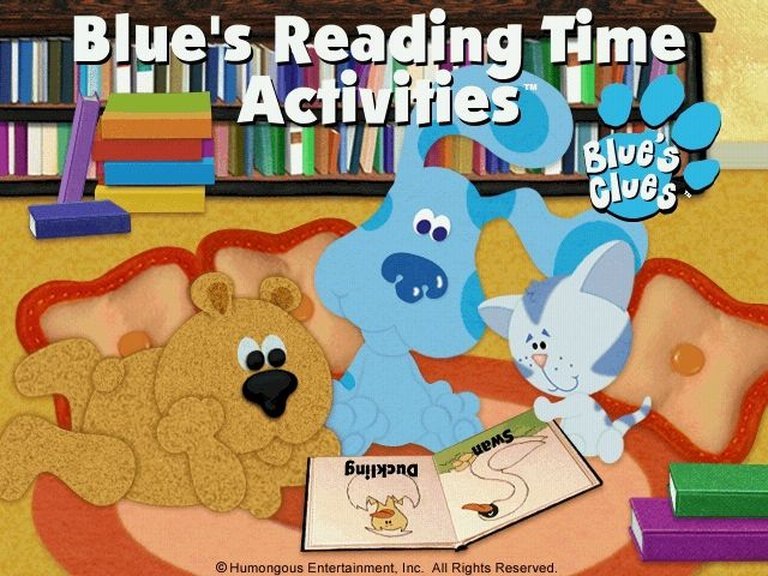
Blue’s Clues: Blue’s Reading Time Activities is an educational game set in the whimsical world of the Blue’s Clues TV show, where young players help Blue the puppy and friends create newspapers to build reading skills. Featuring activities like fixing mixed-up dictionary labels, collecting action verbs in Neighborhood News, matching words to pictures, and crafting sticker-based stories, kids complete 45 newspapers to unlock a full puzzle reward, all with the show’s signature claymation-style visuals and interactive early-education feedback.
Gameplay Videos
Blue’s Clues: Blue’s Reading Time Activities Free Download
Blue’s Clues: Blue’s Reading Time Activities Guides & Walkthroughs
Blue’s Clues: Blue’s Reading Time Activities: Review
Introduction
Imagine a world where learning to read feels like piecing together the front-page scoop of a neighborhood newspaper, guided by a perky blue puppy and her human sidekick—welcome to Blue’s Clues: Blue’s Reading Time Activities, a 2000 gem from Humongous Entertainment that transformed preschool screen time into a stealthy literacy bootcamp. As part of the blockbuster Blue’s Clues video game series, inspired by Nickelodeon’s beloved TV show, this title rode the wave of the franchise’s massive popularity, where earlier entries like Blue’s ABC Time Activities and Blue’s 123 Time Activities had already sold over a million units collectively. In an era when educational software was exploding as a parental must-have, this game stands out not just for its charm but for its laser-focused pedagogy on word recognition and comprehension. My thesis: Blue’s Reading Time Activities is a masterclass in edutainment design, proving that games for the youngest learners can be profoundly effective without sacrificing joy, cementing Humongous’ legacy as pioneers in accessible, TV-synced interactive learning.
Development History & Context
Humongous Entertainment, founded in 1992 by industry veterans like Ron Gilbert (co-creator of The Secret of Monkey Island), had by 2000 solidified its dominance in children’s PC gaming with hits like Putt-Putt Joins the Parade and Freddi Fish. Specializing in point-and-click adventures for kids, the studio’s vision was always “edutainment”—education disguised as play—leveraging simple mouse-driven interfaces on CD-ROMs for Windows 95/98 and Macintosh. For Blue’s Reading Time Activities, released simultaneously with Blue’s Art Time Activities on August 22, 2000 (though some sources cite March 28), Humongous partnered with Nickelodeon to faithfully recreate the TV show’s aesthetic using real, clay, and paper-cutout visuals, voiced by show host Steve Burns.
The creative team was a tight-knit group of 120 credits, led by producer Denise Heimel, interactive designers Matthew Mahon, Renee Leiby, and Kelle DeLuca, with art lead Renee Leiby handling backgrounds and layouts. Programming leads like Mahon and sound effects specialists Shawn South and Paul Briehl ensured smooth, feedback-rich interactions. Technological constraints of the era—1.44 MB floppies giving way to 650 MB CD-ROMs, 800×600 resolutions, and DirectX precursors—meant no 3D or online features; instead, the focus was on offline, single-player mouse/keyboard activities optimized for low-spec PCs (Pentium-era hardware). The gaming landscape in 2000 was bifurcated: AAA console shooters like Half-Life dominated, but the edutainment market boomed amid Y2K parental anxieties over screen time, with Blue’s Clues titles capitalizing on the TV show’s ratings dominance (over 13 million weekly viewers). Humongous’ licensing deal with Nickelodeon positioned this as a “guise of creating newspapers,” aligning perfectly with preschool curricula amid No Child Left Behind precursors, making it a commercial no-brainer in a $1.5 billion kids’ software sector.
Narrative & Thematic Deep Dive
At its heart, Blue’s Reading Time Activities eschews traditional plotting for an episodic, activity-driven “story” framed around Steve’s ambitious launch of The Big News Gazette. The narrative hook: Steve enlists you and Blue to interview friends at the library—Purple Kangaroo, Mailbox, Baby Bear, Fan, and newcomer Periwinkle—gathering “articles” to fill newspapers. No pawprint clues or mailtime here (a deliberate shift from show format), but the dialogue mirrors the TV’s empowering, repetitive reinforcement: Steve’s gentle prompts like “We can do anything we wanna do!” build confidence, while characters like Sarge Ant bark verb commands in Neighborhood News.
Characters are richly drawn from the show: Blue as the inquisitive protagonist, joined by a menagerie including Chicks, Pig, Starfish, Yellow/Red Kittens, Octopus, Blue Bird, Green Kitten, Dot, Mr. Salt/Mrs. Pepper/Paprika, Shovel/Pail/Magenta, and cameos like Tickety Tock or the Girl from Blue’s ABCs. Dialogue, penned by Laurie Bauman Arnold and edited by Deborah Reber, is sparse but pedagogically precise—short sentences, rhymes, and picture cues emphasize phonics without overwhelming. Themes revolve around literacy as empowerment: reading unlocks movement (verbs propel Blue), stories (madlibs foster prediction), and community (news unites friends). Underlying motifs include curiosity (exploring farm/beach/backyard/library), collaboration (player-Steve-Blue trio), and prediction (filling blanks teaches comprehension). Cameos like faceless Picket Fence nod to show lore (What Was Blue’s Dream About?), weaving a tapestry of familiarity that reassures young players while subtly advancing skills like spelling and vocabulary—profoundly thematic for an age group grappling with symbolic language acquisition.
Gameplay Mechanics & Systems
This is no action epic; core loops are bite-sized, replayable activities building toward 45 newspapers (five articles each) for nine puzzle pieces, culminating in a full puzzle reveal. Mouse-driven point-and-click reigns, with keyboard optional—ideal for tiny hands.
-
Dictionary/Word Find (with Dot): Side-view screens of thematic items (e.g., farm tools) feature mixed-up labels or detachable ones; drag-and-drop matching teaches object-word association. Feedback: Correct sparks cheers; wrong prompts gentle retries.
-
Neighborhood News (with Sarge Ant): Collect “powerful words” (verbs like “jump,” “run”) to advance Blue along a path past ants/Chicks/Pig. Logical sequencing reinforces action vocabulary.
-
Completing Stories (Periwinkle/Green Kitten/Purple Kangaroo): Multiple-choice blanks in tales (e.g., beach adventures); prediction hones comprehension, with specific “correct answers” lists ensuring scaffolded success.
-
Sticker Story Maker (with Fan): Madlib paradise—select image/word stickers (e.g., Frog, Slippery Soap) for editorial stories. Collect five for a newspaper page.
-
Word Match/Big Word Match: Card game pitting Blue against teams (Shovel/Pail/Magenta or Salt/Pepper/Paprika). Match picture-word pairs (e.g., “ball,” “puppy,” “apple”); shared words like “soap” add crossover. Wins prompt article requests (“Yes” for Blue, “No” for opponents—clever replay nudge).
UI is intuitive: Living Room hub with skidoo to Dictionary page, picture frame tracks newspapers. No progression trees or combat—just escalating mastery loops. Flaws? Repetition can frustrate without supervision (per All Game Guide), and demo limits (e.g., Paprika match) tease full content. Innovations shine: Adaptive difficulty via hints, TV-style pauses for thinking, and 45-newspaper cap prevents burnout. Systems flawlessly loop education: play → article → newspaper → puzzle, embodying Humongous’ “try-try again” ethos.
World-Building, Art & Sound
The game’s universe mirrors the show’s whimsical house: Living Room hub branches to Library, Backyard, Outside, Farm, Beach, World of Labels—vibrant, side-view dioramas bursting with claymation textures. Art direction (Renee Leiby, Carolyn Blackwood, Steven Rowse) nails Nickelodeon fidelity: paper-cutouts for characters, hand-painted backgrounds evoke preschool craft time. Atmosphere is cozy-exploratory, with no dark corners—pure safety net for tots.
Visuals pop at 640×480: Smooth animations (Ken Campana et al.) like Blue’s tail-wags or Periwinkle’s spins enhance immersion. Sound design elevates: Steve Burns’ live voice acting delivers warm narration; jaunty soundtrack recycles show stocks (“Blue Wants to Play a Game,” “Math!”) with custom jingles for successes. SFX (Shawn South/Paul Briehl)—barks, clicks, cheers—provide instant auditory feedback, crucial for pre-readers. Collectively, these craft a multisensory haven: visuals invite interaction, sounds affirm progress, fostering “aha!” moments that glue kids to the screen for hours.
Reception & Legacy
Launch reception was stellar: MobyGames aggregates 91% critic score (100% from Just Adventure, Edutaining Kids, Tech with Kids; 96% Review Corner; 90% macHOME; lone 60% All Game Guide citing manual/tech glitches). Players rate 4.6/5. Praise centered on “word awareness over rote ABCs” (Tech with Kids), kid-tested replayability (Edutaining Kids), and “never misses teaching opportunities” (Review Corner). Commercially, it rode the series’ wave—predecessors topped PC Data charts (e.g., ABC Time #1 educational 1998)—though exact sales are untracked amid Humongous’ portfolio surge.
Legacy endures: A BESSIE-adjacent pinnacle (sibling 123 Time won for Math), it influenced edutainment’s shift to activity-centers over linear adventures, paving for Blue’s Clues Preschool (2002). Licensing woes block re-releases (unlike Humongous Selects’ Putt-Putt revivals), but abandonware archives preserve it, running flawlessly on modern Windows via compatibility modes. Industry impact: Reinforced TV-to-game pipelines (cf. Sesame Street titles), emphasizing comprehension in Common Core precursors. For historians, it’s a snapshot of 2000s preschool tech—mouse as equalizer—shaping apps like Endless Alphabet.
Conclusion
Blue’s Reading Time Activities masterfully distills Blue’s Clues‘ magic into a reading powerhouse: innovative loops, faithful world-building, and unyielding pedagogy propel preschoolers from word-matching to story-crafting with infectious glee. Minor UI niggles aside, its exhaustive focus on listening, recognition, and comprehension—framed in newspaper quests—delivers transformative play. In video game history, it claims a definitive perch as Humongous’ finest Blue’s Clues edutainment entry: essential for early literacy, a 9.5/10 preschool paragon whose influence whispers in every modern ABC app. Dust off that CD-ROM; Blue’s still got the scoop.