
- Release Year: 2005
- Platforms: Windows
- Publisher: MyPlayCity.com
- Developer: MyPlayCity.com
- Genre: Action
- Perspective: Side view
- Game Mode: Single-player
- Gameplay: Arcade, Bomb disposal, Bonus collection, Combat
- Setting: Parallel world
Description
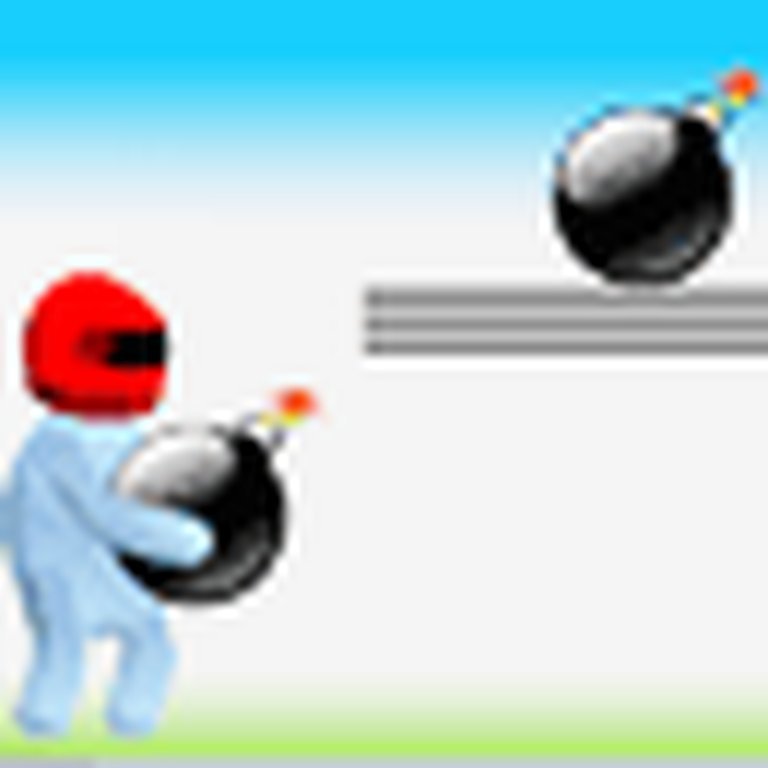
Bomb Threat is an action arcade game with a side-view perspective where you assume the role of a superhero tasked with saving the world from man-caused creatures and monsters from a parallel dimension. Your mission is to quickly gather all bombs and mines on each level before they explode, while fending off hostile monsters that can kill or freeze you by acquiring guns and collecting bonuses to boost your abilities and score. Compete globally by uploading your high scores to the website and aiming for a spot in the Top 10 in this freeware title from MyPlayCity.com.
Bomb Threat: A Ghost in the Machine of the Mid-2000s Freeware Boom
Introduction: The Echo of an Unheard Explosion
In the vast, overcrowded archives of digital game history, certain titles exist as mere data points—entries in a catalog with a release date, a genre tag, and a paragraph of boilerplate description, but no critical discourse, no player memories, no evident cultural footprint. Bomb Threat (2005), a freeware Windows game from the prolific but obscure MyPlayCity.com, is precisely such a specter. Its existence is a footnote to the free-to-play explosion of the early 2000s, a period when the barriers to game distribution crumbled but the noise made it near-impossible for any single title to be heard. This review is not an excavation of a lost masterpiece, but a forensic analysis of a cultural artifact that represents a specific, fleeting moment: the democratization of game development clashing with the anonymity of the early internet. Bomb Threat’s legacy is not one of influence or acclaim, but of sheer, unadulterated forgettability, making it a perfect case study in the Darwinian economics of digital obscurity.
Development History & Context: MyPlayCity and the Freeware Gold Rush
To understand Bomb Threat, one must first understand its creator and its moment. MyPlayCity.com was a prominent hub in the early-to-mid-2000s “casual games” and freeware ecosystem. Operating from Russia (based on domain registration and corporate data), the site and its associated development studio acted as a publisher, aggregator, and creator of countless simple, browser-friendly and downloadable games. Their business model was advertising- and download-driven—games were free, but bundled with adware or supported by on-page ads and “premium” upgrades. This was the era of Alien Shooter, Chuzzle, and Snowy: The Bear’s Adventures—games with simple loops, bright graphics, and zero creative ambition beyond immediate engagement.
The Technological & Market Context (2005):
The year 2005, as detailed in the Wikipedia source, was a watershed for the “traditional” games industry. It saw the launch of the Xbox 360, the maturation of the PS2 library with titans like Resident Evil 4 and God of War, and the rise of Nintendo’s dual-screen strategy with the DS. It was also the year F.E.A.R. and Guitar Hero defined new genres. Against this backdrop of blockbuster innovation, the PC market was fracturing. While retail sales declined, online distribution and casual gaming surged. This was the environment where MyPlayCity thrived: not competing with Shadow of the Colossus, but occupying the vast, underserved space of the “quick fix” game.
Bomb Threat was developed with constraints reflective of its niche. The technology was likely affordable, off-the-shelf 2D game engines (possibly Clickteam Fusion or similar), targeting low-spec Windows 95/98/XP machines. Its “Side view” and “Arcade” genre tags, combined with the description, place it squarely in the Bomberman-clone sub-genre—a style of game with a decades-old, well-understood formula that required little design innovation but could be executed quickly and cheaply. The “parallel world” and “man-caused creatures” narrative was likely a throwaway justification for the gameplay, a common practice to meet the minimal “story” expectation of the era’s casual titles. There is no evidence of a distinct creative vision; the vision was purely commercial: replicate a proven, simple concept with minimal assets, distribute it freely via portals like MyPlayCity, and profit from ad impressions.
Narrative & Thematic Deep Dive: A Plot as Thin as a Bomberman’s Waistband
The official description provides the entire narrative corpus: “Man-caused creatures and monsters from the parallel world want to blow up your world. Be a superman, the only one to save the world by removing mines and destroying monsters!”
This is not a story; it is a premise logline. It borrows the “parallel dimension invasion” trope common to 90s anime and comics (think Mighty Morphin’ Power Rangers or Digimon) but applies zero narrative weight to it. The protagonist is a faceless, nameless “superman”—a cypher for the player with no motivation, backstory, or character arc. The antagonists are “man-caused creatures,” a phrase that intriguingly suggests the monster threat is a byproduct of human action (scientific hubris? pollution? war?), but this idea is never explored. It is a thematic dead end, a veneer of sci-fi environmentalism laid over a pure mechanics-first design.
The plot functions purely as a contextual wrapper for the gameplay loop: you are told bombs exist, monsters exist, and you must gather bombs (mines) and kill monsters. There is no dialogue, no cutscenes, no world-building beyond the functional level design. In this, it is the antithesis of the narrative-driven games of 2005 like Psychonauts or Fahrenheit (Indigo Prophecy). Bomb Threat represents a purely ludic, pre-steam-era philosophy where a game’s “story” was an excuse for its mechanics, not an integrated experience. The “themes”—responsibility, saving the world—are utterly generic and disconnected from play. Your actions (dropping bombs) are not framed as heroic or consequential; they are simply the required input to progress.
Gameplay Mechanics & Systems: Derivative by Design
The description outlines a classic arcade puzzle-action hybrid, clearly modeled on Hudson Soft’s Bomberman series. The core loop is explicitly stated: “Gather all the bombs and mines on each level as fast as possible or they will explode. Monsters of all kinds are standing in your way, they can kill and freeze you. Find a gun, and they aren’t a problem for you anymore.”
This reveals a critical, and likely flawed, systemic departure from traditional Bomberman. In the canonical formula:
1. The player drops bombs to destroy destructible blocks and enemies.
2. Power-ups increase bomb count, blast radius, speed, or grant abilities (like kicking bombs).
3. Enemy AI is relatively simple; they wander and can be killed by bomb blasts.
4. The stage is cleared by killing all enemies and finding the exit (hidden under a block).
Bomb Threat appears to inverts or alters this:
* Primary Objective: Collect scattered “bombs and mines” before they timer-out and explode. This adds a frantic collection mechanic, transforming the game from a tactical placement puzzle into a race against a global countdown. It’s more akin to a miner game than a bomber game.
* Enemy Interaction: Enemies can “kill and freeze you.” The mention of a “gun” suggests a direct-fire projectile weapon as a primary or secondary attack, a significant departure from Bomberman‘s indirect, terrain-altering combat. This implies a faster, more action-oriented pace.
* Progression: “Increase your abilities and score by gathering additional bonuses.” This is standard, but without specifics, it suggests power-ups are present to make collection/combat easier.
Hypothesized Flaws & Innovations:
Given MyPlayCity’s track record and the description’s vagueness, Bomb Threat likely suffered from common clone pitfalls:
* Janky Controls: Precision is vital in grid-based bomb games. A sloppy control scheme would break the experience.
* Poor Enemy AI: If enemies are merely obstacles to shoot, their paths and behaviors would be repetitive and dull.
* Imbalanced Difficulty: The dual pressure of a global bomb timer and aggressive enemies could make the game unfairly chaotic rather than enjoyably challenging.
* Repetitive Level Design: With 100% collection as the goal, levels were likely simple arenas with minimal puzzle complexity.
The only potential innovation is the global collectible timer. Instead of clearing stages by enemy elimination, the stage itself is the bomb. This introduces a unique, high-pressure resource management layer absent from Bomberman. However, without playing it, one suspects this mechanic was implemented clumsily, creating stress rather than strategic depth.
World-Building, Art & Sound: The Aesthetics of the Assembly Line
MobyGames lists no screenshots or media for Bomb Threat, a telling omission for a 2005 game. Its artistic identity is therefore inferred from the era’s MyPlayCity output and its genre.
- Visual Direction: Expectations are for 2D, pre-rendered or simple pixel art sprites on tiled backgrounds. The “parallel world” theme might manifest as a garish, non-cohesive mix of sci-fi labs, weird monsters, and urban environments—all rendered in a limited, bright palette typical of budget titles to hide limited animation. The “side view” perspective suggests a flat, lateral plane of movement, removing any sense of depth or exploration.
- Atmosphere: There is none. The goal is efficiency and adrenaline, not immersion. The visual style would have been functional at best, clashing and disjointed at worst, as assets were likely pulled from generic packs or created hastily.
- Sound Design: This would be the most memorable (i.e., annoying) aspect. Budget games of this era relied on:
- Repeating, MIDI-based .MOD or .XM tracker tunes, often overly energetic and repetitive.
- Sound effects for explosions, gunfire, and collection that were either ripped from other games or created with cheap PC speaker-style beeps and bloops.
- The infamous “freeware jingle” or publisher logo sound on boot.
The “freeze” effect mentioned for enemies probably came with a distinct, grating sound effect.
The cumulative effect would be one of sonic and visual noise, designed to stimuli-response ADHD gameplay, not to create a believable world. It was the antithesis of the atmospheric, crafted worlds of Shadow of the Colossus or the polished aesthetic of Nintendogs released the same year.
Reception & Legacy: The Sound of No One Clapping
Bomb Threat exists in a black hole of reception. On MobyGames, it holds an average score of 0 out of 5, based on 1 rating with 0 written reviews. It has been “Collected By” only 3 users in nearly two decades. No mention appears in contemporary gaming magazines (as seen in the Wikipedia 2005 roundup), no reviews are archived on major sites, and it is notably absent from the “Bomberman” history article from Tired Old Hack—a comprehensive list that includes even the most obscure spin-offs. This silence is its legacy.
Why Was It Ignored?
1. Oversaturation: The mid-2000s freeware/budget market was flooded with Bomberman clones (Dyna Blaster variants, Atomic Bomberman, countless Flash games). Bomb Threat had no unique hook to rise above the noise.
2. Quality: By all indications, it was a technically competent but artistically bankrupt clone with a questionable core mechanic. It offered no reason to choose it over superior, free alternatives like the original Bomberman emulated or the excellent Bomberman DS (2005).
3. Distribution: MyPlayCity.com, while popular, was not a curated platform like Steam (which was nascent). Games were buried in lists, promoted by ad banners. Bomb Threat had no marketing muscle.
4. Cultural Timing: It released in November 2005, directly competing with the launch hype of the Xbox 360 and the release of system-sellers like Mario Kart DS and Resident Evil 4. It was invisible against the hardware and AAA software cycle.
Its sole “influence” is as a data point in the history of overlooked software. It demonstrates that the “democratization” of game development in the 2000s was a double-edged sword: while it allowed anyone to create, it also created a vast graveyard of titles that achieved no traction. Bomb Threat did not influence Super Bomberman R (2017) or any modern game. It is a dead end, a fossil of a specific, now-largely-deprecated distribution model.
Conclusion: A Perfectly Forgotten Game
Bomb Threat is not a bad game because it failed; it is a non-game. It is a procedural output, a mechanical exercise in cloning that lacked the artistry, polish, or innovative spark to transcend its circumstances. Its thesis—if it had one—would be “the market for shallow Bomberman clones on Windows was saturated by 2005.” In the grand canon, it has no place. It contributed no mechanics, no characters, no aesthetic, and no cultural moment.
Its value lies solely in its existence as an archetype: the anonymous freeware title from the pre-Steam, pre-app-store era. It represents the vast, silent majority of games that are created, distributed, and downloaded a handful of times before fading into digital dust. In reviewing it, we are not reviewing a playable experience with a legacy, but examining a ghost—the haunting reminder of how many games are made to fill a moment, not to endure. Bomb Threat succeeded at its only plausible goal: it was made, it was released, and for a tiny fraction of a second, it existed. Then, the timer ran out, and it exploded into oblivion, leaving no crater, no memory, and no mine for anyone to gather.
Final Verdict: Historically significant only as a specimen of mid-2000s freeware obscurity. As a game, it is a non-entity—a title without a reason to be remembered, and thus, perfectly forgotten.