
- Release Year: 2017
- Platforms: Blacknut, Linux, Macintosh, Nintendo Switch, PlayStation 4, Windows Apps, Windows, Xbox One
- Publisher: Curve Digital Publishing Limited, MP Digital, LLC
- Developer: Runner Duck Games Ltd.
- Genre: Simulation, Strategy, Tactics
- Perspective: 3rd-person
- Game Mode: Single-player
- Gameplay: Crew management, Management, Plane Building, Resource Management, Roguelite, Strategy, Survival
- Setting: World War II
Description
Bomber Crew is a World War II-era simulation and strategy game where players assume the role of a bomber commander, responsible for overseeing every aspect of aerial missions. This includes real-time management of the aircraft’s systems, crew assignments for roles like piloting, navigation, gunnery, and engineering, and making critical decisions to complete bombing objectives while striving to keep the crew alive amidst the challenges and perils of combat, all presented with a charming yet brutally difficult gameplay style.
Gameplay Videos
Where to Buy Bomber Crew
Bomber Crew Free Download
Bomber Crew Guides & Walkthroughs
Bomber Crew Reviews & Reception
saveorquit.com : it has some inherent design problems that might ruin some people’s fun.
Bomber Crew: Review
Introduction: Chocks Away for a Different Kind of War
Imagine the scene: your Avro Lancaster laboriously climbs into a boundless, cloud-dappled sky over 1942 England. The cartoonish faces of your crew—a nervous newbie, a grizzled veteran—peer from the cockpit and gun turrets. The serene, pastel-hued clouds belie the hell about to erupt. A sharp crack of flak shatters the illusion. A fighter’s Messerschmitt silhouette blots out the sun. Alarms blare. A fire erupts in the tail. Your engineer is already scrambling, your radio operator is feverishly tagging the bandit, your pilot is wrestling the stick. This is Bomber Crew: a game that wears the jaunty, almost twee art style of a Saturday morning cartoon like a deceptive mask, beneath which lies one of the most brutally tense, systemically dense, and emotionally charged management sims ever conceived. It is not a flight simulator in the traditional sense; it is a survival simulator masquerading as a bomber command game, a title that asks you to manage not a plane, but a fragile ecosystem of human lives against the relentless mechanics of aerial warfare. This review will argue that Bomber Crew, through its stark juxtaposition of aesthetic and mechanic, its pioneering “crew-first” design philosophy, and its unflinching embrace of permadeath, carved a unique and enduring niche in the strategy/simulation landscape. It is a flawed, often frustrating masterpiece—a game where the constant, simmering threat of catastrophic failure is precisely what makes occasional, hard-won success so profoundly rewarding.
Development History & Context: From Free-to-Play Purgatory to Indie Stardom
Bomber Crew is a testament to the power of a focused, artist-driven indie vision, forged in the crucible of creative desperation. The game was the debut project of Runner Duck, a studio born from the shared frustration of its co-founders, Dave Miller (artist) and Jon Wingrove (programmer). As detailed in their MCV/DEVELOP interview, they toiled in the free-to-play mobile sector, a world they described with palpable disdain as one of deliberate, cynical annoyance—designing games where fun was obstructed to entice microtransactions. Their dream was the opposite: to build something deeply authentic and mechanically satisfying, a game they themselves would have loved as kids programming on their ZX Spectrums.
The core inspiration was Miller’s great uncle, a navigator on a Whitley bomber during WWII. Letters home painted a picture of an existence so surreal it demanded exploration: “one night they’d be in a pub in England, the next night they’d be over Berlin.” This was not about piloting a vehicle, but about the crew—the young men (and, in the game’s “politically correct” anachronism, women and diverse personnel) trapped in a metal tube, utterly dependent on each other for survival. They looked to older flight sims like B-17: The Mighty 8th and found them wanting; the crew felt like NPCs, not personalities. The goal was inverted: you are not the plane. You are the crew’s commander.
With only two full-time developers, discipline was paramount. The cartoony, simple pixel art style was a pragmatic masterstroke. Miller stated directly: “The whole art style of Bomber Crew is designed so that it can be done by one person.” This aesthetic served a secondary, profound purpose: the minimalist sprites force players to project imagination and empathy onto the procedurally generated crew members with their names, ages, and backstories. This emotional projection is crucial for the permadeath mechanic to cut deep. The style also nods to Cannon Fodder, another game that used cute visuals to underscore anti-war themes.
The 10-month development sprint to the October 2017 Steam release was “pretty tough.” A key challenge was resisting feature creep. Miller recounts the temptation to let the player directly aim guns or control a single character: “It took a lot of discipline to not give the player too much direct control.” The entire design orbits the player issuing commands to crew stations—”Tag that fighter! Engineer, fix the hydraulics! Navigator, plot a new course!” The initial prototypes had the crew too autonomous; the final version demands constant, frantic micromanagement.
Post-launch, the team grappled with console control schemes, a challenge they later admitted they should have tackled earlier. The final controller mapping became so refined that Wingrove preferred it to mouse and keyboard. Ports to PlayStation 4, Xbox One, and Nintendo Switch in July 2018 broadened the audience significantly. The game’s commercial success—$1 million in sales in two weeks—validated their leap from salaried employees to studio founders, a “paradigm shift” they cite as their biggest hurdle.
Narrative & Thematic Deep Dive: Stories Written in Sky and Flame
Bomber Crew possesses a narrative structure that is both sparse and immensely powerful, built not from scripted cutscenes but from environmental storytelling and procedural generation. The “plot” is the campaign: a series of missions (reconnaissance, supply drops, precision bombing) against Nazi Germany, culminating in an alternate-history finale where a lone Lancaster drops a Grand Slam bomb directly on Hitler’s bunker. The USAAF DLC adds a parallel American campaign, featuring the B-17 Flying Fortress and further bending history with operational German jet and rocket fighters in 1942, complete with a tongue-in-cheek trailer that caricatures “Eagle Land” bravado.
The true narrative emerges from the lived experience of each mission. Your crew are not blank slates. They have names like “Arthur Finch, 22, Former Librarian” or “Maggie Doyle, 19, Mechanic.” Their procedurally generated stories are fragments, but over dozens of missions, players inevitably curate a pantheon of heroes and tragic ghosts. The loss of a veteran tail gunner who survived ten missions is a narrative event; receiving a new recruit named “Klaus Schmidt, 18, Apprentice Baker” is the start of a new story. This is a procedural storytelling engine, where player agency dictates the chronicle.
Thematically, the game explores several potent contrasts:
* The Crapsaccharine World: The visual language is soft, round, and colorful—a stark, deliberate counterpoint to the lethal reality. Seeing a beloved, cartoonish crew member collapse, charred and silent, from a cockpit fire is viscerally upsetting precisely because of the aesthetic dissonance.
* The Cost of Mechanical Triumph: Success is measured not in captured territory, but in returning crew and a flyable bomber. The game questions the romanticized notion of the “lone wolf” ace; your bomber is a fragile, crew-dependent machine. The “Badass Crew” trope is earned, but always precarious.
* Arbitrary Death vs. Strategic Victory: Death can be sudden (a flak shell) or agonizing (a slow fire, a wounded crewman bleeding out while you prioritize engines). Yet, victory is a chess match of resource allocation: fuel, ammo, weight limits, crew placement. The tension between these two poles—chaotic, immediate threat and cold, strategic planning—is the game’s core thematic engine.
* Historical Authenticity vs. Gameplay Convenience: The game acknowledges its “Artistic License – History” with a wink. Lone bombers never operated solo in the strategic bombing campaign. Yet this abstraction allows the player’s crew to shoulder the entire weight of the war effort, making their survival feel mythic. The inclusion of historically accurate subsystems (electrical, hydraulic, oxygen) and the brutal reality that the Lancaster’s 7-man crew truly was stretched thin to man all stations (“Reality Is Unrealistic” in its verisimilitude) grounds the fantasy in a somber truth.
The “Enemy Aces”—like Bruno Brennen with his incendiary ammo or Niko Nachzehrer in his black delta-wing super-prototype—are villainous, almost theatrical foils. Their defeat is a narrative milestone, often punctuated by their melodramatic radio cries (“So, the hunter has become the hunted. Clever girl.”). They represent the concentrated, personalized evil your crew must overcome, turning each mission into a small, desperate War of the Worlds.
Gameplay Mechanics & Systems: The Dance of Panic and Precision
At its heart, Bomber Crew is a real-time management and survival sim heavily indebted to the brilliant FTL: Faster Than Light, but with a crucial, defining shift: your “ship” is a lumbering, vulnerable bomber, and your “systems” are its crew and components.
The Core Loop: Between missions (at base), you recruit, equip, and upgrade. This is a deep RPG-lite layer: crew have primary skills (Gunnery, Engineering, Navigation, Piloting, Bombing, Radio Ops) that improve with use. You assign them gear—heavy coats for high-altitude tolerance, parachutes for bail-out, first-aid kits, armor—all of which modifies their stats and your bomber’s total weight. The weight limit is a constant, brutal constraint: adding armor saves lives but slows the plane; more guns mean more firepower but more ammo to carry and more power drained. This min-maxing puzzle is central to the pre-flight “build.”
The Mission: A real-time odyssey of escalating crises. The player has an aerial overview, issuing commands by clicking on crew stations, enemies, or map locations. Key systems include:
* Tagging: Before gunners will fire, you must tag enemy fighters on screen. This creates a frantic visual scanning loop amid the chaos.
* Subsystem Damage: Enemy fire can cripple engines, hydraulics (which run turrets and landing gear), electrical systems (which power radar warnings), and oxygen. The Flight Engineer must repair these under fire.
* Crew Damage: Crew can be wounded. A critically wounded crewman collapses and bleeds out unless another crewmember administers first aid. Managing this triage while systems fail is the pinnacle of tension.
* Fire & Fuel: Fires must be extinguished by crew with extinguishers. Engine fires can sometimes be put out by a “dive” command. Fuel must be monitored; running dry over enemy territory is a death sentence.
* Navigation & Bombing: The Navigator plots waypoints to avoid radar and flak concentrations. The Bombardier must align the bomber with the target (often requiring a steady, level approach under fire) and drop the payload. The “Improbable Aiming Skills” are a game concession; precision bombing is made feasible.
Innovations & Flaws:
* Innovation: The crew-first, command-based design is its genius. You feel the weight of command not in flying, but in delegation and triage. The permanent weight management and procedural crew bonding create a deep, systemic experience.
* Flaws: The UI can be overwhelming, as the German review from 4Players.de correctly identifies. During a multi-front attack, tagging, repairing, healing, and reloading (a notorious micromanagement chore for turret gunners) compete for attention. The initial lack of a pause function was a major pain point, forcing frantic, error-prone play. The introduction of a “Slow Time” button (a patched-in anti-frustration feature) was a critical fix, but players could still feel punished for not using it.
* The Save Scumming Debate: The autosave-only system is polarizing. For some, it ratchets up the stakes, making every decision weighty. For others, as the Save or Quit review argues, it creates a punishing feedback loop where a single catastrophic failure (a dice-roll subsystem failure on takeoff, an unlucky flak burst) forces you to grind low-level missions to rebuild a crippled crew, nullifying strategic skill. This is the core of the “unforgiving” critique.
* The “Necessary” Upgrade Problem: The review astutely notes that some upgrades feel essential to even attempt later missions, creating a “Early Game Hell” that can feel like a gear-check rather than a skill-check. Ammo-fed turrets, engine upgrades, and specific armor are often cited as non-optional for survival, potentially reducing late-game challenge to a question of preparation rather than execution.
World-Building, Art & Sound: Cute Catastrophe
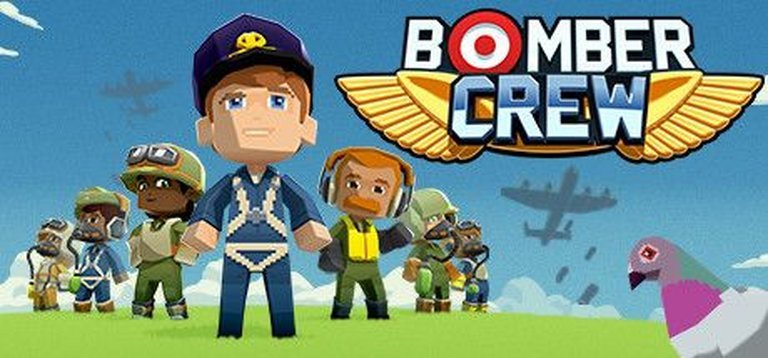
The aesthetic of Bomber Crew is its most immediately striking and thematically integral feature. The world is rendered in bright, chunky 3D with a low-poly, cartoonish filter. The Lancaster and B-17 are lovingly, simply modeled. The sky is a vivid blue, the clouds fluffy. The crew are miniature, big-headed figures with simple animations. This is the “Cute Catastrophe” aesthetic.
Art Direction: This choice was born of necessity (one artist) but evolved into profound commentary. The disconnect between the sunny skies and the gruesome mechanics of war creates a cognitive dissonance that never quite fades. It borrows from Cannon Fodder‘s technique: the simplicity allows players to imprint their own horror and heroism onto the sprites. A burning crewman is just a red sprite falling, but your mind fills in the screams. The nose art and skins (including a humorous Christmas-themed “Secret Weapons” DLC with jumpers and a tree in the ready room) add a layer of personal ownership and dark humor.
Sound Design: The soundtrack by Petros Sklias is a fantastic, period-evoking chiptune/brass hybrid that swells during bombing runs and quiets to a tense drone during navigation. The diegetic soundscape is critical: the deep, rattling thrum of the engines, the clack-clack of machine guns, the shriek of flak bursts, the pneumatic hiss of landing gear, the crackle of radios and alarms. These sounds create an immersive, often terrifying cocoon. The moment a radio call shouts “Fighters at 12 o’clock high!” over the engine drone is pure panic.
Atmosphere: The game’s atmosphere is one of claustrophobic tension. The bomber interior, viewed in cross-section, feels cramped. The constant, droning engine noise is a reminder of your fragile, airborne bubble. The most terrifying moments are often not the dogfights, but the silent stretches where a lone warning light blinks (“Oxygen Low”), the plane shudders from a near-miss, and you know a system is failing somewhere but your engineer is already wounded. It’s the slow-burn dread of survival horror transposed to a bomber.
Reception & Legacy: A Cult Classic Forged in Controversy
Bomber Crew launched to generally favorable reviews, but scores masked a spectrum of passionate, divided opinion.
* Aggregate Scores: Metacritic tallies are modest (PC: 75, Switch: 75, Xbox One: 74). However, the critic spread is telling: from Cultured Vultures’ perfect 10/10 (“a near-perfect and shining example of its genre”) to 4Players.de‘s lukewarm 65%, which excoriated the “abrupt changes from boring build-up to quickly escalating problem minutes” and the “overloaded, confusing control.”
* The Divide: Reviews crystallized two camps. One, represented by IGN (8.5) and Nintendo Life (8), celebrated its “rewarding upgrade cycle,” “thrilling” moments of salvation against all odds, and deep strategic satisfaction. The other, echoed in the user review on Save or Quit, found its difficulty arbitrary and punitive, its upgrade system a gatekeeping grind, and its lack of manual save a fundamental design flaw that encouraged save-scumming.
* Commercial Success: Despite the polarized critiques, it was a commercial hit for an indie, hitting $1M in two weeks. This success validated the two-person team’s leap of faith and secured their future (leading to the sci-fi follow-up, Space Crew).
Legacy and Influence:
* Genre Refinement: Bomber Crew is the most successful—and brutal—attempt to translate the FTL “manage a ship against overwhelming odds” formula to a grounded, historical setting. It emphasized resource triage over direct combat and crew as assets over ship as avatar.
* The “Runner Duck” Model: It stands as a case study in tiny-team, high-concept indie development. Its success proved that a clear, disciplined vision (simple art, complex systems, core fantasy) could compete without AAA resources.
* Cult Following & Niche Appeal: It has not spawned a wave of imitators, but it has earned a dedicated cult following who relish its specific blend of stress and triumph. Its legacy is secure among management/survival sim enthusiasts.
* Historical Curiosity: For WWII aviation buffs, it’s a fascinating, if highly abstracted, look at bomber operations. Its commitment to subsystems (hydraulics, oxygen, electrical) and crew roles is more detailed than most games, even if it compresses the scale of a bomber wing into a single plane.
* Sequel and Beyond: The direct sequel, Space Crew (2020), successfully transplanted the formula to science fiction, addressing many criticisms (auto-fire-fighting, better controller support). Upcoming Badlands Crew aims to bring the “crew management” core to a post-apocalyptic road trip, suggesting Runner Duck has found a sustainable, adaptable design template.
Conclusion: A Flawed, Frustrating, Essential Masterpiece
Bomber Crew is not for everyone. Its steep, often cruel learning curve, its punishing permadeath, its occasionally bewildering real-time demands, and its polarizing upgrade dependency will alienate players seeking a more forgiving or action-oriented experience. Yet, for those willing to endure its gauntlet, it offers something rare: a pure, unadulterated expression of strategic tension and narrative emergence.
Its genius lies in its foundational contradiction: a cute, approachable shell housing a merciless, systemic heart. It makes you care about procedurally generated sprites through sheer mechanical consequence. It turns the mundane act of reloading a tail gun or patching an engine fire into a life-or-death drama. It understands that the horror of war is not in grand explosions, but in the quiet moment when you realize your best gunner is bleeding out on the floor because you prioritized the port engine.
The game’s flaws are the dark side of its ambition. The weight limit constraint that fosters brilliant planning can also lead to “mandatory” upgrades. The real-time pressure that creates sweat-inducing panic can overwhelm the UI. The autosave that raises stakes can feel unfair when a random subsystem failure dooms a 20-hour crew.
But when it all clicks—when your crew, battered but unbowed, levels out over the target, the bombardier’s crosshairs lock, the bombs fall true, and you nurse a smoking, one-engine carcass back to base against the sunset—Bomber Crew delivers a simulated triumph unlike any other. It doesn’t glorify war; it simulates the terrifying, minute-to-minute calculus of survival within it. It is a game about leadership under fire, about the profound weight of a single decision when oxygen masks are dangling and flames are licking the wing.
In the pantheon of WWII games, Bomber Crew does not occupy the tactical battlefield of Company of Heroes or the cockpit realism of IL-2 Sturmovik. It exists in a darker, more psychological trench: the trembling crew compartment. It is a modern classic of the survival-management genre, a game whose emotional resonance and systemic integrity are directly proportional to its capacity to break your heart. It is imperfect, often infuriating, but ultimately essential—a stark, unforgettable memorial not to heroes, but to the fragile, magnificent, and easily extinguished machinery of human cooperation under extreme duress. As Dave Miller’s personal journey culminated in sitting in the cockpit of a real, last-flying Lancaster, so too does Bomber Crew stand as a passionate, pixelated testament to the extraordinary burden carried by those young men and women who flew into the black sky, night after night, knowing the odds. It lets us, for a few hours, share that burden. And for that, it is invaluable.