
- Release Year: 2021
- Platforms: Windows
- Genre: Simulation
- Perspective: 1st-person
- Game Mode: Single-player
- Gameplay: Open World, Sandbox
- Setting: Contemporary
Description
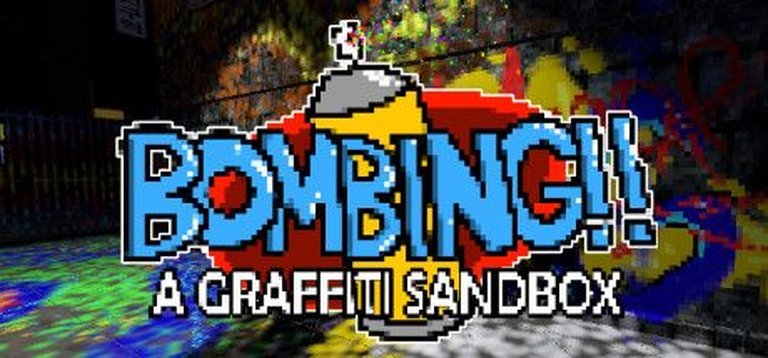
Bombing!! A Graffiti Sandbox is a meditative simulation game developed by Devon Wiersma, released in 2021 for Windows. Set in a contemporary retro world, the game provides an open sandbox environment where players create public art through graffiti, offering a first-person perspective and point-and-select interface. With 95% of the environment paintable, players utilize various color variations and cap patterns to express creativity with minimal limitations in this zen-inspired experience.
Gameplay Videos
Where to Buy Bombing!! A Graffiti Sandbox
Bombing!! A Graffiti Sandbox: Review
Introduction
In an industry often dominated by scripted narratives and competitive mechanics, Bombing!! A Graffiti Sandbox emerges as a defiantly meditative ode to unbridled creativity. Released on May 18, 2021, by solo Canadian developer Devon Wiersma, this deceptively simple simulation transforms the act of digital vandalism into a cathartic art form. More than just a game, it is a canvas—a virtual realm where the constraints of traditional gameplay dissolve, leaving only pure, unfettered expression. This review argues that Bombing!! transcends its sandbox label to become a profound statement on artistic freedom, technological accessibility, and the democratization of public space in the digital age. Its legacy lies not in complex systems or sprawling worlds, but in its quiet invitation to deface reality.
Development History & Context
Bombing!! was birthed from the singular vision of Devon Wiersma, a Canadian indie developer whose work spans from AAA titles to experimental art games. As a solo creator, Wiersma leveraged the Unity engine to craft a game that prioritizes accessibility and creative freedom over technical spectacle, targeting modest hardware with a minimum specification of an Intel i5-6500 and NVIDIA GTX 750. This choice reflects a deliberate rejection of modern gaming’s relentless pursuit of graphical fidelity, instead opting for a low-poly aesthetic that runs comfortably below 500MB.
Developed during a period where indie games embraced “chill” and “artgame” genres—exemplified by titles like Passpartout—Bombing!! positioned itself as a spiritual successor to classic graffiti simulations like Graffiti Bombing (2020). Wiersma’s vision was unapologetically populist: “A game where you can paint on anything,” as stated on the game’s Steam page. The release on both Steam and itch.io ($4–$6.99) underscored this ethos, emphasizing affordability and community engagement over commercial ambition. Post-launch, updates focused on accessibility, adding support for six languages and integrating licensed indie music. The sequel, Bombing!! 2: A Graffiti Paradise (2023), directly addressed fan feedback for larger maps and more tools, cementing the original’s role as a foundational prototype for a burgeoning creative subgenre.
Narrative & Thematic Deep Dive
Lacking traditional plot or characters, Bombing!! derives its narrative from the player’s own actions. The “story” is one of rebellion and creation: armed with a backpack and spray cans, the player trespasses into liminal urban spaces—rooftops, subways, alleys—to reclaim them as personal galleries. This absence of overt narrative is a thematic strength, framing the player as both vandal and artist in a world where creativity is the only objective.
The game’s core theme is the democratization of public space. By making 95% of every environment paintable, Bombing!! simulates the act of “bombing” (rapid, large-scale graffiti) as an act of defiance against institutional control. The retro-styled urban environments evoke the 1980s and 90s, a golden age for street art, where spray paint was both a tool of protest and self-expression. Dialogue is nonexistent, replaced by the visceral satisfaction of applying color to concrete—a non-verbal language of liberation. This resonates with contemporary debates on art ownership and urban aesthetics, positioning the game as a digital protest against sterile, sanitized public realms. As one Steam user noted, it captures the “chill, pressure-free way” to engage with rebellion without real-world consequences.
Gameplay Mechanics & Systems
Bombing!!’s gameplay is a masterclass in minimalist design. Core loops revolve around exploration, tool selection, and application. Players navigate atmospheric levels—from subway tunnels to factory rooftops—via first-person movement, with the environment serving as both playground and palette. The interface is elegantly simple: a point-and-select menu for tools (spray cans, paint pens, caps) and a vibrant color wheel. Each tool offers distinct spray patterns, encouraging experimentation from broad tags to fine-line details.
Key Systems:
– Sandbox Freedom: With 95% of surfaces paintable, the game imposes few constraints. Backpacks, trucks, and even the ground become canvases.
– Tool Customization: Multiple cap patterns and paint types allow for varied textures, from drippy aerosols to precise markers.
– Atmospheric Levels: Each zone (e.g., subway, alley) offers unique backdrops and spatial challenges, subtly guiding artistic decisions.
– Achievements: Nine Steam achievements, like “slide into the back of the factory,” reward playful exploration rather than skill.
Flaws: Despite its strengths, the game shows its indie roots. Some users reported inconsistent pixel density on surfaces (e.g., brick walls vs. truck boxes), limiting precision. Others noted the lack of post-launch content, though Wiersma addressed this with the sequel. The absence of a level editor remains a common community request, highlighting the original’s role as a proof-of-concept.
World-Building, Art & Sound
Bombing!!’s world is a love letter to urban decay. Environments are rendered in a chunky, low-poly style reminiscent of 1990s 3D games, with textures that evoke peeling paint, rust, and cracked concrete. This aesthetic choice is not nostalgic but functional: the simplified geometry ensures smooth performance while amplifying the tactile satisfaction of spray paint. Levels are meticulously crafted to inspire—from the claustrophobic intimacy of subway tunnels to the vertiginous openness of rooftops—each space a stage for the player’s monologue.
Sound design complements the visual artistry. Wiersma licensed tracks from independent artists, blending lo-fi beats, synthwave, and ambient drones to create a meditative soundtrack. The absence of intrusive mechanics (e.g., timers, scores) allows the music to merge with the rhythmic hiss of spray cans, transforming gameplay into a zen-like flow state. The result is an atmosphere that feels simultaneously rebellious and serene—a digital equivalent of late-night street art sessions.
Reception & Legacy
Upon release, Bombing!! was met with immediate acclaim, achieving a “Very Positive” rating on Steam (93% of 106 reviews) and a 4.8/5 stars on itch.io (34 ratings). Critics lauded its “chill” vibe and creative freedom, with Canadian Game Devs calling it a “lo-fi graffiti sandbox” that “fill[s] them with your creations!” Player reviews echoed this sentiment, praising its relaxing nature and potential as a creative outlet. One user noted, “I love drawing on shit. I am very creatively bankrupt but that’s okay because I can scribble everywhere.”
Legacy-wise, Bombing!! pioneered a niche for accessible art games. Its influence is evident in the success of its sequel, which expanded the formula with larger maps. The game also fostered a dedicated community on itch.io, where players share screenshots, discuss techniques (“You can customize your backpack,” one tip advises), and request features. Though it lacks the critical pedigree of mainstream titles, its enduring popularity—evidenced by steady sales and ongoing community engagement—marks it as a cult classic in the “paint and chill” genre. It proved that meaningful experiences could thrive without violence or competition, inspiring developers to prioritize creative expression over mechanics.
Conclusion
Bombing!! A Graffiti Sandbox is a triumph of vision over ambition. In stripping away traditional game structures, Devon Wiersma created a pure digital canvas that celebrates the anarchic joy of creation. Its technical simplicity is its greatest strength, offering a universally accessible entry point for artistic expression. While minor flaws like surface inconsistency and limited post-launch content temper its perfection, they underscore its role as a scrappy, heartfelt experiment.
Verdict: Bombing!! is not merely a game but a cultural artifact—a testament to the power of indie development to democratize art and redefine gameplay. It stands as a landmark in the art game movement, securing its place in history as a defiantly peaceful act of digital rebellion. For players seeking not a challenge, but a canvas, Bombing!! remains an essential, unmissable experience.