
- Release Year: 2012
- Platforms: Macintosh, Windows
- Publisher: Big Fish Games, Inc
- Developer: Boomzap Pte. Ltd.
- Genre: Adventure
- Perspective: 1st-person
- Game Mode: Single-player
- Gameplay: Hidden object, Puzzle
- Setting: Fantasy, Futuristic, Sci-fi
Description
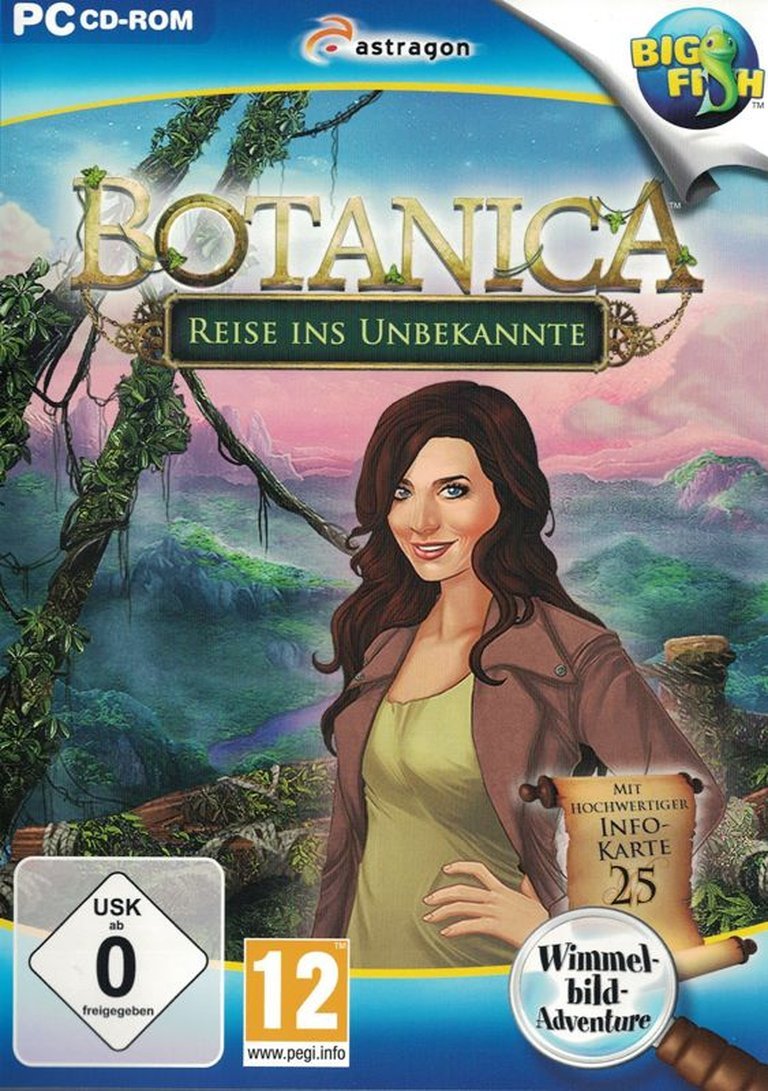
Botanica: Into the Unknown is a hidden object puzzle adventure game that merges fantasy and science fiction settings. Players embody Dr. Ellie Wright, a botanist unexpectedly transported to the alien planet Botanica, featuring exotic creatures, landscapes like alien forests and steampunk villages, and underwater caverns. The game involves solving puzzles with a botanist kit, interacting with other stranded humans, and overcoming challenges from Queen Kassandra to survive and seek a way back home.
Gameplay Videos
Botanica: Into the Unknown Free Download
Botanica: Into the Unknown Guides & Walkthroughs
Botanica: Into the Unknown Reviews & Reception
judsgamereviews.wordpress.com : I highly recommend it.
gamezebo.com : Botanica makes a good job of tying it all together, offering a lot of variety with nothing feeling forced or out of place.
Botanica: Into the Unknown: A Genre-Bending Curiosity from the Casual Gaming Vanguard
Introduction: Portal to a Hybrid World
In the crowded landscape of early 2010s casual gaming, where hidden object puzzle adventures (HOPAs) proliferated with formulaic reliability, Botanica: Into the Unknown arrived as a calculated act of artistic and mechanical rebellion. Released in October 2012 by Boomzap Entertainment and published by Big Fish Games, this title consciously shattered the rigid compartmentalization of its genre. It proposed not a simple hidden object game, but a “puzzle adventure hybrid”—a seamless, if occasionally uneven, blend of point-and-click exploration, narrative-driven object hunts, and diverse minigames, all wrapped in a striking sci-fi/fantasy aesthetic. As a piece of interactive media, Botanica is a fascinating case study: a game whose ambition often outstrips its execution, yet whose core identity as a “puzzlediversityfantasticaladventuringquest” (to coin a phrase from its most ardent reviewers) secures it a peculiar, enduring place in the annals of casual game design. This review will argue that Botanica is less a masterpiece and more a crucial, if flawed, experiment—a game that pushed the thematic and mechanical boundaries of the HOPA format, leaving a legacy of innovative ideas that would influence its own sequel and, subtly, the broader casual adventure space.
Development History & Context: Boomzap’s Calculated Leap
The Studio & The Vision: Boomzap Entertainment, a Singapore-based studio, was by 2012 a veteran of the casual download market. Their pedigree included the well-received Awakening series (a traditional fantasy HOPA) and the atmospheric Otherworld: Spring of Shadows. With Botanica, under Creative Director Christopher Natsuume and Technical Director Allan Simonsen, the studio sought to evolve. The core vision, as articulated in official descriptions and reflected in the writing credits (Paraluman Cruz), was a genre fusion: the methodical, meditative pleasure of hidden object searches combined with the narrative propulsion and puzzle variety of classic adventure games. The fantastical premise—a botanist stranded on an alien world—was a perfect narrative scaffolding for this blend, justifying both environmental puzzles (using a “botanist’s kit”) and the discovery of strange objects.
Technological & Market Context: 2012 was the zenith of the Big Fish Games-dominated casual market. HOPAs were a reliable, high-volume product, but creative fatigue was setting in. Players and critics noted repetitive mechanics and generic settings. Botanica was developed for Windows and Macintosh (specs: 800MHz CPU, 512MB RAM), a standard for the era’s download-only casual titles. Its use of a first-person perspective and illustrated realism was common, but the decision to weave hidden object scenes into a larger point-and-click framework, rather than present them as isolated levels, was a significant technical and design departure. The game’s simultaneous release for iPad in 2013 also shows an awareness of the burgeoning touch-friendly market, though the core design was mouse-centric.
The Publishing Partnership: The exclusive partnership with Big Fish Games was both a blessing and a constraint. It provided immense distribution power and a built-in audience but also operated within a business model reliant on collector’s editions, in-game hints, and skip timers—mechanisms Botanica adopts, sometimes uneasily. The game was launched in a “Collector’s Edition” (with bonus chapter, strategy guide, soundtrack) alongside a standard version, a standard industry practice that speaks to its target demographic: dedicated casual players willing to pay a premium for extra content.
Narrative & Thematic Deep Dive: A Promise Unfulfilled?
Plot & Structure: The story casts players as Dr. Ellie Wright, a botanist whose search for her missing “crazy” scientist father leads her through a portal to the planet Botanica. The narrative premise is a familiar sci-fi/fantasy trope—the unintentional interdimensional traveler—but it introduces a unique twist: Botanica is not a deserted world. Ellie encounters a cast of other Earth humans, all “Outlanders” from different historical periods, who have also crashed here. The central conflict involves the cunning Queen Kassandra, a native ruler hostile to the Earthlings. The plot is structured around a series of location-based chapters (alien forests, steampunk villages, underwater caverns), each advancing the quest to find a way home and unravel the mystery of Botanica itself.
Character & Dialogue: Here, Botanica reveals its most significant weakness, consistently noted by critics. The characters are broadly sketched archetypes—the noble savage, the cynical survivor, the menacing queen—with dialogue that rarely transcends functional exposition. The voice acting, as per the Gamezebo review, is described as “wooden,” and cutscenes as “clumsy and cartoonish.” Ellie’s personal motivation—connecting with her father’s legacy—is potent but underdeveloped, lost amid the transactional “help them, then they help you” quest structure. The thematic potential of examining colonialism (Earthlings in a new world), ecological wonder (a planet of bizarre flora), and cross-cultural misunderstanding is largely left as implicit backdrop rather than explored depth.
Thematic Synthesis: The game’s title suggests a focus on botanical discovery, yet the “botanist kit” is surprisingly underutilized as a core narrative or mechanical device. It functions more as a generic puzzle toolbox than as an expression of Ellie’s scientific identity. The true theme emerges as adaptation and survival through intellect. Ellie doesn’t fight with weapons but with puzzles, using observation and logic to navigate a hostile yet beautiful ecosystem. The juxtaposition of lush, organic environments with steampunk villages hints at a world of coexisting natural and technological orders, a visually compelling but narratively unexamined dichotomy.
Gameplay Mechanics & Systems: A Tower of Varied Pieces
Botanica’s greatest strength and its primary criticism stem from its * mechanics diversity*.
Core Loop & Navigation: The game operates from a first-person point-and-click interface. Players navigate between static, beautifully rendered screens connected by logical pathways. A tablet computer UI serves as journal, map (showing active locations but crucially not interactive, a frequent point of frustration noted by Jud’s PC Game Reviews), and task list. The pacing is deliberate, encouraging exploration and backtracking.
The Hidden Object Revolution: This is where Botanica genuinely innovates. Rejecting the “messy cluttered list” formula, it presents narrative-integrated searches. As Jay Is Games brilliantly details, you might listen to a character’s story and then identify the specific mementos they mention on a neatly arranged desk. Other scenes require finding gears to replace in a machine elsewhere, or coloring in details of a picture. These are not mere hidden object scenes; they are contextualized puzzle tasks that feel logically connected to the story and environment. They are spaced apart and rarely repeat, a masterclass in avoiding player fatigue.
Puzzle & Minigame Assortment: The game is a minigame anthology. Alongside the object hunts, players encounter tile mazes (finding truffles), logic puzzles, card games, and classic sliders. The design philosophy, as per Jay Is Games, is that “all match thematically to the current quest.” A puzzle to repair a device uses gears; one to brew soup uses a tile maze representing herb roots. This thematic integration is a high watermark. However, the difficulty is uneven, ranging from trivial to mildly challenging, and some minigames (like the “Lover Puzzle” or sliders) are cited as awkward or tedious. The hint/skip system (5-minute recharge) is a double-edged sword: it aids casual players but underscores the game’s lack of a consistent challenge curve.
Progression & Systems: Character progression is non-existent in an RPG sense; advancement is purely environmental and narrative. Unlocking new areas by solving puzzles is the core driver. The collectible ladybugs and achievement list provide optional completionist goals. The most significant systemic flaw is the underutilized “botanist kit” concept. It exists as a menu of tools used in puzzles, but it never evolves or feels like a distinctive mechanic that grows with the player. It’s a missed opportunity to deepen the fantasy of being a scientist.
World-Building, Art & Sound: A Verdant, Yet Static, Feast
Visual Direction & Setting: Botanica’s world is its most universally praised aspect. The art direction by John Barry Ballaran, Zulkarnaen Hasan Basri, Caroline Dy, and a large team delivers “gorgeous,” “vivid,” and “eye-pleasing” visuals (Jay Is Games). The fusion of fantasy and sci-fi is tangible: glowing alien flora contrasts with brass-and-gear steampunk villages. The first-person perspective makes the environments feel immersive and vast, despite being a series of slideshow stills. The color palette is rich and layered, avoiding the murkiness that can plague such games. The creature and plant designs are creatively “exotic” and “curious,” fulfilling the game’s core promise of an unknown world.
Sound Design & Music: Composed by Fabian Hee, Jellene Khoh, and Shazrin Saleh, the soundtrack and SFX are cited as “fantastic” (Wikipedia/Alchetron) and contribute significantly to the atmosphere—mysterious, occasionally melancholic, and always supportive of the exploratory mood. The ambient sounds of alien forests and caverns are effective. However, the voice acting is the audio weak point, reinforcing the narrative’s lack of emotional weight.
Atmosphere & Cohesion: The game successfully creates a consistent, wondrous atmosphere. The beauty of the screens encourages lingering, and the puzzle variety prevents environmental monotony. However, the disconnect between the sophisticated visual world and the rudimentary narrative delivery (text boxes, wooden voices) creates a jarring tonal split. You are exploring a breathtaking alien world, but the story being told about it feels cheap and transactional. The steampunk elements are visually fascinating but exist in a narrative vacuum—there’s no explanation for their presence or conflict with the natural world.
Reception & Legacy: A Cult Classic in the Making
Critical Reception: Botanica received moderately positive but sparse critical coverage. German magazine Spielemagazin gave it 75%. More in-depth English-language reviews were mixed:
* Gamezebo (4/5 stars): Praised its “seamless experience in genre-blending” and puzzle design but criticized the “poor” voice acting, “bland stereotypes,” and “jerky” cutscene animation.
* Jay Is Games: Delivered the most effusive praise, highlighting “high quality in all areas” and the “refreshingly different” hidden object scenes. It noted the feeling of “breadth without enough depth” but concluded the game was “fresh and full of new fun.”
* Jud’s PC Game Reviews (5/5 for Graphics/PP/SF): Emphasized the “artistically imaginative, colourful, glorious Graphics” as the primary draw, while noting the non-interactive map caused tedious backtracking.
* Player Reception (MobyGames): Paradoxically, user ratings are very low (2.0/5 from only 2 ratings), suggesting a disconnect between professional critics familiar with HOPA conventions and a more general player base expecting more traditional polish or deeper narrative.
Commercial Performance & Legacy: The game’s success is indicated by the release of a Collector’s Edition, iOS ports, and a direct sequel, Botanica: Earthbound (2013), which improved upon the formula with dual protagonists and received even higher praise (4.5/5 stars). This confirms that Boomzap and Big Fish saw a viable franchise in the concept.
Botanica’s legacy is two-fold:
1. As a Hybrid Pioneer: It stands as one of the most ambitious and successful attempts to merge the HOPA format with point-and-click adventure sensibilities. Its contextual hidden object scenes were a step forward in making that mechanic feel integral to the world, not an extractive mini-game.
2. As a Cautionary Tale: It highlights the difficulty of balancing such diversity. The narrative and voice performance could not match the artistic and mechanical ambition, creating a “uneven” experience. It proved that genre-blending requires equal investment in all blended components.
Its influence is most directly seen in its own sequel, Earthbound, which retained the hybrid model and refined the narrative. Indirectly, it contributed to a slow, ongoing trend in casual games toward more integrated puzzle design and richer atmospheric worlds, even if many later titles retreated to safer, more repetitive formulas.
Conclusion: The Beautiful, Flawed Explorer
Botanica: Into the Unknown is not a forgotten classic, but it is a significant artifact of a specific moment in casual gaming history. It represents a studio leveraging its expertise to push against the creative walls of its chosen genre. Its triumphs—the stunning, imaginative world design and the consistently inventive, story-integrated puzzles—are substantial. Its failures—the thin characterization, clunky dialogue, and underdeveloped core mechanics—are equally apparent.
To play Botanica today is to experience a game that is perpetually on the verge of greatness. You are constantly captivated by the next screen’s beauty, intrigued by the next puzzle’s twist, only to be pulled back by a flat line of dialogue or a needless backtrack. Yet, this very tension is what makes it compelling. It is a game that dared to be different in a space that prized conformity. For historians, it is a vital data point in the evolution of the HOPA. For players, it remains a “fresh and full of new fun” (Jay Is Games) experience, provided one can forgive its narrative shortcomings. Its place in history is not atop a pinnacle, but on a curious, verdant branch of the game design tree—one that bore the fruit of a sequel and the seeds of an idea that genre boundaries are meant to be explored, not fortified. It is, in the end, a flawed but fascinating voyage into the unknown, worthy of recognition for its ambition alone.
Final Verdict: 7.5/10 – A landmark of genre-blending ambition marred by uneven narrative execution. Essential for students of casual game design; rewarding for players seeking beautiful, varied puzzles who can overlook a thin story.