
- Release Year: 2024
- Platforms: Nintendo Switch, PlayStation 4, PlayStation 5, Windows Apps, Windows, Xbox Cloud Gaming, Xbox One, Xbox Series
- Publisher: Whitethorn Games
- Developer: Balloon Studios
- Genre: Simulation
- Perspective: First-person
- Game Mode: Single-player
- Gameplay: Botany, Farming, Gardening, Journal, Puzzle elements
- Setting: 1890s, Europe, Industrial Age
- Average Score: 90/100
Description
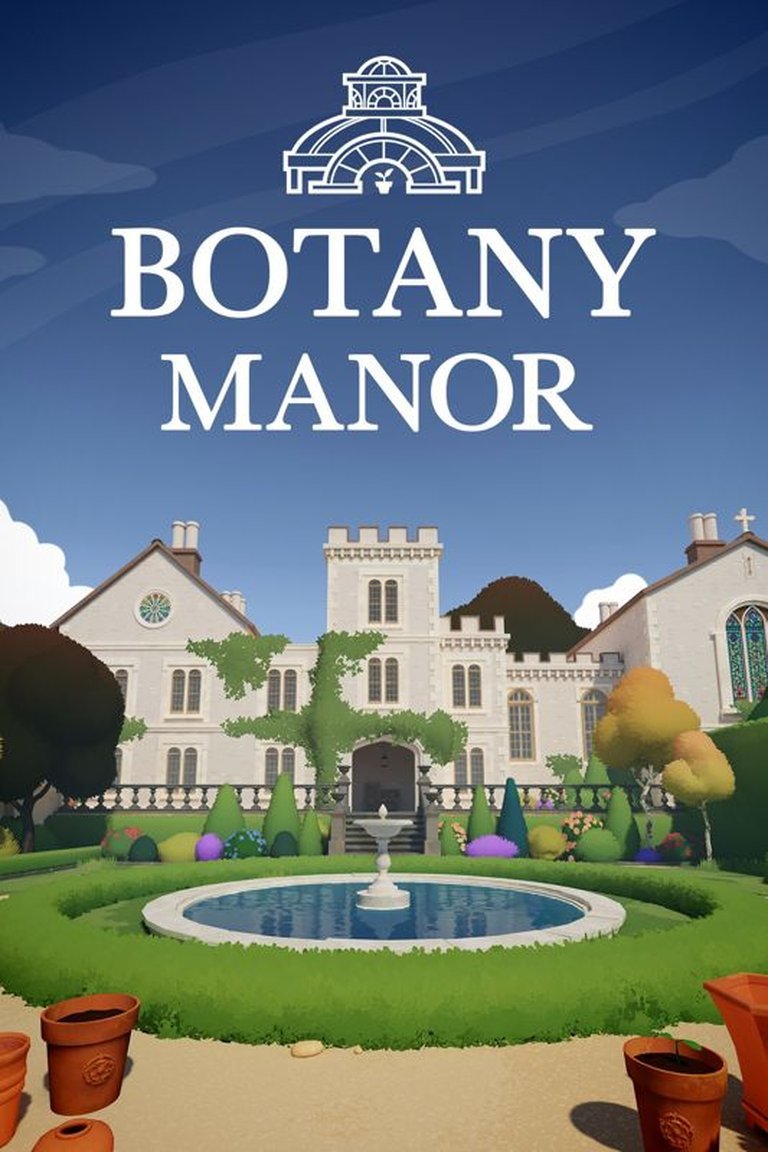
Botany Manor is a first-person puzzle simulation game set in 1890s Europe during the Industrial Age. Players explore a grand manor by cultivating and studying plants to solve intricate puzzles, using a journal to document their findings in an atmospheric and immersive environment focused on discovery and serene gameplay.
Gameplay Videos
Where to Buy Botany Manor
Botany Manor Guides & Walkthroughs
Botany Manor Reviews & Reception
ign.com : A laid-back game that doesn’t ask you to do too much, simply grow strange plants and decompress.
comfycozygaming.com (100/100): It’s gorgeous, the sounds are perfect, and the puzzles are challenging without being impossible.
cgmagonline.com (80/100): The perfect palette cleanser was a cozy little puzzle game to reinvigorate my imagination!
Botany Manor: Review
Introduction: A Sanctuary of Science and Solace
In an era saturated with high-octane action games and sprawling RPGs, Botany Manor emerges as a breathtakingly deliberate anomaly—a game that asks you not to save the world, but to simply tend to it. Released in April 2024 to widespread critical acclaim, this first-person puzzle adventure from the fledgling Balloon Studios quickly established itself as a cornerstone of the “cozy game” movement, yet it transcends that label through a profound, understated narrative about perseverance, intellectual integrity, and the quiet violence of being overlooked. As a historian of interactive media, I find Botany Manor fascinating not merely for its elegant puzzles or its picturesque setting, but for how it weaponizes serenity to deliver a poignant commentary on the systemic barriers faced by women in science during the Victorian era—and, by resonant extension, today. Its legacy is already being cemented as a masterclass in environmental storytelling and thematic cohesion, proving that a game can be both a soothing escape and a quietly disruptive work. My thesis is this: Botany Manor is a landmark title because it perfectly aligns its form, mechanics, and narrative into a singular, meditative experience that challenges the player’s perception of what a “puzzle” can be, making it one of the most artistically and historically significant indie releases of the 2020s.
Development History & Context: A Passion Project Rooted in History
The Studio and Its Vision: Botany Manor is the debut title from Balloon Studios, a small, Devon-based independent team founded by Laure De Mey. De Mey’s background is crucial; she previously worked at the acclaimed Ustwo Games (Monument Valley, Assemble with Care), and was named a BAFTA Breakthrough talent in 2021. Her co-designer and 2D artist is Kitt Byrne, a BAFTA Breakthrough 2023 selectee with experience on titles like Gibbon: Beyond the Trees. This is not a studio born from venture capital but from a specific, personal creative itch. As De Mey stated in an interview with Nintendo Everything, the core idea stemmed from a simple desire: to explore a manor house in a “relaxing way,” directly contrasting the horror or combat tropes of games like Tomb Raider (specifically, Lara Croft’s mansion) or Resident Evil. She wanted the setting itself to be the destination, not a dungeon to be cleared.
Inspirations and Setting: The developmental team undertook extensive historical research to ground their fantastical premise. Two inspirations were paramount: Charles Darwin’s Down House, whose grounds were used as a living laboratory, provided the template for a scientist’s home-as-workshop. The other was the work of Marianne North, the Victorian botanical illustrator whose vast collection at Kew Gardens inspired the game’s visual and narrative heart. The choice of 1890 was deliberate—it captures the “era of great scientific discovery” while providing a “feasible” premise for a woman scientist’s struggle. As De Mey explained to PC Gamer, the era allowed them to explore botany as a discipline “before it was fully professionalized,” creating space for an amateur, female naturalist like Arabella. This research extended to reading primary sources like Flora Domestica by Elizabeth Kent (published anonymously) and the letters of Dr. Agnes Bennett, which directly informed the game’s nuanced portrayal of institutional sexism.
Technological and Design Philosophy: Built in Unity with Wwise for audio, the game’s technical specs are modest but meticulously crafted. The team’s design credo, as De Mey told PC Gamer, was to create a “clear and straightforward” experience with a “nice peaceful setting,” deliberately avoiding unnecessary player “strain.” This informed every system, from the lack of fail states to the gentle audio cues. The small team (with key roles filled by De Mey, Byrne, Tim Steer for 3D art, and Thomas Williams for sound/music) worked largely with contractors, ensuring a focused vision. Announced at a Nintendo Indie World showcase in November 2022, it launched day-and-date on multiple platforms (Switch, Windows, Xbox) on April 9, 2024, with PS4/PS5 ports following in January 2025. Its immediate availability on Xbox Game Pass was a strategic masterstroke, aligning perfectly with its identity as a short, accessible, and premium “afternoon” experience.
Narrative & Thematic Deep Dive: The Unpublished Life of Arabella Greene
Plot and Structure: Botany Manor is structurally unique. There is no traditional narrative arc with dialogue or cutscenes. Instead, you are Arabella Greene, a retired botanist in 1890 Somerset, who has inherited a grand estate. Her goal is to compile her life’s work, Forgotten Flora, a herbarium book documenting “forgotten flora”—plants with strange, magical properties. The gameplay loop of exploring rooms, finding seeds, and solving环境-based puzzles to grow each plant directly completes the digital pages of this book. Progression is gated not by combat but by the acquisition of keys or mechanisms to unlock new wings of the manor, each chapter focusing on one or more plants.
Environmental Storytelling and Character: Arabella is a silent protagonist, yet her character is etched into the very fabric of the manor. The narrative is delivered entirely through diegetic documents: letters, pamphlets, newspaper clippings, books, and notes left around the estate. These fragments reveal a life of profound intellectual passion consistently thwarted by the gendered prejudices of her time. A letter from a college (dated 1853) dismisses her application, patronizingly encouraging her to tend her garden as a “hobby.” Another, from a researcher she assisted, offers only a meager position where her “domestic duties would be much appreciated.” The most powerful text objects are the ones where her anger simmers beneath genteel phrasing—the letter she ultimately shreds in a kindling box. The narrative is not about a grand public victory but about private resilience. As the Journal of Geek Studies interview reveals, De Mey and Byrne deliberately drew from historical figures like Olive Dame Campbell (whose work was published under her husband’s name) and the broader context of women’s contributions being annexed. This is why the ending is so devastatingly perfect: Arabella’s Forgotten Flora is not published. Instead, the final scene reveals she used her legacy to found a school for women (the library is now a classroom with a seating chart of young female students). Her victory is not in the book printed, but in the minds and hands she directly cultivates. This subverts the typical “puzzle game reward” and aligns the player’s gardening with her pedagogical mission—both are acts of nurturing growth that outlast immediate recognition.
Themes: The game explores several interlocking themes:
1. The Interconnectedness of Knowledge: As Shacknews’ Larryn Bell noted, the game underscores how understanding a plant (or a person) requires observing its entire environment—the soil, the light, the sounds, the historical context.
2. Feminist Recovery: It is a work of historical recovery, imagining the quiet, persistent work of women excluded from official scientific canons.
3. Legacy vs. Recognition: The core question is whether a life’s work is invalidated if it isn’t formally accredited. Arabella’s story argues for the value of intrinsic purpose and community impact over institutional validation.
4. The Cozy as Resistance: The serene, violence-free space is itself a political act. It creates a sanctuary for contemplation, mirroring the safe space Arabella carved out for herself and her students.
Gameplay Mechanics & Systems: The Logic of Growth
Core Loop: The gameplay is a first-person exploration-puzzle hybrid, akin to a botanical Myst or a lighter The Witness. The cycle is:
1. Explore: Navigate the interconnected manor and grounds (first-person, with sprint option).
2. Discover: Find a seed packet and associated clue documents for a specific “forgotten flora.”
3. Hypothesize: Use the Forgotten Flora in-game journal to assign found documents to the plant’s page. The journal logs document titles and general locations but not their content, forcing the player to either remember details or physically re-explore to re-read.
4. Experiment: Take the potted seed to the correct location and manipulate environmental tools (heaters, vents, phonographs, telegraphs, projectors, etc.) based on deduced clues.
5. Succeed: The plant blooms instantly in a burst of color and magical effect, the journal page fills with an illustration and lore, and progression to a new area is often granted.
Puzzle Design: The brilliance lies in the real-world fantastical logic. Plants are inspired by real phenomena (pyrophytes like the Pine Lily for the fire-dependent Ash Plume; mycoheterotrophs like Ghost Plant for the glucose-needing Pixie Tears) but taken to magical extremes. Puzzles are environmental literacy tests. You must read a Victorian thermometer chart to set a temperature, follow a fable’s sequence to unlock a panel, or use a moth lifecycle diagram to set a projector. The difficulty curve is gentle but smart. The first chapter (the conservatory) is a self-contained tutorial. Subsequent chapters open sprawling new areas (the library, the attic, the gardens), with clues scattered across old and new spaces, encouraging backtracking. While most puzzles are satisfyingly logical, some critics noted moments of vagueness (e.g., the Nightfall flower’s color sequence puzzle involving moth diagrams and sky charts) where the leap from clue to solution felt obscure, leading to brute-force testing.
Systems & Flaws: The game’s greatest strength—its commitment to a physical, tactile world—is also its primary weakness. The journal system is notoriously divisive. By not allowing you to review clue text or images in the journal, the game forces physical retracing of steps. Proponents see this as immersive and encouraging note-taking; detractors (like Play Critically and IndieGames) call it tedious “backtracking sim” design, a friction point that interrupts flow. There is no map with player marker, making navigation in the later, labyrinthine manor reliant on spatial memory. Other minor issues include occasional pop-in, glitched achievements (Press Start), and a very short playtime (3-5 hours). However, these are mitigated by the game’s pacing; it feels “perfectly sized” to most critics, a deliberate choice to avoid padding.
World-Building, Art & Sound: The Manor as a Character
Setting and Atmosphere: Botany Manor is a character. It is not a haunted house but a lived-in, slightly worn, but lovingly preserved Victorian estate. The setting is 1890s Somerset, England, during the Industrial Age—a period of scientific ferment and social rigidity. The manor is a museum of botany: walls are lined with botanical prints, shelves hold specimen jars, Victorian scientific instruments sit ready. Yet, it’s also a home: a fire crackles in the kitchen, a teacup might be on a table. This duality creates a unique eerie solitude. Arabella is alone, but the space feels occupied by ghosts—the ghost of her thwarted ambitions, the ghost of the society that dismissed her, and the literal spectral silhouettes of ancestors on the walls. There is no other human presence, only her voice (in journal entries) and the letters of others. This amplifies the themes of isolation and quiet struggle.
Visual Design: The art style, led by Tim Steer and Kitt Byrne, is a low-poly, bright, and “bouncy” aesthetic (as Rock Paper Shotgun described). It avoids photorealism, instead opting for a painterly, slightly storybook-like look that makes every room pops with color. This serves multiple purposes: it is computationally efficient, it creates a soothing, “cozy” visual palette, and it allows the magical plants (which burst with saturated, impossible hues) to feel spectacularly out of place yet harmoniously integrated. The visual storytelling is impeccable—a discarded letter on a floor, a specific book on a shelf, a poster on a wall—all are deliberate breadcrumbs. The use of stained glass (which also inspires achievement icons) adds a layer of elegance and symbolic beauty.
Sound Design: Thomas Williams’ audio work is integral to the experience. The soundtrack is classical, minimalist, and piano-driven, evoking a gentle, contemplative mood. Ambient sounds—the rustle of leaves, distant birdsong, the creak of floorboards—ground the player. Crucially, diegetic sound is a puzzle mechanic: the hum of a telegraph, the click of a phonograph, the splash of water. The audio provides satisfying feedback when a solution is correct (a resonant chime) and gently nudges the player when they are near an interactive object. This creates a “calmly prodding” atmosphere, as Digitally Downloaded noted, removing frustration and reinforcing the game’s core tenet of relaxed discovery.
Reception & Legacy: A Critical Darling with a Niche But Lasting Impact
Critical Reception: Upon release, Botany Manor was met with universal critical praise, if not universal adoration. On Metacritic, it holds scores of 82-87 across platforms (PC: 82, Xbox Series X: 87). OpenCritic reports a 91% recommendation rate. The consensus, summed up by outlets from GameSpew (10/10, “one of the best puzzle games of recent years”) to IGN (8/10, “clever clues… lighthearted first-person puzzler”), is resoundingly positive. Praises consistently target:
* Environmental Design: The manor is “beautifully crafted” (Digitally Downloaded), “picturesque” (IGN), and a “bright, bouncy world” (RPS).
* Puzzle Quality: Puzzles are “clever,” “well-designed,” “logical,” and “satisfying” (PC Invasion, Hardcore Gamer), hitting a sweet spot between accessibility and challenge.
* Thematic Depth: The narrative about women in science is hailed as “thoughtful,” “poignant,” and “subtly powerful” (Shacknews, RPS). GamingBible noted it “exceeds expectations” despite its short length.
* Tone: The “cozy,” “laid-back,” and “relaxing” pacing was almost universally commended (Nintendo Life, Shacknews).
Criticisms: The recurring critiques form a precise list:
1. Short Duration: At 3-5 hours, many felt it was over too soon (3rd Strike, GameCritics.com). The price point ($24.99) was occasionally deemed steep for the content (IndieGames, Gameliner), though its day-one Game Pass inclusion heavily mitigated this for many.
2. Journal & Map Systems: The lack of a proper clue-log and minimap was the most frequent quality-of-life complaint (Nintendo Life, Digitally Downloaded, Play Critically).
3. Narrative Depth: Some, like IGN’s Saniya Ahmed, found the story “one-note” and “trail behind,” wanting more emotional depth from the documents.
4. Replayability: Once puzzles are solved, the game’s rigidity means “you can’t easily return to re-do the puzzles” for a fresh challenge (GAMINGbible).
Legacy and Influence: Botany Manor is already being positioned as a touchstone for the “cozy puzzle” subgenre. It is frequently compared to Strange Horticulture (for its plant theme) and The Witness (for its open-ended, clue-based puzzles in a beautiful landscape). Its success demonstrates that a game can be both deeply relaxing and intellectually stimulating without combat or time pressure. More importantly, it has expanded the narrative scope of cozy games, showing they can tackle complex, weighty historical social issues with nuance. Its influence will likely be seen in a new wave of games that use serene aesthetics to explore challenging themes. As a debut from Balloon Studios, it announces the studio as a purveyor of high-quality, thoughtful, and aesthetically distinct experiences—a promising start with immense potential.
Conclusion: A Delicate, Enduring Blossom
Botany Manor is a masterful synthesis of idea and execution. It is a game where every element—the puzzle that requires you to read a fable, the journal that denies you convenience, the warm light filtering through a stained-glass window, the triumphant burst of a flower blooming—serves a unified artistic vision. Its short length is not a flaw but a feature, a deliberate act of respect for the player’s time and the story’s thematic focus on quality over quantity, process over product.
Yes, it has flaws: the backtracking can be wearisome, the map is useless, and you will finish it wanting more. But in a medium obsessed with endless content loops and live-service models, Botany Manor’s conciseness feels like an act of courage. It offers a complete, beautifully crafted, and emotionally resonant experience that asks for only a few hours of your life but leaves a lasting impression.
Historically, it belongs to a lineage of investigative puzzle games (Myst, The Witness) but carves its own path by embedding its puzzles in a specific, research-backed historical context and using them to tell a story of quiet rebellion. It proves that a game about growing flowers can be as narratively potent as one about waging wars.
Final Verdict: Botany Manor is a 9/10 game—a near-flawless, genre-defining piece of interactive art. It is not the most challenging puzzle game, nor the longest, but it is arguably one of the most meaningful and perfectly pitched releases of 2024. It is a game to be played in a single sitting, pondered afterward, and recommended to anyone who believes that video games can be spaces for gentle reflection, historical empathy, and the profound satisfaction of making something beautiful—and meaningful—grow. It is, in the truest sense, a masterpiece of cozy formalism, and its seeds will undoubtedly bear fruit in the indie landscape for years to come.