
- Release Year: 1980
- Platforms: Atari 2600, Windows, Xbox 360
- Publisher: Activision, Inc., Microsoft Corporation
- Developer: Activision, Inc.
- Genre: Sports
- Perspective: Top-down
- Game Mode: Hotseat, Single-player
- Gameplay: Fighting
- Average Score: 67/100
Description
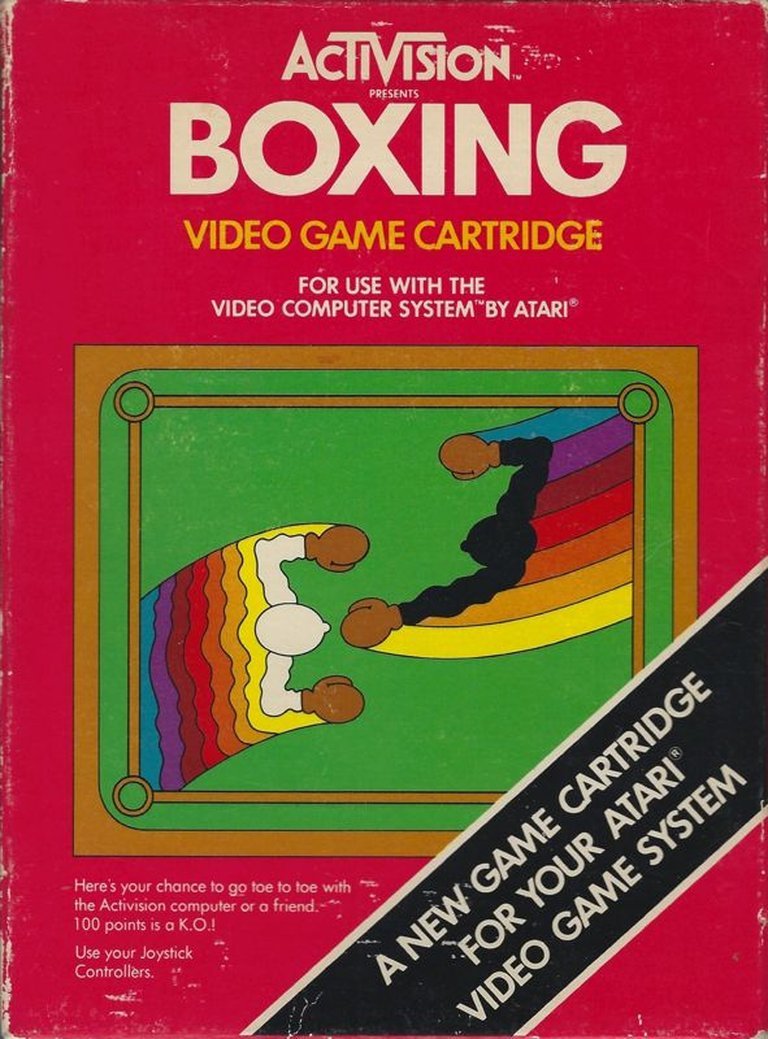
Boxing is a fast-paced top-down sports game for one or two players, developed by Activision and released in 1980 on the Atari 2600. Players engage in two-minute matches, earning points through long jabs (1 point), close power punches (2 points), and knockouts (100 points), with individually adjustable difficulty levels. The game’s simple mechanics and overhead perspective deliver an intense arcade-style boxing experience that emphasizes quick reflexes and strategic punching.
Gameplay Videos
Where to Buy Boxing
PC
Boxing Free Download
Atari 2600
Boxing Guides & Walkthroughs
Boxing Reviews & Reception
mobygames.com (67/100): It is, in 80’s lingo, rad! It still has it’s touch, even after 24 years.
gamearchives.net (67/100): This game rocks! This is game is so fun, I almost don’t want to give up my Atari.
Boxing Cheats & Codes
PlayStation 1
Enter codes using a cheat device like Action Replay, Code Breaker, or GameShark.
| Code | Effect |
|---|---|
| 801FEDD8+0AF0+801FEDDC+0AF0 | P1 Infinite Health |
| 801FEDE0+0AF0 | P1 Infinite Stamina |
| 801FEDD0+0032 | P1 Infinite Rush |
| 801FEDD8+0000+801FEDDC+0000 | P1 No Health |
| 801FEDE0+0000 | P1 No Stamina |
| 801FEDD0+0000 | P1 No Rush |
| 801FEE10+0AF0+801FEE14+0AF0 | P2 Infinite Health |
| 801FEE18+0AF0 | P2 Infinite Stamina |
| 801FEE08+0032 | P2 Infinite Rush |
| 801FEE10+0000+801FEE14+0000 | P2 No Health |
| 801FEE18+0000 | P2 No Stamina |
| 801FEE08+0000 | P2 No Rush |
| 801FE850+FFFF | Tons Of Points |
| 50000702+0000+801FE6D0+0101 | Unlock All Characters (GS 2.2 Or Higher Needed!) |
| 301FE6D3+0001 | Unlock B.T. |
| 301FE6D4+0001 | Unlock Puma |
| 301FE6D5+0001 | Unlock Prince |
| 301FE6D6+0001 | Unlock Misha |
| 301FE6D7+0001 | Unlock Silver Man |
| 301FE6D8+0001 | Unlock Gio |
| 301FE6D9+0001 | Unlock Kojiromaru |
| 301FE6DA+0001 | Unlock Spice |
| 301FE6DB+0001 | Unlock Asteka |
| 301FE6DC+0001 | Unlock Mr.Crown |
PlayStation 1 (NTSC-U)
Enter codes using a CodeBreaker device or compatible emulator.
| Code | Effect |
|---|---|
| 801FEDE0 0AF0 | P1 Infinite Stamina |
| 801FEDD0 0032 | P1 Infinite Rush |
| 801FEDE0 0000 | P1 No Stamina |
| 801FEDD0 0000 | P1 No Rush |
| 801FEE18 0AF0 | P2 Infinite Stamina |
| 801FEE08 0032 | P2 Infinite Rush |
| 801FEE18 0000 | P2 No Stamina |
| 801FEE08 0000 | P2 No Rush |
| 801FE850 FFFF | Tons Of Points |
| 301FE6D3 0001 | Unlock B.T. |
| 301FE6D4 0001 | Unlock Puma |
| 301FE6D5 0001 | Unlock Prince |
| 301FE6D6 0001 | Unlock Misha |
| 301FE6D7 0001 | Unlock Silver Man |
| 301FE6D8 0001 | Unlock Gio |
| 301FE6D9 0001 | Unlock Kojiromaru |
| 301FE6DA 0001 | Unlock Spice |
| 301FE6DB 0001 | Unlock Asteka |
| 301FE6DC 0001 | Unlock Mr. Crown |
| 801FEDD8 0AF0 801FEDDC 0AF0 | P1 Infinite Health |
| 801FEDD8 0000 801FEDDC 0000 | P1 No Health |
| 801FEE10 0AF0 801FEE14 0AF0 | P2 Infinite Health |
| 801FEE10 0000 801FEE14 0000 | P2 No Health |
| 50000702 0000 801FE6D0 0101 | Unlock All Characters |
Boxing: Review
Introduction
In the crucible of 1980, as the video game industry emerged from its arcade infancy into the living room, Activision’s Boxing for the Atari 2600 landed not as a technological marvel, but as a masterclass in distilled design. Developed by industry pioneer Bob Whitehead—one of the original “programmers” who defied Atari to form the third-party publisher—this 2KB cartridge distilled the primal chaos of boxing into a two-minute ballet of aggression and strategy. Its legacy endures not in graphical fidelity or narrative depth, but as a foundational artifact: a game that proved the sport’s essence—space control, risk-reward, and relentless competition—could be captured with breathtaking economy. This thesis argues that Boxing transcends its technical limitations to become a timeless testament to design purity, its influence echoing in every competitive fighter that followed, while also exposing the era’s brutal trade-offs between ambition and hardware constraints.
Development History & Context
Boxing emerged from the fertile, rebellious soil of Activision’s first wave. Founded in 1979 by disgruntled Atari programmers, Activision pioneered the “developer credit” model and quality control, rejecting the industry’s then-prevalent “crash and burn” ethos. Bob Whitehead, whose prior credits included Atari’s Video Chess and Football, saw sports as a natural fit for his minimalist philosophy. As he admitted in interviews, sports games offered pre-defined rules, allowing him to focus on “how the game plays” rather than inventing mechanics from scratch.
The game’s DNA traces directly to Atari’s doomed 1978 arcade prototype, Boxer. Designed by Mike Albaugh, Boxer featured an overhead view and experimental controls (six potentiometers for fist movement), but its complexity proved unworkable. Whitehead, inspired by its core concept but freed from arcade constraints, simplified it for the Atari 2600’s 128 bytes of RAM and 2KB ROM. The gaming landscape was dominated by space shooters and simple ports; sports titles were rare, making Boxing a bold, genre-defining move. Activision’s willingness to “strike out boldly in new directions,” as Video magazine noted, positioned it as a tastemaker, leveraging the Atari 2600’s installed base to challenge Atari’s monopoly.
Narrative & Thematic Deep Dive
Boxing eschews traditional narrative, instead embodying the sport’s archetypal themes through emergent gameplay. The two boxers—visually distinct only by color (white vs. black)—are blank slates, their “characters” defined solely by player actions. This abstraction transforms every match into a micro-drama of strategy and resilience.
The core themes are elemental:
– Aggression vs. Caution: Landing “power punches” (close-range, 2 points) demands risk—proximity to the opponent—but yields higher rewards, mirroring boxing’s dance between offense and defense.
– Endurance: The computer’s “tired” behavior after 60 seconds (slower reactions) humanizes the AI, framing the bout as a test of stamina.
– Dominance: The “ropes juggle”—a player cornering an opponent to land rapid, unblockable punches—becomes a metaphor for total dominance, a “secret” Whitehead embedded as a high-skill tactic.
Without named champions or story arcs, Boxing reduces boxing to its purest form: psychological warfare within a confined space. As one 1983 review noted, it “captures the spirit of the sport perfectly,” its relentless action turning button-mashing into a visceral, almost physical struggle.
Gameplay Mechanics & Systems
Boxing’s genius lies in its minimalist yet nuanced mechanics:
- Core Loop: Matches last two minutes. Points are earned via jabs (1 point, long-range) or power punches (2 points, close-range). A “knockout” occurs at 100 points, or the player with more points wins after time expires.
- Combat: Pressing the joystick’s fire button triggers punches, with the game automatically selecting jab or power based on distance. Proximity is key: closing the gap for power punches invites counterattacks but delivers higher damage.
- Innovation: “Ropes Juggling”: A subtle exploit—if an opponent is knocked into the ropes, they can be “bounced” between punches, enabling rapid, high-scoring combos. This rewards spatial mastery over brute force.
- AI & Difficulty: The computer opponent adapts dynamically. If losing, it becomes aggressive, pressing the attack. Its “tired” state after 60 seconds provides a strategic window. Difficulty switches adjust movement speed, allowing handicaps.
- UI & Controls: The Atari joystick’s simplicity is weaponized. Movement and attacks are mapped to one stick and one button, but mastering footwork—circling opponents, dodging—demands precision. The UI is stark: a timer, score, and ring dominate the screen.
Flaws: The 2KB ROM limits variety—no rounds, knockdowns, or selectable fighters. The AI, while competent, reveals patterns after repeated play. Yet these constraints breed depth; Boxing’s purity lies in what it excludes, forcing players to engage with its core mechanics.
World-Building, Art & Sound
Boxing’s world is a stark abstraction, the ring a flat, bounded space with no spectators or detail—a functional arena for combat. The visuals, however, are a masterstroke of 2600 optimization:
– Boxers: White and black sprites, rendered via sprite-scaling techniques Whitehead perfected in Combat. Arms animate smoothly on impact, with a distinct “nose-smash” effect for hits.
– Ring: Simple lines define the ropes, while the Activision logo—a high-resolution brand marker—appears as a subtle watermark.
– Atmosphere: Low-resolution graphics sanitize boxing’s violence, turning brutal punches into abstract collisions. As Whitehead noted, the “cartoony” style made the sport “not graphic” in a disturbing way.
Sound design is equally minimal but effective:
– Punches: A percussive “thud” confirms hits.
– Crowd: A low-frequency roar swells during volleys, implying tension.
– Silence: The absence of music focuses attention on the action, making each punch land with impact.
This aesthetic—functional yet charming—reflects Activision’s house style, proving that limitation breeds creativity.
Reception & Legacy
Initial Reception:
– Praise: Video magazine (1980) lauded its “willingness to strike out boldly,” applauding its simplicity and “non-stop action.” It won honorable mentions for “Best Competitive Game” and “Most Innovative” in the 1981 Arcade Alley Awards.
– Criticism: Video Action (1981) noted fatigue after extended play, while critics lamented the 2KB ROM’s lack of extras.
Commercial & Cultural Impact:
– Sales: No precise figures exist, but Activision’s early success (e.g., Dragster’s million-plus sales) suggests strong performance.
– Legacy:
– Genre Blueprint: Its top-down, score-based combat influenced later fighters, including Punch-Out!!’s dodge-and-counter mechanics.
– Preservation: Included in compilations like Activision Anthology (2002) and Microsoft’s Game Room (2010), keeping it accessible.
– AI Research: In 2011, researchers created Clever Boxer, a remake using fuzzy logic to test adaptive AI, validating Boxing’s design as a benchmark.
– Pop Culture: Featured in The Walking Dead (Season 8) and Call of Duty: Black Ops Cold War as an Easter egg, cementing its iconic status.
Conclusion
Boxing is less a game and more a perfect equation: sport + hardware limits = timeless fun. Its legacy is twofold: as a historical artifact, it exemplifies the ingenuity of Activision’s “golden age,” proving that greatness lies not in scale, but in execution. As a design document, it distilled boxing’s essence into a blistering, two-minute crescendo of strategy and reflexes, influencing competitive gaming for decades.
Verdict: While its graphical simplicity and lack of depth may alienate modern players, Boxing remains a foundational masterpiece. It is an essential relic of a bygone era—the pugilistic pioneer that proved video games could capture the soul of a sport with shocking elegance. For historians, it’s a critical link between arcade brawlers and modern simulations; for players, it’s a visceral, exhausting joy. In the annals of game history, Boxing doesn’t just throw a punch—it lands a knockout.