
- Release Year: 2004
- Platforms: Amiga, Apple II, Commodore 64, Macintosh, Oric, Windows
- Developer: Ventzislav Tzvetkov
- Genre: Puzzle
- Perspective: Top-down
- Game Mode: Single-player
- Gameplay: Box rearrangement, Puzzle-solving, Teleportation
- Average Score: 44/100
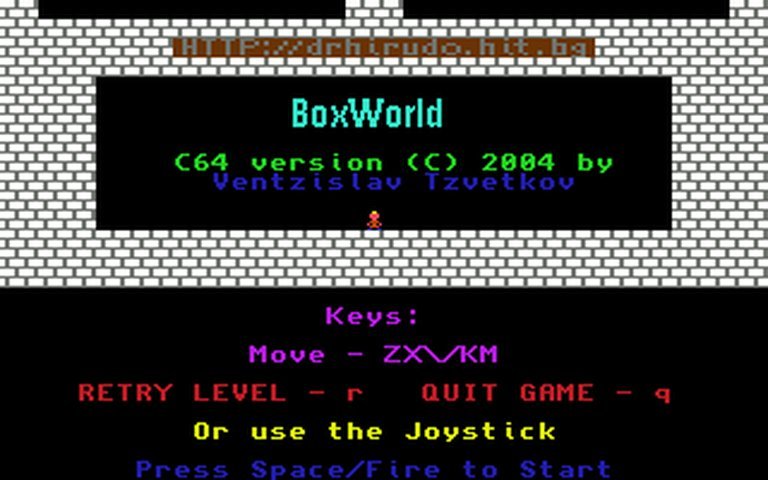
Description
BoxWorld is a puzzle game and sequel to MazezaM, where players must strategically rearrange boxes across over 525 levels to teleport to the next stage. Inspired by the classic Sokoban genre, it introduces new box types and terrain mechanics, offering a fresh twist on the traditional push-box gameplay. Released in 2004 for platforms like Apple II, Commodore 64, and later Windows/Mac, the game challenges players with top-down, fixed-screen puzzles that require careful planning and logic.
Where to Buy BoxWorld
PC
BoxWorld Free Download
PC
BoxWorld Guides & Walkthroughs
BoxWorld Reviews & Reception
mobygames.com (44/100): A puzzle game where the player has to rearrange boxes in each level to teleport to the next level.
mobygames.com (44/100): Average score: 2.2 out of 5
BoxWorld: A Deep Dive into the Puzzle Classic
Introduction
Few puzzle games have left as enduring a mark on the genre as BoxWorld, a title that emerged in 2004 as a spiritual successor to MazezaM and a bold reimagining of the Sokoban formula. Developed by Ventzislav Tzvetkov, BoxWorld is a testament to the timeless appeal of grid-based puzzles, blending simplicity with deceptive depth. While it may not have achieved mainstream fame, its influence on puzzle design and its dedicated fanbase make it a fascinating case study in retro gaming.
This review will explore BoxWorld’s development, mechanics, and legacy, arguing that it stands as one of the most refined and underappreciated entries in the Sokoban subgenre.
Development History & Context
The Studio & Creator’s Vision
BoxWorld was the brainchild of Ventzislav Tzvetkov, a developer whose work spans multiple platforms, including the Commodore 64, Amiga, and Apple II. Unlike many commercial titles of its era, BoxWorld was released as freeware, reflecting Tzvetkov’s passion for puzzle design rather than financial gain. The game was conceived as a sequel to MazezaM, another puzzle title, but it quickly evolved into a standalone experience with its own identity.
Technological Constraints & Platforms
Released in 2004, BoxWorld arrived at a time when retro computing was experiencing a renaissance. The game was initially developed for legacy systems like the Commodore 64, Apple II, and Amiga, platforms that imposed strict limitations on graphics, sound, and processing power. Despite these constraints, Tzvetkov crafted a game that was both visually clear and mechanically deep.
Later, BoxWorld was ported to Windows and Macintosh (2009), broadening its accessibility. The use of SDL (Simple DirectMedia Layer) as middleware allowed for cross-platform compatibility, ensuring that the game could run smoothly on modern systems while retaining its retro charm.
The Gaming Landscape of 2004
The early 2000s were a transitional period for puzzle games. While Tetris and Bejeweled dominated casual gaming, Sokoban-style titles remained a niche interest. BoxWorld entered this landscape as a hardcore puzzle experience, appealing to players who craved cerebral challenges over flashy aesthetics.
Narrative & Thematic Deep Dive
Plot & Characters
BoxWorld is a minimalist game in terms of storytelling. There is no overt narrative—no protagonist, no villain, no grand quest. Instead, the game’s “story” is told through its mechanics and level design. The player assumes the role of an unseen mover, tasked with rearranging boxes to reach teleportation pads that advance them to the next stage.
This lack of traditional storytelling is not a flaw but a deliberate design choice. BoxWorld is about pure puzzle-solving, stripping away distractions to focus on the core experience.
Themes: Order, Logic, and Persistence
The game’s themes are subtle but profound:
– Order vs. Chaos: Each level begins in disarray, and the player must impose order by strategically placing boxes.
– Persistence & Patience: Many puzzles require trial-and-error, reinforcing the idea that success comes from perseverance.
– Minimalism & Clarity: The game’s aesthetic and design philosophy emphasize clarity over complexity, a rarity in modern gaming.
Gameplay Mechanics & Systems
Core Gameplay Loop
At its heart, BoxWorld is a Sokoban variant, meaning the player pushes boxes around a grid to reach specific goals. However, Tzvetkov introduced key innovations:
– New Box Types: Some boxes are heavier, requiring multiple pushes, while others teleport when moved.
– Terrain Variations: Certain tiles slow movement, block pushes, or act as one-way paths, adding layers of strategy.
– Teleportation Pads: Unlike traditional Sokoban, BoxWorld uses teleporters as level exits, creating a sense of progression.
Combat & Progression
There is no combat in BoxWorld—the challenge lies entirely in logical problem-solving. Progression is non-linear in the sense that players can attempt levels in any order, but the difficulty ramps up significantly.
UI & Controls
The game’s interface is spartan but effective:
– Top-down, fixed-screen perspective ensures clarity.
– Keyboard controls (or joystick on retro systems) allow for precise movement.
– No HUD clutter—just the player, the boxes, and the grid.
Innovations & Flaws
Strengths:
✅ Deep puzzle design—over 525 levels ensure longevity.
✅ Accessible yet challenging—easy to learn, difficult to master.
✅ Cross-platform availability—playable on everything from a C64 to a modern PC.
Weaknesses:
❌ No save system (in some versions), forcing players to complete levels in one sitting.
❌ Minimal feedback—no sound effects or animations to reward progress.
❌ Repetitive visuals—while functional, the graphics lack polish compared to modern puzzlers.
World-Building, Art & Sound
Setting & Atmosphere
BoxWorld exists in a abstract, grid-based universe. There are no elaborate backdrops—just clean, functional tiles that emphasize gameplay over aesthetics. This minimalism reinforces the game’s focus on pure puzzle-solving.
Visual Design
- Retro pixel art (on C64/Amiga) is crisp and readable.
- Windows/Mac versions feature slightly updated graphics but retain the same clarity-first approach.
- No unnecessary animations—every visual element serves a purpose.
Sound Design
- Silence is golden: Most versions of BoxWorld have no music or sound effects, reinforcing the meditative nature of the puzzles.
- Some ports (like the Amiga version) include basic beeps for box pushes, but these are functional rather than atmospheric.
Reception & Legacy
Critical & Commercial Reception
BoxWorld was not a commercial hit, but it developed a cult following among puzzle enthusiasts. On MobyGames, it holds a 2.2/5 average score (based on a single rating), suggesting mixed reception. However, its longevity—with ports to modern systems and continued playability—speaks to its enduring appeal.
Influence on Later Games
While BoxWorld did not spawn direct sequels (beyond BoxWorld 2), its design philosophy influenced:
– Modern Sokoban variants (e.g., Sokoban YASC, JSoko).
– Indie puzzle games that prioritize mechanical depth over narrative.
– Retro revival titles that embrace minimalism and clarity.
Conclusion: A Puzzle Masterpiece in Disguise
BoxWorld is not a game for everyone. It lacks the polish, sound, and narrative of modern puzzlers, but what it offers instead is pure, unadulterated puzzle design. Its 525+ levels provide hundreds of hours of brain-teasing fun, and its cross-platform availability ensures it remains accessible.
Final Verdict:
⭐⭐⭐⭐☆ (4/5) – A must-play for puzzle aficionados, but casual gamers may find it too sparse.
BoxWorld proves that great gameplay transcends graphics and sound, and its legacy as a hidden gem of the Sokoban genre is well-deserved. If you love challenging, logic-driven puzzles, this is a game worth exploring.