
- Release Year: 2002
- Platforms: Windows
- Publisher: Lagoon Multimedia
- Genre: Compilation, Strategy, Tactics
- Game Mode: Single-player
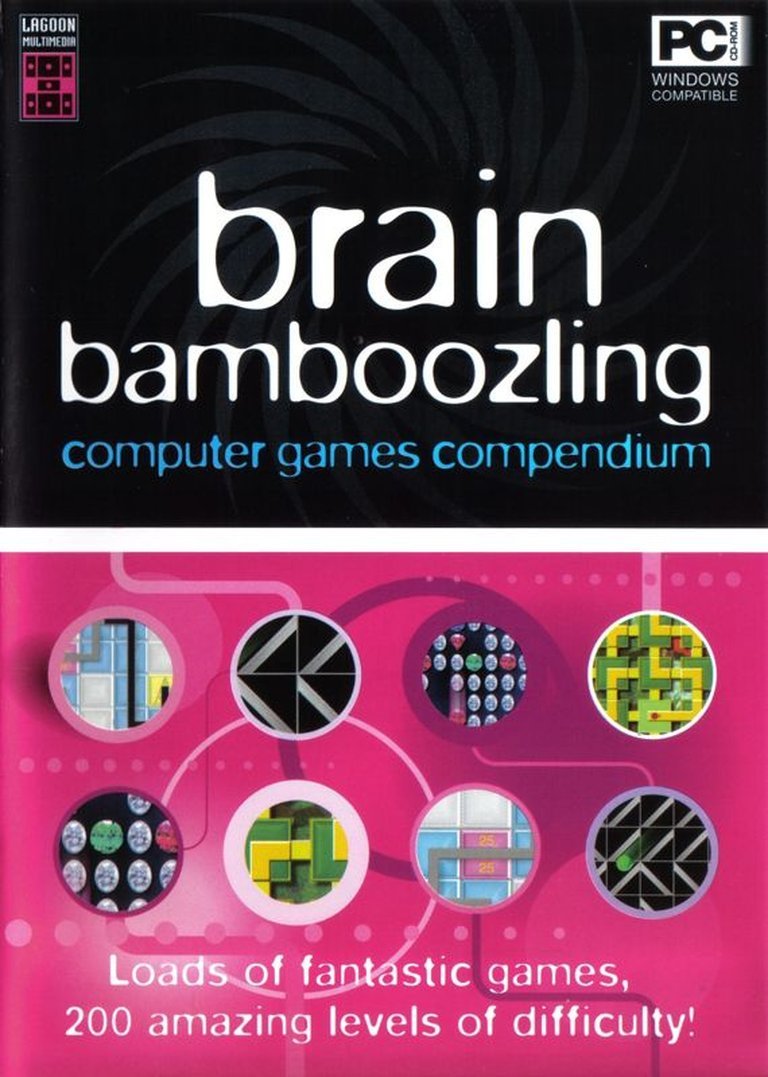
Description
Brain Bamboozling: Computer Games Compendium is a 2002 Windows compilation published by Lagoon Multimedia, featuring ten special edition strategy and logic games from Soleau Software’s Galaxy of Games series. This collection includes titles such as Oilcap Pro, Gem Jam, and Beetle Run, offering over 200 levels of arcade-style puzzles designed to challenge players’ cognitive abilities with mind-bending gameplay that blends entertainment with brain-training exercises.
Brain Bamboozling: Computer Games Compendium: Review
Introduction: A Time Capsule of Early 2000s Casual Gaming
In the early 2000s, the PC gaming landscape was a bustling frontier where innovative indie experiments coexisted with blockbuster titles, and the concept of “casual gaming” was beginning to crystallize from a niche interest into a broader cultural phenomenon. It was against this backdrop—a period marked by the dominance of Windows XP, the ubiquity of CD-ROM compilations, and the nascent rise of puzzle-focused titles—that Lagoon Multimedia released Brain Bamboozling: Computer Games Compendium in 2002. This compilation, culled from the back catalog of the obscure Soleau Software, represents a humble yet telling artifact of its era. My thesis is straightforward: while Brain Bamboozling is unlikely to be remembered as a landmark title, it serves as a fascinating case study in the democratization of brain-teasing entertainment, reflecting the industry’s shift toward accessible, logic-driven gameplay that would later explode into the “brain training” craze. As a review, this analysis will dissect the compilation not for its individual games—many of which are lost to time—but for what it reveals about the technological, cultural, and design currents of its moment.
Development History & Context: The Rise of the Budget Compilation
The Studio and Its Vision
Soleau Software, the developer behind the ten games compiled here, was a small, largely undocumented studio that operated in the shadow of industry giants. From the available records, Soleau appears to have specialized in lightweight, puzzle-oriented games for Windows, often released as shareware or budget titles. Their “Galaxy of Games” series, from which this compendium draws, was likely an attempt to create a recognizable brand for simple, replayable experiences. The vision behind Brain Bamboozling seems pragmatic: to repackage existing, low-cost titles into a single, marketable product that could appeal to a broad audience—from children seeking entertainment to adults looking for mental stimulation. There’s no evidence of grandiose ambitions; instead, the goal was likely commercial viability through volume and accessibility, a common strategy for small publishers in the early 2000s.
Technological Constraints and the Gaming Landscape
Released in 2002 for Windows, Brain Bamboozling was a product of its technological moment. The game arrived on CD-ROM, a medium that, by then, was standard for PC games but increasingly seen as legacy compared to the rising DVD format. This choice reflects the budget nature of the compilation: CD-ROMs were cheap to produce and widely compatible, but limited in storage capacity, which may have constrained the scope of each included game. Graphically, the titles would have utilized 2D sprites and basic animations, typical of the era’s indie puzzle games, with sound design relying on simple MIDI sequences or basic digital samples. The Windows XP environment was the default, and games like these often ran in windowed mode with minimal system requirements, ensuring they could be played on a wide range of hardware.
The gaming landscape of 2002 was undergoing a quiet revolution. While console gaming was locked in the sixth-generation war (PlayStation 2, Xbox, GameCube), PC gaming was seeing the rise of online multiplayer and the tail end of the “bedroom coder” era. More pertinently, the casual puzzle genre was gaining traction thanks to games like Bejeweled (2001) and the burgeoning popularity of Microsoft’s Solitaire and Minesweeper as pre-installed time-wasters. Compilations like Brain Bamboozling capitalized on this trend, offering a variety of mini-games in a single package—a model that would later be perfected by collections like Microsoft Entertainment Pack or Luxor series. However, the early 2000s also saw a tension between depth and accessibility; Brain Bamboozling likely erred on the side of the latter, prioritizing quick, digestible sessions over narrative or mechanical complexity.
Narrative & Thematic Deep Dive: Logic Over Lore
As a compilation of ten disparate games—Oilcap Pro, Rollem, Squark, Wall Up, Flaps, Quarry, Diaggle, Axium Adventures, Gem Jam, and Beetle Run—Brain Bamboozling has no unified narrative or overarching storyline. Instead, its thematic core revolves around cognitive engagement: each game is designed to challenge different facets of player intelligence, from pattern recognition and spatial reasoning to strategic planning and quick reflexes. The tagline “brain-boggling, mind-bending, IQ-stretching” is not mere hyperbole; it encapsulates the era’s fascination with gamified mental exercise, predating the scientific branding of titles like Dr. Kawashima’s Brain Training by four years.
Individual Game Themes (Based on Titles)
- Oilcap Pro and Quarry: Likely involve resource management or extraction puzzles, theming around industrial efficiency and logistical planning.
- Rollem and Beetle Run: Suggest physics-based or maze navigation games, where players guide objects or creatures through obstacles, emphasizing dexterity and pathfinding.
- Squark and Flaps: Imply auditory or rhythmic challenges, possibly involving sound-based puzzles or timing mechanics.
- Wall Up and Diaggle: Hint at construction or deconstruction puzzles, where players build or dismantle structures under constraints.
- Axium Adventures and Gem Jam: Evoke adventure and collection themes, likely involving exploration or matching mechanics with a fantasy or treasure-hunting veneer.
The common thread is abstraction: these games eschew character-driven stories for pure mechanics. There are no dialogues, no character arcs, and no plots to speak of. Instead, the “narrative” is the player’s progression through levels of increasing difficulty—a meta-narrative of self-improvement and problem-solving. This reflects a design philosophy aligned with the “serious games” movement of the 1990s and early 2000s, where entertainment and education were blurred, but without the pedantry of formal educational titles. The themes are optimistic and universal: the joy of discovery, the satisfaction of solving a puzzle, and the competitive urge to beat one’s high score. In this sense, Brain Bamboozling is a product of its time, capturing the pre-social media era’s belief in solitary, screen-based mental enrichment.
Gameplay Mechanics & Systems: Variety Without Depth
The core appeal of Brain Bamboozling lies in its promise of “200 amazing levels” across ten games, each presumably offering a distinct gameplay loop. As a compilation, it doesn’t innovate so much as它聚合了多种经典机制,但缺乏整合。
Core Gameplay Loops
Each game likely revolves around a simple, repeatable action: rotate gems in Gem Jam, navigate a beetle through a maze in Beetle Run, or manage oil flow in Oilcap Pro. The loops are designed for short, intense sessions—perfect for the “five-minute break” demographic that would later define mobile gaming. Progression is typically level-based, with increasing complexity in puzzle design, enemy speed, or resource scarcity. Since these are “special editions” of earlier Soleau titles, they may include enhanced features like additional levels or improved interfaces compared to their original shareware versions.
Combat, Progression, and UI
Combat, as traditionally understood, is absent. Instead, “opposition” comes from the puzzles themselves—time limits, moving obstacles, or scoring thresholds. Character progression is nonexistent; there are no avatars to upgrade or stats to improve. The only progression is the player’s skill and the unlocking of subsequent levels. The user interface is functional and utilitarian, likely featuring a main menu to select games, in-game pause options, and score tracking. Given the era, it might lack modern niceties like customizable controls or accessibility options, reflecting the simpler expectations of early 2000s PC users.
Innovative or Flawed Systems
Innovation is not a strong suit here. The compilation’s primary “innovation” is economic: bundling multiple games for a single price, a practice that was common but rarely celebrated. However, it does highlight an early form of the “games as a service” model, where players might return to different games for varied mental challenges. Flaws are predictable: the games likely suffer from repetition, with mechanics that don’t evolve significantly across levels. As standalone experiences, they might be shallow, but the compilation format masks this by offering variety. Another flaw is the lack of cohesion—no shared scoring system or central hub, which could have made the package feel like a unified “brain gym” rather than ten isolated exercises. Nonetheless, for its target audience—families seeking affordable entertainment—this simplicity may have been a virtue, not a vice.
World-Building, Art & Sound: Functional Aesthetics
The sensory experience of Brain Bamboozling is emblematic of early 2000s indie PC gaming: technically modest but earnest in execution.
Setting and Atmosphere
Each game probably has a minimalist setting. Axium Adventures might feature a fantasy landscape with gem-filled caverns, while Quarry could situate players in a mining site. However, world-building is minimal to nonexistent. The atmosphere is clinical and focused on gameplay; backgrounds are likely static or simple parallax scrolling, with no narrative context. This aligns with the “brain game” ethos, where distraction is minimized to maximize cognitive engagement. The overall feel is friendly and non-threatening, with bright colors and straightforward visuals intended to appeal to all ages.
Visual Direction
Graphically, the games would use 2D sprites and tile-based environments, common for puzzle games of the period. Resolution is probably capped at 640×480 or 800×600, with limited color palettes to ensure compatibility with older systems. Art style is generic and functional: gems, beetles, walls, and oil pipes are rendered with clear, recognizable shapes rather than artistic flair. This is not a criticism; for puzzle games, clarity trumps aesthetics. However, by modern standards, it feels dated and uninspired.
Sound Design
Sound effects are likely basic bleeps, bloops, and jingles—archetypal of early PC games. Music, if present, would be simple MIDI loops that loop indefinitely without becoming intrusive. The audio design serves a utilitarian purpose: providing feedback for actions (e.g., a chime for matching gems, a buzz for errors) and enhancing the arcade-like feel. There’s no orchestral score or voice acting, which is appropriate for the genre but contributes to a sense of cheapness.
Contribution to Overall Experience
Together, these elements create a cohesive but unremarkable aesthetic package. The art and sound don’t elevate the gameplay; they merely support it. In a compilation, this homogeneity can be both a strength (consistent experience) and a weakness (lack of standout moments). For players in 2002, the “awesome graphics” claimed in marketing might have been relative—comparing favorably to Solitaire but paling next to Return to Castle Wolfenstein. The atmosphere is one of quiet, cerebral engagement, devoid of the cinematic ambition that was rising in AAA titles. This makes Brain Bamboozling a pure mechanics-focused experience, which aligns with its educational aspirations but may limit its lasting appeal.
Reception & Legacy: The Quiet Footnote
Critical and Commercial Reception
Upon its 2002 release, Brain Bamboozling: Computer Games Compendium appears to have been utterly ignored by mainstream critics. MobyGames and Metacritic list no critic or user reviews, and its MobyScore is “n/a”. This silence speaks volumes: the game was likely a budget title sold in discount bins or bundled with other software, with minimal marketing push from Lagoon Multimedia. Commercially, it probably sold modestly to a niche audience—parents seeking non-violent games for children, or casual players drawn to the “brain training” label before it was a trend. Without sales data, its commercial success remains speculative, but the absence of any recorded reviews suggests it failed to make waves.
Evolution of Reputation
Over time, Brain Bamboozling has drifted into obscurity. It is not preserved in gaming canon, nor does it have a cult following. Among collectors, it might be a curiosity for its obscurity or as an example of Soleau Software’s work, but it lacks the charm of similarly obscure titles like Rod Land or The Lost Vikings. Its reputation has not evolved because it never had one to evolve; it remains a statistical blip in database records, collected by only a handful of enthusiasts on MobyGames.
Influence on the Industry
Direct influence is negligible. However, Brain Bamboozling is part of a lineage that contributed to the casual and brain training boom. Compilations like this—along with Microsoft Entertainment Pack and later Dr. Brain Thinking Games series—helped normalize the idea of games as tools for mental fitness. When Nintendo launched Brain Age in 2005, it tapped into a pre-existing, if diffuse, market for logic puzzles. Brain Bamboozling represents an early, unrefined iteration of that concept: no scientific backing, no sleek hardware integration, just a CD-ROM of simple games. In the broader history of video games, it is a footnote in the transition from arcade and console dominance to the diversification of genres and audiences in the 2000s. It highlights how compilations were a stopgap for small developers to reach consumers, a model that would later be superseded by digital storefronts like Steam.
Conclusion: A Harmless relics of a Bygone Era
Brain Bamboozling: Computer Games Compendium is not a game that demands analysis for its artistry or innovation. Instead, its value lies in its representativeness. It captures a moment when PC gaming was fragmenting into specialized niches, and “brain games” were emerging from the puzzle genre’s periphery. The compilation is technically competent for its time, offering variety and simplicity, but it lacks the charm, depth, or polish to stand out. Its legacy is as a time capsule—a reminder of an era when a CD-ROM full of mini-games could be marketed as an “IQ-stretching” experience without irony.
In the grand tapestry of video game history, Brain Bamboozling is a minor thread, easily overlooked. Yet, it is precisely this ordinariness that makes it worth examining. It reflects the democratization of game development in the early 2000s, where small studios could package and distribute their creations through publishers like Lagoon Multimedia. It also underscores the commercial reality that not every compilation achieves the iconic status of, say, The Orange Box or Super Mario 3D All-Stars. For historians, it serves as a data point in the evolution of casual gaming; for players, it is a nostalgic curiosity or a forgotten bargain. My final verdict is this: Brain Bamboozling is a forgettable compilation that, through its very forgettability, illuminates the vast, uncharted landscape of early 2000s PC gaming—a landscape where countless such titles thrived in obscurity, paving the way for the brain-training empires of tomorrow. It deserves not a place in the hall of fame, but a mention in the annals of gaming’s quiet, unassuming corners.