
- Release Year: 2006
- Platforms: Macintosh, Windows
- Publisher: EdAlive
- Developer: EdAlive
- Genre: Educational
- Perspective: Fixed / flip-screen
- Game Mode: Single-player
- Gameplay: Mini-games, Paper doll inventory, Whac-A-Mole
- Setting: Pre-school, Reading, Space flight, toddler, writing
- Average Score: 80/100
Description
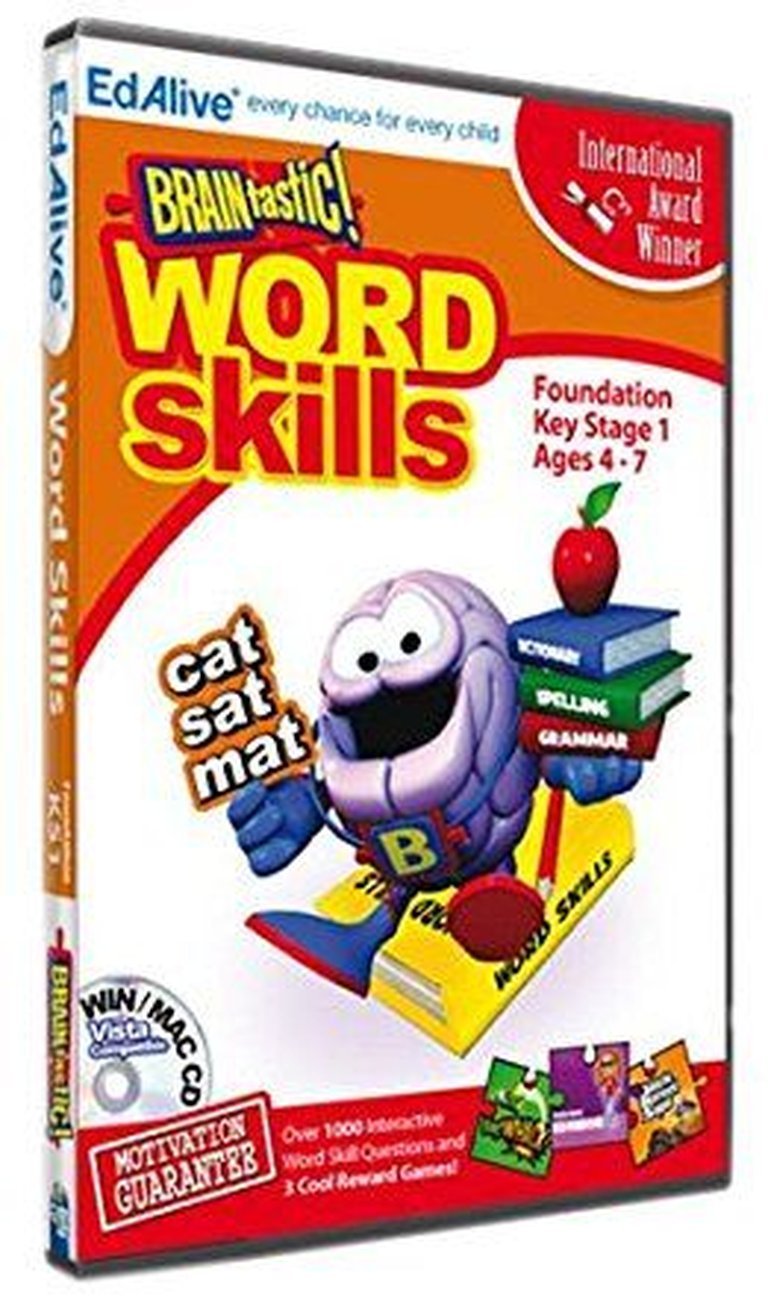
BRAINtastic! Word Skills Key Stage 1 is an educational game designed for children aged 4-7, developed by EdAlive to support literacy skills in alignment with UK, Australian, and New Zealand curricula. The game features three mini-games—Bug Whack! (a Whac-A-Mole-style challenge), Extreme Fashion (a dress-up activity), and Galactic Retrieval Squad (a space-themed gem-collecting game)—which are unlocked by answering questions correctly. Players earn limited access to these games as rewards, with progress saved automatically, blending learning with playful, motivational gameplay.
BRAINtastic! Word Skills Key Stage 1 Reviews & Reception
sockscap64.com (80/100): BRAINtastic! Word Skills Key Stage 3 is one in a series of titles from Australian educational software publisher EdAlive who produce titles for maths & literacy for the UK, Australian and New Zealand education systems.
nationalparentingcenter.com : Edalive has achieved that goal with Braintastic! Word Skills, a multi-level word-building title that our testers described as ‘inviting’ and ‘encouraging’, ‘interesting’ and ‘exciting’.
BRAINtastic! Word Skills Key Stage 1: A Deep Dive into Edutainment’s Hidden Gem
Introduction: The Unassuming Titan of Early Literacy Software
In the vast, often overlooked landscape of educational software, few titles have left as quiet yet enduring a mark as BRAINtastic! Word Skills Key Stage 1. Released in 2006 by Australian developer EdAlive, this unassuming CD-ROM title might not have the cultural cachet of The Oregon Trail or the nostalgic clout of Reader Rabbit, but it represents a fascinating microcosm of early 2000s edutainment design—a period where the line between “game” and “learning tool” was both fiercely debated and creatively blurred. This review aims to dissect BRAINtastic! not just as a relic of its time, but as a case study in how educational software can (and sometimes fails to) balance pedagogy with play.
At its core, BRAINtastic! Word Skills Key Stage 1 is a literacy-focused title targeting children aged 4–7, aligned with the UK’s Key Stage 1 curriculum. It’s part of a broader series that spans multiple age groups and subjects, but this iteration stands out for its laser focus on foundational word skills. The game’s premise is deceptively simple: answer questions to unlock mini-games, which serve as both reward and reinforcement. Yet beneath this straightforward loop lies a nuanced (if flawed) philosophy about motivation, progression, and the role of fun in learning.
This review will explore the game’s development context, its mechanical and thematic underpinnings, its reception, and its legacy. We’ll ask: Did it succeed in making learning feel like play? Did it innovate, or did it merely iterate? And what can modern educational games learn from its successes and shortcomings?
Development History & Context: The EdAlive Ethos
The Studio: EdAlive’s Pedagogical Mission
EdAlive, the Australian publisher behind BRAINtastic!, is not a household name, but it’s a stalwart in the educational software niche. Founded in the 1990s, the company carved out a reputation for creating curriculum-aligned titles tailored to the UK, Australian, and New Zealand education systems. Their modus operandi was clear: games as motivational tools. Unlike some contemporaries that cloaked learning in thinly veiled gameplay, EdAlive’s titles often wore their educational intent on their sleeves, using games as rewards rather than disguises.
This philosophy is evident in BRAINtastic!’s structure. The game doesn’t pretend to be anything other than a learning tool; the mini-games are explicitly framed as prizes for correct answers. This approach reflects a broader tension in edutainment design: Should educational games trick kids into learning, or should they be transparent about their goals? EdAlive opted for the latter, a choice that colors every aspect of the experience.
Technological Constraints and Design Choices
Released in 2006, BRAINtastic! arrived at a transitional moment in educational software. The mid-2000s saw the decline of CD-ROM-based learning tools as web-based platforms began to rise. Yet EdAlive doubled down on the physical medium, likely due to the reliability and offline accessibility it offered schools and households with limited internet.
The game’s technical specifications are modest even for the era:
– Fixed/flip-screen visuals: No 3D acceleration or complex animations.
– Keyboard and mouse input: No support for emerging peripherals like interactive whiteboards.
– Minimal system requirements: Designed to run on the aging hardware still prevalent in schools.
These constraints shaped the game’s three mini-games (Bug Whack!, Extreme Fashion, Galactic Retrieval Squad), which prioritize simplicity and accessibility over graphical fidelity. The development team, led by Project Coordinator Graham East and Lead Programmer Toby De Ieso, included educators and content designers (like Helenmary Jarrott and Jacquelyn Whitland), ensuring the questions aligned with curriculum standards.
The Gaming Landscape of 2006
To understand BRAINtastic!’s place in history, consider its contemporaries:
– Commercial edutainment: JumpStart and Reader Rabbit were still dominant, though their heyday was waning.
– Casual gaming: The rise of Brain Age (2005) and Big Brain Academy (2005) on the Nintendo DS signaled a shift toward “brain training” as a mainstream genre.
– Web-based learning: Platforms like Starfall (2002) and ABCmouse (2010) were beginning to eclipse CD-ROMs.
BRAINtastic! occupied a curious middle ground. It wasn’t as polished as Nintendo’s offerings, nor as interactive as emerging web tools. Yet its curriculum-specific focus gave it a niche appeal, particularly in schools where standardized testing was becoming increasingly emphasized.
Narrative & Thematic Deep Dive: The Illusion of Story
The Absence of Plot
BRAINtastic! is, at its heart, a non-narrative experience. There are no characters to guide the player, no overarching story, and no lore. The closest it comes to a “world” is the menu system, which frames the mini-games as destinations to unlock. This lack of narrative is both a strength and a weakness.
Strengths:
– Focus on learning: Without a story to distract, the game keeps players engaged with the core content.
– Universal appeal: No cultural or gendered assumptions are baked into the experience.
Weaknesses:
– Missed emotional engagement: Modern educational games like DragonBox or Prodigy Math use narrative to create emotional stakes. BRAINtastic!’s sterile presentation can feel cold by comparison.
– Lack of context: The mini-games (Bug Whack!, Galactic Retrieval Squad) exist in a vacuum, untethered to any larger world or purpose.
Themes: Reward, Repetition, and the Gamification of Learning
The game’s central theme is earned play. The mini-games aren’t just fun—they’re privileges, dolled out only after demonstrating competence. This reflects a behaviorist approach to education, where positive reinforcement (the games) is tied to desired actions (correct answers).
The Mini-Games as Metaphors:
1. Bug Whack!: A Whac-A-Mole clone where players swat bugs with a sandal. The bugs have point values, encouraging strategic play. Thematically, it’s a simple cause-and-effect loop: hit the right thing, get points.
2. Extreme Fashion: A dress-up game with no “wrong” answers, offering creative freedom. This stands in stark contrast to the quiz-based structure, suggesting a tension between structured learning and open-ended play.
3. Galactic Retrieval Squad: A space-themed collection game with fuel mechanics and collision penalties. It’s the most “game-like” of the three, with progression (nine levels) and risk (damage).
The Underlying Message:
Learning is work, but work can earn you play. This is a double-edged sword. On one hand, it validates the effort of learning. On the other, it reinforces the idea that education is a chore to be endured for the sake of rewards—a philosophy that modern educators increasingly challenge.
Gameplay Mechanics & Systems: The Carrot-and-Stick Loop
Core Gameplay Loop
- Answer Questions: Players tackle word-based quizzes (e.g., spelling, vocabulary, sentence structure).
- Unlock Mini-Games: After five correct answers, a mini-game is unlocked for a limited time.
- Play and Repeat: The mini-game session ends, and the cycle begins anew.
This loop is brutally efficient but also mechanically shallow. There’s no progression system beyond the mini-games themselves, no adaptive difficulty, and no long-term goals.
The Quiz System: Pedagogy Over Play
The questions are the game’s backbone, designed by educators to align with Key Stage 1 standards. They cover:
– Phonics
– Sight words
– Sentence construction
– Basic grammar
Strengths:
– Curriculum-aligned: Teachers could trust the content’s relevance.
– Automatic saving: Progress was tracked, allowing for incremental learning.
Weaknesses:
– No adaptivity: The game doesn’t adjust to a player’s skill level.
– Repetitive: The same questions recur, leading to memorization rather than mastery.
Mini-Game Analysis
| Mini-Game | Mechanics | Educational Tie-In? | Engagement Level |
|---|---|---|---|
| Bug Whack! | Whac-A-Mole with point values | None | High (fast-paced) |
| Extreme Fashion | Dress-up with no failure states | None | Medium (creative) |
| Galactic Retrieval | Fuel management, gem collection | None | High (progression) |
Key Observations:
– The mini-games are entirely divorced from the educational content. They’re rewards, not reinforcements.
– Galactic Retrieval Squad is the most “game-like,” with its fuel mechanics and level progression, but it’s also the most punishing (collisions damage the ship).
– Extreme Fashion is the outlier—a rare moment of unstructured play in an otherwise rigid system.
UI and UX: Functional but Uninspired
The interface is sparse, with large buttons and clear text—necessary for young players but lacking charm. The menu system is utilitarian, with no animations or feedback to make navigation feel dynamic.
Missed Opportunities:
– No visual progression: Unlike Prodigy Math, which uses avatars and worlds to show growth, BRAINtastic! offers no tangible sense of advancement.
– No social features: Even in 2006, multiplayer or shareable progress could have added depth.
World-Building, Art & Sound: The Aesthetics of Utility
Visual Design: Form Follows Function
The game’s art style is deliberately simple:
– Bright colors: High contrast for readability.
– Cartoonish bugs and spaceships: Friendly but generic.
– Static backgrounds: No parallax scrolling or dynamic elements.
Comparison to Peers:
– JumpStart (1990s): More detailed, with animated characters.
– Brain Age (2005): Minimalist but polished, with a cohesive aesthetic.
– BRAINtastic!: Feels like a template rather than a world.
Sound Design: The Silence of the CD-ROM
The game’s audio is sparse:
– No voice acting: Text is text-only, limiting accessibility.
– Basic sound effects: Bugs make a splat when whacked; the spaceship emits a beep when collecting gems.
– No music: The absence of a soundtrack makes the experience feel sterile.
Why It Matters:
Modern research shows that audio feedback (e.g., celebratory sounds for correct answers) can reinforce learning. BRAINtastic!’s silence is a missed opportunity.
Reception & Legacy: The Quiet Success
Critical Reception: The Lack of Reviews
Strikingly, MobyGames lists no critic or player reviews for BRAINtastic! Word Skills Key Stage 1. This isn’t necessarily a sign of failure—educational software often flies under the radar of gaming press—but it speaks to the game’s niche appeal.
What We Can Infer:
– School adoption: The game’s curriculum alignment suggests it was more likely to be used in classrooms than homes.
– Parent reactions: The National Parenting Center’s 2007 Seal of Approval praises its “scope and breadth,” calling it “inviting” and “encouraging.” Parents appreciated its mirroring of school lessons.
Commercial Performance: The eBay Afterlife
A glance at eBay listings reveals the game’s second life:
– Prices: Typically £5–£15, suggesting moderate collector interest.
– Descriptions: Sellers highlight its “near mint” condition and “fast dispatch,” implying it was well-preserved but not widely played.
– Bundles: Often sold alongside other BRAINtastic! titles or educational CDs, indicating it was part of a larger ecosystem.
Legacy: The Ghost of Edutainment Past
BRAINtastic!’s influence is subtle but detectable:
– Mini-games as rewards: Later titles like ABCmouse and Khan Academy Kids use similar structures.
– Curriculum alignment: The game’s laser focus on standards prefigured the rise of Common Core-aligned software.
– The decline of CD-ROM edutainment: By the late 2000s, web-based platforms rendered physical discs obsolete. BRAINtastic! was a late entry in a dying genre.
Modern Equivalents:
| Game | Platform | Key Innovation Over BRAINtastic! |
|---|---|---|
| Prodigy Math | Web | Narrative world, adaptive difficulty |
| ABCmouse | Web/App | Animated characters, progression system |
| Endless Alphabet | Mobile | Tactile interactions, voice acting |
Conclusion: A Flawed but Fascinating Artifact
BRAINtastic! Word Skills Key Stage 1 is not a great game by any stretch. Its mechanics are repetitive, its presentation is sterile, and its mini-games feel tacked-on rather than integrated. Yet it’s a fascinating artifact—a snapshot of a moment when educational software was transitioning from the CD-ROM era to the digital age, and when the philosophy of “games as rewards” was still dominant.
Final Verdict:
✅ For Educators: A functional, curriculum-aligned tool that does its job without frills. 7/10
❌ For Gamers: Lacks the depth, polish, or narrative to hold attention outside a classroom. 4/10
🔮 For Historians: A valuable case study in edutainment’s evolution. 8/10
Where It Succeeds:
– Pedagogical rigor: The questions are well-designed and aligned with standards.
– Accessibility: Simple controls and clear UI make it usable for young children.
– Transparency: It doesn’t pretend to be anything other than a learning tool.
Where It Fails:
– Engagement: The mini-games are fun but disconnected from the learning.
– Adaptivity: No dynamic difficulty or personalized feedback.
– Aesthetics: The lack of audio, animation, and narrative makes it feel outdated even for 2006.
Ultimate Question: Does It Hold Up?
In an era of Endless Alphabet and Prodigy Math, BRAINtastic! feels like a relic. But its core idea—that learning can be rewarded with play—remains influential. The game’s greatest sin isn’t that it’s bad, but that it’s forgettable. And in the crowded field of educational software, forgettable is the kiss of death.
Final Score: 6.5/10 – A Noble Experiment, But Time Has Passed It By.
For historians and educators, BRAINtastic! Word Skills Key Stage 1 is worth a look. For everyone else, it’s a curious footnote—a game that tried to make learning fun, but forgot to make it memorable.