
- Release Year: 1991
- Platforms: FM Towns, PC-98, SNES, TurboGrafx CD, Windows
- Publisher: KOEI Co., Ltd., NEC Home Electronics, Ltd., Nihon Falcom Corp.
- Developer: Nihon Falcom Corp.
- Genre: Action, Role-playing (RPG)
- Perspective: Top-down
- Game Mode: Single-player
- Gameplay: Dungeon crawler, Exploration, Loot, Magic
- Setting: Dungeon, Fantasy, Underground
- Average Score: 82/100
Description
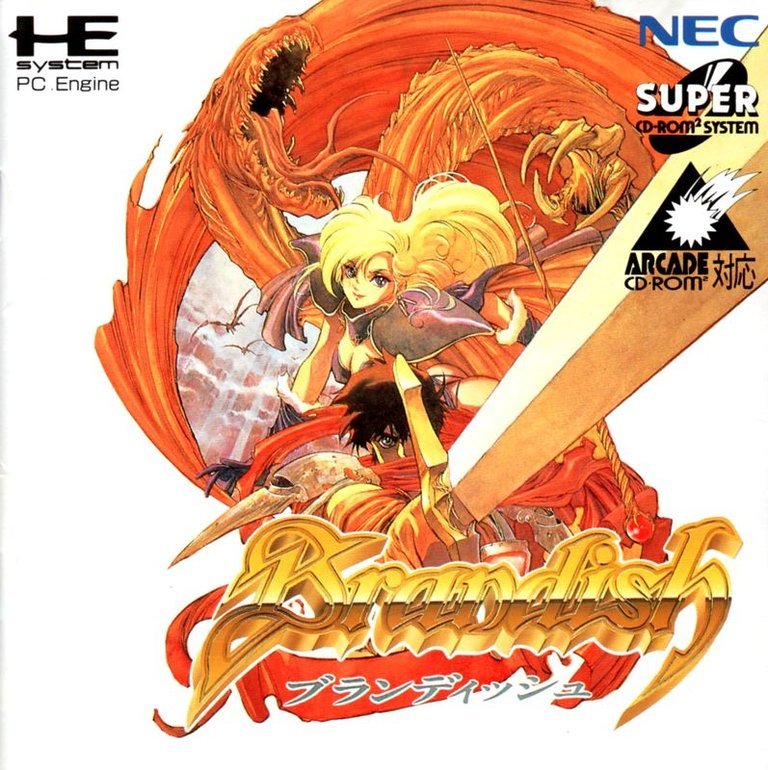
Brandish is an action RPG dungeon crawler set in a fantasy world. Players control Varik, a traveler accused of murder who falls into the underground maze of a lost kingdom, cursed and sealed beneath the earth after its king was transformed into a demon. As Varik, you must navigate treacherous dungeons, battle demonic creatures, collect weapons and armor, and use magic spells to escape the wrath of your adversary and the dangers of the abyss.
Gameplay Videos
Brandish Guides & Walkthroughs
Brandish Reviews & Reception
imdb.com (80/100): This game has some of the best gaming music i have ever heard, through thousands of video game tracks.
gamesreviews2010.com (85/100): A classic action-RPG that still holds up today.
starboy91.blogspot.com : But why? What turned (and is still turning) them away?
Brandish Cheats & Codes
SNES
| Code | Effect |
|---|---|
| L + R | Restores energy during gameplay. |
| Up, Down, Left, Right, X, B, Y, A | Enables a sound test on the title screen. |
| Start, L + R, Start | Refills health while the game is paused. |
| 1NJ2 6P1X J7YX JJYM | Views the game’s ending (password). |
| L + R, Start | Instant Game Over. |
Brandish: Review
Introduction
In the pantheon of 1990s Japanese computer RPGs, Brandish stands as a defiant, disorienting masterpiece—a dungeon crawler that dared to defy convention with its rotating camera and punishingly atmospheric design. Developed by Nihon Falcom, the studio behind Ys and The Legend of Heroes, Brandish first emerged in 1991 for NEC PC-98 and FM Towns, later haunting the Super Nintendo Entertainment System in 1995 as the series’ sole Western release. Its legacy is one of cult adoration in Japan and divisive curiosity abroad, a game that challenges players to navigate a cursed labyrinth not by sight alone, but by spatial intuition and relentless perseverance. This review argues that Brandish is more than a niche relic; it is a pioneering work that fused innovative mechanics with a dark, cyclical narrative, leaving an indelible mark on the action RPG genre despite its initial Western obscurity.
Development History & Context
Brandish emerged from Nihon Falcom’s ambitious PC-98 era, a period of transition from 8-bit to 16-bit computing. Directed by Yoshio Kiya—who conceived it as a mouse-driven action RPG before a bitter conflict with Falcom president Masayuki Kato (who insisted on a PC-88 port) led to his temporary departure—the project was rescued by programmer Yukio Takahashi. This clash underscored the era’s technological tensions: Kiya’s vision relied on the PC-98’s superior memory and mouse support, insisting a title without such features would be “not much fun.” Kato’s eventual capitulation allowed the game to launch on October 25, 1991, for PC-98 and FM Towns, leveraging hardware that supported real-time rotation and tile-based movement.
The game’s release coincided with the zenith of Japanese PC dungeon crawlers, such as Dragon Slayer and Sorcerian, but Brandish distinguished itself through its camera mechanic. Ports followed: NEC’s 1994 PC Engine CD-ROM² version added CD-quality audio and voice acting, while Koei’s SNES localization (1994 Japan, 1995 North America) adapted controls for the d-pad—simplifying rotation but sacrificing fluidity. The SNES version infamously censored Dela’s attire to comply with Nintendo of America’s policies and altered plot details, reflecting the era’s localization challenges. A 1995 PC-98 “Renewal” edition refined mechanics, and the 2009 PSP remake, Brandish: The Dark Revenant, modernized the experience with 3D graphics. These iterations highlight Falcom’s commitment to refining a concept born from technological constraints, transforming a PC curiosity into a genre touchstone.
Narrative & Thematic Deep Dive
Brandish’s narrative is a tapestry of hubris and redemption, rooted in the mythic fall of the kingdom of Vittoria (Berimya in the SNES localization). Centuries prior, King Bistalle (Berebus) sought the dragon’s “Essence of Power” atop the kingdom’s tower. His greed backfired: the dragon’s curse transformed him into a grotesque demon and sank Vittoria beneath the earth, a fate echoing themes of unchecked ambition and divine retribution.
The modern story begins with Ares Toraernos (localized as Varik), a wandering swordsman framed for the murder of sorcerer Balcan (Balkan). Pursued by Balcan’s apprentice, the vengeful Dela Delon (Alexis), their confrontation collapses the earth, trapping both in the ruins of Vittoria. Here, Ares must descend through five hellish zones (Ruins, Tower, Cave, Dark Zone, Fortress), battling demons and navigating traps to escape. Dela’s role evolves from antagonist to reluctant ally; her fate—whether Ares aids her or not—alters the ending, underscoring themes of redemption and moral ambiguity.
The dialogue is sparse but potent, conveyed through anime cutscenes and environmental storytelling. Dela’s repeated pursuit (“ALEXIS!!!!!!!!!!!!!!!!!!” as one player lamented) embodies obsession, while Ares’ silent stoicism highlights his burden as a cursed wanderer. The narrative’s cyclical nature—kingdoms rising and falling, vengeance chaining generations—echoes the game’s rotating camera, forcing players to confront recurring dangers. As Falcom’s Brandish Storybook novelization expanded, the saga became a meditation on fate: can one escape the “wheel of ruin,” or is redemption a fleeting illusion?
Gameplay Mechanics & Systems
Brandish’s core innovation is its rotating camera: the player character faces upward while the entire dungeon rotates 90 degrees with each turn, creating a pseudo-3D disorientation that maps onto real-world navigation. This mechanic, born from PC-98 mouse controls, transforms exploration into a spatial puzzle. Movement is grid-based, with momentum-based strafing and a jump function to evade traps or gaps. Combat is real-time but tactical—enemies counterattack on every strike, demanding hit-and-run tactics over button-mashing. Weapons break (swords degrade with use), and inventory is strictly limited, forcing resourceful management. Magic scrolls (fire, ice) consume MP, replenished via risky “rest” functions (leaving players vulnerable).
Key Systems:
– Stats: Arm Strength (melee damage), Knowledge (magic potency), and Magic Endurance (spell resistance) improve through action—fists boost strength, taking magic damage enhances endurance.
– Puzzles & Traps: Hidden walls (detected by sledgehammers), pits (revealed by steel balls), and switches requiring precise timing. The “magnifying glass” (shoulder buttons in SNES) is critical for hazard detection.
– Progression: Keys unlock doors, stairs descend floors, and hidden shops (e.g., in Dark Zone) offer upgrades. The SNES version’s automap, while static, aids navigation.
– Dela Mode (Dark Revenant): An alternate campaign as Dela, shorter (10 hours) and harder, with new dungeons. She uses magic instead of melee, emphasizing evasion.
These systems create a high-stakes dance of survival. As one critic noted, Brandish is “not for everyone,” but its “punishing difficulty” yields profound satisfaction when mastered.
World-Building, Art & Sound
Brandish’s world is a claustrophobic masterpiece of environmental storytelling. The ruins of Vittoria are divided into five zones, each with distinct aesthetics: the crumbling Ruins evoke decay, the Tower’s blue bricks suggest ancient grandeur, the Cave’s water puzzles hint at life, the Dark Zone’s oppressive shadows breed dread, and the Fortress’s organic walls foreshadow the final boss. This vertical descent—from surface to abyss—mirrors the narrative’s themes of damnation.
Art Evolution:
– PC-98/FM Towns: Detailed sprites and atmospheric lighting; Nobuteru Yuuki’s cover art (featuring Dela) became iconic.
– SNES: Simplified graphics, censored Dela (armor replacing her revealing attire), and cramped UI.
– Dark Revenant: 3D models with dynamic lighting, character art by Jun Suemi, and environmental depth that smooths the rotation’s disorientation.
Sound design, composed by Falcom Sound Team J.D.K. (Tenmon, Mieko Ishikawa), is atmospheric yet divisive. The SNES version’s music—area-specific themes like the haunting “Ruins” or the epic “Fortress”—was praised for mood but criticized as repetitive. Critically, the 1994 opening theme was replaced in Western releases due to similarities to Rodrigo’s “Concierto de Aranjuez,” a subtle nod to the game’s tension between homage and innovation. Sound effects are minimal (GamePro lamented “practically nonexistent” audio), emphasizing the dungeon’s oppressive silence. Together, art and sound forge a world where every step feels perilous, every corner a potential trap.
Reception & Legacy
Upon release, Brandish was a cult hit in Japan, praised for its innovation and atmosphere. The SNES port garnered mixed Western reviews: GamePro awarded it 4.5/5 for “funfactor” but criticized sound and automap usability; RPGFan scored it 75%, calling it “confusing” but compelling. German magazine Video Games lamented the SNES version’s “enttäuschend” (disappointing) downgrade from PC originals, citing weaker enemy AI.
The 2009 Dark Revenant remake, however, redeemed the series in the West. It holds an 81% Metacritic average, with Destructoid (8/10) and Hardcore Gamer (4.5/5) praising its “smooth” rotation and “definitive” presentation. Kurt Kalata of Hardcore Gaming 101 hailed it as the series’ best iteration.
Legacy:
– Sequels & Spin-offs: Three direct sequels followed in Japan (Brandish 2: The Planet Buster, 1993; Brandish 3: Spirit of Balcan, 1994; Brandish VT/4, 1996), expanding lore but never localized. Dela cameoed in Ys vs. Trails in the Sky (2010) and Dead or Alive 5 Last Round.
– Influence: The rotating camera inspired later dungeon crawlers like Wizardry and Etrian Odyssey. Preservation efforts—fan translations of Brandish 2 (2009), emulation, and the 2025 Nintendo Switch Renewal port—sustain its cult following.
– Cultural Impact: Speedrunning communities celebrate its “No Major Glitches” categories, while debates persist: is it a punishing masterpiece or a dated relic? Its reputation endures as a “hardcore” benchmark.
Conclusion
Brandish is a flawed, unforgettable artifact—a game that turns its limitations into strengths. Its rotating camera, born from PC-98 constraints, remains a brilliant innovation, forcing players to confront space and time in ways few games dared. The narrative’s cyclical themes of ruin and redemption, paired with brutal yet fair gameplay, create an experience that is both alien and deeply immersive. While the SNES version’s Western release was divisive—crippled by censorship and control quirks—the Dark Revenant remake affirms its brilliance.
In the annals of video game history, Brandish occupies a unique niche: it is a dungeon crawler that prioritizes atmosphere over accessibility, and challenge over hand-holding. It influenced generations of developers and preserved Falcom’s legacy as a studio unafraid to experiment. For players willing to embrace its disorientation, Brandish offers not just a game, but a journey—a descent into darkness that culminates in one of the medium’s most cathartic escapes. Its place is secure: a cult classic, a genre pioneer, and a testament to the power of bold design.