
- Release Year: 1986
- Platforms: Amstrad CPC, Antstream, Arcade, Commodore 64, NES, Nintendo Switch, Windows, ZX Spectrum
- Publisher: 612 Games, Data East Corporation, Data East USA, Inc., Flying Tiger Entertainment, Inc., Golem Entertainment, U.S. Gold Ltd., Ziggurat Interactive, Inc.
- Developer: Data East Corporation
- Genre: Action, Driving, Racing
- Perspective: Diagonal-down
- Game Mode: Single-player
- Gameplay: Arcade, Automobile, Shooter, Vehicular
- Setting: Airfield, Bridge, City, mountains, Plains
- Average Score: 60/100
Description
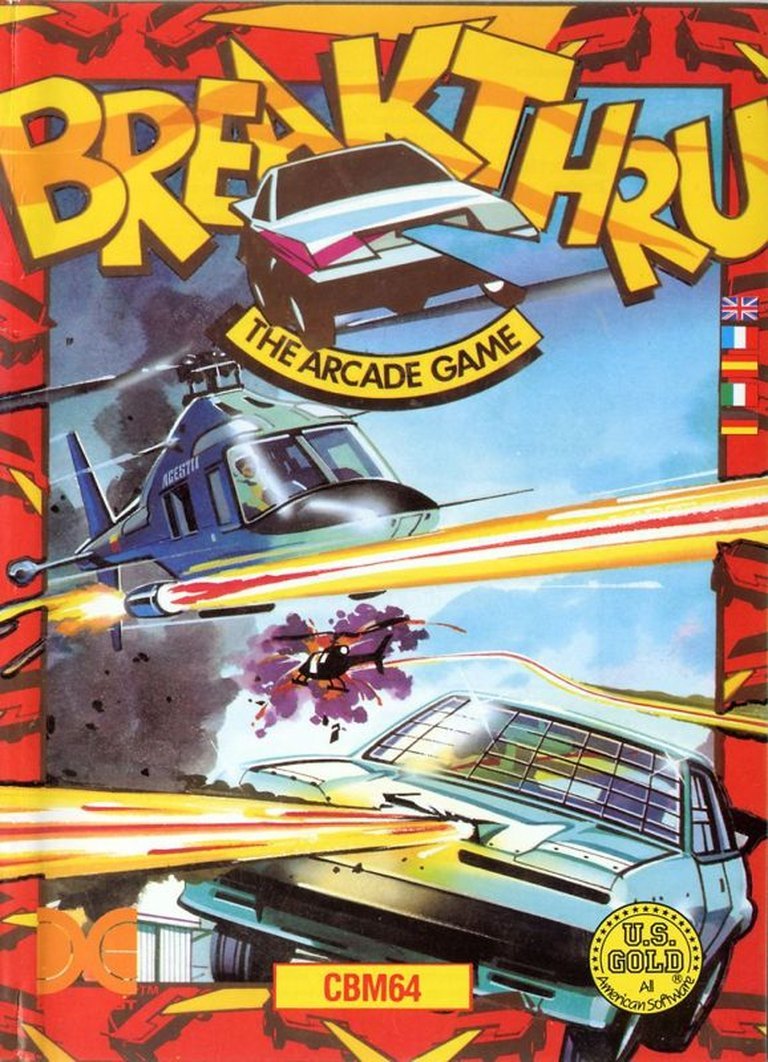
BreakThru is a 2D side-scrolling vehicle shooter where players race, jump, and blast their way through five levels—mountains, bridge, plains, city, and airfield—to recapture a stolen jet fighter while facing enemy soldiers, mines, vehicles, aircraft, rocket attacks, and falling rocks.
Gameplay Videos
BreakThru Free Download
BreakThru Guides & Walkthroughs
BreakThru Reviews & Reception
metacritic.com (40/100): Break Thru’s frustrating gameplay and awkward jumping mechanic make for one irritating retro formula that simply isn’t all that fun.
hardcoregaming101.net : BreakThru is one of many mid-80s Data East games that fell through the cracks and was quickly forgotten. It’s a fun game, but it’s also easy to see why it wouldn’t leave a lasting impression.
imdb.com (80/100): Overall, it’s a solid vintage game, though this is the kind of game I mainly would recommend to anyone that loves hard retro games and wants a challenge, this game is worth a test drive.
gamesreviews2010.com : Released in 1986, BreakThru is a 2D side-scrolling vehicle shooter that captivated arcade enthusiasts with its thrilling gameplay, intense action, and futuristic visuals.
BreakThru Cheats & Codes
NES
Enter codes using a Game Genie or Action Replay device.
| Code | Effect |
|---|---|
| GZUKYPVG | Infinite lives for both players |
| GZKSLZVG | Freeze weapon timer |
| PEUKPZLA | Player 1 start with 1 life |
| PEKGGZLA | Player 2 start with 1 life |
| TEUKPZLA | Player 1 start with 6 lives |
| TEKGGZLA | Player 2 start with 6 lives |
| PEUKPZLE | Player 1 start with 9 lives |
| PEKGGZLE | Player 2 start with 9 lives |
| ZANKLZPA | Start game on level 2 |
| LANKLZPA | Start game on level 3 |
| GANKLZPA | Start game on level 4 |
| IANKLZPA | Start game on level 5 |
| LTUKTLAA | Start each life with 3-way firing and 99 seconds |
| SXKVTZSA | Invincibility |
| 00B2:03 | Infinite Lives |
| SLUKYPVK | Infinite Lives |
| 003D:00 | Ghost Mode |
| 00B2:09 | Infinite Lives P1 |
| PTNILXKP | Jump To Fly |
BreakThru: Review
Introduction
In the golden age of arcades, when neon lights and quarter-fed machines defined pop culture, BreakThru (1986) emerged from Data East as a vehicular shooter that promised high-octane action but ultimately faded into obscurity. A 2D side-scrolling odyssey where players piloted a dune buggy to recapture a stolen jet fighter through five enemy strongholds, it embodied the era’s penchant for arcade-to-home conversions. Yet, while contemporaries like Commando or Bump ‘n’ Jump achieved legendary status, BreakThru languished as a footnote—a technically competent but conceptually constrained product of its time. This review dissects its legacy through development, narrative, gameplay, artistry, and reception, arguing that despite its flaws, BreakThru remains a vital artifact of mid-80s gaming, bridging mechanical innovation with the limitations of rushed porting.
Development History & Context
BreakThru was developed by Data East Corporation, a Japanese powerhouse riding the wave of arcade hits like Kung-Fu Master (1984). Released in arcades in 1986, it swiftly underwent home conversions via U.S. Gold Ltd., targeting the Commodore 64, ZX Spectrum, Amstrad CPC, and NES (1987). The vision was simple: create a “side-scrolling vehicle shooter” emphasizing speed, jumping, and destruction. However, development occurred amid intense technological constraints. The arcade hardware rendered tiny sprites against scrolling backdrops, forcing compromises in visual detail. This was the era of the “quarter-muncher,” where arcade games prioritized immediate, repeatable engagement over narrative depth—a pressure evident in BreakThru’s truncated design.
The home ports revealed the era’s conversion challenges. The ZX Spectrum and Amstrad CPC versions, credited to programmer Paul Houbart and artist Dawn Drake (a prolific Ocean Software designer), showcased Drake’s talent for detailed backgrounds but suffered from crippling bugs. The Spectrum’s infamous “jump glitch” allowed players to skip the entire game unharmed by holding the jump button—a flaw stemming from rushed QA. Data East’s confidence in the title was questionable; the NES box back prioritized name-dropping classics (Kung-Fu Master, Karate Champ) over hyping BreakThru itself. Meanwhile, the gaming landscape was saturated: 1986 saw arcade giants like Out Run and Twin Cobra dominate, while home systems grappled with inconsistent port quality. BreakThru’s legacy as a “bridge” between Data East’s earlier Bump ‘n’ Jump (1983) and the unreleased Mad Motor (a Mitchell-developed prototype) underscores its transitional, yet ultimately unpolished, place in history.
Narrative & Thematic Deep Dive
BreakThru’s narrative is a stark, Cold War-infused vignette: a secret jet fighter (PK430) is stolen, and players command a futuristic dune buggy to infiltrate five enemy zones (Mountains, Bridge, Prairie, City, Airfield) and reclaim it. This premise, functional yet threadbare, avoids character names, dialogue, or cutscenes beyond a perfunctory ending where the player abandons the buggy to pilot the jet. The narrative serves purely as a scaffold for action, mirroring the era’s trend where gameplay trumped storytelling.
The themes are equally minimalist: military escalation, technological supremacy, and lone-wolf heroism. The buggy symbolizes Western ingenuity against faceless, numerically superior enemies (soldiers, tanks, helicopters). Each level represents a tactical escalation—mountain passes test agility, cities demand urban navigation, airfields culminate in aerial combat. Yet the ending is jarringly abrupt. After clearing the final level, the hero sprints to the jet and flies away, rendering the buggy’s earlier triumphs anticlimactic. As Hardcore Gaming 101 notes, this raises a logical paradox: if the jet was so critical, why did a single buggy dismantle an entire army? This inconsistency reflects rushed development, prioritizing arcade thrills over narrative cohesion. Ultimately, BreakThru’s story is a relic—a utilitarian framework for vehicular mayhem rather than a compelling tale.
Gameplay Mechanics & Systems
BreakThru’s core loop is a diabolical fusion of speed, precision, and trial-and-error. Players navigate a horizontally scrolling dune buggy, dynamically adjusting screen-scrolling speed (left to slow, right to accelerate) to dodge obstacles and land jumps. This mechanic, innovative for 1986, added strategic depth: higher speed enabled longer jumps but risked overwhelming screen clutter. The buggy could leap over chasms, land on weaker enemies (a nod to Bump ‘n’ Jump), and wield a cannon augmented by rare three-way power-ups. Five levels, each with distinct hazards (e.g., falling rocks, drill tanks), tested reflexes and memorization.
Combat, however, devolved into repetition. Enemy diversity was superficial—jeeps, helicopters, and soldiers with identical behaviors—rendering early encounters as engaging as late ones. Collision detection was notoriously unreliable, especially in the arcade’s diagonal-down view, leading to cheap deaths. The NES port mitigated this with adjusted enemy placement, but computer versions like the Spectrum retained the buggy’s flaw. Progression was punitive: checkpoints allowed continuation but offered no upgrades, forcing players to master levels through sheer persistence. The Spectrum’s jump glitch epitomized the era’s QA failures, enabling players to bypass challenge entirely. While the speed-adjusting jumps were a highlight, the gameplay’s lack of depth—coupled with a steep difficulty curve—limited its longevity. It was a system of elegant mechanics trapped in a loop of diminishing returns.
World-Building, Art & Sound
BreakThru’s world-building is a masterclass in functional minimalism. The five levels, though geographically distinct (snow-capped mountains, steel bridges, urban sprawls), lacked lore or environmental storytelling. Environments were arenas for combat, not immersive locales. Yet, the art direction varied by platform. Dawn Drake’s Spectrum and Amstrad CPC backgrounds, praised for their detail, elevated the game beyond its arcade counterparts. These versions traded the arcade’s frantic pace for atmospheric vistas, proving that limited hardware could evoke mood. The NES, meanwhile, offered crisp, colorful sprites but bland backdrops.
Sound design followed a similar trajectory. The arcade version’s pulsating, level-specific soundtracks were infectious, with crisp effects for engine roars and explosions. Home ports, however, faltered; Spectrum’s beeper audio and NES’s chiptune renditions stripped away the arcade’s intensity. The overall aesthetic leaned into 80s militarism: gritty, utilitarian, and devoid of personality. This consistency reinforced the game’s identity as a “pure action” title, but its visual and audio peaks were fleeting. In an era defined by sprite-heavy extravagance, BreakThru’s artistry was competent yet forgettable—a testament to Data East’s efficiency over ambition.
Reception & Legacy
BreakThru’s reception at launch was a study in contrasts. The arcade version found modest success but was quickly overshadowed by flashier titles. Home ports polarized audiences: the NES earned an 80% from Top Secret for its solid controls but was lambasted by Ultimate Nintendo (40%) for “dullness.” The Spectrum divided critics—Sinclair User praised its addictive ease (80%), while Computer Gamer deemed it too difficult (45%). The Amstrad and Commodore 64 versions were eviscerated; Amtix! awarded the Amstrad port a 5%, calling it an “April Fool joke,” and Zzap! deemed the C64 version a “waste of time.” The recurring critique? Unfinished feel, buggy mechanics, and a failure to capture arcade magic.
Over time, BreakThru’s legacy faded into retro obscurity. MobyGames’ 36% critic score and 2.5/5 player rating reflect its lukewarm standing. It never spawned sequels or inspired major franchises, yet its influence lingers in subtle ways. As Hardcore Gaming 101 notes, its speed-jumping mechanics bridged Bump ‘n’ Jump and unreleased titles like Mad Motor, hinting at Data East’s experimental ethos. Modern re-releases on Switch and Windows (e.g., Retro Classix) preserved it as a niche curiosity, but these did little to resurrect its reputation. The game endures as a cautionary tale: a technically sound concept undone by rushed ports and a lack of innovation, serving as a benchmark for the challenges of arcade conversions in the 80s.
Conclusion
BreakThru is a time capsule of mid-80s gaming ambition and compromise. Its dynamic speed-jumping mechanics were a brilliant spark in an era defined by repetitive gameplay, yet it was extinguished by shallow combat, technical flaws, and narrative apathy. The arcade version delivered competent arcade thrills, but home ports—especially on computers—exposed the era’s QA failures. Its legacy is not one of greatness but of context: a title that exemplified the arcade-to-home conversion trend’s potential and pitfalls. For historians, it offers a window into Data East’s creative process and the pressures of a saturated market. For players, it remains a challenging, if frustrating, relic—a “break-through” in name only. In the pantheon of 8-bit classics, BreakThru is neither masterpiece nor misfire. It is simply BreakThru: a forgotten skirmish in gaming’s endless war, remembered only by those who fought the battles.