
- Release Year: 2007
- Platforms: Macintosh, Windows
- Publisher: Idigicon Limited, Selectsoft Publishing
- Developer: Britannica Games
- Genre: Strategy, Tactics
- Perspective: Top-down
- Game Mode: Single-player
- Gameplay: Game show, quiz, trivia
Description
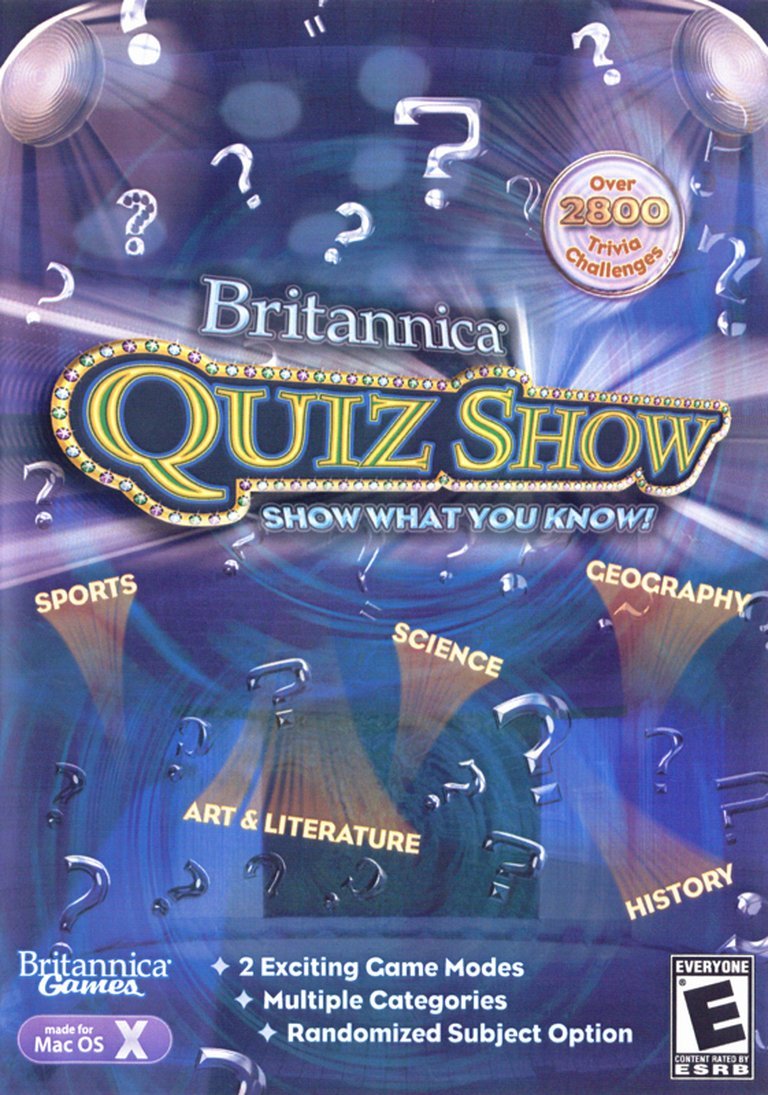
Britannica Quiz Show is an educational quiz game developed by Britannica Games and released in 2007. The game offers two modes: a timed mode where players race against the clock to answer questions, and a relaxed mode with no time constraints. It features over 2,800 multiple-choice questions across various categories including geography, art & literature, sports, science, history, and a miscellaneous category called ‘kaleidoscope’. Players can choose specific categories or answer questions from all fields, making it a versatile and engaging learning tool.
Britannica Quiz Show Free Download
Britannica Quiz Show: Review
Introduction
In 2007, amidst a watershed year for video games dominated by titans like BioShock, Halo 3, and Assassin’s Creed, a quieter contender emerged: Britannica Quiz Show. Developed by Britannica Games and published by Idigicon Limited and Selectsoft Publishing, this trivia title sought to leverage the storied authority of the Encyclopædia Britannica to deliver a cerebral, knowledge-driven experience. Yet, in an era defined by blockbuster narratives and technological leaps, Britannica Quiz Show carved its niche as a straightforward, no-frills homage to the quiz show genre. This review unpacks its legacy, interrogates its design, and asks: Does it stand as a forgotten gem of edutainment, or a relic of a bygone era?
Development History & Context
Britannica Quiz Show was born from the intersection of two industries: video games and educational publishing. In 2007, the gaming landscape was dominated by AAA franchises and the rise of online multiplayer, but casual and educational titles thrived in parallel. Britannica Games, a division of the 239-year-old encyclopedia publisher, aimed to translate its repository of knowledge into interactive formats. The studio’s vision was clear—create a quiz game that embodied the Britannica brand’s reputation for rigor and accessibility.
Technologically, the game was constrained by its target audience. Designed for Windows and Macintosh, it avoided the graphical demands of contemporaries, opting instead for simplicity. With modest system requirements (a Pentium III processor and 64MB RAM), it prioritized accessibility over spectacle. This approach aligned with its educational intent, ensuring it could run on school computers and family PCs alike.
The mid-2000s saw a resurgence of trivia games, fueled by TV shows like Who Wants to Be a Millionaire? and Jeopardy!. Britannica Quiz Show tapped into this trend but lacked the licensing firepower of its peers. Instead, it relied on the Britannica name—a double-edged sword that lent credibility but also pigeonholed it as a “serious” product in a market increasingly embracing humor and innovation.
Narrative & Thematic Deep Dive
As a trivia game, Britannica Quiz Show lacks a traditional narrative, but its thematic core is rooted in the pursuit of knowledge. The game positions players as contestants in a virtual quiz show, evoking the mid-century Golden Age of television with its no-nonsense presentation. Questions span six categories: Geography, Art & Literature, Sports, Science, History, and Kaleidoscope (a catch-all for eclectic facts).
The absence of characters or storyline is deliberate, focusing attention on the trivia itself. Each question is a micro-narrative—a brief glimpse into a historical event, scientific principle, or cultural artifact. For instance, a query about the Treaty of Versailles isn’t just a test of memory but an invitation to reflect on 20th-century geopolitics. This design echoes the Britannica ethos: knowledge as an end in itself.
However, the game’s tone lacks the whimsy of contemporaries like You Don’t Know Jack. Its dialogue-free structure and straightforward delivery may feel sterile to players seeking personality. Thematic cohesion relies solely on the Britannica brand’s gravitas—a choice that risks alienating casual audiences.
Gameplay Mechanics & Systems
At its core, Britannica Quiz Show is a multiple-choice quiz engine with two modes:
1. Timed Mode: Players answer questions rapidly, earning bonus points for speed.
2. Relaxed Mode: No time limit, ideal for leisurely play or classroom use.
The game’s 2,800 questions provide breadth, though depth varies. Science and history questions skew toward foundational knowledge (e.g., “Who invented the telephone?”), while Kaleidoscope offers quirky outliers (e.g., “What is the world’s largest species of butterfly?”). The randomization algorithm ensures replayability, but the lack of difficulty scaling means experts and novices face the same challenges.
UI/UX: The interface is functional but dated. Menus are text-heavy, resembling early-2000s edutainment software. The absence of visual flourishes—no virtual host, no animated transitions—underscores its utilitarian design. For some, this austerity reinforces its educational mission; for others, it feels lifeless.
Innovations & Flaws: The game’s standout feature is its Britannica-backed authenticity. Unlike crowd-sourced trivia games, its questions are vetted for accuracy—a boon for educators. However, the lack of multiplayer, online leaderboards, or progressive difficulty curves feels like a missed opportunity. Compared to Buzz! Quiz TV (2008), which embraced party-game chaos, Britannica Quiz Show is a solitary, meditative experience.
World-Building, Art & Sound
Britannica Quiz Show’s aesthetic is best described as “corporate minimalism.” Static backgrounds and a muted color palette evoke a boardroom more than a gameshow stage. The art direction leans on Britannica’s traditional branding—stately, authoritative, but visually uninspired.
Sound design is equally restrained. A looping elevator-music soundtrack accompanies gameplay, punctuated by sparse sound effects for correct/incorrect answers. There’s no voice acting, no audience cheers—just the quiet click of a mouse. This austerity may appeal to purists but robs the game of kinetic energy.
Reception & Legacy
At launch, Britannica Quiz Show garnered little critical attention. It was neither reviled nor celebrated, existing in the shadow of 2007’s blockbusters. Commercial performance is unrecorded, but its niche appeal likely limited sales. Over time, it has become a footnote—a curiosity for retro gaming enthusiasts or Britannica completists.
Yet, its legacy lies in its fidelity to education. In an era of “fake news,” its rigorously fact-checked questions feel almost radical. While it didn’t influence the industry directly, it presaged the rise of trivia apps like QuizUp (2013), proving that knowledge-based gaming endures.
Conclusion
Britannica Quiz Show is a paradoxical creation: a game that embodies its source material’s strengths and weaknesses. It is meticulous, authoritative, and unapologetically high-minded—but also dry, repetitive, and devoid of modern flair. For trivia purists and educators, it remains a worthwhile time capsule. For the broader gaming world, it’s a relic of an era when “educational” and “entertaining” rarely coexisted.
Final Verdict: Britannica Quiz Show is not essential gaming history, but it is a fascinating artifact—a digital echo of the encyclopedia’s transition into the 21st century. Its place in video game history is minor, yet its commitment to knowledge as gameplay deserves a quiet nod of respect.