
- Release Year: 2006
- Platforms: Windows
- Publisher: S.A.D. Software Vertriebs- und Produktions GmbH
- Developer: NEULAND MULTIMEDIA GmbH
- Genre: Action
- Perspective: Diagonal-down
- Game Mode: Single-player
- Gameplay: Animal killing, Escape, Keyboard control, Stealth
- Setting: Austria, Borderland, Germany
- Average Score: 24/100
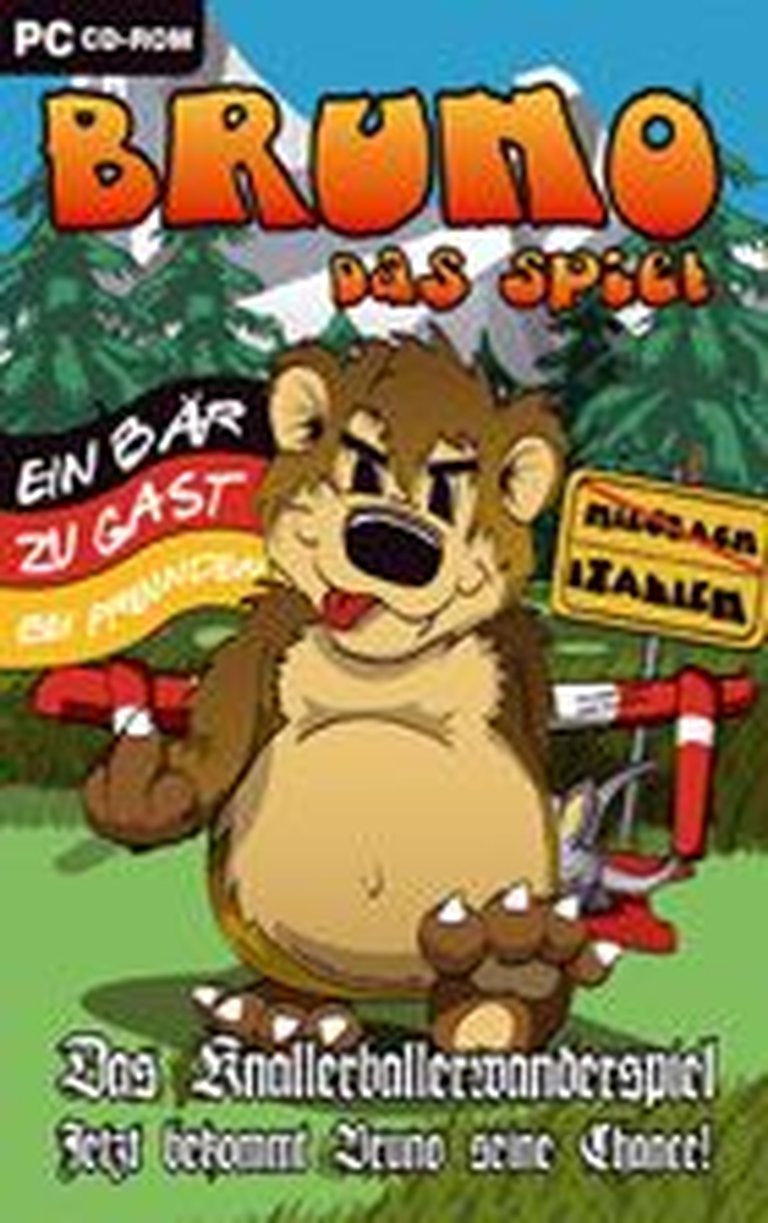
Description
Bruno: Das Spiel is a 2006 action game based on the real-life story of Bruno, a wild bear that became a media sensation after wandering from Italy to the German/Austrian border. Players control Bruno across twelve top-down levels, tasked with killing specific animals (like chickens or bee hives) before escaping to Austria while evading hunters. Bruno uses his intimidating presence to scare hunters, but must distract their dogs by laying dung—a tactical ability with a cooldown period. The keyboard-controlled game blends dark humor with arcade-style survival, offering a satirical take on the controversial real-world events surrounding Bruno’s fate.
Bruno: Das Spiel Mods
Bruno: Das Spiel: A Satirical Flop Lost in the Woods of Mediocrity
Introduction
In the summer of 2006, Germany mourned the death of Bruno, a brown bear whose journey from Italy to Bavaria became a bizarre media spectacle. Capitalizing on the public’s morbid fascination with the bear’s tragic fate, Bruno: Das Spiel emerged as a satirical action game that aimed to rewrite history—letting players guide Bruno to freedom. But what could have been a poignant commentary on humanity’s fraught relationship with nature instead became a clunky, forgettable oddity. This review argues that Bruno: Das Spiel is a fascinating cultural artifact marred by poor execution, offering a cautionary tale about rushed game development and the pitfalls of chasing zeitgeist-driven relevancy.
Development History & Context
Studio & Vision
Developed by NEULAND MULTIMEDIA GmbH and published by S.A.D. Software, Bruno: Das Spiel was a clear cash-in on the bear’s sensationalized story. NEULAND, a small German studio with limited prior credits (like Sataan: Das Spiel), positioned the game as a “Knallerballerwanderspiel” (“explosive ramble-wander-game”), blending dark humor with arcade action. The team’s vision was satirical: to critique the media circus and bureaucratic incompetence surrounding Bruno’s death while transforming the bear into a folk hero.
Technological Constraints
Released in 2006 for Windows, the game’s rudimentary 2D graphics and keyboard-only controls reflected its low budget. Built for systems as weak as a Pentium III with 128MB RAM, it prioritized accessibility over polish. The diagonal-down perspective, common in early 2000s budget titles, clashed with contemporaries like Diablo II or Grand Theft Auto: San Andreas, highlighting its technical limitations.
Gaming Landscape
The mid-2000s saw a surge in satirical games (Destroy All Humans!, Postal 2), but Bruno: Das Spiel lacked their ambition. It arrived alongside German “Das Spiel” branded titles (Tell: Das Spiel zum Film), a trend of hastily produced media tie-ins. NEULAND’s attempt to merge topical satire with arcade action fell flat in an era dominated by immersive 3D worlds.
Narrative & Thematic Deep Dive
Plot & Characters
The game’s premise mirrors reality: Bruno, nicknamed JJ1, escapes Italy and rampages through Bavaria, hunted by authorities. Players guide him through 12 levels, completing tasks like devouring livestock and evading hunters. The narrative reframes Bruno as a rebellious antihero—a “Schinderbruno” or “Störtebär” (a pun on “Störtebeker,” a Germanic pirate legend)—seeking asylum in Austria.
Themes & Satire
Bruno: Das Spiel skewers media sensationalism and bureaucratic absurdity. The hunters embody incompetent authorities, while Finnish dog handlers (a nod to real-life tracking efforts) add xenophobic undertones. The game’s tagline—“Bruno’s Revenge”—positions the bear as a symbol of resistance against human encroachment, but its humor relies heavily on slapstick (e.g., scaring mountain bikers, defecating to distract dogs).
Dialogue & Tone
While the game includes Bavarian and Finnish voice acting, dialogue is minimal. Bruno communicates through growls and roars, reinforcing his role as a lone warrior. The campy tone clashes with the tragedy of the real Bruno’s death, undermining its potential as meaningful satire.
Gameplay Mechanics & Systems
Core Loop
Each level tasks players with:
1. Killing a set number of animals (sheep, chickens, beehives).
2. Evading hunters and dogs.
3. Escaping to the Austrian border.
Bruno’s abilities include:
– Roar: Scares hunters (ineffective against dogs).
– Defecation: Distracts dogs but has a cooldown.
– Stealth: Poorly implemented, with erratic enemy AI.
Flaws & Frustrations
– Repetitive Objectives: Levels lack variety, relying on the same fetch-and-kill tasks.
– Clunky Controls: Keyboard-only input feels dated, with no mouse support.
– Unbalanced Difficulty: Hunters oscillate between hyper-aware and oblivious, while dogs respawn endlessly.
– No Progression: Bruno gains no upgrades, making later levels tedious.
UI & Presentation
The interface is barebones, with a minimal HUD showing objectives and a cooldown meter for Bruno’s abilities. Menus feel rushed, reflecting the game’s overall lack of polish.
World-Building, Art & Sound
Visual Design
Critics panned the game’s “ugly 2D landscapes” (GameStar). Environments—forests, rivers, villages—are drab and repetitive, with low-resolution sprites and jarring color palettes. Bruno’s character model is comically stiff, undermining any emotional resonance.
Atmosphere
Despite its grim premise, the game opts for cartoonish absurdity. Bavarian architecture and alpine backdrops are poorly realized, failing to evoke a tangible sense of place.
Sound Design
The lone bright spot is the punk soundtrack, Der letzte Robin Hood by KIM (“Kind im Magen?”). Its rebellious lyrics (“The last Robin Hood, shot like a stray dog”) add unintended pathos, contrasting sharply with the game’s slapstick tone. Sound effects—growls, gunshots, barks—are serviceable but forgettable.
Reception & Legacy
Launch Reception
Bruno: Das Spiel bombed critically and commercially:
– GameStar Germany: 24/100, calling it “unchallenging” and “boring.”
– Player Reviews: Averaged 1.3/5, with complaints about broken mechanics.
Cultural Impact
The game briefly gained notoriety as a morbid curiosity, bolstered by its tie-in website (brunos-rache.de—”Bruno’s Revenge”) and merchandise. However, it faded quickly, overshadowed by more competent satirical games.
Industry Influence
NEULAND’s follow-ups (Eisbär! Das PC-Spiel) fared no better, cementing the studio’s reputation for cheap tie-ins. Bruno: Das Spiel remains a footnote in gaming history—a cautionary tale about exploiting tragedy for profit.
Conclusion
Bruno: Das Spiel is a fascinating failure. Its premise—a satirical reimagining of a national trauma—had potential, but rushed development, technical ineptitude, and tonal inconsistency doomed it. While the punk soundtrack and audacious concept hint at deeper ambitions, the game ultimately serves as a time capsule of mid-2000s German pop culture rather than a meaningful critique. For historians, it’s a curious relic; for players, it’s a tedious slog. In the pantheon of video game oddities, Bruno’s virtual escape attempt is memorable only for how spectacularly it misses the mark.
Final Verdict: Bruno: Das Spiel is not a good game, but it’s an instructive one—a reminder that even the most topical satire needs heart, humor, and competent design to resonate.