
- Release Year: 2019
- Platforms: Nintendo Switch, PlayStation 4, Windows
- Publisher: Atari Interactive, Inc., Billion Soft (Hong Kong) Limited, UFO Interactive Games, Inc.
- Developer: Choice Provisions Inc.
- Genre: Action, Auto-run platformer
- Perspective: Side view
- Game Mode: Single-player
- Gameplay: Auto-scroll, Double jump, Flying, Gliding, Item collection, Pouncing, Shooting, Sliding
- Setting: Fantasy
- Average Score: 61/100
Description
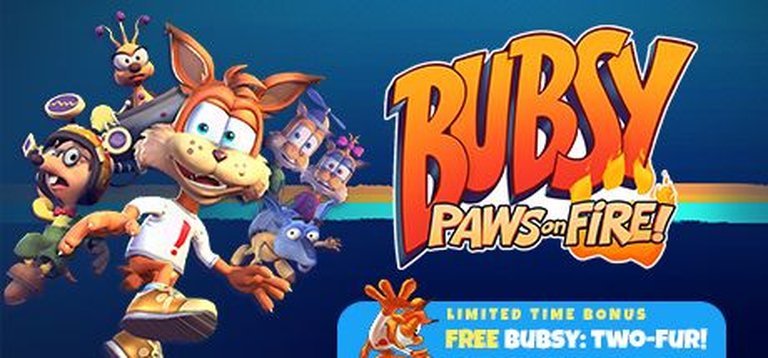
During the 14th Annual Yarn Ball, Oinker P. Hamm captures animals across the galaxy for his zoo, prompting Bubsy and his allies—including Arnold, Virgil, and a woolie soldier—to embark on a mission to stop him. This auto-scrolling platformer features stages with three levels and bonus rounds, where players use timed moves to dodge traps, attack enemies, and collect items, with each character offering unique abilities like Bubsy’s pouncing and gliding.
Gameplay Videos
Where to Buy Bubsy: Paws on Fire!
PC
Bubsy: Paws on Fire! Patches & Updates
Bubsy: Paws on Fire! Mods
Bubsy: Paws on Fire! Guides & Walkthroughs
Bubsy: Paws on Fire! Reviews & Reception
metacritic.com (63/100): Anyone with any nostalgia for this despicable bobcat should find enjoyment here, even if in only short bursts.
opencritic.com (59/100): it isn’t brilliant by any means… but it’s not bad either, and comfortably ranks in the upper echelons of the bobcat’s back catalogue.
nintendolife.com : it isn’t brilliant by any means… but it’s not bad either, and comfortably ranks in the upper echelons of the bobcat’s back catalogue.
destructoid.com : The gameplay gets very samey, very quickly, leading to lethargy due to repetitiveness.
Bubsy: Paws on Fire!: Review
Introduction
Few characters in video game history embody the paradox of ironic revival quite like Bubsy the Bobcat. Once a mascot hopeful pitched as the next Sonic or Mario, Bubsy instead became a cautionary tale of 90s mascot fatigue, defined by clunky controls, grating dialogue, and infamously poor design choices—notably the universally reviled Bubsy 3D. Fast forward to 2019, and Bubsy: Paws on Fire! arrives as the franchise’s sixth entry, developed by Choice Provisions—the studio behind the acclaimed BIT.TRIP RUNNER series. While it undeniably stands as the best Bubsy game by critical consensus, this distinction is less a testament to excellence and more a reflection of the franchise’s historically low bar. Paws on Fire! is a competent, polished auto-runner that temporarily sheds the series’ most toxic traits, yet it remains hampered by repetitive design, technical quirks, and a fundamental struggle to escape its own legacy. This review dissects its place in Bubsy’s tumultuous history, examining its successes, flaws, and the peculiar challenge of reviving a mascot defined by failure.
Development History & Context
Paws on Fire! emerged from an unlikely collaboration between Atari’s dormant Accolade brand and Choice Provisions, a studio revered for its rhythm-platforming expertise. Directors Mike Roush and Alex Neuse, alongside producer Dant Rambo, spearheaded a project initially conceived as a return to Bubsy’s 2D roots. However, early debates—sparked by the character’s mixed legacy—led to a pivotal shift: the team abandoned traditional platforming in favor of an auto-runner structure, directly inspired by Choice Provisions’ own BIT.TRIP RUNNER 3. This pivot, while controversial, proved savvy; it leveraged the studio’s strengths while sidestepping Bubsy’s historically unwieldy movement controls.
Development was not without hurdles. Character assets were recycled from older games and the infamous Bubsy cartoon pilot, forcing a complete rework to align with the new vision. The game’s launch timeline saw multiple delays, shifting from a March 2019 release to May 16 for PC and PlayStation 4, with the Nintendo Switch version following on August 29. Funding for the project was bolstered by a Kickstarter campaign that raised $25,000, culminating in a limited-edition Switch release bundled with an audio CD of Stemage’s chiptune soundtrack. Technically, the game operated on Unity, a choice that enabled multi-platform support but also introduced performance inconsistencies across hardware. The era of its release—2019—marked a surge in 2D revivals (e.g., Cuphead, Hollow Knight), making Paws on Fire! feel both timely and anachronistic, clinging to a mascot whose relevance had long faded.
Narrative & Thematic Deep Dive
The plot of Paws on Fire! is a self-aware, if threadbare, pastiche of Bubsy’s lore. It opens during the “14th Annual Yarn Ball,” a celebration disrupted by the return of Oinker P. Hamm—the greedy capitalist pig from Bubsy II—who plans to capture animals for his intergalactic zoo, the “Amazootorium.” Bubsy, warned by the Woolie queens Poly and Ester, allies with his nephew Terry, niece Terri, scientist Virgil Reality, and Arnold the Armadillo to thwart Oinker. The narrative leans hard on franchise callbacks: Virgil originates from Bubsy’s aborted cartoon pilot, while Arnold and Oinker are legacy villains. The dialogue, once Bubsy’s Achilles’ heel, is deliberately restrained. Quips are sparse and contextual—e.g., one-liners per level upon death—spared the relentless, fourth-wall-breaking chatter that plagued earlier entries. This restraint is a masterstroke; Bubsy’s sass remains charming without becoming grating.
Thematically, the game explores redemption and alliance. Bubsy, traditionally a lone hero, must collaborate with former enemies (the Woolies), symbolizing a fragile truce against a greater evil. Oinker’s zoo-centric greed serves as a satirical jab at corporate exploitation, while Bubsy’s initial self-preservation (“fearing mostly for himself”) evolves into reluctant heroism. The narrative’s brevity—confined to two cutscenes and level intros—avoids overexposure, yet its simplicity underscores the game’s identity as a vehicle for gameplay rather than storytelling. Still, the inclusion of obscure characters like Virgil (a vole in a high-tech helmet) and references to the failed cartoon pilot (“Oblivia was here” graffiti) signals a deep reverence for franchise history, even as it lampoons it.
Gameplay Mechanics & Systems
At its core, Paws on Fire! is an auto-runner where forward movement is automatic, and player input focuses on timed actions to overcome obstacles. This structure, inherited from BIT.TRIP RUNNER, streamlines Bubsy’s notoriously finicky controls but introduces new mechanics through four playable characters:
- Bubsy: The titular bobcat wields a glide (holding jump), pounce (air dash), and ground pound. His levels emphasize precision, requiring split-second decisions to dodge spikes, bounce off enemies, or collect yarn balls.
- Virgil Reality: The scientist vole offers a double jump, slide, and ground pound to activate bounce pads. His playstyle mirrors Commander Video from BIT.TRIP, prioritizing verticality and momentum.
- Woolie Soldier: Piloting a UFO, the Woolie engages in shmup-style gameplay, firing projectiles to clear hazards. Her controls feel floaty and less engaging, often reduced to avoiding obstacles while collecting golden yarn balls.
- Arnold the Armadillo: Unlocked only after collecting three medal fragments per level (one per character), Arnold stages are 3D tunnel runs where he rolls forward, collecting crystals while avoiding “fart bags” and glue. These sections lack challenge and suffer from unresponsive controls.
The progression system is the game’s most controversial element. To unlock new worlds, players must earn victory tokens, obtained by replaying each level as all three core characters (Bubsy, Virgil, Woolie). This artificial padding inflates the game’s length—27 core stages across three worlds (Village, Research Lab, Amazootorium)—but drains momentum. Each character’s variant of a level introduces minor tweaks (e.g., Woolie replaces a spike pit with airborne enemies), yet the repetition becomes wearying. Boss battles (three total, including Oinker) break the monotony but feel underdeveloped, with two forcing Bubsy into the Woolie’s UFO for shmup segments.
Collectibles—yarn balls (Bubsy), atoms (Virgil), golden yarn balls (Woolie), and crystals (Arnold)—serve dual purposes: they fuel a combo system for leaderboards and currency for costumes. The costume shop, run by Terry and Terri, offers cosmetic customizations (e.g., Bubsy in a tuxedo), though small character models diminish visual impact. Critically, the game abandons Bubsy’s history of one-hit deaths, introducing infinite lives and checkpoints. This accessibility lowers frustration but also eliminates tension, making failure feel inconsequential.
World-Building, Art & Sound
Paws on Fire!’s world-building is functional yet visually inconsistent. The three worlds—vibrant rural villages, sterile labs, and the chaotic Amazootorium—serve as backdrops for platforming rather than immersive environments. While character models are expressive (Bubsy’s smirks, Virgil’s lab gear) and animate fluidly, backgrounds are repetitive and sparse. The Village’s cotton fields and the Research Lab’s machinery offer thematic cohesion but lack the detail to distinguish individual stages. This 2.5D aesthetic, reminiscent of Bubsy: The Woolies Strike Back, is polished but unremarkable, prioritizing clarity over spectacle.
The sound design, however, is a standout achievement. Stemage’s 32-bit chiptune soundtrack blends electronic, rock, and synthwave, with each track dynamically adapting to the current character. For example, a stage’s music shifts when replayed as Bubsy, Virgil, or the Woolie, with distinct intros, variations, and outros—a technical feat that combats repetition. Voice acting, once a franchise weak point, is notably improved. Bubsy’s quips are measured, and newcomers like Virgil (nerdy, enthusiastic) and the Woolie (grudgingly cooperative) add personality without overshadowing the protagonist. Sound effects—yarn ball jingles, explosion booms—are crisp and rhythmic, synchronizing with the game’s tempo to reinforce its auto-runner identity.
Performance issues mar the experience. On Switch, frame rate dips and long load times (up to 30 seconds) disrupt flow, while jaggies plague the TV mode. These technical hiccups are particularly jarring given the game’s simple visuals, underscoring the limitations of Unity optimization.
Reception & Legacy
Upon release, Paws on Fire! received mixed-to-average reviews. Aggregators placed its Metascore at 63% (PlayStation 4), with critics polarized by its strengths and flaws. Positive reviews, like ZTGameDomain’s (80%) and GamingTrend’s (80%), lauded it as Bubsy’s “first truly great outing,” praising the tight rhythm-based controls and the franchise’s best iteration of humor. Destructoid (50%) acknowledged its “fun visuals and music” but criticized its “repetitive gameplay and hollow world.” At the other end, Push Square (20%) deemed it “frustrating beyond belief,” while TechRaptor (25%) excoriated its “messed up hitboxes” and padding. Player reviews on platforms like MobyGames averaged 3.4/5, with some praising accessibility and others dismissing it as a BIT.TRIP RUNNER reskin.
Commercially, the game performed modestly, buoyed by curiosity around Bubsy’s revival and Choice Provisions’ credibility. Its legacy is defined by mediocrity. It remains the highest-rated Bubsy title but failed to resurrect the series commercially or culturally. The game’s—dare we say—competence highlighted the franchise’s potential while exposing its inherent limitations. By 2026, Bubsy 4D is already announced, suggesting the cycle of ironic revivals continues. Critics and players alike agree: Paws on Fire! is the best Bubsy game, but that’s a low bar indeed. It serves as a footnote in the annals of 90s mascots, a game that tried to elevate a legacy but was ultimately dragged down by it.
Conclusion
Bubsy: Paws on Fire! is a curate’s egg: undeniably flawed yet unexpectedly compelling. As the best installment in a historically maligned series, it succeeds by excising Bubsy’s most toxic traits—relentless chatter, punishing design—while leveraging Choice Provisions’ expertise to create a polished auto-runner. Stemage’s rhythmic soundtrack, character-specific mechanics, and restrained humor provide fleeting moments of joy, yet the game is sabotaged by its own design. The forced replayability of token progression, the Woolie’s underwhelming shmup levels, and Arnold’s frustrating bonus stages turn novelty into tedium. Technical woes on Switch further muddy the experience.
Ultimately, Paws on Fire! is a paradox: a well-crafted game that cannot escape its own baggage. It proves Bubsy can be fun in short bursts but never transcends the irony of his existence. For series loyalists, it’s a must-play—finally, a Bubsy game that doesn’t actively hurt to experience. For newcomers, it’s a competent, if forgettable, auto-runner best approached on sale. In the pantheon of revivals, it stands as a lesson: even the most polished execution cannot wholly redeem a icon built on failure. Bubsy may have paws on fire, but for once, the flames aren’t consuming him. They’re just smoldering.
Verdict: A passable, if unremarkable, entry that earns the title of “Best Bubsy Game” by default. Recommended only for series completionists or masochists nostalgic for 90s mascot fatigue.