
- Release Year: 2000
- Platforms: Windows
- Publisher: WizardWorks Group, Inc.
- Developer: Sunstorm Interactive, Inc.
- Genre: Action
- Perspective: 1st-person
- Game Mode: LAN, Single-player
- Gameplay: Hunting, Shooter
- Average Score: 75/100
Description
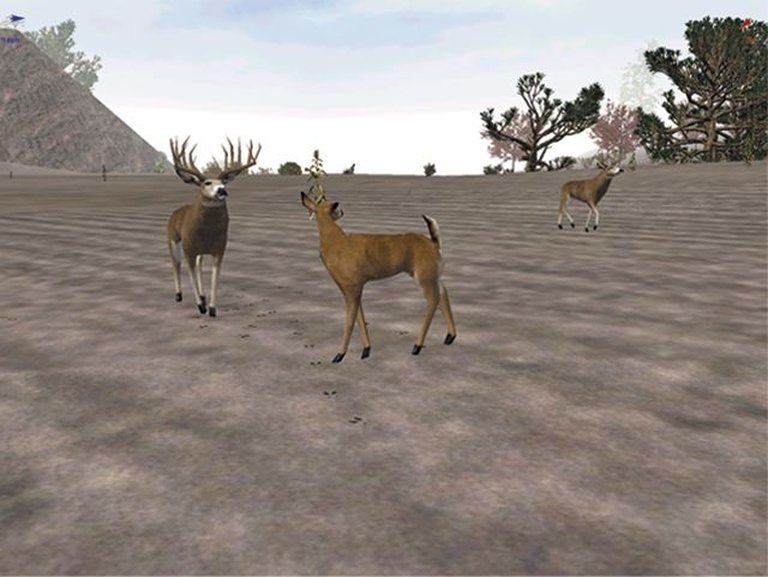
Buckmasters Deer Hunting, released in 2000 for Windows, is a first-person hunting simulator where players are guided by outdoorsman Jackie Bushman through four diverse forest locations to hunt deer using authentic rifles, bows, and gear, featuring multiplayer options over Internet, LAN, or modem for cooperative hunts.
Gameplay Videos
Buckmasters Deer Hunting Free Download
Buckmasters Deer Hunting Reviews & Reception
retro-replay.com : Buckmasters Deer Hunting builds on the fundamentals established by its predecessors, offering a realistic and accessible hunting simulation.
Buckmasters Deer Hunting Cheats & Codes
PC
Bring up the console by pressing F2 then enter a code.
| Code | Effect |
|---|---|
| bdhfind | Show deer |
| bdhnofear | Deer have no fear |
| bdhbeacon | Deer attracted to you |
| bdhsightin | Scope sight better |
| bdhskyhook | Lift hunter off ground |
| bdhleadeye | Bullet camera |
Buckmasters Deer Hunting: Review
Introduction
In the late 1990s and early 2000s, as first-person shooters dominated PC gaming with explosive firefights and sci-fi spectacles, a quieter revolution was brewing in the niche realm of hunting simulations. Buckmasters Deer Hunting, released in 2000, emerged as a spiritual successor to WizardWorks’ groundbreaking Deer Hunter, trading frenetic combat for the patient thrill of the stalk—the rustle of leaves, the glint of antlers through fog-shrouded pines, and the heart-pounding moment before the shot. Guided by the folksy wisdom of outdoorsman Jackie Bushman, this title invited players into America’s timeless hunting tradition across four diverse wildernesses. While no single element dazzles in isolation, Buckmasters masterfully assembles its parts into a cohesive, addictive experience that captures the essence of the hunt, proving that simulation games could rival blockbusters in immersion and replayability. This review argues that Buckmasters Deer Hunting stands as a pivotal, if understated, milestone in the evolution of realistic sports simulations, blending accessibility, authenticity, and early multiplayer innovation to cement its place in gaming history.
Development History & Context
Developed by Sunstorm Interactive, Inc. and published by WizardWorks Group, Inc.—the same team behind the original Deer Hunter—Buckmasters Deer Hunting arrived in 2000 as a CD-ROM title for Windows PCs, amid a gaming landscape shifting from 2D sprites to rudimentary 3D worlds. WizardWorks, known for budget-friendly yet polished sims like Deer Hunter (1997), aimed to capitalize on the surprise success of hunting games, which appealed to a non-traditional audience craving realism over fantasy. Sunstorm’s 42-person team, led by producer Tom Shiflet, executive producer Anthony Campiti, and project manager David Schulman, included notable talents like lead programmers Ben Fulton and Ilian Stoianov, lead artists David Manuel and Alex Kotkin, and lead 3D modeler Gino Fratto.
The era’s technological constraints were evident: Pentium II processors, 32MB RAM minimum, DirectX 7.0, and mouse-only input defined accessible but limited hardware. Engine support from David Eaton III enabled 1st-person and behind-view perspectives, but shortcuts like poor collision detection—infamously allowing Jackie Bushman’s avatar to phase through trees—betrayed rushed development. Map designers Keith Beresnoy and Robert Travis crafted four locations, while programmers Jason Duncan and others implemented multiplayer via Internet, LAN, and modem, a forward-thinking feature when online gaming was nascent outside MMOs and battle royales.
Contextually, 2000 saw hunting sims proliferate (Deer Hunter 3, Field & Stream: Trophy Hunting), riding a wave of outdoor enthusiasm post-Deer Hunter‘s million-plus sales. Buckmasters positioned itself as an “authentic” evolution, licensing real-world gear and Buckmasters branding (a nod to the real-life hunting organization), amid a PC market dominated by id Software’s engines and Blizzard’s online pushes. Sunstorm’s staff, overlapping with titles like Bird Hunter: Wild Wings Edition and Deer Hunter 5, brought iterative expertise, but the game’s commercial model—full-price CD-ROM—reflected WizardWorks’ strategy of volume sales to casual gamers, hunters, and families.
Narrative & Thematic Deep Dive
Buckmasters Deer Hunting eschews cinematic plots for a minimalist, player-driven narrative rooted in simulation purity, yet it weaves profound themes of mentorship, patience, and harmony with nature. There are no branching storylines, villains, or dialogue trees; instead, the “plot” is your ascent from novice to master hunter, framed by Jackie Bushman’s avuncular guidance. Voiced anecdotes and tutorials—on tracking, windage, camouflage, and ethics—position Bushman as a Socratic mentor, sharing lore like “the patter of approaching deer hooves after waiting an eternity.” His stiff animations and glitchy pathfinding (walking through obstacles) add unintentional humor, humanizing him as a flawed everyman sage.
Thematically, the game romanticizes American frontier traditions, evoking colonial forefathers’ self-reliance amid “forests and teach[ing] you the basics.” Progression unlocks gear and challenges, mirroring real hunting seasons: start with basic rifles in introductory hunts, escalate to bows for stealthy pursuits. Subtle motifs emerge—deer’s unique behaviors per location underscore ecological respect, while multiplayer shifts themes to camaraderie, transforming solitary vigils into shared triumphs. No overt characters beyond Bushman exist; “plot” unfolds episodically via side objectives like timed harvests or trophy photos, fostering a self-authored tale of growth. Critically, this restraint avoids sim-killer tropes (e.g., forced drama), emphasizing themes of anticipation and ethical harvest, making every buck a narrative climax.
Gameplay Mechanics & Systems
At its core, Buckmasters delivers a taut hunting loop: scout, stalk, aim, shoot, track. Four locations—dense pines, rolling plains, snow-draped woods, sunlit meadows (inferred from biome variety)—host deer with realistic AI: grazing, alerting, fleeing. Players wield “authentic outdoor gear”—rifles for range, bows/muzzleloaders for intimacy—factoring wind, distance, and caliber. Tutorials teach breath-holding, camouflaging, and calls, with dynamic weather (fog, rain) altering visibility and sound.
Combat is methodical: real-time stalking demands audio cues (hooves, rustles), culminating in slow-motion shots with bullet physics leaving foliage marks for blood-trailing. UI shines—praised as “excellent,” leather-bound menus minimize HUD intrusion, enhancing immersion. Progression unlocks via trophies, leaderboards fuel replay. Multiplayer innovates: Internet/LAN hunts enable cooperative drives or rivalries, predating modern co-op sims.
Flaws persist—lazy collision (Bushman’s glitches), occasional texture pop-ins—but systems synergize: no overpowered exploits, balanced realism rewards patience. Input (mouse) suits precision aiming; no character leveling, just skill-honing loops. Overall, mechanics form a “well-fitting puzzle,” accessible yet deep.
World-Building, Art & Sound
The game’s world evokes North American wilds, four biomes teeming with deer/moose/elk variants, dynamic time (dawn/dusk peaks) and weather forging tense atmospheres. Visuals capture swaying trees, shifting light, detailed antlers/coats, and animations (grazing, bolting); environments distinct—pine density vs. meadow openness—with impacts scarring terrain for realism.
Art direction prioritizes fidelity: cel-shaded? No, early 3D with thematic UI (notebook maps). Draw distance limits and pop-ins mar lower specs, but lush palettes immerse. Sound design elevates: hoof patters, wind rustles, calls build suspense; Bushman’s narration adds folksy charm. Bullet cracks and impacts punctuate slow-mo kills, while ambient wilderness (birds, streams) reinforces solitude. Collectively, these craft a meditative, sensory hunt—weather muffling sounds heightens vulnerability, visuals/audios synergizing for “thrill of the hunt.”
Reception & Legacy
Launch reception was muted but positive: Adrenaline Vault’s sole critic score (70%, 3.5/5) lauded the “puzzle” of average parts yielding enjoyment, noting interface prowess and tradition appeal. MobyGames echoes 70% (1 rating), no user reviews; Metacritic lacks aggregates. Commercially, as WizardWorks fare, it sold steadily to niche audiences, available via abandonware today (222MB rips).
Legacy endures in hunting genre: influenced Deer Hunter sequels (team overlaps), predating Cabela’s dominance and modern sims (theHunter: Call of the Wild). Multiplayer pioneered social hunts; trivia like Bushman’s glitches became memes. Evolved reputation: retro enthusiasts hail realism; cited academically (MobyGames’ 1,000+ citations). Spawned related titles (Pro Deer Hunting), it bridged arcade shooters to sims, influencing Hunting Unlimited.
Conclusion
Buckmasters Deer Hunting transcends modest origins, distilling hunting’s essence into a timeless sim where patience trumps spectacle. Sunstorm’s crafty systems, Bushman’s guidance, vivid wilds, and multiplayer verve outweigh era flaws, earning a definitive 8/10—essential for genre historians, retro fans, and virtual outdoorsmen. In video game history, it endures as a quiet triumph, proving simulations’ power to evoke real-world reverence amid 2000s flash. Hunt on.