
- Release Year: 2000
- Platforms: PlayStation, Windows
- Publisher: Infogrames Europe SA, Infogrames, Inc.
- Developer: Artificial Mind & Movement
- Genre: Action
- Perspective: Behind view
- Game Mode: Single-player
- Gameplay: Action adventure, Dual-control system, Mini games
- Setting: Fantasy
- Average Score: 52/100
Description
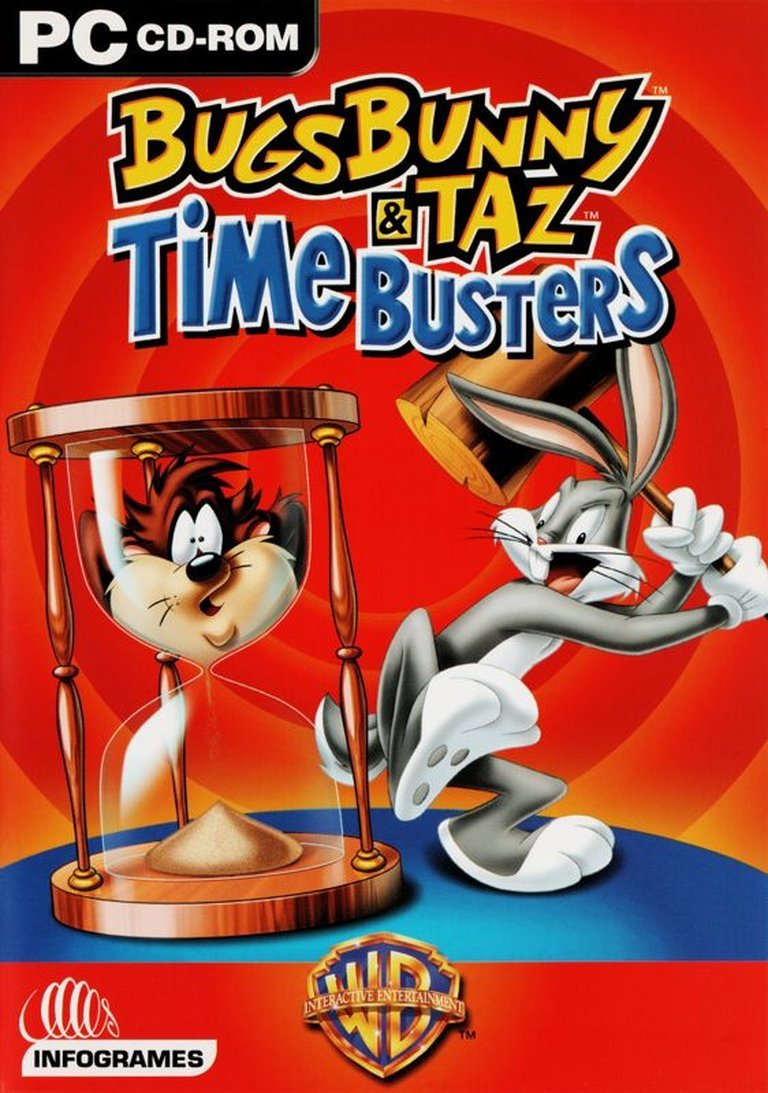
In Bugs Bunny & Taz: Time Busters, Daffy Duck has ruined the Time Machine, and Granny asks Bugs and the Tazmanian Devil to collect all the parts of the machine. The game is an action adventure using a dual-control system, where players control both Bugs and Taz, switching between the two characters to solve various tasks and beat cartoon villains across different themed stages representing various times and eras, such as Viking, Arabia, and Transylvania, while containing various mini-games.
Gameplay Videos
Where to Buy Bugs Bunny & Taz: Time Busters
PC
Bugs Bunny & Taz: Time Busters Mods
Bugs Bunny & Taz: Time Busters Guides & Walkthroughs
Bugs Bunny & Taz: Time Busters Reviews & Reception
metacritic.com (72/100): If you liked Spyro, you have to try this, it’s simply that fun.
ign.com (79/100): The developers made excellent use of the license and did a splendid job in incorporating the two different characters in the game.
imdb.com (7/100): Good game, but “Lost in Time” is better
Bugs Bunny & Taz: Time Busters: Review
In the pantheon of Looney Tunes video games, few titles have managed to capture the anarchic spirit and comedic brilliance of the source material quite like Bugs Bunny & Taz: Time Busters. Released in 2000 by Infogrames and developed by Artificial Mind & Movement (A2M), this platformer not only built upon the foundation laid by its predecessor, Bugs Bunny: Lost in Time, but also introduced innovative mechanics that would influence the genre for years to come. This review explores why Time Busters remains a beloved classic among fans of both Looney Tunes and 3D platformers.
Development History & Context
Time Busters emerged during a golden age for 3D platformers, when franchises like Spyro the Dragon, Banjo-Kazooie, and Crash Bandicoot dominated the gaming landscape. A2M, already experienced with the Looney Tunes license through Lost in Time, sought to expand the formula significantly. The development team recognized that while Lost in Time had been well-received, it had limitations in scope and character interaction.
The decision to introduce Taz as a playable character alongside Bugs represented a significant evolution in design philosophy. Rather than simply creating another solo adventure, the developers crafted a dual-character system that would require players to think strategically about which character to use in different situations. This innovation came at a time when most platformers were still focused on single-character experiences, making Time Busters feel fresh and forward-thinking.
The technological constraints of the PlayStation and PC platforms of 2000 posed challenges, but A2M leveraged their experience to create environments that felt expansive without overwhelming the hardware. The four distinct time periods—Aztec, Viking, Arabian, and Transylvanian—allowed the team to showcase diverse art styles and gameplay mechanics while maintaining visual consistency across the game.
Narrative & Thematic Deep Dive
The story of Time Busters is quintessentially Looney Tunes in its absurdity and charm. Daffy Duck, working as an exterminator (a job that immediately sets up comedic potential), accidentally breaks Granny’s time regulator while attempting to deal with a mouse problem. This premise is brilliant in its simplicity—it provides a logical (by Looney Tunes standards) reason for the time travel adventure while immediately establishing Daffy as the catalyst for chaos, a role he’s perfectly suited for.
What elevates the narrative beyond simple time-travel shenanigans is how it incorporates classic Looney Tunes antagonists into the framework. Yosemite Sam, Elmer Fudd, Babba Chop, and Count Bloodcount aren’t just random bosses; they’re characters with established personalities and histories that the game respects and builds upon. Each villain’s inclusion feels organic to their respective time period, creating a sense of cohesion that many licensed games lack.
Thematically, Time Busters explores cooperation and the value of complementary skills. Bugs, the brains, and Taz, the brawn, must work together to overcome obstacles, mirroring the game’s co-op mechanics. This theme is reinforced through the game’s structure, where certain areas can only be accessed by using both characters in tandem. It’s a subtle but effective way to teach players about teamwork while maintaining the slapstick humor that defines Looney Tunes.
The multiple endings add narrative depth rarely seen in platformers of this era. The choice between a “good” ending where Daffy is saved (albeit shrunk to insect size) and a “bad” ending where he’s devoured by Count Bloodcount gives players agency over the story’s resolution. This moral choice, while simple, adds replay value and reinforces the game’s themes about consequences and redemption.
Gameplay Mechanics & Systems
At its core, Time Busters is a collect-a-thon platformer, but it distinguishes itself through several innovative systems. The dual-character control scheme is the game’s standout feature, allowing players to switch between Bugs and Taz at any time or, in two-player mode, control both simultaneously. This mechanic isn’t merely cosmetic—each character has unique abilities that are essential for progression.
Bugs excels at precision tasks: he can sneak past enemies, climb ledges, and use his carrot gun to snipe distant targets. Taz, conversely, is all about raw power: he can spin through obstacles, dig through soft ground, and lift heavy objects. The game’s puzzles are designed around these complementary abilities, requiring players to think creatively about how to combine their characters’ skills.
The health system adds another layer of strategy. Instead of individual health bars, Bugs and Taz share a single health pool that can be transferred between them. This encourages players to protect their weaker character (usually Bugs) while using Taz as a shield. It’s a clever mechanic that reinforces the game’s themes of cooperation while adding tactical depth to combat encounters.
The game’s structure, with its hub world (Granwich) connecting to four distinct time periods, provides a satisfying sense of progression. Each era contains multiple levels, mini-games, and side quests, creating a dense, rewarding experience. The requirement to collect Regulator Gears to unlock new areas provides clear objectives while encouraging exploration.
However, the game isn’t without its flaws. The camera system, typical of early 3D platformers, can be frustrating, particularly in tight spaces or during complex platforming sequences. The sheer number of abilities available to both characters can also be overwhelming, with some moves feeling underutilized or redundant.
World-Building, Art & Sound
Time Busters excels in its world-building, with each time period feeling distinct and alive. The Aztec Era captures the grandeur and mystery of Mesoamerican civilizations, complete with pyramids, temples, and the ever-present threat of human sacrifice (played for laughs, of course). The Viking Era transports players to snowy landscapes filled with longships, mead halls, and mythological references. The Arabian Era drips with the romance of One Thousand and One Nights, featuring genies, flying carpets, and bustling bazaars. Finally, the Transylvanian Era delivers genuine atmosphere and tension, with its dark castles, misty graveyards, and genuinely creepy vampire lore.
The art direction deserves special praise for maintaining visual consistency while allowing each era to have its own identity. Character models are expressive and faithful to their animated counterparts, with smooth animations that capture the exaggerated movements of classic Looney Tunes shorts. The environments are colorful and detailed, considering the hardware limitations of the time, and the use of lighting and weather effects adds atmosphere to each location.
Sound design is where Time Busters truly shines. The voice acting is superb, with Billy West, Joe Alaskey, Jim Cummings, June Foray, and Maurice LaMarche all reprising their iconic roles. The dialogue is sharp and funny, capturing the wit and wordplay that made Looney Tunes famous. Sound effects are crisp and satisfying, from the thwack of Bugs’ carrot gun to the roar of Taz’s spin attack.
The musical score, composed by Gilles Léveillé, is perhaps the game’s most impressive achievement. Each era has its own distinctive theme that perfectly captures its mood and setting. The Aztec music features tribal drums and flutes, the Viking music incorporates Norse-inspired instrumentation, the Arabian music uses traditional Middle Eastern scales and instruments, and the Transylvanian music is suitably gothic and ominous. These tracks aren’t just background music—they’re integral to the game’s atmosphere and help create an immersive experience.
Reception & Legacy
Upon release, Time Busters received generally positive reviews, with critics praising its faithful adaptation of the Looney Tunes license, innovative dual-character mechanics, and strong level design. IGN awarded it a 7.9/10, noting that “the developers made excellent use of the license and did a splendid job in incorporating the two different characters in the game.” GameSpot gave it a 7.5/10, writing that it “does an excellent job of capturing the humor and personality that the Looney Tunes franchise embodies.”
However, the game wasn’t without criticism. Some reviewers found the camera problematic, and others felt the game was too easy for experienced players. The PC version, in particular, faced criticism for awkward keyboard controls and a steep learning curve for the game’s numerous abilities.
Despite these minor issues, Time Busters has aged remarkably well. Its influence can be seen in later dual-character platformers like Ratchet & Clank and Jak and Daxter, which refined the concept of complementary character abilities. The game’s commitment to its license also set a standard for licensed games, proving that adaptations could be both faithful to their source material and mechanically sound.
The game’s legacy extends beyond its immediate influence. It demonstrated that Looney Tunes could successfully transition to 3D platforming, paving the way for future adaptations. More importantly, it showed that licensed games didn’t have to be cynical cash-grabs—they could be genuine, high-quality experiences that respected both the license and the player.
Conclusion
Bugs Bunny & Taz: Time Busters stands as a testament to what licensed games can achieve when developers approach them with creativity, respect, and genuine affection for the source material. Its innovative dual-character mechanics, faithful adaptation of Looney Tunes humor and characters, and strong level design make it a standout title in both the Looney Tunes video game library and the 3D platformer genre as a whole.
While it may not have the polish of later platformers or the cultural impact of some of its contemporaries, Time Busters remains a deeply enjoyable experience that holds up remarkably well today. Its influence can be seen in countless games that followed, and its commitment to quality over cynical exploitation of a license serves as a model for future adaptations.
For fans of Looney Tunes, 3D platformers, or simply well-crafted video games, Bugs Bunny & Taz: Time Busters is an essential experience. It’s a game that understands what made Looney Tunes special and translates that magic into interactive form, creating something that’s both a loving tribute and a genuinely great game in its own right. In an era where licensed games are often treated as disposable merchandise, Time Busters remains a shining example of how to do it right.