
- Release Year: 2018
- Platforms: Macintosh, Windows
- Publisher: astragon Entertainment GmbH
- Genre: Compilation
Description
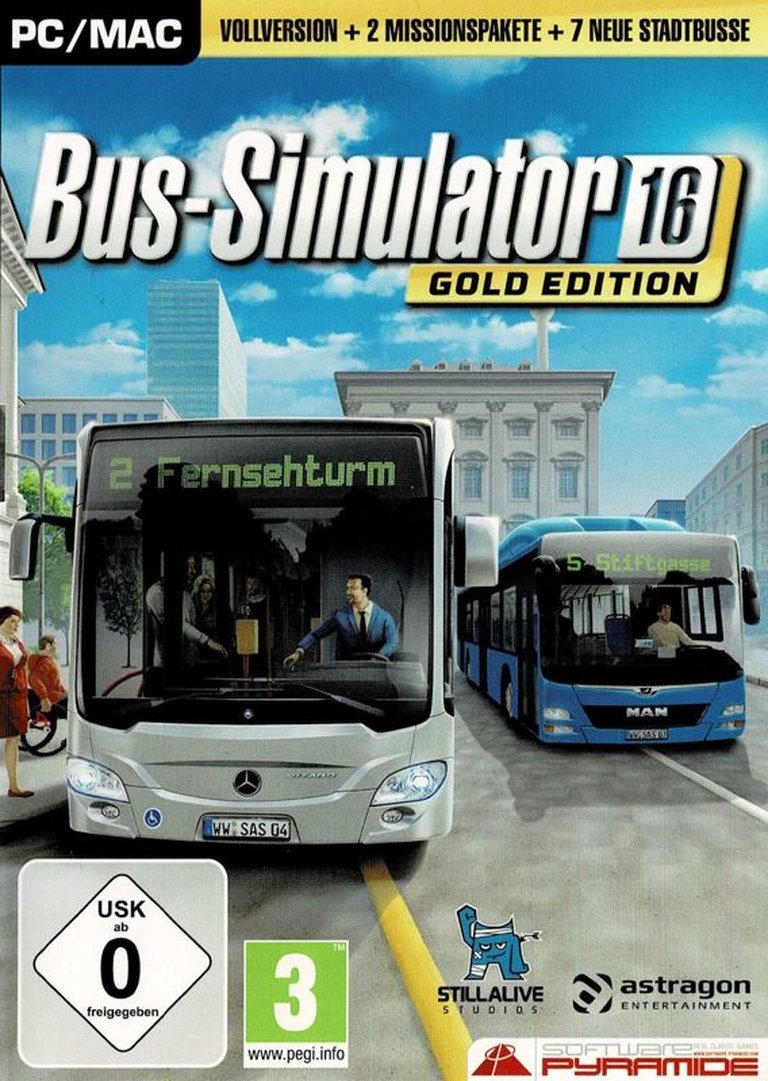
Bus Simulator 16: Gold Edition is a comprehensive compilation released in 2018 that bundles the original Bus Simulator 16 game with all its downloadable content, including DLC for MAN Lion’s City and Mercedes-Benz Citaro buses, as well as mission packs. Players immerse themselves in a realistic bus simulation set across five distinct districts of a detailed open-world city, driving licensed vehicles, managing custom bus routes via a route editor, and interacting with passengers in this Unity-powered experience.
Bus-Simulator 16: Gold Edition Reviews & Reception
gamingrespawn.com : For most people, that’s enough to turn them away but for those who are more open-minded or can appreciate a decent simulator, you’ll find a game which is easy to get into and can be a joy to play.
Bus-Simulator 16: Gold Edition: The Democratic Dictatorship of the Daily Commute
Introduction: The Unlikely Monarch of the Mundane
To the uninitiated, the concept of a “bus simulator” evokes a peculiar, almost masochistic curiosity. What could possibly be compelling about piloting a multi-ton, diesel-powered behemoth through meticulously recreated urban sprawl, all for the sake of adhering to a timetable and managing passenger fare evasion? Yet, within the fertile and oft-misunderstood soil of the vehicle simulation genre, Bus Simulator 16 and its definitive Gold Edition compilation stand not as a mere curiosity, but as a pivotal, consciously accessible landmark. It represents the moment the niche, hardcore obsession of bus driving shed its most impenetrable layers, embracing a broader audience with a compelling cocktail of corporate management, lighthearted chaos, and mod-friendly creativity. This review will argue that Bus Simulator 16: Gold Edition is a critical bifurcation point: a game that sacrificed hardcore realism for mass-market appeal, thereby securing commercial success and a vibrant community, but at the cost of the very authenticity that defines its predecessors and most dedicated followers. It is, in essence, the game that democratized the bus stop, for better and for worse.
Development History & Context: Stillalive’s First Route and the State ofSim in 2016
Bus Simulator 16 marks a significant institutional shift for the franchise. Developed by Austrian studio stillalive Studios and published by the prolific German simulation house astragon Entertainment GmbH, it was the first entry in the long-running Bus Simulator series not developed by TML Studios. This change in stewardship came at a key juncture; the series, which began with Bus Simulator 2008, had established a reputation for a certain level of European-focused realism. Stillalive’s assignment was to modernize and broaden the formula.
Technologically, the game was built in Unity, a powerful but often generic engine that facilitated cross-platform release (Windows and macOS) but imposed visual and performance constraints compared to bespoke engines. This choice prioritized accessibility and development speed over graphical prowess or deep simulation physics. The game’s development was publicly chronicled through a series of Dev Diaries, hinting at a team keen on showcasing their city, “Sunny Springs,” as a living character.
The gaming landscape of early 2016 was heady for vehicle simulators. SCS Software’s American Truck Simulator had recently revitalized the trucking genre with a perfect blend of accessibility and authenticity. Farming Simulator was a annual commercial juggernaut. Against this backdrop, Bus Simulator 16 entered a crowded field, aiming to carve its niche by focusing on the uniquely urban, passenger-centric stress of public transport. Its delay from a planned January 20th release to March 3rd, 2016, due to “technical issues,” was a minor early stumble that foreshadowed the stability questions that would plague its launch.
Narrative & Thematic Deep Dive: The Lore of the Layover
Bus Simulator 16 possesses no traditional narrative. There is no protagonist with a backstory, no overarching plot, no scripted dramatic crescendo. Its “story” is one of emergent environmental storytelling and capitalist progression. The narrative is the player’s own journey from a fledgling bus company owner to the tyrannical monarch of Sunny Springs’ public transit.
The game’s world is populated by a cast of recurring, systemic characters that form its thematic backbone:
* The Passenger: The ultimate arbiter of your success/failure. They are a symphony of complaints, requests, and silent judgment. Their collective mood—represented by the ubiquitous smiley/frowny face icon—is your primary metric. They represent the faceless, often ungrateful public, embodying themes of service industry resentment and the burden of civic duty. Their repetitive, often absurd dialogue (the man perpetually “calling in sick” being a noted example from player reviews) underscores the soul-crushing monotony and dark comedy of the daily grind.
* The City of Sunny Springs: Anode of order versus chaos. Its five districts (unlocked progressively) are not just maps but assertions of control. You begin in a sleepy suburb and systematically conquer the city center, industrial zones, and waterfront. The city’s AI traffic, construction zones, and sudden emergency vehicle sirens are manifestations of the unpredictable chaos you must navigate and, ultimately, tame through your efficient routes.
* Your Company: The silent, growing entity on your company screen. It embodies entrepreneurial expansion, optimization, and cold, monetary logic. Hiring drivers (each with skill stats), purchasing routes, and slapping advertising banners on your buses are acts of commodifying movement. The Wachowski and Tannhauser DLC missions (included in the Gold Edition) inject faint narrative scaffolding—a wealthy enthusiast and a city bureaucrat—but they are merely quest-givers, reinforcing the game’s core mechanic: the city is a puzzle of profitable routes to be solved.
The underlying theme is a simulation of petty sovereignty. You are not a hero; you are a utility. Your power is measured in reputation points, fleet size, and geographical coverage. The game subtly critiques, yet ultimately celebrates, the boring, essential bureaucracy of keeping a city moving.
Gameplay Mechanics & Systems: The Delicate Dance of the Diesel-Powered Ballet
The core gameplay loop is a brilliantly simple yet deep observe-react-manage cycle:
1. Plan: Use the route editor (a critical, flawed system) to select stops from unlocked districts. Your choices determine length, difficulty, and potential profit.
2. Prepare: Choose your bus (2-door, 3-door, or articulated), check its condition (fuel, cleanliness), and possibly add advertising.
3. Execute (Driving): Navigate Sunny Springs. This involves obeying (or cautiously ignoring) traffic laws, managing speed, judging turns for long buses, and responding to dynamic events: roadworks, protest marches, and the piercing wail of an ambulance requiring you to yield.
4. Execute (Passenger Management): At each stop, a complex sub-game begins. You must:
* Align perfectly with the curb (scored).
* Operate doors (repair if jammed).
* Sell correct tickets via the interface minigame.
* Issue change (mistakes cost you money).
* Deploy wheelchair ramps promptly.
* Respond to passenger complaints about temperature or comfort.
This layer transforms driving from a simple A-to-B task into a multitasking stress test. Your reputation and daily takings are the direct results of your performance here.
5. Manage & Repeat: Return to your depot, review financials, hire/fire drivers (assigning them to autonomous routes), purchase new routes, and customize buses. Progression is gated by reputation and money, creating a compelling short-term dopamine hit from a successful run and a long-term strategic hook in company growth.
Innovations & Flaws:
* The Cockpit Mouse Cursor: A genuinely innovative UI solution. Holding right-click brings up a mouse pointer to interact with the bus’s myriad switches, key, and controls. It elegantly avoids overwhelming the keyboard while maintaining immersion.
* The Route Planner’s Dog Leash: The most cited flaw. You select start and end stops, but the game dictates the precise path between them. You cannot manually plot a direct route or avoid specific roads. This robs the player of true strategic planning, forcing a frustrating game of “stop hopscotch” to approximate a desired route.
* AI & Traffic: Traffic is busy and generally coherent, but often unrealistically cautious or obtuse. Pedestrian AI is notoriously poor, with “rigor mortis” movement and frequent clipping issues (leading to unreachable passengers and penalties), as noted in player reviews.
* Stability & Performance: The game has a reputation for long load times and stuttering framerates, even on recommended hardware. It feels, as one review stated, “more like an Early Access title.” This technical roughness is its most persistent criticism.
World-Building, Art & Sound: The Charm of Sunny Springs
Sunny Springs is the game’s secret weapon. It is not a photorealistic masterpiece—textures are low-poly, draw distances are limited—but it possesses a cohesive, cheerful, almost toy-like aesthetic. The bright, slightly saturated colors and clean architectural design make the city feel pleasant and safe, a welcoming sandbox rather than a grim urban sprawl. This “arcadey” look performs a vital function: it masks technical limitations while contributing to a low-stress, broadly appealing atmosphere. It doesn’t look real; it looks fun.
The sound design is functional. The roars and grumbles of the diesel engines are satisfyingly chunky. The clunk of doors, the hiss of air brakes—these are adequate. Where it stumbles is in repetition and quality. Passenger voice lines are limited and often poor quality, cycling rapidly to the point of absurdity. The in-game radio music is universally derided as generic and forgettable, a missed opportunity to enhance the atmosphere.
The world feels alive because of its systemic density: pedestrians talking on phones (the same repeated lines), cyclists, other vehicles, and the dynamic construction/emergency events. It’s a living diorama, not a living city, but for the purposes of a lighthearted simulator, its charm outweighs its emptiness.
Reception & Legacy: The Bittersweet Success
Upon release, Bus Simulator 16 received “mixed or average” reviews. Its Metacritic score of 46/100 is damning from a critic’s perspective, reflecting complaints about performance, repetitive gameplay, and simplistic mechanics compared to “hardcore” rivals like OMSI 2. Publications like GameStar (45/100) were particularly harsh.
Commercially, the story was different. Its accessible design, familiar franchise name, and low system requirements (by modern standards) made it a steady seller, especially on Steam where it amassed thousands of reviews, with a “Mixed” overall verdict (63% positive from over 2,350 English reviews). The Gold Edition, released in 2018, cemented its value by bundling the base game with all DLC (additional buses from MAN and Mercedes-Benz, two mission packs) at a compelling price point.
Its legacy is complex and significant:
1. The Mainstream Bridge: It successfully brought the bus sim concept to a wider audience who might have been intimidated by OMSI’s complexity. Its management layer provided a familiar “tycoon” hook.
2. The Modding Catalyst: The game’s mod-friendly nature, explicitly advertised by the developers (supporting Blender/Gimp), fostered a vibrant, enduring modding community. Custom buses, liveries, and even city edits have extended its lifespan far beyond what the base game offered. This user-generated content is arguably its most lasting contribution.
3. The Template for Successors: The formula—accessible driving, light management, an open world, DLC buses—was refined and directly evolved into Bus Simulator 18 and, later, Bus Simulator 21, which saw significant critical improvement (Metascores of 67/100 and 73/100 respectively). BS16 was the necessary, if rough, prototype.
4. The Dividing Line: It created a schism in the niche. For many, it is the definitive casual bus sim. For purists, it is a betrayal of the genre’s depth, a “sim-lite” that prioritizes quantity of content (13 buses, 5 districts) over qualitative simulation depth (physical accuracy, detailed operational procedures).
Conclusion: A Flawed Foundation Stone
Bus Simulator 16: Gold Edition is not a great game by conventional critical metrics. It is technically uneven, mechanically simplistic in places, and narratively barren. Its core route-planning mechanic is frustratingly restrictive, and its AI is often comically bad. Yet, to dismiss it would be to ignore its profound, pragmatic success.
Its genius lies in its democratizing design philosophy. It understood that for every hardcore enthusiast craving a 1:1 dashboard experience, there were dozens of players curious about the idea of being a bus driver—the routine, the management, the quiet satisfaction of a timely, profitable route. It wrapped this curiosity in a cheerful, stable-enough package with a compelling progression loop and a toolkit for community creativity.
As a historical artifact, the Gold Edition represents the moment the Bus Simulator franchise consciously chose the path of the mainstream. It is the blueprint that funded and informed its technically superior, more respected sequels. Its place in history is secure not as a masterpiece, but as a transformative, if contentious, stepping stone. It proved that even the most mundane profession could be gamified for the masses. For that, for its robust modding scene, and for the hundreds of thousands of hours spent piloting virtual buses through Sunny Springs, Bus Simulator 16: Gold Edition earns a grudging, historical respect. It is the game that made bus driving a viable, if有时 frustrating, fantasy for everyone.