
- Release Year: 1998
- Platforms: Arcade, Dreamcast, Game Boy Color, PlayStation 3, PlayStation, PS Vita, PSP, Windows
- Publisher: Acclaim Entertainment, Inc., Agetec Europe, Ltd., Agetec, Inc., Altron Corporation, CyberFront Corporation, D3Publisher Inc., Interplay Entertainment Corp., Natsume, Inc., Sony Computer Entertainment America LLC, Taito Corporation
- Developer: Taito Corporation
- Genre: Puzzle
- Perspective: Side view
- Game Mode: Single-player
- Gameplay: Bubble shooting, Chain reaction, Pulley system, Tile matching
- Average Score: 74/100
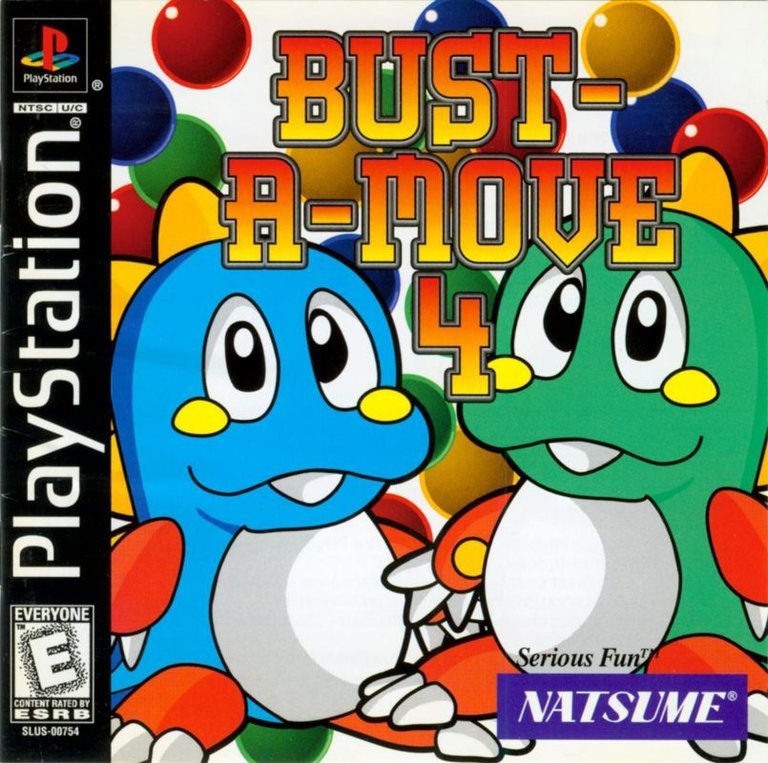
Description
Bust-A-Move 4 is a puzzle game that builds on the series’ core mechanic of shooting colored bubbles to match and clear them from the screen. It introduces new playable characters, a Story mode where players defeat CPU opponents to earn Tarot cards, and additional modes like Win Contest, Challenge, and an unlockable Edit mode for creating custom puzzles, all set in an anime-inspired world with fast-paced, real-time tile-matching gameplay.
Gameplay Videos
Bust-A-Move 4 Free Download
Bust-A-Move 4 Reviews & Reception
metacritic.com (79/100): It’s an ideal diversion for the puzzle-game fan looking for a little or a lot more action than most other puzzle games provide.
Bust-A-Move 4 Cheats & Codes
PlayStation 1
Button sequences are entered at the title screen. Action Replay codes require a cheat device like CodeBreaker or GameShark.
| Code | Effect |
|---|---|
| Triangle, Left, Right, Left, Triangle | Unlocks a new set of puzzles in Arcade mode (Another World for NTSC). |
| Square, Circle, X, Square, Circle | Unlocks a new set of puzzles in Arcade mode (Another World for PAL). |
| Left, Left, Triangle, Right, Right, Triangle, Left, Left | Unlocks bonus characters. |
| Right, Right, Triangle, Left, Left | Unlocks bonus characters or all characters. |
| Right, Right, Right, Triangle, Left, Left, Left | Unlocks hidden characters. |
| Up, Triangle, Down, Triangle, Up | Enables tarot reading mode in options. |
| Square, Up, Left, Down, Right, Up, Square, Down, Left, Up, Right, Down, Square | Enables talk demo mode in options (requires other codes). |
| L1 + L2 + R1 + R2 | Skips to the next level during gameplay. |
| 80192EFC 0080 | Always have guide. |
| 80167BC0 0000 | Elapsed time is always 0. |
| 80192F76 0007 | Player 1 always gets bubbles. |
| 80192F76 0000 | Player 1 never gets bubbles. |
| 80192E32 0007 | Player 2 always gets bubbles. |
| 80192E32 0000 | Player 2 never gets bubbles. |
| 80167A70 0101 | New tarot reading menu in options. |
| 80167A96 0001 | Ura puzzle mode (different set of games). |
| 80167A48 0001 | Talk demo in options. |
| 30167A96 0001 | More puzzles in puzzle and arcade mode. |
Game Boy
Enter codes at the main menu or via Game Shark device.
| Code | Effect |
|---|---|
| Up, Down, Left(2), Right, Up, A, B(2), A | Unlocks bonus characters. |
| A, Left, Right, Left, A | Unlocks bonus levels when ‘Push Start’ appears. |
| 01042DD5 | Infinite credits. |
Game Boy Color
Enter codes at the main menu or via Game Shark device.
| Code | Effect |
|---|---|
| Up, Down, Left(2), Right, Up, A, B(2), A | Unlocks hidden characters. |
| A, Left, Right, Left, A | Unlocks hidden levels when ‘Push Start’ appears. |
PC
Enter at the screen where it asks to press start.
| Code | Effect |
|---|---|
| Triangle, Left, Right, Left, Triangle | A little monster appears on the bottom right of the screen. |
Bust-A-Move 4: Review
Introduction: The Bubble Legacy
In the pantheon of puzzle games, few franchises have achieved the timeless, cross-generational appeal of Bust-A-Move (known as Puzzle Bobble in its native Japan). Following in the colossal shadow of Tetris, Taito’s bubble-blasting phenomenon carved its own niche by marrying frantic shooter-like dexterity with deep, strategic tile-matching. By 1998, the series had already cemented its legacy across arcades and home consoles. Bust-A-Move 4 arrives not as a revolutionary reboot, but as a definitive, content-rich iteration—a game that both refines the beloved formula and, for some, pushes it into contentious new territory. This review argues that Bust-A-Move 4 represents the zenith of the classic Puzzle Bobble aesthetic and structural design, a sprawling, mechanically deep capstone that prioritizes abundant content over radical reinvention. Its legacy is twofold: it is the final, pure expression of the series’ original vision, and the point where its iterative additions began to polarize a community fond of elegant simplicity.
Development History & Context: Taito’s Iterative Mastery
Developed by Taito Corporation, with director Kazuhiro Ohhara and base game designer Seiichi Nakakuki at the helm, Bust-A-Move 4 (JP: Puzzle Bobble 4) was released for the Taito F3 System arcade hardware in December 1997. It was the direct sequel to Bust-A-Move 3 DX and marked the series’ final appearance on the arcade, PlayStation, and, uniquely, its sole entry on the Sega Dreamcast. The development team, part of Taito’s famed Zuntata sound department (with Hisayoshi Ogura and Rimiko Horiuchi composing), operated within the technical constraints of the late ’90s. The shift to 3D-capable consoles like the Dreamcast and PlayStation presented a paradox: the core gameplay was inherently 2D, and the team’s solution was to layer ornate, anime-inspired backgrounds and character portraits behind the fixed playfield, rather than fully reimagining the graphics in 3D.
This era was a golden age for puzzle games. Tetris maintained its ubiquitous dominance, while new IPs like Puyo Puyo and Columns competed for mindshare. Taito’s strategy was one of confident iteration. The Bust-A-Move formula was a proven cash cow, and BAM4’s development philosophy, as suggested by the credits and the final product, was to expand the game’s scope dramatically—adding new mechanics, an immense number of stages, and robust suite of modes—rather than to gamble on a fundamental redesign. The result is a game that feels both comprehensive and, to some critics, creatively static, embodying the “if it ain’t broke, don’t fix it” adage while also being accused of “feature creep.”
Narrative & Thematic Deep Dive: A Cosy Cosmic Heist
The plot of Bust-A-Move 4 is a delightful piece of nonsensical lore, delivered with earnest charm. The story unfolds on the planet Bubbleluna, home to the twin dinosaurs, Bub and Bob. The core conflict arises when the Fairy of the Night, Cleon, steals the planet’s light source—the “Rainbow for Full-Moon Madame Luna”—and shatters it into seven colored light bubbles, scattering them across the galaxy. Bub and Bob (or whichever of the 16 selectable characters the player chooses) must journey to recover these bubbles and restore daylight.
This simple premise is filtered through the game’s unique “Story” and “Story Versus” modes. In the console-exclusive Story Mode, the player navigates a tarot card-themed landscape (the “Arcana”), with each card representing a cluster of stages. Completing a stage set “secures” that Arcana. The narrative justification is provided by a character named Cronoa, who explains the Arcana have “fallen into various dreams.” This dream-logic framing allows for wildly disparate stage themes (from “Grrrrmm” to “Navajo” to “Diable”) under one cohesive, mystical banner. Notably, the antagonist Madame Luna is ultimately revealed to be Dreg, the series’ recurring main villain, tying this entry into the broader Bubble Bobble universe.
The Story Versus mode offers a more traditional arcade ladder, complete with character-specific opening and ending cutscenes. Here, each playable character has their own motivation for wanting the rainbow bubbles, leading to humorous and personality-driven exchanges before each match. This mode was new to the series and added a layer of characterization previously absent. The cast is a kooky ensemble of anime-style archetypes: the vampiric dragon Develon, the totem-pole-like Monsta, the regal but sinister Madame Luna. Their exaggerated animations—Develon’s “miserable grin” upon winning, his “nervous fluttering” when losing—are a key part of the game’s identity, reinforcing a theme of playful, low-stakes competition. The narrative is not profound, but it is cohesive and whimsical, providing just enough context to make the bubble-popping feel like a grand, cute adventure.
Gameplay Mechanics & Systems: Depth Through Duality
At its core, Bust-A-Move 4’s gameplay is immediately accessible: a launcher at the bottom of the screen fires colored bubbles upward into a ceiling of clustered orbs. Connecting three of the same color causes a pop, with attached bubbles falling to potentially trigger further chains. The ever-descending ceiling creates relentless pressure. Where BAM4 diverges is in its two major, polarizing innovations: the Pulley System and Chain Reactions.
-
The Pulley System: Introduced in single-player Puzzle and Story modes, this mechanic replaces static stages with “Balance Fields.” Here, groups of bubbles hang from either end of a rope strung across two pulleys. Popping bubbles on one side makes that side “lighter,” causing it to rise, while the heavier side lowers. If either side descends past the bottom line, the player loses instantly. This transforms puzzle-solving from a purely spatial color-matching exercise into a tense balancing act. Strategy involves deliberately creating symmetrical “anchor” clusters between the two pulley groups to stabilize them, then methodically clearing from the center outward. It’s a brilliantly lateral addition that requires foresight and adds a unique, gravity-based puzzle layer not seen in any other major Puzzle Bobble title.
-
Chain Reactions: This mechanic is exclusive to player-vs-player (or player-vs-CPU) modes. When a bubble is dropped and pops a cluster, any resulting falling bubbles can, upon landing, instantly pop a separate cluster of the same color below them. This can cascade, creating a single shot that clears vast sections of the opponent’s screen. A handicap system (five damage levels) allows players to adjust the severity of the attack sent to the opponent upon a successful pop. Chain Reactions are the game’s primary dramatic swing factor—they can instantly turn a losing battle into a victory. However, as some critics noted, their semi-random nature can feel less controlled than the core shooting mechanics, leading to moments where the player feels like a spectator to their own success or failure.
Other Systems & Modes: The game’s content volume is staggering.
* Puzzle/Arcade Mode: A branching pyramid of stages (Set A to Set Z?) with an “Another World” secret set accessible via a code, effectively doubling stage count to a rumored 760 total.
* Challenge Mode: A five-level test of specific skills (speed, accuracy, endurance, pulley mastery), graded E through A, pushing expert players.
* Win Contest: An endless survival mode against progressively stronger CPU opponents, unlocking secret characters like Monsta and Packy.
* Edit Mode: Unlocked after completing Challenge, it allows creation and sharing of custom puzzles (up to 25 saved), fostering a community aspect.
* Versus Mode: The robust 1v1 competitive heart of the game, incorporating Chain Reactions and handicaps.
Criticisms of the gameplay largely centered on the perceived dilution of the original’s purity. The Gaming Hell review famously called it the “shark-jump of the series,” and Joypad lamented that the chain reaction made the player “no longer truly master of the game.” Yet, proponents like Digitally Downloaded hailed the pulley system as adding “a whole new dimension of strategy.”
World-Building, Art & Sound: A Sugary, Synesthetic Experience
The Bust-A-Move universe has always been defined by its stark, cute-yet-creepy anime aesthetic, and BAM4 is a vibrantcanvas of this style. The playfield is a simple, clean grid, but the background is a lavish, scrolling diorama unique to each world—from the candy-colored “Joyland” to the gothic spires of “Gothic.” The character designs by Miyabi are exceptionally expressive, with Bub and Bob’s simple blobs contrasting with more elaborate figures like the dancer-turned-boss Alkanet or the hulking Gigant. This “kawaii” presentation is relentless and intentionally saccharine.
The sound design, crafted by Taito’s Zuntata unit, is equally character-driven. The soundtrack is a mix of peppy, infectious J-pop melodies and more atmospheric, dreamy tunes for story stages. The true star, however, is the audio feedback: the celebratory pop of a cluster bursting, the whimsical voice clips (“Bajonga!” for Develon), and the tense, escalating music as the ceiling descends. Some Western critics (e.g., Daily Radar, Video Games DE) found this “saccharine-sweet” audio overwhelming and “irritating,” arguing it clashed with the strategic depth. For others, this sensory overload is part of the game’s addictive charm—a rewarding, multi-sensory “feel-good” hit for every successful move.
Visually, the Dreamcast and PlayStation versions were noted for being functionally identical to the arcade and prior console entries, a point of frustration for some (Fun Generation, Consoles Plus) who expected more from 128-bit hardware. However, the art’s timeless, crisp 2D sprites held up well, and the increased color palette on color-enabled systems (like the Game Boy Color) was a significant upgrade over monochrome predecessors.
Reception & Legacy: A Divisive Pillar
At launch, Bust-A-Move 4 received generally favorable reviews, but with a notable spread that hints at its divisive nature. Aggregate scores vary: Metacritic shows 79 for Dreamcast, 80 for PlayStation, but dips to 64 for Windows and 73 for Game Boy Color. The critical consensus praised its immense content (640+ levels, multiple modes, level editor) and the strategic depth of the pulley system, while simultaneously criticizing a perceived lack of innovation and, on some PC ports, poor optimization.
- Praised For: Addictive core gameplay, enormous replay value, charming presentation, the strategic innovation of the pulley system, and robust competitive modes. IGN (Dreamcast: 88%) called it “a whole lot of fun,” while Digitally Downloaded (PS3 re-release: 90%) declared it “puzzling genius.”
- Criticized For: Being “more of the same” (Super Play), the chaotic and sometimes arbitrary-feeling chain reactions (IGN PS1: 75%, Joypad), the lack of a four-player mode on Dreamcast (a major sore point for critics like Futuregamez and VicioJuegos), and technical shortcomings on PC (PC Zone’s scathing 30%).
Commercially, it performed solidly, being listed as the #8 arcade game in Japan in April 1998 (Game Machine) and receiving the runner-up “Puzzle Game of the Year” award from EGM readers. Its legacy is that of a transitional capstone. It is the last game in the series to feature the classic Bust-A-Move look and feel before titles like Bust-A-Move Millennium and Ultra Bust-a-Move introduced more drastic visual overhauls and gameplay experiments. For purists, BAM4 represents the peak of the original design covenant. For others, it’s the moment the formula began to feel over-extended. Its influence is less about direct copying and more about cementing the “puzzle game with a competitive versus mode” archetype that later titles like Puzzle Fighter and Puyo Puyo would also refine. The pulley system remains a uniquely Bust-A-Move mechanic rarely seen elsewhere.
Conclusion: The Last Classic Bubble
Bust-A-Move 4 is a game of extraordinary abundance and subtle contention. It provides perhaps the most complete, feature-rich package in the classic Puzzle Bobble lineage, offering hundreds of meticulously designed stages, a groundbreaking (if divisive) new mechanic in the pulley system, and a suite of modes from solitary puzzle-solving to heated versus combat. Its charming, anime-infused world and satisfying audio-visual feedback remain potent.
However, its quest for more content inevitably led to more complexity. The chain reaction mechanic, while dramatic, can feel like a loss of control. The absence of a four-player mode on the Dreamcast, a system built for such experiences, is a baffling omission that haunted its contemporary reception. Critically, it sits at a crossroads: praised for its depth by some, dismissed as creatively stagnant by others.
In the grand history of video games, Bust-A-Move 4 is not the Tetris—the immutable, perfect classic. Instead, it is the definitive, comprehensive manifestation of a beloved franchise’s core identity. It is the game where Taito synthesized every lesson from the first three entries, added ambitious new layers, and delivered a package so vast it could satisfy any player for months. For this reason, it earns its place as a pivotal, if imperfect, monument in the puzzle game canon. It is the last, great, uncynical Bust-A-Move—a game that believed, with almost desperate optimism, that more modes, more stages, and more ideas could only mean more fun. Sometimes it succeeded brilliantly; occasionally, it overreached. But it always, undeniably, bubbled with personality.