
- Release Year: 2014
- Platforms: Nintendo Switch, PS Vita, PSP, Windows
- Publisher: PROTOTYPE Co., Ltd.
- Developer: Aromarie
- Genre: Adventure, Visual novel
- Perspective: 1st-person
- Game Mode: Single-player
- Gameplay: Menu structures, Visual novel
- Setting: City – Tokyo, Futuristic, Japan, Modern, World War I
- Average Score: 93/100
- Adult Content: Yes
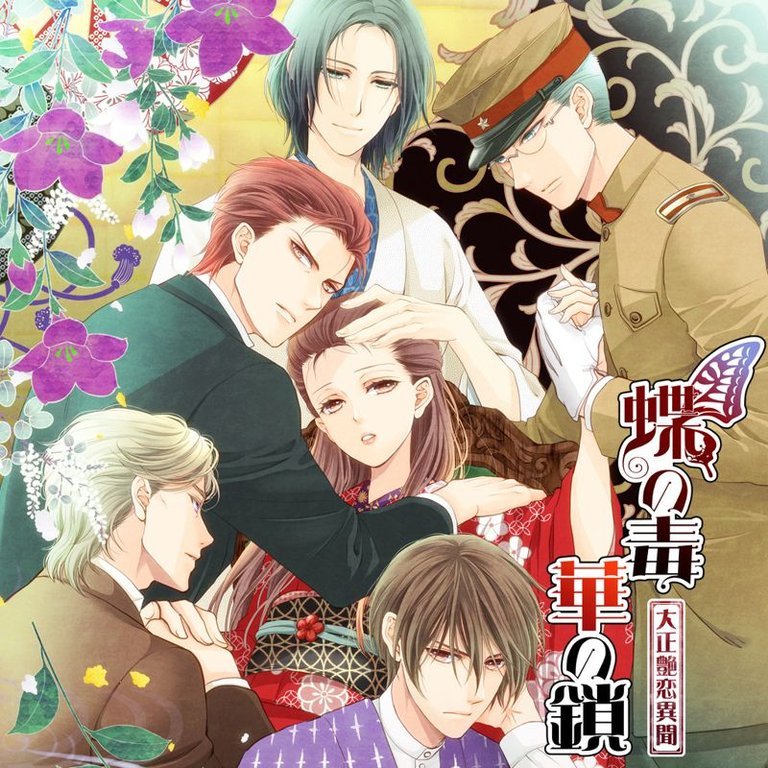
Description
Butterfly’s Poison; Blood Chains is a gripping visual novel set in modern/futuristic Japan, with roots in the World War I era. The game delves into a dark and twisted narrative of romance and psychological thriller, featuring morally grey characters and high-stakes emotional drama. Players navigate a branching storyline filled with forbidden desires and disturbing themes, making it a far cry from typical fluffy otome games. The story is rich with psychological depth and complex relationships, ensuring an engaging and unsettling experience.
Gameplay Videos
Where to Buy Butterfly’s Poison; Blood Chains
PC
Butterfly’s Poison; Blood Chains Guides & Walkthroughs
Butterfly’s Poison; Blood Chains Reviews & Reception
steambase.io (96/100): A triumphant return to form for the series.
blushnpixels.com (90/100): For fans of twisted, high-stakes romance and morally grey characters.
steamcommunity.com : Butterfly’s Poison; Blood Chains is an otome that is shackled to its mobile presentation, but manages to shatter those restraints in a way I was never expecting, leaving me breathless with how good the story and writing can be in this formerly pay-to-play visual novel.
Butterfly’s Poison; Blood Chains: A Haunting Dance of Desire and Decay in Taisho-Era Tokyo
Introduction
In the crowded landscape of otome visual novels, Butterfly’s Poison; Blood Chains (2011/2022) stands as a poison-laced rose—beautiful, thorned, and unapologetically lethal. Developed by Aromarie and localized by PROTOTYPE, this game redefines “mature storytelling” by weaving a tale of aristocratic decay, forbidden intimacies, and psychological warfare set against the twilight of Japan’s Taisho era. Our thesis? This is not a romance—it’s a survival horror story masquerading as a dating sim, one that dares to interrogate power dynamics, societal rot, and the cost of desire with unflinching brutality.
Development History & Context
Born from the eroge (erotic game) boom of late-2000s Japan, Butterfly’s Poison began as an R18 PC title in 2011 before being sanitized for consoles in 2014. Its evolution mirrors the otome genre’s own shift from niche adult markets to mainstream acceptance. Writer Marqui Bunge and artist Chigiri Amano crafted a narrative steeped in Taisho Romanticism—a period defined by Westernization, economic disparity, and the collapse of feudal hierarchies.
The game’s 2022 Switch/Steam localization faced immediate scrutiny: How would a story originally reliant on explicit sexual tension translate to a censored format? PROTOTYPE’s solution was elegant yet contentious. By fading to black during intimate scenes, they emphasized the psychological weight of Yuriko’s choices rather than their physicality. Notably, voice actors retained pseudonyms from the original R18 release, a nod to Japan’s stigma around adult game performances.
Technologically, the game’s PSP-era roots show. Static backgrounds and basic UI clash with Amano’s lush character designs—a relic of its mobile origins. Yet these limitations paradoxically heighten the focus on its text, which remains its sharpest weapon.
Narrative & Thematic Deep Dive
Plot & Characters
Yuriko Nomiya, the daughter of a debt-ridden viscount, navigates a gauntlet of five suitors, each embodying a facet of Taisho-era corruption:
– Shiba Junichi: A former servant turned capitalist predator, representing nouveau riche ambition.
– Hideo Ozaki: A childhood friend turned soldier, symbolizing rigid traditionalism.
– Mizuhito Nomiya: Yuriko’s adoptive brother, whose artistic escapism masks incestuous longing.
– Majima Yoshiki: A drug-trafficking doctor, the embodiment of societal decay.
– Fujita Hitoshi: The family butler, a half-British outsider questioning loyalty and colonialism.
The narrative deconstructs the otome fantasy. Routes like Majima’s force players to reconcile attraction with horror, as Yuriko is manipulated into opium addiction. Meanwhile, Mizuhito’s route dances with taboos, framing brotherly love as both sanctuary and prison.
Themes
- Class & Gender: Yuriko’s agency is shackled by her family’s decline. Her “choices” often reduce to marrying for money or falling into prostitution—a grim reflection of Taisho-era misogyny.
- Forbidden Desire: The game weaponizes taboo. Shiba’s route, for example, eroticizes power imbalances, while Amami Kyoko’s queer-coded storyline (a woman disguised as a man) flirts with subtextual lesbianism.
- Moral Ambiguity: No character is purely heroic. Even Fujita, the butler, enables the Nomiya family’s dysfunction through passive compliance.
Gameplay Mechanics & Systems
As a kinetic novel, Butterfly’s Poison prioritizes branching narratives over gameplay complexity. Key features include:
– Route Locking: Mizuhito and Majima’s routes unlock only after completing others, ensuring players confront the story’s darkest layers gradually.
– Ending Variants: Each suitor has a “Best,” “Tragic,” and “Bad” ending. The latter often veer into psychological torment (e.g., Yuriko becoming Majima’s drug-addled mistress).
– UI Shortcomings: Bland menus and a lack of backlog navigation frustrate, though quick-save mitigates this.
The true innovation lies in its choice design. Seemingly innocuous decisions—like accepting a drink—can spiral into degradation. This unpredictability mirrors Yuriko’s precarious social standing.
World-Building, Art & Sound
Setting
1918 Tokyo is a character in itself. Willow Court aristocrats cling to fading grandeur while war profiteers like Shiba exploit postwar chaos. The game’s fixation on flowers—orchids, lilies, poisonous blooms—serves as metaphor: beauty masking corruption.
Visuals
Amano’s art oscillates between haunting and decadent. Yuriko’s sprite transforms across routes: poised in Shiba’s path, disheveled in Majima’s. CGs linger on tactile details—grasping hands, crumpled kimonos—to amplify intimacy.
Audio
Voice acting is sublime, particularly Tatsuya Hirai (Mizuhito), whose lethargic delivery evokes both sensuality and despair. The soundtrack, however, is a weak link, relying on generic Taisho-inspired melodies.
Reception & Legacy
Upon its 2022 localization, critics praised its “uncompromising maturity” (Blush & Pixels) while noting its “exorbitant $45 price tag” (Steam Review). The Steam version holds a 96% approval rating, with players lauding its “morally complex characters” and “heart-wrenching tragedies.”
Its influence is evident in titles like Psychedelica of the Black Butterfly (2015) and Collar x Malice (2016), which similarly blend romance with psychological thriller elements. However, Butterfly’s Poison remains unmatched in its willingness to explore eroticism as both weapon and vulnerability.
Conclusion
Butterfly’s Poison; Blood Chains is not a game for the faint-hearted. It is a gauntlet thrown at the feet of otome conventions, a story that conflates love with predation and freedom with surrender. While its presentation falters, its narrative audacity cements it as a landmark work—a Gone with the Wind by way of Edgar Allan Poe, dripping with venom and velvet.
Final Verdict: A masterclass in taboo storytelling, best suited for players who relish emotional danger as much as romance. Its legacy? Proof that visual novels can be literature.