
- Release Year: 2001
- Platforms: Windows
- Publisher: Activision Value Publishing, Inc.
- Developer: Clever’s Games Ltd.
- Genre: Driving, Racing
- Perspective: Behind view
- Game Mode: Single-player
- Gameplay: Exploration, Navigation, Vehicle deformation
- Setting: Desert, mountains
- Average Score: 60/100
Description
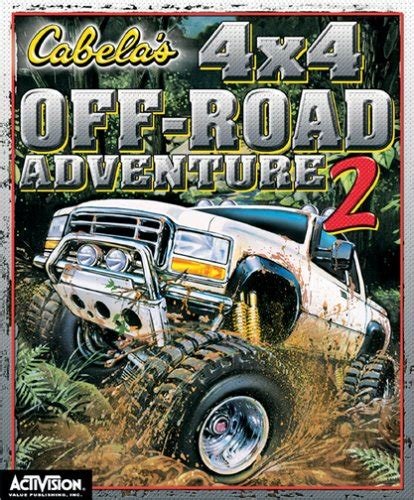
Cabela’s 4×4 Off-Road Adventure 2 is a single-player off-road racing game that prioritizes navigation and exploration over traditional competition. Players must find navigation buoys across six diverse terrains—such as deserts and mountains—using maps and compasses, with no time limits or opposing vehicles. The game includes six modes like skill and endurance, 12 fictitious vehicles (mainly pickups and a military truck), and a dynamic damage system where crashes deform the car and impact handling, offering a focused driving simulation.
Gameplay Videos
Cabela’s 4×4 Off-Road Adventure 2 Reviews & Reception
en.wikipedia.org (60/100): a diamond in the rough that’s slowly puttering down the long, hard, road towards respectability.
myabandonware.com : Cabela’s 4×4 Off-Road Adventure 2 was an above-average licensed title title in its time.
Cabela’s 4×4 Off-Road Adventure 2 Cheats & Codes
PC
Enter codes at the main menu.
| Code | Effect |
|---|---|
| treasure | Unlocks all tracks. |
| phantom | Unlocks all cars. |
| settyrescale | Unlocks all modes. |
Cabela’s 4×4 Off-Road Adventure 2: A Solitary Pilgrimage Through Digital Wilderness
Introduction: The Road Less Traveled
In the crowded landscape of early-2000s PC racing games, dominated by the arcade-infused speed of Need for Speed and the emerging simulation purism of Richard Burns Rally, a strange, quiet outlier existed. Cabela’s 4×4 Off-Road Adventure 2, released in November 2001 by Activision Value and developed by the Romanian studio Clever’s Games Ltd., was not a game about competition. It was, as GameSpot’s succinct review noted, “unlike virtually any previous driving game in that it does not force you to compete against other cars or a constantly ticking clock.” It was a game about navigation, endurance, and the solitary dialogue between driver and terrain. This review excavation posits that the game represents a fascinating, if flawed, dead-end in racing game design—a deliberate rejection of mainstream racing’s dopamine-driven feedback loops in favor of a slow, contemplative, and often punishing interaction with simulated nature. Its legacy is not one of influence, but of a stark “what if?”: what if the thrill of off-roading was not in beating an opponent, but in simply surviving the journey?
Development History & Context: The Budget License Experiment
The game’s context is inseparable from its production circumstances. Clever’s Games Ltd., operating under Activision Value’s budget-oriented publishing label, worked within the tight constraints typical of the “value” market. The credits, meticulously listed on MobyGames, reveal a compact, Hungarian-speaking (primarily) team of 43 developers managing programming, art, and sound with a small footprint. Technical decisions reflect this reality: the use of the ubiquitous and affordable FMOD sound engine and the Lua scripting language for game logic were pragmatic choices for a small studio. The game’s engine was built for a specific, narrow purpose—simulating vehicle deformation and terrain interaction—rather than for graphical spectacle.
This was the era of the licensed sports and outdoor game. Activision’s partnership with Cabela’s, the iconic hunting and fishing retailer, was a potent branding exercise targeting an outdoors-enthusiast demographic underserved by the high-octane racing mainstream. The first game in the series (developed by Fun Labs) had been released earlier in 2001 to a tepid but curious reception (IGN called it “a diamond in the rough”). Clever’s Games, having worked on other Activision Value titles like Secret Service: In Harm’s Way and F.D.N.Y. Firefighter, was handed the sequel with a mandate to refine the core concept. The result was a game that doubled down on the first title’s most idiosyncratic element—the pure, opponent-free navigation challenge—while remaining visually and technologically modest. In November 2001, it arrived into a market saturated with Grand Theft Auto III’s urban chaos and the upcoming MotoGP 2‘s precision, standing utterly apart.
Narrative & Thematic Deep Dive: The Story Is The Landscape
Cabela’s 4×4 Off-Road Adventure 2 possesses a narrative only in the most elemental, environmental sense. There is no plot, no characters, no dialogue, and no cutscenes. The “story” is emergent, written entirely by the player’s actions against the game’s six distinct terrains: desert, mountains, forest, winter, swamp, and canyon (implied by “e.g. desert, mountains” from the source). The thematic core is a quasi-spiritual communion with harsh, indifferent wilderness.
The game’s manual, reportedly scant as noted in the IGN review of the first title, provides the only “lore”: the player is an off-road enthusiast undertaking solo challenges certified by the fictional Cabela’s organization. The true narrative mechanics are the buoys. These navigation markers are the game’s only objectives, transforming the player into a pilgrim seeking waypoints in a vast, open space. The absence of a race clock or rival drivers reframes every rock, mud puddle, and sheer cliff face from an obstacle to be overcome for its own sake, into a central character in a personal drama of mechanical stress anddriver patience. The theme is one of mastery through humility—the vehicle is not a weapon to dominate the track, but a fragile tool that must be petitioned and cajoled through a hostile world. The dynamic deformation system, where crashes permanently scar the vehicle and affect handling, reinforces this; every dent is a story of a mistake, a permanent scar on your machine’s history.
Gameplay Mechanics & Systems: The Meditation on Movement
The game’s six modes—Skill, Navigation, Explore, Discovery, Endurance, Freedom—are permutations on a single, hypnotic core loop: drive, observe, navigate, survive.
- The Navigation Puzzle: The primary mechanic is finding buoys using a compass, a map, or distance readings. This is a pure spatial reasoning challenge. The HUD presents minimal data, forcing the player to correlate the top-down map with the third-person vehicle view, creating a constant, low-grade cognitive tension. “Explore” and “Discovery” likely increase map obscurity or buoy placement complexity, while “Endurance” and “Freedom” (unlocked later) presumably impose resource or damage constraints, turning the navigation into a marathon of attrition.
- Vehicle Dynamics as a Character: The 12 fictitious vehicles (mainly pickups and a military truck) are not just cosmetic variants. Each would have distinct weight, torque, suspension travel, and center of gravity. The dynamic deformation system is the game’s most innovative and punishing feature. A hard impact to the front bumper doesn’t just look cool—it can realign steering, cause a persistent wobble, or reduce cooling efficiency, leading to overheating. This creates a profound consequence loop: reckless driving begets cumulative damage, which begets compromised handling, which begets more crashes. The player must learn to read the vehicle’s changing “personality” through feedback vibrations and altered responses.
- The Illusion of Freedom, The Reality of Constraint: “Freedom” mode suggests open-world exploration, but the maps, while sizable, are bounded and hand-crafted with specific challenges. The lack of a time limit removes frantic pressure, but replaces it with a more insidious tension: the knowledge that a wrong turn into a box canyon or a swamp could mean a long, arduous backtrack with a crippled vehicle. The game is less about speed and more about efficiency of movement. Progression is gated not by lap times, but by successfully completing navigation challenges, unlocking harder maps and vehicles.
- UI and Innovation: The interface is functional and sparse, prioritizing the map and compass. The innovation lies in its systemic integration: the damage model isn’t a separate meter but is expressed directly in the vehicle’s physical behavior. The flaw, as the GameSpot review hints, is likely in controller issues and imprecise handling models—a common critique of budget simulation attempts. Achieving fine control over a rock-crawling pickup on a slippery slope with a keyboard or cheap joystick would be a significant, often frustrating, skill barrier.
World-Building, Art & Sound: Authenticity Over Spectacle
The six map environments are not photorealistic; they are archetypal. The desert is all cracked earth and mesas; the mountains feature jagged peaks and snow lines; the swamp is murky water and dead trees. The graphics, described in the IGN first-game review as looking “smooth” from a distance but growing “significantly more pixilated” up close, represent a typical DirectX 6/7-era budget aesthetic. The beauty is in the atmospheric detail: convincing splash effects when carving through water, plausible dust clouds in the desert, and the way snow accumulates on the vehicle’s body. The use of FMOD would have allowed for positional audio—the crunch of gravel under tires, the splash of water, the scrape against rock—which is absolutely critical to the tactile feedback the game demands.
The soundtrack, composed by Gábor Dénes Szabó, is described as “rollicking rock tunes” in the IGN review, but the more important audio is diegetic: the V8 engine sounds (credited to “Lacee, Zola, Steve, Szamba, Inti”). The authenticity of these recorded engine noises, coupled with the environmental soundscape, is what sells the experience. You are not hearing a generic “truck sound”; you are hearing your truck, straining against a grade, coughing through water, clattering over rocks. The sound design is not just decoration; it is primary diagnostic data, a crucial tool for judging traction and mechanical stress in the absence of a complex visual HUD.
Reception & Legacy: The Cult of the Niche
At launch, Cabela’s 4×4 Off-Road Adventure 2 was reviewed almost exclusively as a budget title. GameSpot’s 70% (“good”) score is telling: it acknowledges the game’s unique premise and solid value (“its very palatable price”) while citing “controller issues and lack of multiplayer support” as major flaws. The critical consensus, based on the scant single-source data, seems to be that it was a competent curiosity for a very specific audience—outdoor enthusiasts and simulationists tired of racing for position.
Its commercial performance is lost to history, but its placement in the “Collected By” stats (only 2 players on MobyGames as of this writing) confirms its status as a deep-cut relic. Its legacy is confined to its own series. The third and final entry, Cabela’s 4×4 Off-Road Adventure 3 (2003, developed by Fun Labs), received a lower 5.7 from GameSpot, which called it “too quirky, too slow-paced, and too repetitious.” This review suggests the series’ fundamental design philosophy—the solitary navigation challenge—was ultimately too niche for even a budget audience. The series died not because it was broken, but because its core idea, however pure, had a very limited appeal.
Industry Influence: The game had none. Its concepts did not filter into mainstream racing design. The dynamic deformation system was a precursor to the more integrated damage models of later hard-core simulations like BeamNG.drive, but its implementation was too simple and its audience too small to inspire imitation. It stands as a cul-de-sac in game design history: a fascinating, fully realized dead-end. Modern off-road racers like Forza Horizon 5‘s “Trailblazer” events or SnowRunner incorporate some navigation and damage elements, but they are always wrapped in a framework of progression, points, and multiplayer competition, losing the pure, lonely essence of Clever’s creation.
Conclusion: The Quiet Triumph of the Un-Fun
Cabela’s 4×4 Off-Road Adventure 2 is not a “good” game by conventional metrics. It is slow, visually dated, controls imprecisely, and offers none of the instant gratification that defines the genre. Its narrative is nonexistent, its UI minimal, and its challenge derived from frustration as much as skill.
Yet, to dismiss it is to miss its radical, almost zen-like, design thesis. In an industry obsessed with mastery through victory, it offered mastery through persistence through adversity. It replaced the thrill of the checkered flag with the quiet satisfaction of reaching a distant buoy after a 20-minute slog through a digitally rendered swamp, your truck sputtering and leaking but intact. It was a game about the journey, not the destination, and the journey was deliberately, punishingly slow.
Its place in history is not as a landmark but as a curio—a bold, budget-constrained experiment in subverting racing game conventions. It proves that even within the rigid taxonomy of “Racing / Driving,” a game can strive for a completely different emotional and cognitive experience. It is a monument to the idea that a video game can be a digital analogue for a solitary, challenging hike, where the equipment matters, the terrain is an antagonist, and the only opponent is your own dwindling patience. For that audacious, quixotic goal, Cabela’s 4×4 Off-Road Adventure 2 earns its quiet, forgotten place in the archives—a testament to a road less traveled, and one that few, if any, chose to follow.
Final Verdict: 6/10 – A deeply flawed, historically niche, but conceptually fascinating oddity. Its deliberate rejection of racing conventions is its only true innovation, and its execution is too compromised to achieve its lofty, solitary aims. A must-study for game design historians examining genre boundaries, but an ordeal for all but the most patient off-road purists.