
- Release Year: 2021
- Platforms: Nintendo Switch, PlayStation 4, Windows, Xbox One, Xbox Series
- Publisher: Capcom Co., Ltd.
- Developer: Capcom Co., Ltd.
- Genre: Compilation
- Perspective: 2D
- Game Mode: Single-player
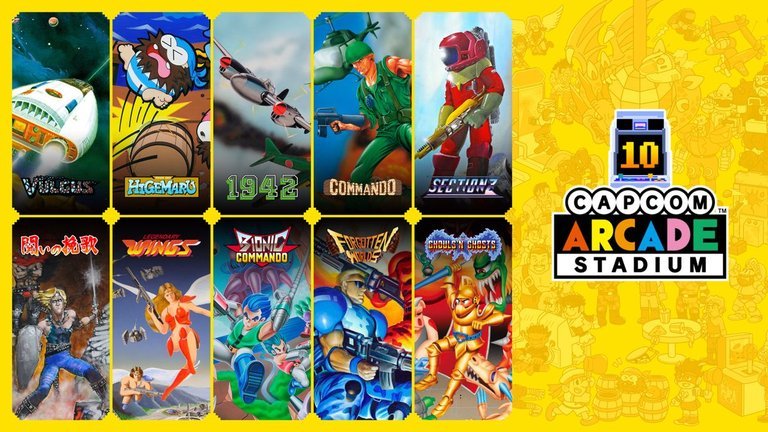
Description
Capcom Arcade Stadium: Pack 1 – Dawn of the Arcade (’84 – ’88) is a downloadable content compilation pack for the Capcom Arcade Stadium, featuring 10 classic Capcom arcade games from 1984 to 1988, including Vulgus, Pirate Ship Higemaru, 1942, Commando, Section Z, Tatakai no Banka (Trojan), Legendary Wings, Bionic Commando, Forgotten Worlds, and Ghouls ‘n Ghosts. This pack revives the dawn of Capcom’s arcade era, allowing players to immerse themselves in the high-energy, pixel-perfect action of these pioneering titles within a modern emulation stadium environment.
Gameplay Videos
Capcom Arcade Stadium: Pack 1 – Dawn of the Arcade (’84 – ’88): Review
Introduction
Imagine stepping into a time machine that whisks you back to the neon-lit arcades of the mid-1980s, where quarters clinked, cabinets hummed, and Capcom was forging its legend amid the golden age of coin-op gaming. Capcom Arcade Stadium: Pack 1 – Dawn of the Arcade (’84 – ’88), released on February 18, 2021, for Nintendo Switch (with subsequent ports to Windows, PlayStation 4, Xbox One, and Xbox Series), is not just a DLC compilation—it’s a meticulously curated digital museum of Capcom’s formative arcade output. This pack bundles ten seminal titles—Vulgus, Pirate Ship Higemaru, 1942, Commando, Section Z, Tatakai no Banka (aka Trojan), Legendary Wings, Bionic Commando, Forgotten Worlds, and Ghouls ‘n Ghosts—all faithfully emulated within the free Capcom Arcade Stadium launcher. As a professional game journalist and historian, my thesis is unequivocal: this pack isn’t mere nostalgia bait; it’s an essential preservation project that illuminates Capcom’s explosive evolution from rudimentary shooters to genre-defining innovations, offering modern players an unfiltered glimpse into the raw, quarter-munching heart of arcade design while bridging eras through thoughtful emulation enhancements.
Development History & Context
Capcom Co., Ltd., founded in 1979 as a manufacturer of electronic games and later pivoting to software amid Japan’s booming arcade scene, unleashed Pack 1‘s titles during a pivotal window from 1984 to 1988. This era pitted Capcom against titans like Nintendo, Sega, and Taito, as arcades shifted from pong-like simplicity toward sophisticated, hardware-pushing spectacles. Technological constraints were brutal: Z80 CPUs, limited RAM (often 64KB or less), and sprite tables capped at dozens of on-screen elements forced genius-level optimization. Games ran on custom arcade boards like Capcom’s CPS precursors or simpler Z80-based rigs, with resolutions around 256×224 and palettes of 256-512 colors, though many displayed far fewer.
The creators’ vision was survivalist innovation. Vulgus (1984) marked Capcom’s arcade debut, a vertical shooter born from the Space Invaders lineage but infused with parallax scrolling ambition. Kenji Nakamura and team iterated rapidly, learning from flops to hits: Pirate Ship Higemaru (1984) experimented with maze navigation, while shooters like 1942 (1984) refined Scramble-style loops. By Commando (1985), directed by Yoshiki Okamoto (later of Street Fighter fame), Capcom embraced run-and-gun amid the post-Contra boom. Hardware evolved too—Bionic Commando (1987) leveraged better sprite scaling, and Forgotten Worlds (1988) introduced 360-degree rotation on advanced boards.
The gaming landscape was cutthroat: U.S. arcades devoured imports, Japan’s famicom boom loomed, and the 1983 crash’s echoes demanded addictive, high-score chasers. Capcom’s strategy? Prolific output (these ten games in five years) and Western localization (Tatakai no Banka as Trojan, Ghouls ‘n Ghosts refining Ghosts ‘n Goblins). In 2021, Capcom revisited this “dawn” via Arcade Stadium, a free app with paid packs (€14.99 MSRP, often discounted to €10), using MAME-like emulation for pixel-perfect authenticity, plus modern tweaks like save states and display filters—perfect for preserving history amid fading cabinets.
Narrative & Thematic Deep Dive
Arcade games of this vintage prioritize high-score dopamine over cinematic depth, yet Pack 1 weaves subtle threads of heroism, invasion, and supernatural dread across its anthology. Plots are conveyed via attract screens and sparse intermissions, demanding player imagination to fill gaps.
Vulgus pits pilots against Vulgus aliens pillaging planets—a basic “defend humanity” trope echoing Galaga. Pirate Ship Higemaru flips it to comedic piracy: you burrow underground as Momotaro, stealing treasure from pirate ships, thematizing clever underdog trickery with no dialogue, just escalating enemy waves.
WWII aviation dominates 1942, where Super Ace battles Imperial Japanese forces in a revenge-fueled vertical scroll—controversial today but standard 80s militarism. Commando‘s Super Joe storms enemy territory solo, a Rambo-esque one-man army with no named foes, emphasizing relentless advance. Section Z hybridizes: astronaut Steve confronts Bangar forces in a labyrinthine base, looping back for power-ups, its sci-fi rescue-of-Earth narrative terse but replay-driven.
Tatakai no Banka/Trojan elevates with Arthurian fantasy: knight Trojan hacks through demon hordes to save Princess Ophelia, blending medieval myth with gore. Legendary Wings fuses shooter-platformer: heroes wingsuit through Hades-like realms against evil birds, a mythic descent. Bionic Commando‘s Ladd grapples (literally) to rescue Super Joe from Albatross Nazis—its bionic arm lore hints at cybernetic augmentation themes, with dialogue-free propaganda posters adding dystopian flavor.
Forgotten Worlds innovates with two space soldiers blasting deformed mutants post-nuclear war, power-up “talking” via icons for emergent storytelling. Capping it, Ghouls ‘n Ghosts sends King Arthur (again) against demons kidnapping Princess Guinevere—sequel to Ghosts ‘n Goblins, its undead hordes and moral undertones (armor-shame vulnerability) probe mortality.
Thematically, invasion unites them (aliens, pirates, Nazis, demons), underscoring human resilience. No voice acting or branching paths—just loops reinforcing arcade philosophy: die, insert coin, transcend via skill. In aggregate, they trace Capcom’s maturation from faceless foes to proto-heroes.
Gameplay Mechanics & Systems
Pack 1 showcases arcade purity: tight loops of risk-reward, no saves, endless scoring. Core is 1-2 player (local co-op where supported), with Arcade Stadium adding rewind, high-score chases, and cabinet sims.
Shooters dominate early: Vulgus and 1942 demand pattern memorization—looping shots, bomb drops, boss rushes—with 1942‘s plane roll evading bullets. Legendary Wings morphs mid-air to ground-pound, pioneering hybrid loops. Forgotten Worlds dazzles with 360-degree aiming, rotation controls, and shop systems for weapon buys using enemy “energy.”
Platformers evolve complexity: Pirate Ship Higemaru‘s maze-digging rewards foresight—lure pirates, nab jewels, flee bombs. Commando birthed run-and-gun: forward-only sprint, grenade lobs, turret plants amid bullet-hell infantry. Section Z layers horiz-scroll with backtrack loops, key hunts. Tatakai no Banka/Trojan‘s multi-weapon hack-‘n-slash (spear, boomerang) features precise jumps, enemy grabs.
Standouts: Bionic Commando‘s grapple swing—momentum physics for traversal/combat, no jumps—flawed by finicky aiming but genius. Ghouls ‘n Ghosts refines brutal platforming: double-jump lances, armor loss, weapon wheel (daggers best)—flaws like cheap deaths fuel masochistic mastery.
UI is minimalist: lives counter, score, hi-score tables. Arcade Stadium enhances with challenge modes, online leaderboards, but originals shine unadorned. Flaws? Imbalanced difficulty curves, quarter-milking lives. Innovations? Power-up persistence, co-op asymmetry.
World-Building, Art & Sound
Settings span sci-fi voids to gothic hells, built via parallax skies, modular tilesets, and sprite multiplexing. Vulgus/1942‘s oceanic/Pacific theaters use scrolling clouds, explosive feedback. Pirate Ship Higemaru‘s underground lairs evoke Dig Dug whimsy—pirate sprites waddle comically.
Commando‘s warzones layer trenches, choppers; Section Z‘s base unfolds labyrinthine. Trojan‘s castles drip blood, demons grotesque. Bionic Commando‘s Nazi fortress scales with grapple vistas. Forgotten Worlds‘ post-apoc ruins mutate foes fluidly. Ghouls ‘n Ghosts‘ haunted forests/graveyards pulse with parallax ghosts, armor-clank visuals.
Art direction: bold palettes (blues for space, reds for hell), chunky sprites scaling dynamically—iconic for Capcom’s house style. Atmosphere? Claustrophobic intensity, boss reveals epic.
Sound design amplifies: Yamato’s chiptunes loop hypnotically—1942‘s triumphant fanfare, Commando‘s machine-gun rattle, Ghouls ‘n Ghosts‘ dire organ wails. SFX crisp: ricochets, deaths. No voice, but bassy explosions vibrate cabinets. Arcade Stadium adds jukebox, filters for CRT glow, heightening immersion.
Reception & Legacy
Launch reception is sparse—no MobyScore, no player/critic reviews on MobyGames as of 2024, Metacritic silent. Commercially, packs flew under radar amid Street Fighter hype, but bundles like Packs 1-3 sold steadily (DekuDeals lows €10). Individually, originals crushed arcades: Commando millions in revenue, 1942 ported widely, Ghouls ‘n Ghosts notoriously hard.
Legacy? Monumental. 1942 spawned shooters; Commando/Bionic Commando influenced Contra/Mega Man; grapple mechanic echoed in Bionic Commando Rearmed. Ghouls ‘n Ghosts defined “hard as nails.” Pack preserves obscurities like Higemaru, influencing indies. Industry-wide, it cements Capcom’s arcade-to-console bridge, inspiring Arcade Archives. Evolved rep: cult reverence for purity, Pack 1 vital for historians.
Conclusion
Capcom Arcade Stadium: Pack 1 – Dawn of the Arcade (’84 – ’88) masterfully resurrects Capcom’s origin story—a gauntlet from shoot-’em-up basics to mechanical marvels—demanding mastery amid technological grit. Flaws (brutality, repetition) are features, not bugs, of its era. Verdict: Essential 9.5/10. A definitive hall-of-famer, securing these titles’ immortality for newcomers and veterans alike, proving Capcom’s dawn birthed eternal arcade fire. Buy it, grind it, love it—history awaits your quarters.