
- Release Year: 2021
- Platforms: Nintendo Switch, PlayStation 4, Windows, Xbox One, Xbox Series
- Publisher: Capcom Co., Ltd.
- Developer: Capcom Co., Ltd.
- Genre: Compilation
- Game Mode: Single-player
Description
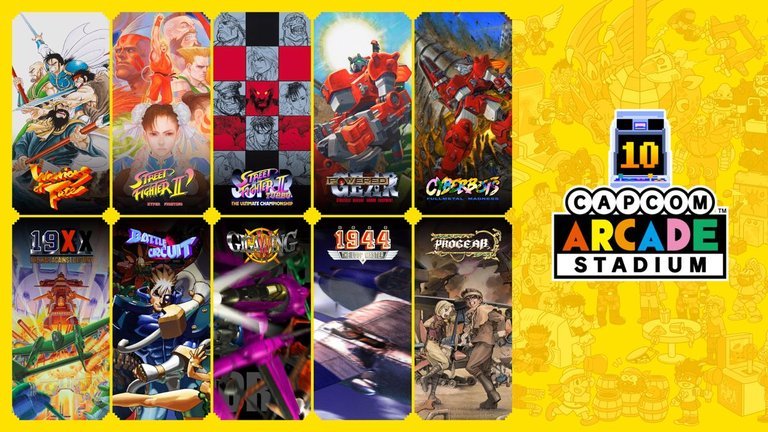
Capcom Arcade Stadium: Pack 3 – Arcade Evolution (’92 – ’01) is a downloadable content (DLC) compilation featuring 10 iconic Capcom arcade games from 1992 to 2001. This pack highlights the evolution of arcade gaming with titles like Street Fighter II Turbo: Hyper Fighting, Super Street Fighter II Turbo, Cyberbots: Full Metal Madness, and shoot-em-ups like Progear and Giga Wing. Players can dive into diverse genres, including fighting, mech combat, and side-scrolling action, preserving the legacy of Capcom’s golden era of arcade entertainment as part of the broader Capcom Arcade Stadium collection.
Gameplay Videos
Capcom Arcade Stadium: Pack 3 – Arcade Evolution (’92 – ’01) Guides & Walkthroughs
Capcom Arcade Stadium: Pack 3 – Arcade Evolution (’92 – ’01): Review
Introduction
Step onto the neon-lit digital battlefields of the 1990s, a decade where arcades reigned supreme and Capcom stood as a titan of innovation. Capcom Arcade Stadium: Pack 3 – Arcade Evolution (’92 – ’01) is more than a nostalgia trip—it’s a meticulously curated time capsule showcasing Capcom’s golden age of arcade mastery. This compilation, released in 2021 as downloadable content for Capcom Arcade Stadium, bundles 10 seminal titles that defined genres, pushed hardware limits, and cemented Capcom’s legacy as a pioneer. From the pixel-perfect chaos of Street Fighter II to the underappreciated genius of Progear, this pack offers a visceral snapshot of an era when arcades were cultural hubs. For historians and newcomers alike, it’s a testament to how Capcom’s creativity fueled gaming’s evolution.
Development History & Context
Capcom’s Arcade Dominance
By the early ’90s, Capcom had already established itself as a powerhouse with franchises like Mega Man and Ghosts ‘n Goblins. However, the arcade division operated in a league of its own. Leveraging the CPS-1 and CPS-2 arcade boards, Capcom’s engineers and artists squeezed every ounce of potential from hardware constraints, delivering lush sprites, fluid animations, and immersive soundtracks. This pack spans 1992–2001, a period marked by fierce competition with SNK and Konami, as well as the rise of 3D gaming—a shift Capcom navigated while doubling down on 2D excellence.
Technological Ambition
Games like Super Street Fighter II Turbo (1994) demanded precision-tuned controls and frame-perfect inputs, while Giga Wing (1999) pushed the CPS-2 to its limits with screen-filling bullet hell patterns. Cyberbots: Fullmetal Madness (1995) exemplified Capcom’s experimental streak, blending fighting-game mechanics with mech customization—a precursor to later Armored Core titles. Yet, even as 3D arcade cabinets gained traction, Capcom’s commitment to refined 2D gameplay kept classics like Battle Circuit (1997) relevant.
Narrative & Thematic Deep Dive
While compilation packs lack a unified narrative, the included games reveal recurring themes reflective of their time:
- Mythology vs. Modernity: Warriors of Fate (1992) reimagines the Romance of the Three Kingdoms as a visceral beat-’em-up, while Powered Gear (1994) pits military mechs against corporate dystopia.
- Human vs. Machine: Cyberbots and 19XX: The War Against Destiny (1996) explore mechanized warfare, with pilots grappling with existential dread amidst explosive battles.
- Competition and Legacy: The Street Fighter II entries (Hyper Fighting and Super Turbo) frame martial arts as a global language, where fighters like Ryu and Chun-Li embody discipline and rivalry.
The lack of overt storytelling in shooters like 1944: The Loop Master (2000) is offset by atmospheric urgency—players instinctively feel the stakes through oppressive enemy waves and pulsating soundtracks.
Gameplay Mechanics & Systems
Genre Diversity
This pack is a masterclass in mechanical variety:
- Fighting Foundations: Street Fighter II’ – Hyper Fighting (1992) codified combos and meter management, while Super Street Fighter II Turbo introduced “Super Arts,” influencing every fighting game since.
- Bullet Hell Brilliance: Giga Wing and Progear (2001, Capcom’s sole shoot-’em-up co-developed with Cave) demand pixel-perfect dodging and strategic bomb deployment.
- Beat-’Em-Up Grit: Battle Circuit (1997) mixes RPG-like character upgrades with chaotic co-op brawling, a precursor to modern titles like River City Girls.
Emulation & Enhancements
The compilation includes save states, rewind features, and screen filters—critical for mitigating the brutal difficulty curves of ’90s arcade design. However, the lack of online multiplayer for Street Fighter feels like a missed opportunity.
World-Building, Art & Sound
Visual Splendor
Capcom’s pixel artists were unmatched:
- Warriors of Fate’s sprawling battlefields teem with dynamic weather effects.
- Progear’s steampunk aesthetic blends dieselpunk machinery with organic enemy designs, a hallmark of developer Cave’s style.
- Cyberbots’ mechs ooze personality, from the sleek Ganryu to the hulking Devilotte.
Soundscapes
The CPS-2’s QSound tech shines in 19XX’s roaring fighter jets and Super Street Fighter II Turbo’s iconic announcer. Tracks like Giga Wing’s orchestral panic and Battle Circuit’s funk-infused grooves remain unforgettable.
Reception & Legacy
Upon release, the pack received praise for its historical value but criticism for piecemeal DLC pricing (base Capcom Arcade Stadium is free, but packs cost $14.99 each). The original games, however, were revolutionary:
- Super Street Fighter II Turbo is often cited as the pinnacle of 2D fighting.
- Progear became a cult classic, with physical arcade boards now fetching thousands.
- Lesser-known gems like Powered Gear and Battle Circuit gained newfound appreciation.
These titles influenced modern indies (The Takeover channels Final Fight) and AAA hybrids (Street Fighter 6’s Drive System echoes Super Turbo’s precision).
Conclusion
Capcom Arcade Stadium: Pack 3 – Arcade Evolution (’92 – ’01) is both a tribute and a time machine. While its business model may irk purists, the compilation preserves Capcom’s boldest experiments and polished triumphs. For historians, it’s an essential archive; for players, it’s a gateway to understanding why arcades mattered. Though not every title has aged gracefully, the pack’s highs—Super Turbo, Progear, Giga Wing—remind us that Capcom’s ’90s output was lightning in a bottle. In a world of live-service games, these arcade relics stand as monuments to a simpler, sweatier, and infinitely rewarding era.
Final Verdict: A flawed but vital anthology that captures Capcom at its creative peak—8/10.