
- Release Year: 2017
- Platforms: Macintosh, Windows
- Publisher: Sapphire Dragon Productions
- Developer: Sapphire Dragon Productions
- Genre: Adventure
- Perspective: 1st-person, Top-down
- Game Mode: Single-player
- Gameplay: Japanese-style adventure, Visual novel
- Average Score: 64/100
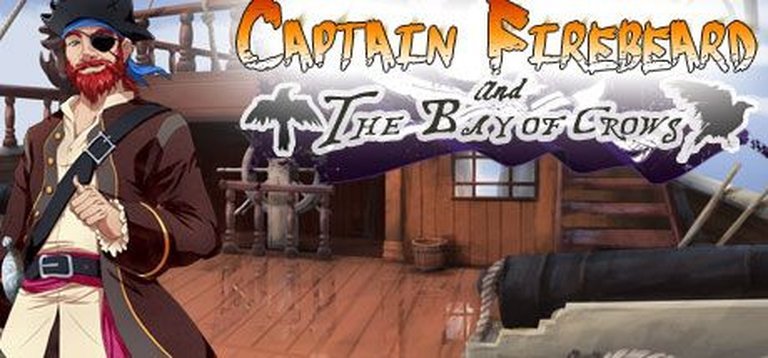
Description
Captain Firebeard and the Bay of Crows is a comedic pirate adventure visual novel set in the whimsical and mysterious Bay of Crows. Players embark on a story-rich journey with Captain Firebeard, blending sharp humor, naval escapades, and swordplay through engaging dialogues, all complemented by an addictive arcade-style minigame and vibrant anime-inspired art.
Gameplay Videos
Where to Buy Captain Firebeard and the Bay of Crows
PC
Captain Firebeard and the Bay of Crows Guides & Walkthroughs
Captain Firebeard and the Bay of Crows: A Hy-Brid Buccaneer’s Tale – A Hidden Gem in the Visual Novel Mainstream
Introduction: A Swashbuckling Spark in the Indie Scene
In the vast, often overcrowded digital storefronts of the modern era, it is a rare and delightful thing to stumble upon a game that wears its heart—and its absurdity—so proudly on its sleeve. Captain Firebeard and the Bay of Crows is precisely such a title. Released in October 2017 by the singular entity Sapphire Dragon Productions, this game is not a sprawling AAA epic nor a minimalist art house experiment. Instead, it is a passionate, cheeky, and intentionally compact fusion of two seemingly disparate genres: the story-driven Japanese-style visual novel and the twitch-responsive, score-chasing arcade minigame. My thesis is this: Captain Firebeard is a fascinating, if modest, case study in genre hybridity and indie pragmatism. It demonstrates how a narrow creative vision, constrained by accessible tools and a clear tonal goal, can produce a cohesive and memorable experience that prioritizes charm and comedic timing over systemic depth or narrative complexity. Its legacy is not one of industry-shaking influence, but of quiet proof that a “comedy swashbuckling adventure” can exist as a viable, focused package in a market that often demands scale.
Development History & Context: The Solo Captain’s Ship
The development context of Captain Firebeard and the Bay of Crows is intrinsically linked to the rise of accessible game creation tools in the 2010s. Sapphire Dragon Productions, as listed on MobyGames and its own website, functions as both developer and publisher—a hallmark of the solo or micro-team indie developer. The choice of TyranoBuilder as the game engine is the single most telling technical detail available. TyranoBuilder is a visual novel engine designed for non-programmers, utilizing a script-like interface to create branching narratives, display art, and integrate simple mini-games. This choice reveals several key aspects of the project’s reality:
- Pragmatism Over Power: With no listed credits for programmers, 3D modelers, or dedicated sysops, the team (likely one or two people) prioritized a tool that allowed them to focus on writing, art direction, and voice production. TyranoBuilder handled the foundational presentation, letting the creators concentrate on their strengths: humor and aesthetic.
- Financial and Logistical Constraints: The game’s system requirements—a mere 1GB RAM and integrated graphics—speak to a development cycle aimed at maximum accessibility. The target was not high-end PCs but anyone with a basic machine, a crucial consideration for an indie title seeking an audience on Steam’s crowded platform.
- The 2017 Indie Landscape: 2017 was a peak year for visual novels and narrative adventures on Steam, following the success of titles like Doki Doki Literature Club! and the continued localization of Japanese visual novels. However, the specific “adventure/comedy with an arcade minigame” pitch was niche. The game entered a space where niche could be a strength, carving out a path for players seeking a short, humorous, story-first experience with a tactile twist, rather than a 50-hour epic or a pure kinetic novel.
- The Solo Vision: The lack of any credited designers, producers, or additional developers in the MobyGames entry (as of its last modification in 2025) suggests a project driven by one or two core visionaries. This explains the uniform tone and the seamless, if simple, integration of the minigame—it is a reflection of a single creative will, not a committee product.
Narrative & Thematic Deep Dive: Luck, Levity, and Low Provisions
The official description provides the entire narrative scaffolding: Captain Lucius “Firebeard” Cole, a pirate down on his luck due to naval patrols and a disintegrating ship, discovers a marooned Spanish officer with a “terrible secret.” The player’s decisions will determine if he becomes the greatest pirate or meets a “unfortunate fate.”
- The Protagonist as a Joke: The name “Firebeard” is immediate parody, evoking the grandiosity of pirates like Blackbeard while undercutting it with a comic, almost childish image. His stated problems—bad luck and poor ship maintenance—frame him not as a fearsome anti-hero but as a relatable underdog, a man whose greatest enemy is mundane decay. This sets the comedy’s premise: the swashbuckling fantasy filtered through the lens of bureaucratic failure and financial anxiety.
- The MacGuffin and Moral Ambiguity: The “terrible secret” of the Spanish officer is the classic engine for pirate adventure. The description’s “Only you can decide” implies a branching narrative likely centered on choices of greed vs. ethics, betrayal vs. loyalty, and risk vs. reward. Given the “comedy” tag, these choices are probably presented with a wink—the “terrible secret” might be something profoundly silly or bureaucratically inconvenient (e.g., the location of the Royal Navy’s lost supply of gruel) rather than world-ending. The theme is thus less about darkness and more about the absurdity of ambition in a world of arbitrary rules and naval red tape.
- Dialogue & Character: The promise of “charming and witty characters” and “sharp humour” suggests a script reliant on banter, puns, and character archetypes played for laughs. The “hapless crew” indicates a ensemble of incompetents, a comedic staple that allows the protagonist to seem relatively competent by comparison. The tone is explicitly not gritty realism but a parody of pirate tropes, more in line with The Pirates! Band of Misfits or Pirates of the Caribbean’s lighter moments than with Assassin’s Creed IV: Black Flag.
- Narrative Structure: As a visual novel, the story is linear with key decision points. The “arcade style minigame” likely serves as a narrative gate or a way to quantify success/failure in key moments (e.g., a sword duel, a naval chase, a navigation puzzle). This creates a unique gameplay-narrative loop: read a scene, face a choice, then “prove” your choice’s merit (or fail) through a skill-based,而非 purely choice-based, minigame. This hybrid model is the game’s most defining mechanical and thematic feature.
Gameplay Mechanics & Systems: The Two-Part Jig
Captain Firebeard is built on a clear, bifurcated gameplay loop:
-
Visual Novel Segment (The “Read & Choose” Phase):
- Core Loop: Players progress through text and static anime/Manga-style art (perspectives noted as 1st-person and top-down, suggesting some scenes show first-person dialogue and others use a top-down map for navigation/choice displays). Full English voice acting (a significant feature for a $1.99/$9.99 game) adds production value and helps sell the comedic timing.
- Choice System: The “Only you can decide” ethos points to a classic VN choice system. The depth and consequence of these choices are the game’s narrative engine. Based on the tone, choices are likely humorous (e.g., “Insult his hat” vs. “Compliment his boots”) but with tangible outcomes affecting the story’s branch and the minigame’s context.
- UI/UX: TyranoBuilder’s interface is typically minimalist: text box, character sprites, background art, and choice buttons. The simplicity is a feature, not a bug, for this scale of project.
-
Arcade Minigame (The “Act” Phase):
- Nature & Integration: Described as “amusing” and “addictive,” this is the game’s action heart. The exact form is not specified in sources, but tags like “Swordplay,” “Puzzle,” and “Naval/Sailing” give clues. It could be a top-down sword-fighting duel (matching the “swordplay” tag), a simple sailing/puzzle navigation challenge (“Naval,” “Sailing,” “Puzzle”), or a quick-time event style sequence. Its “arcade style” implies a score, a clear win/lose state, and potential for retries, making it a skill-check against the narrative’s choices.
- Innovation & Flaws: The innovation lies in the combination. It breaks the passive VN rhythm with an active challenge. The potential flaw is imbalance: if the minigame is too hard, it frustrates the narrative flow; if too easy, it feels like a pointless interruption. The success of the hybrid depends entirely on the minigame’s polish and its seamless integration into the story’s thematic moments (e.g., a chaotic, funny sword fight that mirrors the character’s clumsy bravado).
- Progression: Character progression is likely non-existent in a traditional RPG sense. “Progression” is almost certainly narrative-based: unlocking different story branches and endings based on cumulative choices and minigame successes. Steam Achievements (5 listed) will likely be tied to specific outcomes, minigame scores, or completing all branches.
World-Building, Art & Sound: A Vibrant, Focused Canvas
- Setting & Atmosphere: The “Caribbean” setting is classic pirate lore. However, the comedic tone suggests a stylized, exaggerated version—less historical menace, more whimsical danger. The “Bay of Crows” itself is a evocative, slightly ominous name that promises a specific, hopefully visually distinct, locale. The world-building is conveyed through the visual novel’s text and art, focusing on character interactions and location descriptions that likely lean into comedy (e.g., a tavern run by a depressed parrot, a Spanish officer who complains about the humidity).
- Visual Direction (Art: Anime/Manga): The “Brilliant art style” claim from the store page points to a cohesive, likely anime-inspired aesthetic. Character sprites are probably expressive and designed for comedic effect (exaggerated reactions, dynamic poses). Backgrounds will establish the Caribbean vibe—ports, ship decks, jungles—but rendered in a colorful, non-photorealistic style that matches the game’s light-hearted heart. The top-down perspective may be used for map scenes or the minigame, providing a clear, schematic view of the “bay.”
- Sound Design:
- Voice Acting: “Full English Voice Acting” is a major selling point for a low-budget VN. The quality is unknown from sources, but its inclusion demonstrates a commitment to production value and a understanding that comedy relies heavily on vocal timing and inflection.
- Soundtrack: The “Epic Orchestral soundtrack” is an intriguing descriptor for a comedic pirate game. This suggests a deliberate contrast—grand, dramatic themes underscoring silly events, which is a classic comedic technique (the “heroic treatment” of mundane tasks). It could range from sea shanties to tense, dramatic strings for sword fights, all performed by a small ensemble or high-quality sample library.
- SFX: Not mentioned, but essential for the minigame’s “arcade” feel—sword clashes, ship creaks, comedic pratfall sounds.
Reception & Legacy: The Quiet Crowd
- Critical & Commercial Reception (Launch): There is a critical vacuum. MobyGames shows no critic reviews, and Metacritic has zero user reviews. This is not unusual for a tiny indie launch on Steam with minimal marketing. The commercial data is sparse; Steam lists a current price of $9.99 (with frequent sales to $1.99), and it has been collected by only 4 players on MobyGames. The “Deluxe Edition” and inclusion in the “Dragon Imperial Connection” bundle suggest Sapphire Dragon Productions is building a small catalog and using bundles to cross-promote, a common indie strategy.
- Player Reception (Evolving): The available user review aggregated data tells a story of a “Mixed” or “Mostly Positive” (65-64.71% positive) but extremely small sample size (34 reviews on Steambase, 6 directly on Steam as of one snapshot). The small number of reviews is the key fact. A 65% score from 34 people is statistically insignificant and indicates the game exists on the periphery of most players’ awareness. The user tags—Casual, Adventure, Visual Novel, Pirates, Great Soundtrack, Funny, Naval, Sailing, Puzzle, Story Rich, Colorful, Swordplay, Mystery, Anime—perfectly match the marketing description and suggest the players who did engage got exactly what was promised: a funny, story-focused, pirate-themed VN with minigame elements.
- Influence & Legacy: There is no discernible influence on the industry. It has not spawned clones, been cited by larger developers, or entered any “best of” lists for its genres. Its legacy is that of a niche artifact. It exists as a successful (for its scale) execution of a hyper-specific pitch: a comedic pirate VN with an arcade minigame, built on TyranoBuilder. It proves the model can work for a small audience. Its direct “sequel,” The Curse of the Golden Crab (2018), listed as an add-on/DLC, suggests the world or characters had enough resonance for the developer to expand upon it, a vote of confidence in its own creation from the creators themselves.
Conclusion: A Niche Vessel, But Its Own Captain
Captain Firebeard and the Bay of Crows is not a lost classic. It is not a game that will be dissected in academic papers on narrative design (outside of a case study on micro-budget VN development). Its place in video game history is not one of monumental impact, but of principled niche existence. It is a testament to the “passion project” model: a clear, limited vision (funny pirate story + simple action game) executed competently with the tools available (TyranoBuilder, voice actors, orchestral samples), and delivered to a specific audience that appreciates that precise blend.
Its strengths are its unwavering tone, its commitment to its hybrid design, and its charming, low-stakes presentation. Its weaknesses are the inherent limitations of its scale: a likely short playtime, simple mechanics, and a narrative that probably lacks the depth to sustain multiple playthroughs beyond achievement hunting. The “Mixed” user score with tiny review counts is the perfect encapsulation: those who stumbled upon it and wanted exactly what it offered likely enjoyed it; the vast majority simply never found it or moved on quickly.
In the grand museum of gaming, Captain Firebeard would be in a small, brightly lit case labeled “Indie Experiments: Genre Smoothies.” It’s not the Mona Lisa of its category, but it is a perfectly executed, amusing sketch—a reminder that not every game needs to sail the seven seas. Some are perfectly content, and indeed successful, ruling a single, well-decorated Bay of Crows. For the player seeking 2-3 hours of witty, voice-acted, pirate-themed silliness with a surprisingly engaging little arcade game attached, Captain Firebeard’s ship is more than seaworthy. It’s a delightful, if brief, charm offensive.