
- Release Year: 2012
- Platforms: Nintendo DS, PlayStation 3, Wii, Windows
- Publisher: dtp entertainment AG, Reef Entertainment Ltd.
- Developer: Wizarbox SARL
- Genre: Adventure
- Perspective: 3rd-person
- Game Mode: Single-player
- Gameplay: Mini-games, Point-and-click, Puzzle-solving
- Setting: Caribbean, Sea pirates
- Average Score: 54/100
Description
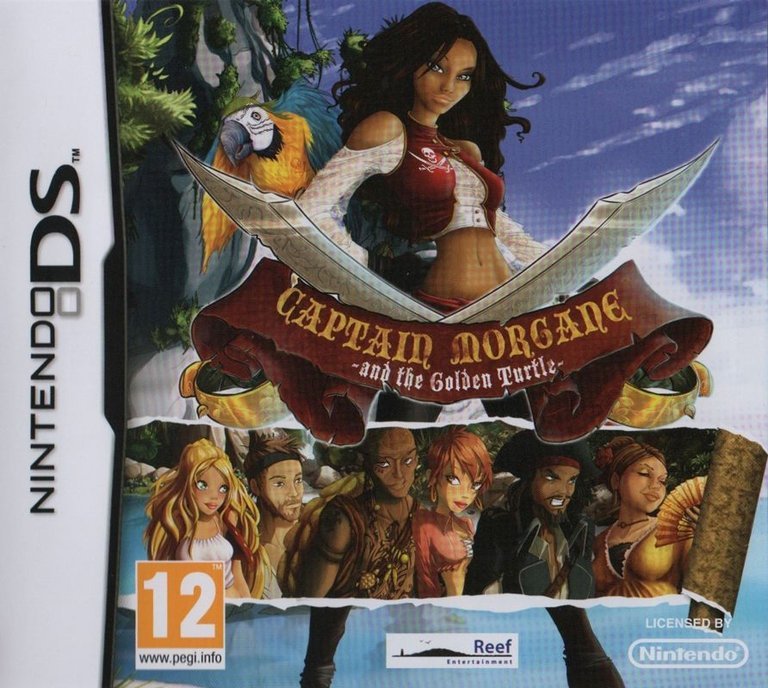
Captain Morgane and the Golden Turtle is a graphic adventure game set in the Caribbean during the age of pirates. Players follow Morgane, the young daughter of pirate captain Alessandro Castillo, as she transitions from doing chores to becoming an acting captain. The game involves exploring five islands via an interactive map, solving puzzles, engaging in dialogue, and playing optional mini-games to uncover family mysteries and the legend of the Golden Turtle.
Gameplay Videos
Where to Buy Captain Morgane and the Golden Turtle
PC
Captain Morgane and the Golden Turtle Free Download
Captain Morgane and the Golden Turtle Guides & Walkthroughs
Captain Morgane and the Golden Turtle Reviews & Reception
metacritic.com (54/100): Cute locations and adventurous captain Morgane on the one side, trivial animations, flat sound and extremely annoying minigames on the other.
adventuredoor.net : Captain Morgane doesn’t quite manage to build its own identity as a title.
Captain Morgane and the Golden Turtle: A Prequel Adrift in the Post-Monkey Island Seas
In the early 2010s, the point-and-click adventure genre existed in a peculiar limbo. The golden age of LucasArts and Sierra had long passed, its classic formulas either remastered for nostalgia or reinvented by Telltale Games’ episodic, choice-driven narratives. Into this transitional landscape stepped Captain Morgane and the Golden Turtle, a 2012 release from French studio Wizarbox. Announced as a prequel/spin-off to the So Blonde series, it promised a classic Caribbean pirate adventure with a twist: a female protagonist taking command in a male-dominated world. Yet, from its very conception, the game faced an uphill battle—not only against a waning audience for traditional adventures but also against the towering, inescapable shadow of The Secret of Monkey Island. This review will dissect Captain Morgane as a product of its time, a competent yet deeply flawed entry that perfectly encapsulates the genre’s struggle to remain relevant, its ambitions often undermined by inconsistent design, technical hiccups, and an identity crisis between its own legacy and its inspirations.
Development History & Context: The Last Gasp of a Classic Formula
Captain Morgane and the Golden Turtle was developed by Wizarbox, a studio with a modest but notable pedigree in the adventure genre. They had previously handled ports of classic titles and developed So Blonde (2008) and its sequel So Blonde: Back to the Island (2010). The project was helmed by a familiar name for adventure veterans: Steve Ince, the acclaimed writer and designer behind Beneath a Steel Sky and key Broken Sword entries. Ince served as the game’s original designer, story writer, and dialogue author, providing a direct lineage to the narrative-driven classics of the 1990s.
The game was built using the OGRE (Object-Oriented Graphics Rendering Engine), a versatile, open-source 3D engine popular among indie and mid-tier studios for its flexibility. This choice reflected the era’s transition: point-and-clicks were no longer purely 2D sprite-based affairs. Captain Morgane utilized 3D character models over lush, hand-drawn 2D backgrounds, a technique seen in other contemporary adventures like The Whispered World. This hybrid approach aimed to give characters more expressive animations while retaining the painterly beauty of traditional backgrounds.
The development context is crucial. By 2012, the “pure” point-and-click was a niche proposition. Major publishers had largely abandoned the format, leaving it to small European studios like Wizarbox, Daedalic, and future Telltale. Captain Morgane was thus a game made by fans, for a dwindling core audience, but with commercial ambitions requiring multi-platform release (Windows, PS3, Wii, Nintendo DS). The Nintendo DS version, notably, omitted voice acting entirely—a significant cost-saving measure and a stark indicator of the constraints under which the game was produced. The announcement in July 2011 and a rapid March 2012 release suggest a development cycle focused on meeting a fiscal year deadline rather than a prolonged creative gestation.
Narrative & Thematic Deep Dive: A Story of Growth, Grief, and Ghosts
The narrative structure of Captain Morgane is its most ambitious and, ultimately, its most uneven element. It attempts to balance two timelines: a prologue featuring eight-year-old Morgane and the main story set on her seventeenth birthday. This “A Minor Kidroduction” serves as a tutorial but also establishes the foundational trauma—the disappearance of her beloved Uncle Eduardo (presumed dead) and, later, her mother Bonita’s passing. These events cast a long shadow, transforming the game from a simple treasure hunt into a coming-of-age drama deeply concerned with grief and familial duty.
The plot proper follows Morgane, now made acting captain of her father Alessandro’s ship, the Winsome Maid. Her dual quests—to find a cargo/job and to recruit a new crew—are quickly subsumed by the larger mystery of the Golden Turtle, a deity-protector of Turtle Island, hired by the eccentric merchant Thomas Briscoe. The narrative strength lies in how these personal and external mysteries intertwine. The search for the Golden Turtle becomes a conduit for resolving her father’s mourning. The ghost of Bonita Castillo is not a mere horror trope but a core narrative mechanic and thematic anchor. Her lingering presence, tied to Alessandro’s inability to let go, forces Morgane to orchestrate a poignant, surreal “exorcism” of her father’s grief—a sequence that is both clever in its gameplay integration and emotionally weighty.
Thematically, the game explores female agency in a patriarchal world. Morgane constantly confronts skepticism about her role as captain, from the grumbling first mate Diego to various island officials. Her journey is about proving competence not through brute force (she famously never uses her sword or pistol for combat), but through intelligence, empathy, and problem-solving. The game also dabbles in post-colonial critique through the Atabey islanders and the corrupt priest Baba Carey, though this is handled with the subtlety of a family-friendly adventure. The revelation of Uncle Eduardo as a parrot is a classic adventure twist, blending humor with pathos, as his avian form becomes a key to the final clue.
The narrative’s flaw is its overstuffing. The AdventureDoor review accurately diagnoses “an insane amount of backtracking” and superfluous subplots (like the barOwner’s long-lost husband) that add length without depth. The game’s 10-act structure sometimes feels like it’s repairing its own inconsistencies. Furthermore, the connection to the So Blonde series feels tacked-on; the famous “blonde” (Sunny) gets only a cryptic, throwaway call-forward from a native chief (“The blonde will be our saviour”), hinting at a larger universe Wizarbox was building but never fully capitalized on, especially after the studio’s closure.
Gameplay Mechanics & Systems: Solid Foundations, Shaky Execution
As a point-and-click, the core loop is standard: navigate static scenes, collect items, combine them, talk to NPCs, solve puzzles. The game’s interface is generally clear. Hotspots are indicated by cursor changes and text labels, a “hotspot indicator” toggle is appreciated, and the inventory (a treasure chest) is functional. The inclusion of a quest log is a godsend given the numerous concurrent tasks.
Where the gameplay stumbles is in puzzle design consistency. Critics noted a frustrating oscillation between the “too simple” and the “too tordu” (twisted/convoluted). Some puzzles are satisfyingly logical (using environmental clues, multi-step combinations). Others, as the AdventureDoor review highlights, violate basic logic in un-fun ways, like the whistle that only birds can hear—a solution that breaks real-world auditory science and feels like a designer’s arbitrary “gotcha.” The mini-games are a major point of contention. Intended to add variety, they are frequently cited as low-points: “mini-games that reek of desperation” (Absolute Games), “extremely annoying” (LEVEL Czech). While an optional cheat button exists, their pervasive inclusion feels like filler to pad the runtime.
The combat system is almost entirely an illusion. Morgane acquires a sword and pistol early, but they are repurposed for mundane tasks (cutting plants, hammering). The single time the pistol is fired is to scare seagulls—a deliberate, joke subversion of pirate tropes. This is consistent with the game’s tone but may disappoint those expecting action.
User experience flaws are significant:
* Save System: The single-slot save system (requiring menu navigation to copy saves) is universally panned as archaic and user-hostile.
* Performance & Bugs: Several reviews (AdventureDoor, God is a Geek) mention memory leaks, stuttering, and general instability, particularly on PC.
* DS Version’s Lack of Voice: The Nintendo DS release has no voice acting, a critical omission in a dialogue-heavy genre that severely impacts atmosphere and accessibility.
* Inconsistent Art Styles: The game employs 3D models for walking, 2D cartoon portraits for dialogue, and pre-rendered cutscenes with yet another visual style. This “schizophrenic” presentation (AdventureDoor) is jarring.
World-Building, Art & Sound: A Beautiful, Broken Caribbean
This is the game’s most redeeming and criticized aspect in equal measure. The visual artistry is frequently singled out for praise. The hand-drawn 2D backgrounds are vibrant, detailed, and full of life, capturing a stylized, sun-drenched Caribbean that feels both authentic and cartoonish. The character design is highlighted by Jeuxvideo.com as “d’exception” (exceptional), with Morgane and the colorful cast being memorable and expressive.
However, this artistry is undermined by technical execution.
1. The Model-Portrait Disconnect: The 3D in-game models often look drastically different from their 2D dialogue portraits. This is not just a stylistic choice but a jarring break in visual continuity that pulls the player out of the experience.
2. Cutscene Quality: The pre-rendered cutscenes are often described as looking “cheap” or like “hidden object game cutscenes” (AdventureDoor), with animation that feels stiff compared to the in-game models.
3. Audio: The voice acting is a major divisive point. While some (God is a Geek) call it “solid” and praise the script, others are brutal: “grotting synchronization and translation work” (Adventure-Treff, German review), “miserable voice acting” (GBase), and “schrecklich vertont” (terribly voiced, GamezGeneration). The inconsistency suggests direction or localization failures. The music is often cited as repetitive but pleasant, while the sound design on the DS version (with its total lack of sound effects) was deemed a “redhibitory defect” (Jeuxvideo.com DS review)—a catastrophic failure for a pirate game where ambient sea sounds and clashing swords are fundamental.
The world itself is a pastiche of pirate adventure tropes done with affection. It includes a Tree Top Town (Atabey village), Drowning Pit, Pirate Booty (subverted as a deity), Combat Stilettos, and even a Shout-Out to The Lion King’s iconic outcrop. It’s a loving, if unoriginal, homage that works best when it leans into its own gentle comedy rather than trying to match the razor-sharp wit of Monkey Island.
Reception & Legacy: A Cultivated Obscurity
Upon release, Captain Morgane and the Golden Turtle received mixed-to-average reviews, reflected in its 62% aggregate score on MobyGames and a 54/100 Metascore on PC. Reception was starkly platform-dependent: the PC version fared best (63%), while the Nintendo DS version was panned (45%), largely due to the missing voice-acting and sound effects. Critics consistently landed on a similar paradox: a game with a “super plot,” “lovely visuals,” and a “cracking script” (Steve Ince’s pedigree showing) that was ultimately dragged down by “odd design decisions,” “technical weaknesses,” and a failure to stand out from its inspirations.
The consensus was that it was “recommendable” for hardcore adventure fans (Jeuxvideo.com) but a “shipwreck” for the uninitiated (GamesMaster UK’s scathing 36/100 review). Its commercial fate was sealed. As God is a Geek presciently noted, it was “destined to be a failure, commercially at least.” The point-and-click market was too small, and the competition from nostalgia-driven remasters (like Monkey Island special editions) and newer formats too fierce.
Its legacy is one of a forgotten footnote. It represents the last gasps of the classic European point-and-click style before the genre’s full transition to Telltale’s cinematic model or the indie revival led by studios like Wadjet Eye. The closure of Wizarbox (which also developed Gray Matter) meant the sequel hook—the White Gold Skull leading to “Ruby Heart’s treasure”—was never pursued. The So Blonde series, of which this is a prequel, also faded into obscurity. Captain Morgane remains a curated artifact for genre completists: a game that demonstrates the enduring appeal of the format—its focus on dialogue, character, and puzzles—but also its fatal vulnerabilities when production values, design consistency, and market timing are not perfectly aligned. It is a testament to Steve Ince’s writing that the story remains engaging despite the mechanical and technical scaffolding that sometimes fails it.
Conclusion: A Worthy but Flawed Voyage
Captain Morgane and the Golden Turtle is a game of profound contradictions. It is beautiful yet visually disjointed, narratively ambitious yet padded with filler, written by a master of the craft yet hampered by uneven puzzle design and poor localization. It is a pirate adventure that subverts pirate tropes (she never fights) while lazily employing others (the voodoo island). It tries to be a heartfelt story about grief and a comedic caper, and the tension between these modes is palpable.
Its ultimate verdict must be conditional. For the patient, veteran adventure gamer who can overlook the save system flaws, the occasional nonsense puzzle, and the voice-acting lottery, there is a rewarding journey here. The core mystery is engaging, the protagonist is a refreshingly grounded and determined heroine, and the emotional climax involving Bonita’s ghost and Alessandro’s redemption is genuinely affecting. It captures the spirit of exploration and conversation that defines the genre’s best work.
However, for anyone else, it will feel like a * dated, uneven relic. In 2012, it was already out of time, a game built on a shrinking island of gamers who remembered the 90s golden age. Today, it is a fascinating case study in *genre preservation and its perils—a game that had the right heart (Ince’s script) and the right look (the background art) but lacked the technical polish, design focus, and perhaps the revolutionary spark needed to transcend its niche. It does not reach the heights of Monkey Island or Broken Sword, nor does it catastrophically fail. It simply exits stage left, a capable but unspectacular entry that reminds us that even with all the right ingredients, a masterpiece requires a flawless execution that Captain Morgane, for all its spirited effort, could not quite muster. It is a game best remembered for what it tried to be: a classic adventure for a new generation, stranded in the wrong decade.