
- Release Year: 2019
- Platforms: Windows
- Publisher: MyDreamForever_Old
- Developer: Life Jumb DT, MyDreamForever_Old
- Genre: Strategy, Tactics
- Perspective: Diagonal-down
- Game Mode: Single-player
- Gameplay: Real-time strategy, Tower defense
- Average Score: 82/100
Description
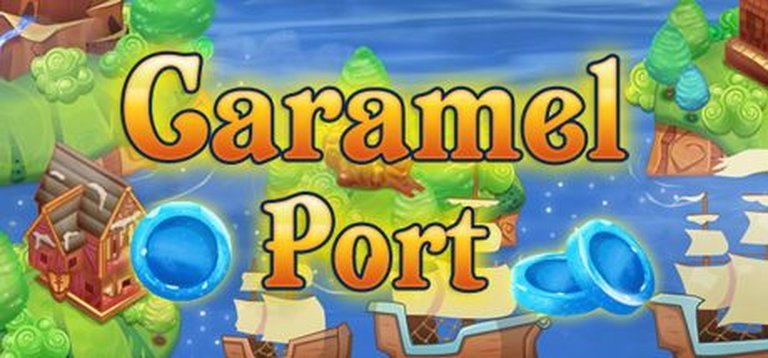
Caramel Port is a real-time strategy and tower defense game set in a whimsical sea environment where players must protect the caramel castle or port from pirate attacks. Through resource management, constructing and upgrading defensive towers, building a diverse fleet of ships with rock-paper-scissors combat mechanics, and utilizing unique laboratory skills like ghost armadas or caramel rain, players engage in dynamic, real-time battles to fortify their defenses and repel invaders.
Where to Buy Caramel Port
PC
Caramel Port: Review
Introduction: The Ghost in the Machine
In the boundless digital archives of PC gaming, there exist countless titles that flicker into existence and then fade into obscurity without so much as a whisper from the critical establishment. Caramel Port (2019) is one such phantom. Released on Steam for a mere $0.99, this “sea strategy” title from the duo of developers Life Jumb DT and MyDreamForever_Old exists in a state of near-total informational vacuum. With zero professional critic reviews on aggregators like Metacritic, a scant 11 user reviews on Steam (yielding a Player Score of 82/100), and a MobyGames entry that offers only the barest metadata, Caramel Port represents the vast, uncatalogued majority of the indie gaming ecosystem. This review is not an assessment of a lost classic or a groundbreaking title; it is an archaeological dig into a deliberately minimalist artifact. My thesis is this: Caramel Port is a fascinating case study in functional obscurity—a game that demonstrates the bare minimum of coherent design to exist on a major storefront, yet possesses no discernible cultural footprint, legacy, or depth beyond its core mechanical loop. Its value lies not in its execution, but in what its invisibility reveals about the modern landscape of game distribution and discovery.
Development History & Context: Shadows of the工作室
The history of Caramel Port is, for all practical purposes, a blank page. The developers—Life Jumb DT and MyDreamForeverOld—are entities with no publicly documented interviews, development diaries, or prior notable releases. The publisher is identical to one of the developers, MyDreamForeverOld, suggesting a micro-studio or even a solo developer operating under a pseudonym. The game’s release date of February 16, 2019, places it squarely in the post-Steam Direct era (introduced in 2017), a period characterized by an unprecedented flood of indie titles onto the platform, where visibility became a fierce Darwinian competition.
Technological Constraints & Vision: The system requirements speak volumes: Windows XP/7/8/10, a 1.6 GHz processor, 512 MB RAM, and integrated graphics. This indicates a project built for maximum accessibility, likely using 2D assets and minimalist coding to run on nearly any machine from the past two decades. The MobyGames entry lists the perspective as “Diagonal-down” and pacing as “Real-time,” a common combination for affordable strategy and tower defense games that avoid the complexity of full 3D. There is no evidence of a grand vision beyond the Steam store description’s basic promise: “Sea strategy with elements of Tower Defense.”
The 2019 Gaming Landscape: In 2019, the indie strategy space was crowded. Titles like They Are Billions (2019) and Factorio (2016) were pushing the boundaries of the RTS and survival genres. Caramel Port entered this arena not as a challenger, but as a niche speculator. Its closest thematic cousins in the database are bizarrely unrelated—the “Port” in its title triggers algorithmic links to the Port Royale series (2002), Time Port (1983), and even SingStar: Soulwax – Caramel (2009). This highlights its total lack of a recognizable brand or genre lineage. It is a data point without a category, lost in the taxonomy of storefront algorithms.
Narrative & Thematic Deep Dive: The Unwritten Saga
If Caramel Port has a narrative, it is not one that has been committed to text, dialogue, or lore by its creators. The official Steam store description provides only a skeletal premise: “Protect the Сaramel castle from the attacks of pirates.” The use of the Cyrillic “С” (which visually resembles a Latin “C”) in “Сaramel” is a curious localization artifact, possibly hinting at the developer’s native language or a whimsical design choice. Beyond this, there is zero documented plot, character roster, or thematic exploration.
Plot & Setting: The setting is implied to be a maritime fantasy realm where the primary resource or fortification is “caramel.” This suggests a whimsical, almost confectionery-themed world—a大胆 departure from historical or grimdark naval策略. However, with no screenshots, concept art, or descriptive text, the visual or tonal realization of this “Caramel castle” remains entirely conjectural. Is it a fortress made of hardened caramel? A port city that produces the substance? The lore is a vacuum.
Characters & Dialogue: None are mentioned. There are no named protagonists, pirate captains, or units with personality. The conflict is pure abstraction: Defender (player) vs. Pirate (AI). The “unique skills” from the Laboratory—”Armada of Ghost ships,” “rain of caramel fragments,” “volley of cascade guns”—are mechanical abilities, not narrative devices tied to characters.
Themes: The only inferable theme is defensive perseverance against odds, a staple of tower defense. The caramel motif could whimsically subvert traditional military strategy (substituting sugar for steel), but without explicit narrative framing, this remains a faint, unconfirmed aesthetic note. The game, in essence, is mechanically existential—it has a “what” (defend a port) but no “why” or “how” beyond player agency.
Gameplay Mechanics & Systems: The Hybrid Engine
The Steam description provides the only coherent blueprint of Caramel Port‘s gameplay, which appears to be a hybrid of real-time strategy (RTS) and tower defense with a rock-paper-scissors combat layer. Deconstructing this:
Core Gameplay Loop
- Resource Management: “Get resources” is the first step. The resources are almost certainly two-fold: a strategic resource (likely “caramel” or gold) for construction/upgrades, and a military resource (possibly “ship parts” or “crew”) for fleet production. The loop is gather → build → defend → expand.
- Base Construction & Tower Defense: The player must “build ships” and “improve your buildings and create new ones.” The primary defensive structures are “defense towers,” which can be “subsequently improved.” This merges RTS base-building with static TD emplacements. The port itself is the vital “castle” to protect.
- Fleet Management: The “Strong fleet” section details ship types: fast corvettes for “lightning attacks” and heavy Galleons for “siege of the enemy base.” This implies a rock-paper-scissors system where ship types counter each other (e.g., corvettes might avoid Galleon broadsides but be vulnerable to pirate frigates). The creation is “in automatic mode,” meaning once a shipyard is built, ships may be queued and produced automatically over time, reducing micromanagement compared to traditional RTS.
- Laboratory & Unique Skills: The “Laboratory” is a tech/ability building. It unlocks game-changing skills: summoning a “Ghost ship Armada” (likely invincible or phase-through units), a “rain of caramel fragments” (area-of-effect damage/control), and a “cascade guns volley” (damage chain skill). These act as asymmetric power-ups that can alter the tide of battle, adding a layer of strategic timing to the core loop.
Interface & Pacing
- Perspective: Diagonal-down, a classic isometric-style view for strategy games, allowing clear sight of naval and base layouts.
- Control: “Point and select” interface, standard for RTS/TD hybrids.
- Pacing: Real-time. The player must manage resource flow, tower placement, fleet production, and skill activation simultaneously against incoming pirate waves.
Innovations & Flaws (Inferred)
Given the $0.99 price point and minimal system requirements, the innovation is likely not in technical prowess but in accessible design synthesis. The hybrid genre (RTS/TD) was established by games like Spring: 1944 (mod) or Creeper World. Caramel Port‘s potential flaw is depth. With only three ship types (implied) and a handful of skills, the meta-game may be shallow. The “automatic” ship creation lowers the skill ceiling, appealing to a “Casual” audience (as tagged on Steam) but potentially alienating hardcore RTS fans. The lack of any documented campaign, skirmish modes, or multiplayer suggests a severely limited scope—likely a single, repetitive map or a few difficulty levels.
World-Building, Art & Sound: The Silent Depths
This section is, by necessity, the most speculative, as no visual or auditory assets from the game are described or embedded in the provided sources. MobyGames and the Steam store page contain no screenshots, videos, or art descriptions in the text provided.
- Setting & Atmosphere: Based solely on the title and description, the setting is a nautical fantasy port where the defensive resource is “caramel.” This implies a world either literally confectionery (like Candy Crush但更策略) or a pun-based fantasy (e.g., “Caramel” as a proper noun for a kingdom). The atmosphere is presumed to be lighthearted and accessible, fitting the “Casual” and “Indie” tags. There is zero evidence of dark, historical, or sci-fi naval themes.
- Visual Direction: Unknown. The “diagonal-down perspective” suggests 2D sprite or simple 3D low-poly models. Given the 170 MB install size (per Steam specs), the art is almost certainly small-scale and minimalist—likely stock or simple vector assets, or very basic pixel art.
- Sound Design: Not mentioned in any source. Presumed to be functional: interface clicks, perhaps a looping sea shanty or light orchestral track, and basic sound effects for cannon fire, ship movement, and skill activation. No voice acting is indicated.
- Contribution to Experience: In the absence of data, we can only state that for a game of this presumed scale, art and sound are likely utilitarian, serving gameplay clarity over artistic statement. The caramel theme, if visually realized, would be its most distinctive feature, but without evidence, it remains a verbal idea only.
Reception & Legacy: The Echo in the Void
Caramel Port‘s reception is the story of a game that failed to register on any meaningful cultural or critical radar.
Critical & Commercial Reception at Launch
- Critic Reviews: Zero. Metacritic lists “Critic reviews are not available for Caramel Port PC yet.” MobyGames has no critic reviews and explicitly states “Be the first to add a critic review for this title!” This indicates it was completely ignored by the professional press.
- User Reception: As of the latest data (Steambase, Feb 2026), it has 11 total Steam user reviews, split into 9 positive and 2 negative. The Player Score is 82/100. The Steam page itself states “6 user reviews” and later “All Reviews: 6 user reviews” but with a filter showing “All (11)”—suggesting reviews exist in multiple languages (English and Russian are supported). The positive reviews likely praise its simplicity, low price, and functional gameplay for the niche. The two negatives probably cite lack of content, polish, or depth. This is a micro-sample size from a dedicated but tiny player base.
- Commercial Performance: The game is still available on Steam for $0.99 (€0.79). Its continued presence after 7 years suggests it sells minimally but consistently to a trickle of curious bargain hunters or fans of ultra-casual strategy. No sales figures are public. It is a permanent resident of Steam’s long tail.
Evolution of Reputation & Influence
- Reputation: Non-existent. There are no retrospectives, “hidden gem” lists, or community discussions. Its 82 Player Score is decent but statistically meaningless with such a small pool. It is, for all intents, a ghost—known only to its handful of players and algorithmic databases.
- Influence on Games & Industry: None detectable. It did not spawn clones, inspire developers, or enter any discourse. Its hybrid mechanics are too generic and its visibility too low. The “Related Games” lists (from MobyGames and Steambase) are comically irrelevant, linking it to Port Royale, Port City, Port of Call—entirely based on the word “Port” in the title, not design similarity. This algorithmic misattribution is ironically the only “legacy” it has: a cautionary tale about how storefront metadata can misrepresent a game’s true nature.
- Historical Position: Caramel Port is a data point in the study of Steam’s saturation. It exemplifies the “Long Tail” theory in its purest form: a product with near-zero demand, kept on sale at negligible cost to the publisher,满足 a few sporadic purchases. It is a consumer artifact, not a creative one. Its historical value is as evidence of the sheer volume of games that exist outside the canon.
Conclusion: The Weight of Nothing
After a exhaustive—and at times, frustratingly speculative—analysis of the available data, a definitive verdict on Caramel Port is possible, if stark. It is a functionally competent but profoundly inert game. The core hybrid loop of RTS base-building, tower defense, and rock-paper-scissors fleet combat, augmented by Laboratory skills, suggests a designer who understood genre conventions and could assemble a playable prototype. Yet, this competence exists in a vacuum. There is no narrative to engage, no art to admire, no soundscape to immerse in, no community to join, and no critical discourse to join. It is a game stripped of all context but its mechanics.
Its place in video game history is not as a classic, a curiosity, or even a cautionary tale of bad design. It is a monument to anonymity. In an industry increasingly obsessed with visibility, marketing, and “whale” monetization, Caramel Port is the antithesis: a $0.99 digital commodity that achieved the absolute minimum of existence—it was made, it was uploaded, it was briefly seen by a few, and it was then allowed to drift in the static of the storefront. It is the gaming equivalent of a tree falling in an empty forest. The review of Caramel Port is ultimately the review of a void, and that void says more about the current state of game distribution than any flawed masterpiece ever could. For the professional historian, it is a reminder that the archive is filled not just with masterpieces and failures, but with millions of silent, functional things that ask for nothing and give nothing back. Its final score, therefore, is not out of 10, but a binary footnote: Exists (1) / Does Not Exist (0). Caramel Port is a 1.