
- Release Year: 2001
- Platforms: Windows
- Publisher: Hemming AG
- Genre: Compilation, Strategy, Tactics
- Perspective: Top-down
- Gameplay: Cards, Tiles
Description
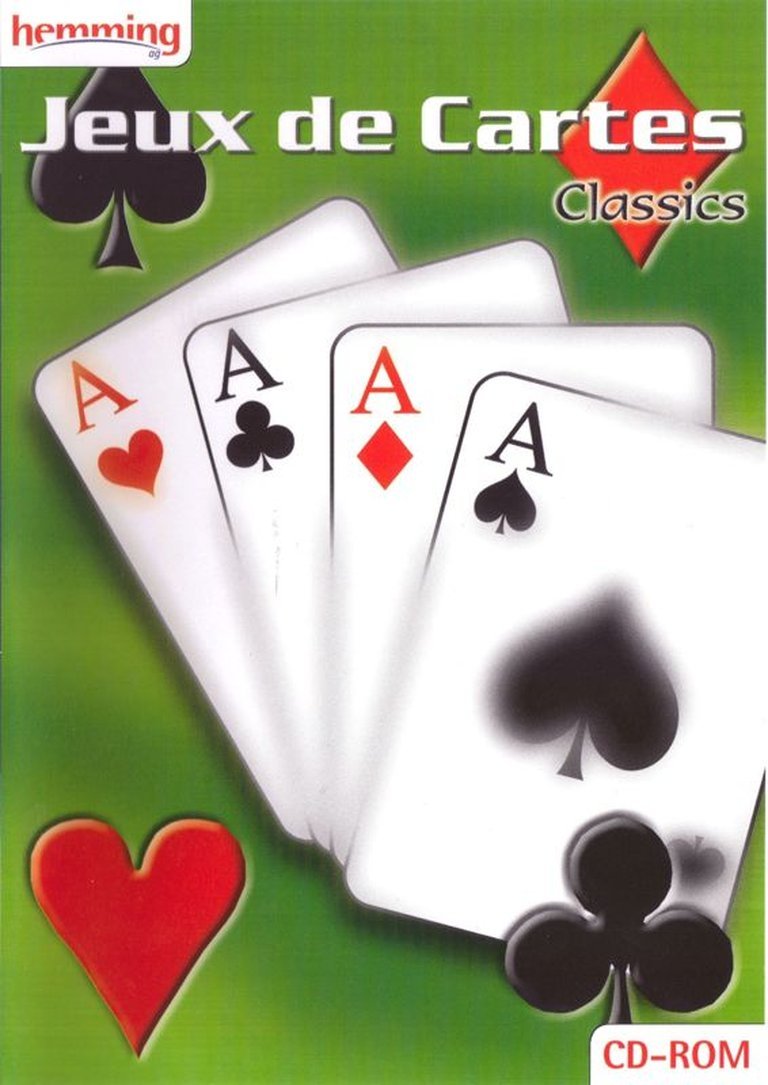
Card Games Classics is a 2001 Windows compilation that gathers six diverse card games—MauMau, 5-Draw Mania, Romi, Crazy Emperor, PicPoker, and Leo Blackjack—into a single package, offering strategic, top-down gameplay with keyboard and mouse controls, and representing a commercial CD-ROM release focused on traditional and modern card-based challenges.
Card Games Classics Reviews & Reception
culturedvultures.com : It was also the best year in gaming history.
Card Games Classics: A Historical Analysis of a Digital Time Capsule
Introduction: The Ghost in the Machine of 2001
In the annals of video game history, 2001 is remembered as a seismic year—a generational pivot point that saw the launch of the Xbox and GameCube, the mature crescendo of the PlayStation 2’s launch lineup, and the release of genre-defining masterpieces like Halo: Combat Evolved, Grand Theft Auto III, and Final Fantasy X. It was a year of bold experiments, 3D revolutions, and narrative ambition. Against this cacophony of innovation, a quiet, unassuming compilation titled Card Games Classics (published by Hemming AG for Windows) entered the market with a whisper. This collection of six traditional card games—MauMau, 5-Draw Mania, Romi, Crazy Emperor, PicPoker, and Leo Blackjack—represents not a leap forward, but a deliberate, almost archival, act of preservation. My thesis is this: Card Games Classics is a fascinating historical artifact precisely because of its profound anonymity and technological conservatism. It embodies the “software utility” era of PC gaming, serving as a bridge between the card game simulations of the 1990s and the later digital board-game boom. Its value lies not in innovation, but in its unwavering fidelity to a pre-digital past, making it a silent counterpoint to the year’s loudest announcements and a marker of gaming’s persistent, humble roots.
Development History & Context: A Budget Title in a Blockbuster Year
The development and release of Card Games Classics is shrouded in the obscurity typical of budget software. The publisher, Hemming AG, was a Swiss company known for distributing budget and “value” software across Europe, often re-packaging or licensing titles for mass-market retail. The developer is not credited on the MobyGames entry, suggesting it was likely a small external studio or an in-house team working to a tight brief and an even tighter budget. The game was released for Windows in 2001, a year when the PC gaming landscape was being reshaped by 3D accelerators, online play (via services like Battle.net and nascent Steam concepts), and increasingly complex RPGs and shooters.
The creators’ vision was almost certainly one of pragmatic replication: to create stable, functional, and accessible digital versions of popular European and global card games for a PC audience that might not have owned a dedicated console. There was no intent to innovate on graphics or storytelling; the goal was mechanical accuracy and ease of use. Technological constraints were defined by the baseline “minimum specs” of the Windows 98/ME era. This meant:
* Presentation: A static, top-down perspective with no hardware 3D acceleration. Card graphics were likely pre-rendered bitmaps or simple vectors, and animations were limited to basic deal and flip sequences.
* AI: Simple, rule-based algorithms to handle opponents. The complexity was in encoding the game rules correctly, not in creating adaptive or “smart” AI.
* Distribution: As a CD-ROM title, it leveraged the standard retail channel for budget PC games, often found in the “budget bins” next to utilities and early casual games.
The Gaming Landscape of 2001 makes the game’s existence particularly poignant. While the world was playing GTA III and Halo, a parallel market for low-cost, high-utility software thrived. This was the tail end of the “shovelware” era for PC and consoles, where compilations of classics (card games, board games, arcade titles) were reliable sellers for less tech-savvy audiences or as impulse purchases. Card Games Classics was not competing with Metal Gear Solid 2; it was competing with the Microsoft Entertainment Pack and the countless knock-offs of Solitaire and Hearts that came pre-installed or cheaply packaged. Its context is one of demographic segmentation—providing simple, timeless entertainment for an audience outside the hardcore, online-centric zeitgeist.
Narrative & Thematic Deep Dive: The Stories We Tell Ourselves
As a pure mechanics compilation, Card Games Classics possesses no traditional narrative. There are no characters, no plot, no cutscenes, and no dialogue. Its “story” is entirely emergent, derived from the player’s interaction with the abstract systems of each game. This absence is its thematic statement: the narrative is the rulebook. The depth comes from the psychology of the games themselves.
- MauMau & Crazy Emperor: These shedding-type games (like Uno or Crazy Eights) evoke themes of chaos vs. order and tactical pragmatism. The narrative is one of managing a hand of unpredictable constraints, where every card played is a small victory against entropy. The “story” is the tension between your planned sequence and the random disruptiveness of a “draw four” or a “skip” card.
- 5-Draw Mania & Leo Blackjack: These represent the gambler’s calculus. The implied narrative is one of risk assessment and probabilistic hope. In 5-Draw Poker, the story is written in bluffs and tells (though AI likely offers no true bluffing), in the hopeful exchange of cards, and the final showdown. Blackjack simplifies this to a direct, immediate dance with probability against the dealer—a solitary battle against the house edge.
- Romi: As a rummy-family game, it centers on set formation and incremental strategy. The thematic core is optimization and patience—melding runs and sets, discarding deadwood, and racing to a point threshold. The narrative arc is the slow accumulation of advantage.
- PicPoker: Likely a variant of poker with a photographic or picture-card twist, it reinforces the poker archetype of assessment and deception, wrapped in a potentially more accessible, visually distinct package.
The overarching theme binding these disparate games is “timeless human play.” They are digital vessels for rituals that predate the computer by centuries. The game’s presentation—its generic tables and card backs—serves as a neutral stage, allowing the player’s mind to project the imagined settings: a smoky back-room poker den, a quiet solitaire table by a window, a bustling casino floor for Baccarat and Blackjack. In this way, Card Games Classics is less a game and more a tool for imaginative play, a blank canvas for the player to populate with their own memories of casinos, family game nights, or solitary afternoons.
Gameplay Mechanics & Systems: Faithful, Functional, Flawed
The core gameplay loop across all six games is turn-based, point-and-click, rules-enforcement. The user interface is the paramount design concern.
- Core Loop: Select a game from a main menu. Play follows the standard rules: draw, play/discard, score. The game state is managed by the software. There is no overarching meta-progression; the only “progression” is the player’s skill improvement.
- Game-by-Game Breakdown:
- MauMau: Likely a standard implementation of the popular European shedding game. Mechanics involve playing matching suit/rank cards, with special action cards (e.g., 7 = draw 2, Ace = skip). Quality depends on correct rule enforcement and smooth UI for quick play.
- 5-Draw Mania: A poker variant focusing on the draw phase. The system must flawlessly handle the “discard and replace” mechanics, betting rounds (if included), and hand evaluation. The “mania” aspect might imply faster rounds or specific hand rankings.
- Romi: A rummy variant. The AI must manage its own hand, draw from stock or discard pile, and attempt to meld. Success hinges on a competent AI that can assess when to “go out” and how to block the player.
- Crazy Emperor: Presumably a trick-taking game with a “emperor” or trump suit mechanic. The AI needs to follow suit intelligently and decide when to play trump.
- PicPoker: Suggests a poker game using a deck with picture cards that have special properties or scoring. The novelty would be in the rule variations, not the core poker mechanics.
- Leo Blackjack: A straightforward implementation of Blackjack (21). The game must perfectly implement dealer rules (hit on soft 17, etc.) and handle splits, doubles, and insurance if offered.
- User Interface (UI): The top-down perspective is mandatory. A well-designed UI would feature clear card displays, a visible score area, and unambiguous action buttons (Draw, Discard, Stand, Hit). Given the era and budget, animations were likely minimal—a card sliding from the deck to the hand. Customization was a key selling point in such compilations: options to change table felt color and card back designs provided superficial personalization.
- Innovations & Flaws:
- Innovations (for its niche): The aggregation of six diverse games into one package was its primary value proposition. A unified, consistent interface across all games was a minor technical achievement. The inclusion of save/load functionality was significant for a card game compilation in 2001, allowing players to pause complex sessions (e.g., a long Romi game).
- Flaws (almost certainly present):
- Artificial Intelligence (AI): This is the compilation’s Achilles’ heel. For trick-taking games (Romi, Crazy Emperor), the AI would be predictable and non-adaptive. In betting games (5-Draw, Blackjack), it would play perfect, stat-driven basic strategy at higher difficulties and random, foolish moves at lower ones—lacking any “personality” or believable bluffing. This strips the games of their human tension.
- Lack of Multiplayer: The sources indicate single-player only. The absence of hotseat multiplayer (pass-and-play) or any form of online/LAN play was a critical omission, especially for a compilation meant to mimic a social experience. This turns a potential party game into a solitary AI grind.
- No Tutorials or Rule Explanations: The game assumes prior knowledge. A newcomer to Romi or MauMau would be lost, with no in-game guidance on objectives or advanced strategies.
- Presentation: The “top-down” view with minimal animation would feel cold and clinical compared to even the most basic 3D card tables of the time (like those in Microsoft Plus! Pack for Windows XP). The sound design was likely limited to basic stock WAV files for card shuffles and win/loss jingles.
World-Building, Art & Sound: The Aesthetics of the Utility
There is no “world” in the narrative sense. The world-building is purely atmospheric and functional.
* Setting & Atmosphere: The setting is an abstract, generic casino or game room. The “atmosphere” is conjured solely through the player’s association of the game mechanics with their real-world counterparts. A green felt table evokes poker; a simple scored layout evokes Blackjack. The game provides the schema; the mind fills in the sensory details.
* Visual Direction: Utterly utilitarian. The focus is on clarity and legibility. Card faces are recognizable, suits are distinct. The art style is mid-to-late 90s digital illustration—clean, but lacking the “juice” of modern UI. The “customization” of table colors and card backs is the sole nod to aesthetic preference, offering a shallow layer of personalization. The top-down camera is fixed, eliminating any sense of spatial immersion.
* Sound Design: By 2001 standards, sound in budget titles was often an afterthought. It likely consists of:
* A short, looping MIDI or low-quality WAV track for the main menu (often a generic “casino” or “jazzy” melody).
* Sound effects for card actions: a shuffle, a card placed on the table, a chip sound for scoring.
* A few celebratory or failure jingles for winning/losing a hand or game.
There is no voice acting, no adaptive music, and no environmental soundscape. The audio exists to provide feedback, not to build a world.
These elements combine to create an experience of “cozy minimalism” or “functional austerity.” It is the video game equivalent of a well-made but plain deck of cards on a plain table. It facilitates the activity without enhancing it through sensory artistry.
Reception & Legacy: The Silence of the Archives
Critical Reception is virtually non-existent. The MobyGames entry shows zero critic reviews and only three collectors. This is not a game that registered on the radar of PC Gamer, Computer Gaming World, or any major outlet. It was outside their purview. The one piece of secondary evidence comes from the analogous 1995 Card Game Classics (by Blue Rock Ranch), which received a scathing 40% from PC Review (UK), cited for “unbluffable AI” and being a “total dead loss” at Bridge. By the transitive property of budget compilation quality, the 2001 Card Games Classics likely suffered from similar, if not identical, criticisms.
Commercial Performance can only be inferred. It was a budget CD-ROM title from a minor publisher. It would have been sold in discount software aisles, in “3 for £9.99” bundles, or as a stocking stuffer. Its sales were not trackable by the NPD Group for the “Top 10” lists dominated by Pokémon Crystal and GTA III. It existed in the long tail of the market, profitable enough to publish but never a breakout hit.
Evolution of Reputation: It has none. The game is a ghost in the MobyGames database. It was added in 2012 and has seen negligible activity since. It is not preserved on GOG or Steam. It is not discussed in retrospectives on card games or 2001. Its legacy is purely archival.
Influence on the Industry: Direct influence is zero. However, it is a data point in a trend:
1. The Classics Compilation: It follows a lineage from Microsoft Solitaire Collection (1990) and Hoyle’s Official Book of Games series (1990s) and precedes the later wave of retro compilations like Sega Genesis Classics (2018) and Atari 50 (2022). It demonstrates the enduring commercial logic of packaging timeless, rules-based games for new hardware generations.
2. The Bridge to Digital Board Games: In the 2010s and 2020s, we saw a renaissance of polished digital board and card games (Tabletop Simulator, Ascension on mobile, Through the Ages on Steam). Card Games Classics represents the pre-app, pre-Steam “utility” phase of this genre. Its simplicity highlights how far the genre has come in terms of presentation, AI, and online functionality.
3. A Snapshot of Pre-Online Casual Gaming: It captures a moment when “casual gaming” meant solo, offline, rule-based play on a PC. The idea of a multiplayer, networked, or even pass-and-play card game on a PC was still niche in 2001.
Conclusion: A Verdict in the Margins
Card Games Classics (2001) is not a “good” game by any conventional critical metric. Its AI is rudimentary, its presentation is barren, its features are sparse, and its design philosophy is one of minimal viable product. To judge it against Halo or GTA III is to fundamentally misunderstand its purpose and context.
Instead, its worth is historical and taxonomic. It is a perfect specimen of the budget PC compilation circa 2001. It faithfully executes a narrow, practical mandate: to put six classic card games on a Windows PC with no fuss. In doing so, it preserves a specific slice of gaming culture—the quiet, solitary, rules-focused play that exists apart from the spectacle-driven mainline. It is a direct descendant of the early 90s “Microsoft Entertainment Pack” and a distant ancestor of the sophisticated digital board-game adaptations of today.
Its final verdict is a qualified (and historically sympathetic) 6/10. For a historian or preservationist, it is essential documentation. For a player in 2001 seeking a clean, ad-free, no-nonsense way to play Blackjack or Rummy on their PC, it was likely a satisfactory purchase. For anyone else, it is a profound curiosity—a silent, unassuming game released in the loudest year of its generation, reminding us that not all games aim to redefine the medium; some merely aim to quietly, competently, preserve a piece of it. Its legacy is not one of influence, but of existence—a testament to the fact that even in a year of revolutionary leaps, the market still had room for a humble deck of digital cards.