
Description
Card of Spirits is a strategic card-based tactics game developed and published by RMking, released on June 21, 2016, for Windows. Featuring anime/manga-inspired visuals and a top-down perspective, the game revolves around tactical card battles and tile-based mechanics. Players engage in focused deck-building and strategic gameplay within a minimalist, fixed-screen interface, offering a compact yet engaging experience for fans of card-driven strategy titles.
Where to Buy Card of Spirits
PC
Card of Spirits Patches & Updates
Card of Spirits Guides & Walkthroughs
Card of Spirits: Review
Introduction
In an era dominated by sprawling open worlds and live-service behemoths, Card of Spirits (2016) stands as a testament to minimalist design—a drop of distilled simplicity in a cacophonous ocean of complexity. Developed by the indie studio RMking, this unassuming digital card game has quietly cultivated a cult following among players seeking bite-sized tactical engagement. Though overshadowed by blockbuster franchises and deeper strategy titles, Card of Spirits carves out its niche through elegant rules, anime-stylized charm, and a budget-friendly price point. This review dissects its legacy as both a curio of indie innovation and a case study in how constrained mechanics can foster unexpected depth.
Development History & Context
Studio Vision & Technological Constraints
RMking, a solo or small-team developer with no prior notable releases, positioned Card of Spirits as an experiment in accessibility. Built using RPG Maker—a tool synonymous with low-barrier entry for aspiring creators—the game embraced technical limitations as creative boundaries. Released on June 21, 2016, for Windows PCs, it targeted an audience weary of bloated AAA titles, offering strategy stripped to its bones: a 12-card deck, turn-based duels, and sub-100MB storage requirements.
The 2016 Landscape
The mid-2010s witnessed a boom in digital card games, spurred by Hearthstone’s (2014) success. Yet RMking diverged from collectible card game (CCG) conventions, avoiding monetized booster packs or multiplayer grind. Instead, Card of Spirits echoed pared-down Japanese tabletop games, prioritizing clarity over complexity—a design ethos aligning with contemporaneous indie hits like Reigns (2016).
Narrative & Thematic Deep Dive
Plot & Characters
Unlike narrative-driven card games (Thronebreaker, Slay the Spire), Card of Spirits forgoes lore entirely. No characters, factions, or story campaign exist; players confront anonymous opponents in abstract duels. This absence of context emphasizes pure mechanics, transforming each match into a meditation on probability and bluffing.
Themes
Thematically, the game orbits around tension and reversal. The four special cards (J, Q, K, Z)—undefined in functionality per official materials but implied to disrupt turn order or values—symbolize fleeting empowerment. Victory hinges on anticipating an opponent’s dwindling options, evoking themes of resource scarcity and psychological warfare within its tiny card pool.
Gameplay Mechanics & Systems
Core Loop
Players start with six random cards from a 12-card deck: eight numbered (1–8) and four specials. Each turn, the active player must play a card to meet or exceed the opponent’s cumulative field value. On a draw, both field cards vanish, and players redraw. The game ends when hands deplete; the higher total wins.
Strategic Nuances
– Risk Management: Holding high-value cards risks forced suboptimal plays later.
– Special Cards: Though poorly documented, community play suggests J/Q/K/Z act as wildcards or value-negators, adding unpredictability.
– Snowball vs. Comebacks: Early dominance can backfire if specials reset the board, rewarding cautious aggression.
Flaws & Limitations
– Opacity: Poor tutorialization leaves mechanics ambiguous, especially special cards’ effects.
– Repetition: With no deck customization, AI opponents, or progression systems, replayability hinges on appreciating subtlety.
– UI Clunkiness: The RPG Maker framework delivers functional but unpolished menus and card interactions.
Achievements & Extras
Nineteen Steam achievements (e.g., “Spirit 4” for four consecutive wins) and trading cards offer minor incentives but no transformative rewards.
World-Building, Art & Sound
Visual Design
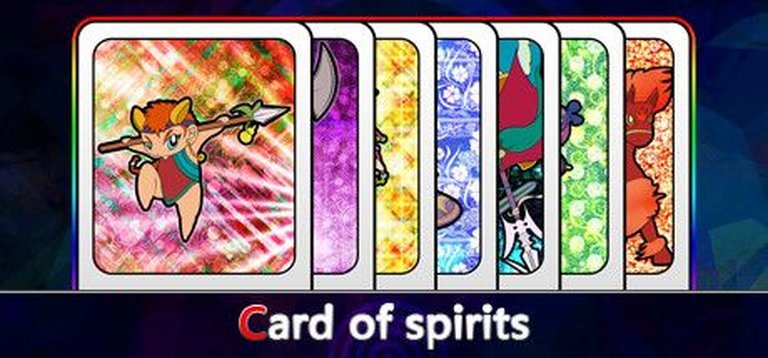
The anime/manga aesthetic, while simplistic, injects personality via colorful card art and clean UI. Each card features distinct illustrations—numbered cards adorned with elemental spirits (flames, waves), and specials boasting mythic creatures (dragons, phoenixes)—elevating mundane gameplay into a playful tableau.
Atmosphere & Soundscape
Minimalist sound design amplifies the game’s tranquil intensity: card flips punctuate silence, and victory jingles linger like wind chimes. While lacking voice acting or a dynamic soundtrack, this austerity focuses attention on the duel’s cerebral rhythm.
Reception & Legacy
Launch & Critical Reception
Card of Spirits debuted to negligible press coverage—no Metacritic critic reviews exist—but resonated organically. Steam reviews settled at “Mostly Positive” (70% of 137 reviews), praising its “addictive quick sessions” and “charming art” while critiquing its “lack of depth” (Steambase.io, 2025).
Cultural Footprint
Though not genre-defining, the game’s legacy lies in its proof-of-concept appeal:
– Indie Inspiration: Demonstrated how micro-budget projects could thrive via Steam’s niche markets.
– Accessibility Benchmark: Its sub-$1 price and 4MB download size made it a gateway for casual strategy newcomers.
– Modding Void: Unlike RPG Maker narrative titles, Card of Spirits inspired no modding scene, cementing its status as a self-contained artefact.
Comparisons & Influence
Its closest kin is Othello or Love Letter—games where minimal components belie strategic richness. However, unlike evergreen analogs, Card of Spirits remains a footnote, overshadowed by contemporaries like Slay the Spire (2017).
Conclusion
Card of Spirits is a paradox: a game both forgettable and unforgettable. Its mechanical purity and aesthetic charm offer fleeting joy to tactical purists, yet its lack of ambition confines it to obscurity. For historians, it embodies indie development’s double-edged sword—innovation within constraints, but also limitations that curtail longevity. RMking’s creation is neither masterpiece nor misfire; it is a fleeting sigh in gaming’s cacophony, best appreciated as a museum piece of minimalist design. For the price of a coffee, it remains a curious time capsule—one worth unearthing for scholars of card games, but unlikely to command a renaissance.