
- Release Year: 2007
- Platforms: Windows
- Publisher: PLAY Sp. z o.o.
- Genre: Compilation
- Perspective: Top-down
- Game Mode: Single-player
- Gameplay: Arcade, Puzzle, Simulation
- Average Score: 82/100
Description
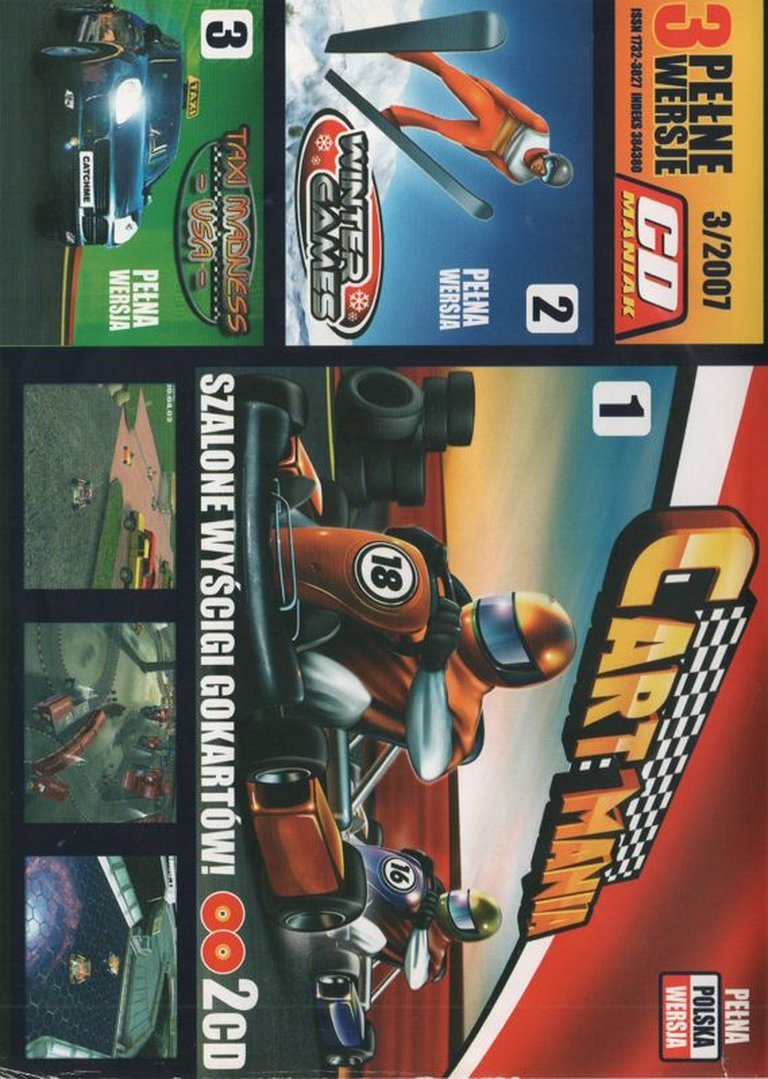
Cart Mania / Winter Games / Taxi Madness USA is a 2007 compilation game for Windows that includes three distinct games: Cart Mania, Winter Games, and Taxi Madness USA, along with 10 demos and 2 puzzle programs. This collection offers a variety of gameplay experiences, from racing simulations to winter-themed challenges and taxi driving adventures, catering to fans of diverse gaming genres.
Cart Mania / Winter Games / Taxi Madness USA Reviews & Reception
myabandonware.com : Genuinely one of the worst games I’ve ever played.
gamepressure.com (82/100): Cart-Mania’s visuals clearly stand out from the standards of modern racing games in terms of quality.
Cart Mania / Winter Games / Taxi Madness USA: Review
Introduction
In the crowded landscape of mid-2000s PC gaming, compilations offered a tempting value proposition: a bundle of games, demos, and utilities for a single price. Released in June 2007 by Polish publisher PLAY Sp. z o.o., Cart Mania / Winter Games / Taxi Madness USA exemplifies this era’s budget-friendly approach. It promises a trio of driving experiences—kart racing, winter sports, and taxi chaos—supplemented by filler content. Yet, as a historical artifact, it represents a fascinating microcosm of pre-distribution digital history: a product designed for low-end hardware, regional markets, and minimal expectations. This review deconstructs its components, contextualizes its creation, and evaluates its place as a footnote in gaming annals, arguing that while technically competent in execution, it remains a symbol of derivative design and missed opportunity in an era rapidly evolving toward digital storefronts and indies.
Development History & Context
The compilation emerged from PLAY Sp. z o.o., a Polish studio/polisher known for budget titles targeting regional markets. Its 2007 release coincided with a pivotal moment: the PC gaming scene was transitioning from physical CD-ROM dominance to digital distribution (Steam, Xbox Live Arcade), while consoles like the Wii and PS3 were reshaping mainstream tastes. Technologically, it was unremarkable: Cart Mania required a mere Pentium III 1 GHz with 512 MB RAM and a 32 MB graphics card (placing it below mid-tier hardware of the era). This reflected the studio’s pragmatic vision: create accessible, low-overhead experiences for casual players, children, or markets without high-end PCs. The compilation model itself—bundling ten demos, two puzzle programs, and three full games—was a holdover from the 1990s, where publishers maximized CD-ROM space to justify shelf space. However, its generic mechanics and lack of innovation positioned it far from contemporary titles like Mario Kart DS or Project Gotham Racing 3, underscoring a gap between global AAA trends and localized budget productions.
Narrative & Thematic Deep Dive
Narrative is conspicuously absent across all three titles. Cart Mania reduces racing to pure arcade functionality: players select from four go-kart models to navigate 16 tracks, with no lore, characters, or story context. Similarly, Winter Games—despite its thematic promise—offers no plot, only abstracted sports events. Even Taxi Madness USA, which implies a narrative of urban chaos, delivers no dialogue, characters, or overarching mission. This absence isn’t an oversight but a deliberate design choice, aligning with the compilation’s philosophy: gameplay as pure, context-free action. Thematically, Cart Mania channels childlike whimsy with its cartoonish karts and spin-heavy collisions, while Taxi Madness USA leans into arcade absurdity. Yet, without deeper themes (e.g., competition in Winter Games or the “madness” implied by its title), the games remain hollow shells—vehicles for mechanics rather than experiences.
Gameplay Mechanics & Systems
The compilation’s core strength lies in its mechanical clarity, albeit executed with diminishing returns.
-
Cart Mania: Its kart-racing loop is simple but functional. Players choose from four identically handling karts for training or races against AI. The standout mechanic is its collision system: impacts trigger instant 180-degree spins and speed loss, creating chaotic but predictable races. Tracks are “tightly twisted,” emphasizing drifts over speed, but the AI is rudimentary, offering little challenge. Power-ups are absent, reducing strategy to lane discipline. The system works but feels archaic compared to Mario Kart’s item-based depth.
-
Winter Games: Largely undocumented, its mechanics likely mirror low-budget sports titles: isolated events (e.g., skiing, sledding) with physics-lite controls. No details survive, but its inclusion suggests minimal innovation.
-
Taxi Madness USA: Derived from a 2002 German title (Der Taxi Racer in den USA), it swaps realism for arcade chaos. Players navigate US cities in first- or third-person, but gameplay specifics are vague. Presumably, it involves time-based challenges or fare collection, yet no unique systems distinguish it from generic racers.
The surrounding demos and puzzles add no value, serving as filler. UIs are bare-bones: minimalist menus and HUDs prioritize functionality over flair. Character progression is nonexistent; races reset with no unlocks, emphasizing replayability through track mastery—a hollow promise given the AI’s simplicity.
World-Building, Art & Sound
The compilation’s visual and audio design reflects its budget constraints, prioritizing functionality over artistry. Cart Mania’s environments are “very poor in detail,” with generic textures, flat lighting, and rigid track layouts. Karts, while varied, lack personality, resembling plastic toys. Winter Games’ winter landscapes, though unexplored in sources, likely feature similar sparse environments. Taxi Madness USA’s urban settings, referencing the USA, offer no regional specificity—generic streets replace iconic locales. Sound design is undocumented, but typical of budget titles: repetitive engine loops, absent music, and minimal effects. The overall aesthetic is one of functional mediocrity—serviceable for low-end PCs but visually forgettable. Only Cart Mania’s “skillful” driving model (as noted by GamePressure) provides a redeeming tactile feel, albeit one undermined by its collision mechanics.
Reception & Legacy
At launch, the compilation received minimal critical attention. MobyGames records no critic reviews, and its sole player rating—a tepid 3.0/5—reflects obscurity rather than acclaim. Contemporary sources like MyAbandonware capture player sentiment: one user deemed Cart Mania “one of the worst games ever played,” comparing it unfavorably to Big Rigs: Over the Road Racing for its lack of engagement. Yet, another admits a “soft spot” for nostalgia, hinting at a cult following for its scrappy charm. Commercially, it vanished without trace, overshadowed by genre giants. Its legacy is one of irrelevance: it never spawned sequels or influenced trends, unlike Mario Kart or Crazy Taxi. Instead, it exemplifies the disposable nature of budget compilations—ephemeral curios preserved only on abandonware sites like MyAbandonware, where it serves as a cautionary tale of derivative design in an industry hungry for innovation.
Conclusion
Cart Mania / Winter Games / Taxi Madness USA is a time capsule of mid-2000s budget gaming: technically functional but creatively barren. Its three core games offer distinct yet shallow experiences—cart racers, winter sports, and taxi chaos—stripped of narrative depth, visual polish, or mechanical innovation. While Cart Mania’s spin mechanic provides fleeting amusement and Taxi Madness USA hints at untapped potential, the compilation as a whole feels like a cynical assembly of filler. Its legacy is not in its gameplay but in its context: a product of a pre-distribution era, catering to regional markets with modest hardware, and ultimately forgotten as digital storefronts reshaped the industry. For historians, it’s a fascinating relic; for players, it’s a relic best left in the past. In the pantheon of gaming history, it occupies a dusty shelf—unremarkable, yet undeniably a product of its time.