
- Release Year: 2023
- Platforms: Nintendo Switch, PlayStation 4, PlayStation 5, Windows Apps, Windows, Xbox One, Xbox Series
- Publisher: AFIL Games, Tribus Games Indie
- Developer: Tribus Games Indie
- Genre: Puzzle
- Game Mode: Single-player
- Average Score: 52/100
Description
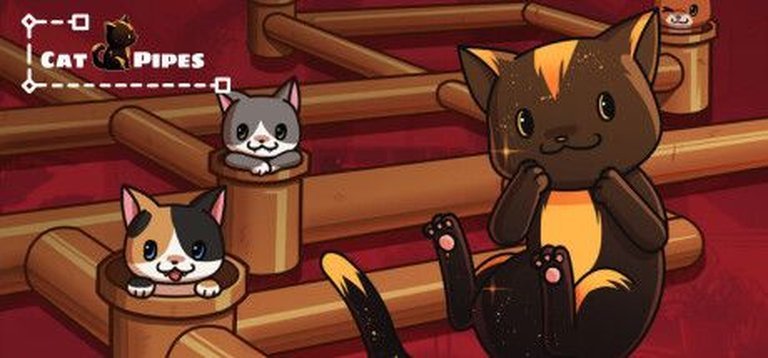
Cat Pipes is a puzzle game developed by Tribus Games Indie and released in 2023, where players connect pipes in a fixed-screen layout using a point-and-select interface. It offers a novel, cat-themed twist on classic pipe-connecting puzzles, available on multiple platforms including Windows, PlayStation, Xbox, and Nintendo Switch at an affordable price point, as noted in reviews for its modest yet engaging gameplay.
Where to Buy Cat Pipes
PC
Cat Pipes Guides & Walkthroughs
Cat Pipes Reviews & Reception
opencritic.com (45/100): Cat Pipes has a cute premise that isn’t executed well. Apart from lackluster graphics ,the tutorial is broken. While the puzzles are somewhat fun, there’s not much challenge and nothing beneath the surface.
metacritic.com (60/100): Cat Pipes is a neat little puzzler that will allow you the chance to while away an hour or so, an evening perhaps if you get stuck on the odd puzzle. But that’s about all you are going to get from it.
Cat Pipes: A Purr-spective on Minimalist Puzzle Design
Introduction: The Quiet Power of a Simple Mechanic
In an era of increasingly complex, narrative-driven, and mechanically dense video games, Cat Pipes arrives as a deliberate act of subtraction. This 2023 indie puzzle title from Tribus Games Indie (published in collaboration with AFIL Games) is not a game that seeks to awe with spectacle or immerse with story. Instead, it offers a singular, meditative proposition: rotate pipes to connect adorable cats to their food bowls. At first glance, it seems almost absurdly slight—a digital version of a children’s placemat puzzle. Yet, within this narrow design corridor, Cat Pipes carves out a distinct and surprisingly effective niche. This review argues that Cat Pipes is a fascinating case study in the “less is more” philosophy. Its legacy is not one of revolution, but of refinement; it demonstrates how a single, perfectly executed core loop, wrapped in a cohesive aesthetic of calm, can provide a genuinely satisfying experience, even if its ambitions and scope remain deliberately modest. It is a game that understands its purpose—to be a short, stress-free palate cleanser—and achieves it with quiet competence.
Development History & Context: An Indie Title in a Crowded Niche
Cat Pipes was developed by Tribus Games Indie, a small studio whose broader portfolio (as seen in their Steam bundles) consists primarily of casual, accessible puzzles and hidden object games like Jigsaw Puzzle Animals and Tiny Tales: Hidden Objects. This context is crucial. Cat Pipes is not a passion project from a renowned puzzle designer but a calculated, portfolio-appropriate entry into the saturated “casual puzzle” market, built in Unity—the engine of choice for thousands of small, multi-platform indie titles.
The game’s release in April 2023 places it amidst a thriving independent puzzle scene. The early 2020s saw a resurgence of minimalist, “chill” puzzlers (Dorfromantik, Townscaper, Potionomics‘s puzzle elements) that prioritized relaxation over punishing difficulty. Cat Pipes fits squarely into this trend, targeting players seeking a low-stakes cognitive exercise. Its simultaneous launch across Windows, PlayStation 4/5, Xbox One/Series, and Nintendo Switch speaks to a standard multi-platform release strategy for casual indies, aiming to capture the vast audience of hybrid “switch-off” gamers on consoles and the budget-conscious on Steam (where it launched at a mere $0.99/$1.99).
Technologically, the constraints are evident but embraced. The “fixed/flip-screen” visual style and “point and select” interface are not limitations but design choices that eliminate scrolling and complex navigation, keeping the player’s focus solely on the grid. The game’s existence is a testament to the low barrier to entry for polished, simple puzzle games in the modern indie ecosystem.
Narrative & Thematic Deep Dive: The Story of Connection (and Its Absence)
Cat Pipes presents one of the most minimalist narrative frameworks conceivable. There is no plot, no characters with dialogue, no lore. The “story” is implied solely through its title, visuals, and core mechanic: You exist to connect hungry cats to their food. This thematic core—connection—is the game’sonly narrative vessel.
The “narrative” unfolds across 45 distinct scenes, each a beautifully illustrated diorama. These vignettes tell micro-stories through environment: a cat napping on a sunlit windowsill, a trio of kittens playfully surrounding a bowl, a feline perched cautiously on a rooftop. The player’s action of rotating pipes is an act of caretaking and problem-solving that directly impacts these scenes. The reward for solving a puzzle is not a story beat but a visual and auditory payoff: the cat’s animation upon reaching the food (a little dance, a satisfied munch), and the pipes glowing with a warm, connected energy.
This absence of traditional narrative is its strength. It avoids the tonal whiplash of a game that might interrupt its peaceful puzzling with forced lore. The theme is universal and immediate: providing for a beloved pet. It taps into a primal, comforting instinct. The game becomes a digital pet-sitting simulation of the highest order, where the satisfaction is purely in the act of successful nurturing. The “story” is the player’s own progression from confusion to mastery, seeing more cats in more charming scenarios—a narrative of gentle accomplishment.
Gameplay Mechanics & Systems: The Elegance of the Single Loop
At its mechanical heart, Cat Pipes is a connection puzzle in the lineage of Pipe Mania and Netwalk. The core loop is beautifully, ruthlessly simple:
1. Observe: A grid (typically 4×4 to 6×6) contains pipes (with ends pointing in various directions), one or more “food source” tiles, and several “cat” tiles.
2. Rotate: Clicking/tapping a pipe segment rotates it 90 degrees counter-clockwise. The goal is to create a single, unbroken path from the food source that passes through the pipe under every cat tile.
3. Confirm: When all cats are connected to the food source via the pipe network, the path illuminates (turns red), the cats react, and the level is complete.
This loop is the entire game. There are no power-ups, no time limits, no move counters, and no penalties for incorrect rotations. The only “system” is a Restart button, which acknowledges that the puzzle’s challenge is purely logical.
Progression & Difficulty Curve: The 45-level structure follows a classic pedagogical curve:
* Levels 1-15 (Acclimation): Simple 3-4 pipe segments, one cat, clear paths. The goal is purely to teach the rotation mechanic and the “connect all cats” rule.
* Levels 16-30 (Complication): Introduction of “jump” or “teleport” pipes that connect non-adjacent tiles, increasing spatial reasoning demands. Grids become denser, often with more pipes than strictly necessary, creating “decoy” segments that must be ignored or used as connectors.
* Levels 31-45 (Refinement): Larger, more complex grids (6×6+), multiple food sources (requiring path separation), and intricate layouts where the order of rotation becomes critical. The challenge shifts from knowing what to connect to figuring out how to connect without creating closed loops or dead ends.
The genius is in the optional complexity. Not every pipe needs to be used. This introduces a layer of selection and omission, a subtle but significant cognitive leap from simple connection puzzles. The player must mentally filter the essential network from the decorative clutter.
UI & Controls: The interface is minimalist to a fault. On PC, mouse click is primary; on console, the ‘A’ button. Arrow keys or D-pad navigate between tiles (a crucial feature for precision on larger grids). The tutorial is widely cited as a major flaw—a series of cryptic pop-ups that fail to adequately explain the “connect all cats” rule or the jump pipes, leaving players to intuit mechanics through trial and error. This is the game’s single significant design misstep, creating an unnecessary barrier to its otherwise frictionless experience.
Innovation vs. Flaws: There is no profound innovation here. The “innovation” is in the thematic wrapping (cats) and the aesthetic commitment to calm. The flaw is the underdeveloped onboarding. The systems are not flawed, but they are exceedingly thin. This is a game built on a single, polished mechanic, and it never strays from that foundation.
World-Building, Art & Sound: The Cozy Catharsis
If the gameplay is the skeleton, the presentation is the warm, purring flesh. Cat Pipes’ world is not a “world” in an RPG sense, but a series of 45 cozy vignettes. The art style, as noted in the Gazettely review, employs a hand-drawn, sketch-like aesthetic with soft pastel palettes. This is not a high-fidelity cat simulator; it evokes children’s book illustrations or gentle indie animation. The cats are not hyper-realistic but charming, cartoonish archetypes: the sleepy tabby, the playful orange tom, the regal black cat.
This style serves a deliberate purpose: to lower cognitive load and induce calm. The soft edges and muted colors are visually undemanding. The “world” changes subtly between levels—a shift from a warm indoor scene to a moonlit garden, from a cluttered bookshelf to a simple tiled floor—providing enough visual variety to prevent monotony without demanding attention.
The sound design is equally instrumental. The soundtrack consists of gentle, minimalist melodies—often solo piano or soft acoustic guitar—that loop seamlessly. It is ambient Muzak for the soul, designed to wash over the player rather than engage them. Sound effects are equally soft: a gentle clunk when rotating a pipe, a satisfying chime upon connection, and the game’s star audio moment: the cat’s delighted meow or crunching sound upon reaching food. These are the primary rewards, carefully crafted to trigger a small dopamine hit of nurturing satisfaction.
Together, art and sound create a “hygge” or “wabi-sabi”-inspired atmosphere. It is a game that feels safe, soft, and free of jagged edges or startling moments. This cohesive sensory blanket is what allows the simple puzzle-solving to feel meditative rather than tedious.
Reception & Legacy: A Niche Success, Not a Benchmark
Cat Pipes‘s reception has been mildly positive but decidedly niche. Critical scores hover around 6/10 (64% on MobyGames from one critic, 50-60% on aggregator sites). The consensus, perfectly articulated by Nindie Spotlight‘s review, is: “It’s hardly awe-inspiring, but it gets the job done, and fulfills its modest goals… for a budget-friendly price.”
Strengths consistently praised:
* Relaxing, stress-free core loop.
* Adorable cat theme and art style.
* Intuitive controls (outside the tutorial).
* Excellent value proposition (sub-$2 on PC, ~$5 on consoles).
* Achievement design (7 Steam achievements, often earned every few levels) makes it attractive for completionists.
Weaknesses consistently cited:
* Extreme brevity and lack of replayability (~1-3 hours for 45 levels).
* Underwhelming challenge for experienced puzzlers.
* Cats are under-utilized visually—they are static sprites on the grid, not integrated into the background.
* Broken/ineffective tutorial.
* Perceived as “too basic” by core puzzle fans.
Its commercial performance is opaque but likely modest, given its budget pricing and placement in the “deep indie” sections of stores. Its legacy is not one of influencing major titles but of perfectly serving a specific audience: young children, stressed adults seeking a 20-minute break, achievement hunters, and cat lovers wanting a low-stakes interactive experience. It is a textbook example of a “comfort food” game.
In the broader history of puzzle games, it does not sit alongside Portal or The Witness as an innovator. Instead, it is a contemporary to games like Unpacking (in its focus on mundane satisfaction) or Smart亦有 (in its minimalist aesthetic). It reinforces a market segment that thrives on accessible, aesthetically-soothing, mechanically-clear experiences—a segment that has grown significantly with the rise of mobile gaming sensibilities on PC and consoles.
Conclusion: A Purr-fectly Executed Modesty
Cat Pipes is not a masterpiece. It does not aspire to be one. To judge it by the standards of genre-defining puzzlers is to miss the point entirely. As a professional historian, its value lies in its purity of purpose and fidelity to its aesthetic philosophy.
It is a game that courageously says: “This is all there is. Rotate these pipes. Connect these cats. Feel calm.” And in that narrow mandate, it succeeds. The 45 levels provide a satisfying arc of gently increasing complexity without ever demanding frustration. The art and sound are not merely functional but actively therapeutic, creating a bubble of serenity.
Its flaws are real and documented: the tutorial is a misstep, the content is brief, and the cat integration is superficial. For a critic seeking depth, innovation, or longevity, the 50-64% scores are justified. However, for its target audience—the player who had a long day, the parent wanting a safe game for a child, the cat enthusiast looking for a digital pet moment—Cat Pipes delivers precisely what it promises.
Final Verdict: Cat Pipes is a minor but well-crafted artifact of the modern casual puzzle movement. It earns a recommendation with caveats. It is highly recommended for its intended audience (casual players, cat fans, achievement hunters) but explicitly not recommended for-hardcore puzzle solvers or those seeking a substantial gaming experience. Its place in history is not as a landmark, but as a competent, charming, and perfectly calibrated example of minimalist design. It reminds us that a game’s worth is not measured in hours played or mechanics invented, but in the quality and intention of the experience it provides. In that measure, Cat Pipes quietly, competently, earns its keep.