
- Release Year: 1999
- Platforms: Windows
- Publisher: Hasbro Interactive, Inc.
- Developer: KnowWare
- Genre: Action
- Perspective: 3rd-person (Other)
- Game Mode: Single-player
- Gameplay: Mini-games
- Average Score: 62/100
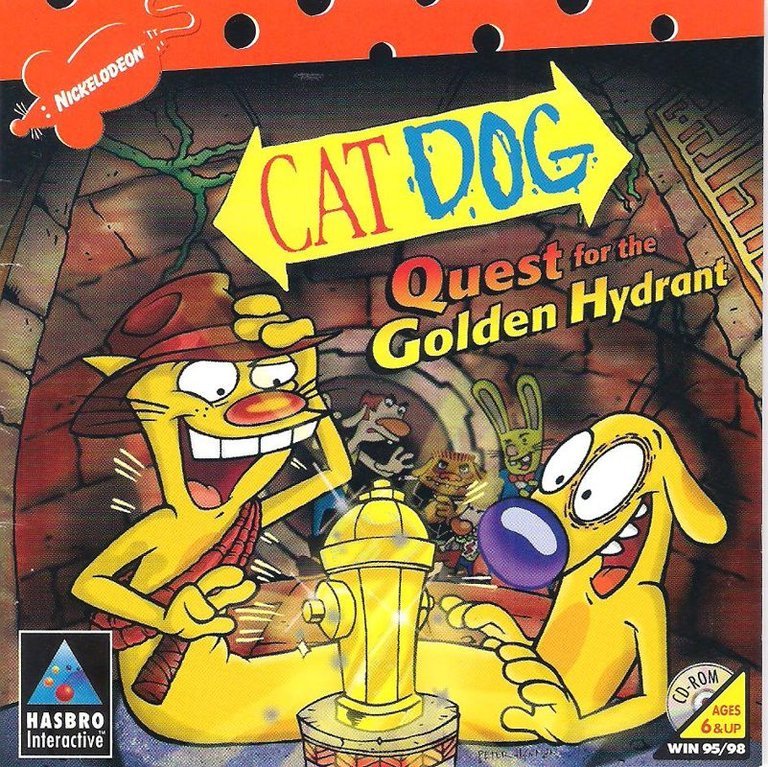
Description
In ‘CatDog: Quest for the Golden Hydrant’, players assist the iconic conjoined duo CatDog in their search for the legendary golden fire hydrant across six diverse mini-games in Adventure Mode. Based on the animated TV series, the game features challenges like catching treasure coupons, scaling mountains, battling aliens, and outrunning rivals, each tied to a narrative progression. Players can adjust difficulty levels and replay mini-games individually in Arcade Mode, offering a mix of lighthearted action and variety faithful to the show’s humor.
Gameplay Videos
CatDog: Quest for the Golden Hydrant Free Download
CatDog: Quest for the Golden Hydrant Cracks & Fixes
CatDog: Quest for the Golden Hydrant: Review
Introduction
In the pantheon of bizarre late-’90s pop culture icons, few were as endearingly absurd as CatDog — a conjoined feline-canine hybrid grappling with suburban life in a world that defied anatomical logic. CatDog: Quest for the Golden Hydrant (1999), developed by KnowWare and published under Hasbro Interactive’s short-lived Nickelodeon licensing deal, embodies the era’s torrent of licensed children’s games: bright, frenetic, and unapologetically eccentric. This review posits that while the game is structurally uneven and technologically constrained, it remains a fascinating artifact of Nickelodeon’s multimedia empire-building, offering a microcosm of late-’90s kid-centric design — equal parts chaotic, charming, and conceptually surreal.
Development History & Context
Studio Vision & Licensing Landscape
KnowWare, a now-obscure developer, was tasked with translating Peter Hannan’s surreal animated series into interactive form during a watershed moment for Nickelodeon. The network, having cemented its identity with Rugrats and Ren & Stimpy, saw CatDog as a flagship for its $350 million animation push. Hasbro Interactive, fresh off acquisitions like Atari, aimed to capitalize on Nickelodeon’s brand power with a three-year licensing pact announced in May 1999. Golden Hydrant was the partnership’s first fruit — a low-budget experiment intended to test the waters for future titles (including the canceled CatDog: Saving Mean Bob).
Technological Constraints & Design Philosophy
Built for Windows 95/98, Golden Hydrant leveraged the era’s rudimentary 3D acceleration and pre-rendered sprites, utilizing Smacker Video for compressed cutscenes. The tight 12-month development cycle necessitated a mini-game compilation structure — a cost-effective staple of licensed titles (SpongeBob SquarePants: Employee of the Month followed a similar template). KnowWare’s vision prioritized accessibility for ages 6–11, mirroring the series’ slapstick humor but struggling to reconcile the show’s subversive edge with Hasbro’s toyetic sensibilities.
Gaming Landscape
Released alongside platformers like Spyro: Year of the Dragon and Donkey Kong 64, Golden Hydrant stood out for its unabashed simplicity. Its mini-game focus echoed Mario Party (1998), but without the multiplayer depth — a reflection of budget limitations and the PC’s niche status in children’s gaming compared to consoles.
Narrative & Thematic Deep Dive
Plot & Structure
The game loosely adapts the show’s eponymous episode, framing six mini-games as steps toward locating the mythical Golden Hydrant — a treasure promising eternal wealth. This MacGuffin-driven quest is narrated through grainy Smacker Video clips, stitching together segments lifted directly from the episode. The Adventure Mode’s storybook progression (vs. Arcade Mode’s free play) emphasizes CatDog’s codependent struggle: Dog’s naïve enthusiasm repeatedly sabotages Cat’s cautious pragmatism, forcing cooperation to overcome obstacles.
Characters & Dialogue
Original voice actors Jim Cummings (Cat) and Tom Kenny (Dog) reprise their roles, lending authenticity to dialogue snippets (“Alone again, naturally!”). Supporting characters like Winslow Oddfellow (Carlos Alazraqui) and the Greaser Dogs (voiced by Maria Bamford and Billy West) appear as antagonists, though their roles are reduced to caricatures due to runtime constraints. The writing lacks the series’ sly wit, opting for disposable one-liners (“Fetch, Dog! Fetch!”) that service gameplay rather than narrative.
Thematic Underpinnings
Thematically, Golden Hydrant mirrors the show’s exploration of forced symbiosis. Each mini-game requires balancing Cat and Dog’s conflicting abilities (e.g., Dog’s speed vs. Cat’s precision), a metaphor for compromise. However, the game’s repetitive structure undermines this message — by the sixth level, the duo’s cooperation feels mechanical rather than meaningful. The Golden Hydrant itself, never visually depicted, becomes a hollow reward, echoing critiques of licensed games’ lackluster payoffs.
Gameplay Mechanics & Systems
Core Loop & Mini-Game Breakdown
The game oscillates between six archetypal genres, each echoing ’90s arcade tropes:
1. Greaser’s the Word: A 2D platformer where CatDog collects treasure map coupons while dodging Greaser Dogs. Hampered by imprecise jumping physics and enemy pathing glitches.
2. Iced, Thawed & Delivered: A downhill sprint with Dog, evading igloos and wolves. Notable for its momentum-based controls, criticized for slippery collision detection.
3. Climb Ev’ry CatDog: A vertical ascent alternating control between Cat (climbing) and Dog (knocking down hazards). The most innovative segment, requiring strategic switching but marred by clunky transitions.
4. Space Madness: A Galaga-inspired shooter where CatDog battles “Salivians” (slime aliens). Limited firing angles and repetitive enemy waves diminish engagement.
5. Taco Trouble: A Diner Dash-style food delivery game with Rancid Rabbit sabotaging orders. Tedious due to unresponsive AI and minimal stakes.
6. Queen of Denial: A Tomb Raider-lite temple crawl, avoiding mummies. Plagued by camera obstructions and unclear hitboxes.
Progression & Difficulty
Each mini-game offers 10 difficulty levels in Arcade Mode, though critics noted negligible differences beyond enemy speed. Adventure Mode’s rigid sequence and lack of save points (per the Russian review, completing it takes “20 minutes”) undermine replayability. Power-ups like “Rancid Treats” (temporary invincibility) feel underdeveloped, seldom altering strategies.
UI & Controls
Keyboard controls are serviceable but unintuitive — combining arrow keys for movement and spacebar for actions creates finger gymnastics. The HUD is minimalist, though unclear objective markers in “Queen of Denial” frustrate younger players.
World-Building, Art & Sound
Visual Design & Atmosphere
KnowWare faithfully recreates the show’s grotesque charm: lumpy character models, garish color palettes, and surreal backdrops (e.g., neon-lit alien spacecraft). Pre-rendered environments, however, clash with low-res sprites, resulting in a “chunky” aesthetic exacerbated by early 3D acceleration limitations. The Greaser Dogs’ jerky animations and CatDog’s disjointed movements (noted by CD-ROM Fossil) amplify the game’s slapdash feel.
Sound Design & Music
Denis M. Hannigan’s soundtrack recycles the show’s jazzy motifs, though compressed MIDI renditions lack depth. Voice lines, while authentic, loop ad nauseam during gameplay — Dog’s incessant “Hi-Yo, Silver! AWAY!” becomes grating. Environmental sounds (e.g., mummy groans, spaceship lasers) are functional but forgettable.
Reception & Legacy
Launch Reception
Critics polarized Golden Hydrant:
– FamilyPC Magazine (85%) praised its kid-friendly design, calling it “a story-driven romp through CatDog’s weird world.”
– Absolute Games (40%) skewered its brevity and simplicity, declaring it “20 minutes of content stretched thin.”
Fan impressions were equally divided — abandonware forums reminisce fondly about its novelty, while noting its technical flimsiness.
Commercial Performance & Cancellations
The game sold modestly, failing to justify Hasbro’s planned sequels (Saving Mean Bob). Its commercial obscurity mirrored Hasbro Interactive’s 2000 collapse post-Rebel Assault II losses.
Cultural Legacy
While Golden Hydrant never achieved the cult status of SpongeBob or Fairly OddParents games, it endures as a niche curiosity:
– Abandonware hubs like MyAbandonware host active fan communities (4.71/5 user rating).
– Its dual-character mechanic presaged co-op dynamics in titles like It Takes Two.
– The game’s existence underscores Nickelodeon’s aggressive ’90s licensing strategy, presaging modern franchise universes.
Conclusion
CatDog: Quest for the Golden Hydrant is less a cohesive game than a time capsule — a rushed, imperfect homage to a show reveling in its own absurdity. Its mini-games oscillate between inventive (the vertical climb) and tedious (the Space Madness shooter), while technical flaws and repetitive design prevent it from transcending its licensed roots. Yet, as a relic of Nickelodeon’s ’90s zenith and Hasbro’s digital ambitions, it remains historically significant. For nostalgic fans, it’s a bittersweet curio; for historians, a stark reminder of how licensing deals often prioritized brand synergy over playability. In the annals of video game history, Golden Hydrant is no lost masterpiece — but like its titular heroes, it’s oddly unforgettable.