
- Release Year: 2024
- Platforms: Linux, PlayStation 4, PlayStation 5, Windows, Xbox One, Xbox Series
- Publisher: Noobzilla, Silesia Games Sp. z o.o.
- Developer: Noobzilla
- Genre: Puzzle
- Perspective: Diagonal-down
- Game Mode: Single-player
- Gameplay: Hidden object
- Setting: Contemporary
- Average Score: 70/100
Description
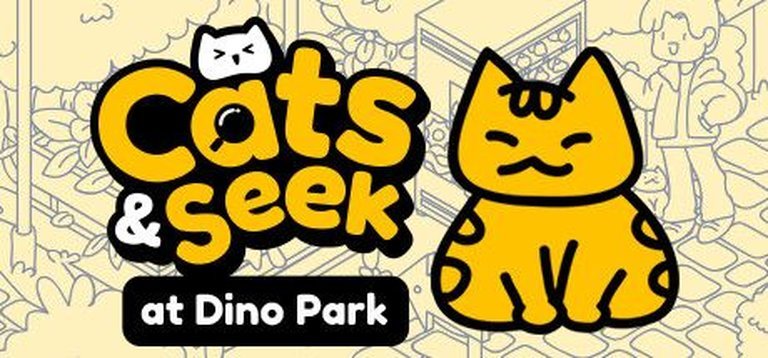
Cats & Seek: at Dino Park is a casual hidden object puzzle game set in a contemporary dinosaur theme park, where players explore vibrant, 2D scrolling illustrations to find cleverly concealed cats. Building on the Cats & Seek series, it features a point-and-select interface, helpful audio cues like meows when few cats remain, and cat bios, delivering a relaxing and charming experience for cat enthusiasts and puzzle fans alike.
Gameplay Videos
Cats & Seek: at Dino Park Guides & Walkthroughs
Cats & Seek: at Dino Park Reviews & Reception
opencritic.com (70/100): Cats and Seek: Dino Park is a charming hidden objects game with cute cats meowing, fun hand-drawn images, and smooth controls.
opencritic.com (70/100): Cats and Seek: Dino Park is another game about finding cats hidden in large illustrations. That’s enough to know that the game offers casual, calm and enjoyable fun, recommended for anyone who wants to spend some relaxing time looking for cute hidden animals.
opencritic.com : There may not be much to it but Cats and Seek: Dino Park is a delightful little game regardless and it’s sure to put a smile on your face. 😅
opencritic.com (70/100): There isn’t much to say about a game like this other than you get what you see. Looking for a relaxed hour of gaming? Look at Cats & Seek. Looking for that game to play after you spent dozens and dozens of hours completing that huge RPG? Look at Cats & Seek. Looking for a fast and easy 1,000 gamerscore? Look at Cats & Seek.
opencritic.com (70/100): Cats and Seek: Dino Park is easy to recommend to fellow cat hunters, or anyone looking for a relaxed one hour palette-cleansing game. The formula is exactly the same as similar titles but the fresh environments, audio and dinosaurs make it worth the investment.
metacritic.com (70/100): There isn’t much to say about a game like this other than you get what you see. Looking for a relaxed hour of gaming? Look at Cats & Seek. Looking for that game to play after you spent dozens and dozens of hours completing that huge RPG? Look at Cats & Seek. Looking for a fast and easy 1,000 gamerscore? Look at Cats & Seek.
metacritic.com (70/100): We reached the end of Cats and Seek: Dino Park without any fuss, and enjoyed the brief time spent with it. Well put together, if you’re a fan of cosy gaming, hidden object hunting, or cats in general, it’ll be well worth your time taking a trip to the Dino Park.
gamersocialclub.ca (70/100): Cats and Seek: Dino Park is easy to recommend to fellow cat hunters, or anyone looking for a relaxed one hour palette-cleansing game.
Cats & Seek: at Dino Park: A Purr-fect Palette Cleanser
Introduction: The Quiet Power of a Cat Hunt
In an era of games striving for ever-greater scale, cinematic ambition, and player retention mechanics, a title like Cats & Seek: at Dino Park stands as a deliberate, almost defiant, footnote. It is a game that asks for nothing more than your time, your eyes, and a quiet fondness for felines. Developed by the Polish studio Noobzilla and published by the prolific casual-game specialists Silesia Games, this 2024 release is the second main entry in the Cats & Seek series, following Cats and Seek: Osaka. It arrived not with a roar, but with a soft meow, targeting a specific, ever-growing niche: the “cosy gaming” community. My thesis is this: Cats & Seek: at Dino Park is not a landmark title in terms of technological innovation or narrative depth. Instead, it is a masterclass in refined, accessible design within the hidden-object genre. It represents the culmination of a development philosophy focused on stress-free engagement, charming aesthetics, and sheer, unadulterated quantity of content—500 cats to be exact—all packaged at a price point lower than a premium coffee. Its significance lies in being a near-perfect execution of a simple premise, offering a vital counterbalance to the industry’s often-intimidating scale.
Development History & Context: The Silesia Games Ecosystem
To understand Cats & Seek: at Dino Park, one must first understand its publisher, Silesia Games Sp. z o.o. This Polish company has become a quiet titan in the “hidden picture” or “hidden object” casual space. Their output is prodigious, with numerous series in parallel: the flagship “Hidden Cats in [City]” titles (e.g., Hidden Cats in Paris, Hidden Cats in London), the “Cats & Seek” series, and other thematic variations like 100 Dino Cats. This is not a studio chasing trends but one深耕 (deeply cultivating) a proven, successful formula with relentless consistency.
Noobzilla, the developer credit for this title, operates within Silesia’s ecosystem. The “technological constraints” here are self-imposed and philosophical. The game uses a 2D, hand-drawn artistic style rendered with a charming, slightly simplistic aesthetic. It employs a diagonal-down perspective and scrolling visuals, classic for the genre. There is no 3D engine, no complex physics, no online multiplayer infrastructure. The “constraint” is the commitment to a lightweight, accessible engine that runs smoothly on everything from a low-end PC to a Nintendo Switch, prioritizing broad compatibility and minimal system requirements. This aligns perfectly with the 2024 gaming landscape, where the “cosy game” boom—fueled by pandemic-era habits and platforms like the Nintendo Switch—created a massive audience for low-stress, high-charm, affordable digital experiences. Cats & Seek: at Dino Park didn’t invent this space but polished one of its most popular sub-variants to a fine sheen.
Narrative & Thematic Deep Dive: A Date with Dinosaurs and Cats
The narrative framework of Cats & Seek: at Dino Park is wafer-thin, as is tradition for the genre. The Steam store description introduces us to “John and Emily on a date to Dino Park.” This is not a story to be consumed but a lens—a casual, relatable scenario that justifies the setting. The theme is pure, uncomplicated recreation. A dino park is a place of wonder and whimsy, and the addition of hundreds of cats transforms it from a generic tourist trap into a personal, playful exploration.
The true “narrative” emerges from the gameplay itself: the act of discovery. Each of the 500 cats found (100 per level across 5 areas) is not just a checkmark. Upon clicking, a small card appears with the cat’s name and a brief, often punny or personality-driven bio. This is where the game’s heart beats. Sources from Simple Game Reviews and Gamer Social Club highlight this as a key charm. You aren’t just finding “Cat #342”; you’re finding “Captain Whiskerbeard” or “Catnip Crook.” These bios, while simple, imbue each feline with a miniature identity, rewarding observation with a tiny morsel of character. This transforms the hunt from a visual puzzle into a form of digital cat-collecting Storytelling. The theme is thus one of curiosity, collection, and affectionate anthropomorphism. The dinosaurs are part of the scenery—friendly, static backdrop elements—but the cats are the dynamic, named protagonists of your personal adventure. The underlying message is one of playful mindfulness: slowing down to appreciate hidden details in a busy, colorful world.
Gameplay Mechanics & Systems: The Refined Loop
At its core, Cats & Seek: at Dino Park operates on an elegantly simple loop:
1. Select one of five hand-drawn, 2D scrolling levels.
2. Use a point-and-click (or controller stick) interface to pan and zoom across the intricate scene.
3. Identify and click on a hidden cat.
4. Receive a satisfying “pop” visual, the cat’s name/bio card, and audio feedback (a cute meow).
5. Repeat until 100 cats + bonus items (birds/bees) are found.
Core Systems & Innovations:
* The 100-Cat Density: Each level is a meticulously crafted “Where’s Waldo?”-esque tableau. The challenge comes from the sheer density and clever camouflage. Cats are tucked into foliage, nestled in dinosaur exhibits, peeking from windows, and blending with patterns. This is not a game of frantic searching but of patient, sweeping observation.
* Accessibility & Player Agency: The game shines in its customization. As noted by Gamer Social Club and the official Silesia Games page, players can adjust brightness, contrast, and color palettes for both the background and the cats themselves. This is a significant, often overlooked feature in hidden-object games, catering to players with visual sensitivities or preferences, and is a mark of thoughtful design.
* Audio as a System: The most lauded mechanical touch is the “last ten cats” audio cue. As you near completion, the cats you haven’t found yet begin to audibly meow when your cursor is on-screen near them. This is a brilliant piece of player-friendly design. It prevents frustration in the endgame, turns the audio from ambiance into a tool, and provides a delightful “aha!” moment when you finally track down a meowing source. It respects the player’s time and eyesight.
* Hint System & Timer Mode: A standard hint button (Y on Xbox, etc.) circles a cat’s location, but with a cooldown. This is a soft nudge, not a giveaway. More interesting is the optional stopwatch/timer mode, which replaces the hint button. This caters to the speedrunning/achievement hunter crowd, introducing a skill-based challenge (finding all 100 cats as fast as possible) where the meowing audio cue becomes critical. It adds replay value without complicating the core casual experience.
* UI & Progression: The interface is clean and minimal. Progress is tracked via a counter (X/100). Finding “special cats” (15 per review sources) unlocks a special gallery, adding a collectathon layer. Progression is purely level-by-level; there is no character progression, stats, or RPG elements. The “progression” is the player’s own observational skill and collection completion.
Flaws: The primary critique across reviews (MobyGames score 68%, Video Chums 60%) is content volume. Five levels, while dense, can be completed in a dedicated 1-2 hour session for a core player. Reviewers like TheXboxHub note it’s “over pretty swiftly.” The lack of a robust time-trial leaderboard or more substantial bonus modes is felt. For its price, the content is fair, but it leaves the dedicated player wanting more.
World-Building, Art & Sound: Crafting the Cosy Vibe
The “Dino Park” setting is not a sprawling 3D world but a series of five beautifully hand-drawn, static 2D panoramas. The art style is pastel, cartoony, and wholesome. Dinosaurs are depicted as friendly, cartoonish figures (think The Land Before Time more than Jurassic Park), coexisting with cubist-style buildings, trees, and fanciful obstacles. This is crucial: the world is not threatening or complex; it is a playground. The “scroll” mechanic allows players to explore every inch of these large, dense illustrations.
The visual design serves the gameplay perfectly. High contrast between cats and backgrounds (default is a newspaper-grayscale style) makes them pop, but the color customization options allow players to tweak this to their preference, potentially reducing eye strain. The art’s simplicity means it doesn’t distract from the core hunt; instead, it creates a coherent, charming atmosphere.
Sound design is a standout feature. There are three looping music tracks to choose from, all gentle, melodic, and designed to promote relaxation. They are unobtrusive, allowing players to listen to podcasts or music instead—a point emphasized by multiple reviewers. The sound effects are the real heroes: the percussive “boop” of a found cat, the hundreds of individual, cute meows (each cat may have a slightly different tone), and the crucial, guiding meows in the final ten. This audio feedback loop is constant, positive, and integral to the game’s stress-reduction philosophy. It turns finding a cat into a multi-sensory reward.
Reception & Legacy: A Stable Pillar of Cozy Gaming
Cats & Seek: at Dino Park received a consistently positive, if not effusive, critical reception. Its MobyGames “Moby Score” is 6.9/10, based on 5 critic reviews yielding a 68% average. The sentiment across PlayStation Country (70%), PSX Brasil (70%), Xbox Tavern (70%), Gamer Social Club (70%), and Video Chums (60%) is unified: this is a charming, relaxing, and well-executed hidden-object game that delivers exactly what it promises.
The divergence comes in weighting its shortcomings. Critics praising it (Gamer Social Club, Xbox Tavern) focus on its value as a “palette-cleanser,” its low price (“worth the price of a coffee”), and its flawless execution of a cozy formula. The more critical voice (Video Chums, TheXboxHub with a 3.5/5) acknowledges its delights but squarely states it is “not as good as the Hidden Cats franchise” and is “over pretty swiftly.” This is the key comparative legacy: within Silesia Games’ own portfolio, the Hidden Cats in [City] series is often cited as the gold standard for artistic beauty and scale. The Cats & Seek series, including Dino Park, is perceived as a slightly more streamlined, thematically quirky sibling—still excellent, but not the flagship.
Its commercial reception appears strong on Steam, where Steambase data shows a remarkable “Very Positive” rating (100/100 Player Score) from over 220 reviews as of early 2026. This starkly contrasts with the more middling critic scores, highlighting a classic divide: professional critics assess it against the wider gaming landscape, while its playerbase (likely core fans of the genre/publisher) adore it for its specific, niche delivery. The low price point ($1.99-$3.89) and wide platform availability (PC, all major consoles, Switch) have clearly found a dedicated audience.
Legacy and Influence: Cats & Seek: at Dino Park is unlikely to appear in “Most Influential Games” lists. Its influence is micro-genre specific. It solidifies the design blueprint for a cozy hidden-object game: 1) A strong, simple thematic hook, 2) Hand-drawn art with customization options, 3) Player-friendly audio/visual aids (meows, hints, zoom), 4) Extremely low cost and barrier to entry. It contributes to the broader “cozy gaming” trend by being an exemplar of “micro-pleasures”—a game you can complete in an evening and feel entirely satisfied, not obligated. It demonstrates that in a market saturated with live-service games and epic RPGs, there is enduring, profitable value in digital mindfulness toys.
Conclusion: A Niche Masterpiece
Cats & Seek: at Dino Park is not a game that will change your life, redefine its genre, or win Game of the Year. It is, however, a near-flawless implementation of a specific, cherished idea. It understands its audience—people seeking a gentle, aesthetically pleasing distraction—and caters to them with unwavering focus. The hand-drawn art is coherent and cute, the sound design is functional and charming, the 500 cats are a generous bounty, and the accessibility options are commendable.
Its primary weakness is also its philosophical strength: it is content to be brief. It is a snack, not a meal. For a critic, this limits its “must-play” status. For its intended player, it is the perfect serving. In the grand tapestry of video game history, Cats & Seek: at Dino Park represents a vital strand: the democratization of game design for pure relaxation. It is a testament to the idea that a video game can be a tool for peace, as valid an artistic expression as any narrative epic. It earns its place not in the hall of fame, but in the library of any player who appreciates the simple, profound joy of finding a cartoon cat in a cartoon dinosaur park, accompanied by a friendly meow. Verdict: A top-tier specimen in the hidden-object zoo, essential for collectors of calm.