
- Release Year: 1998
- Platforms: Windows
- Publisher: H+A Entertainment
- Developer: Artech Digital Entertainment, Ltd.
- Genre: Adventure
- Perspective: 1st-person
- Game Mode: Single-player
- Gameplay: Graphic adventure, Point and select, Puzzle elements
- Setting: Celtic, Island, Mystery
- Average Score: 60/100
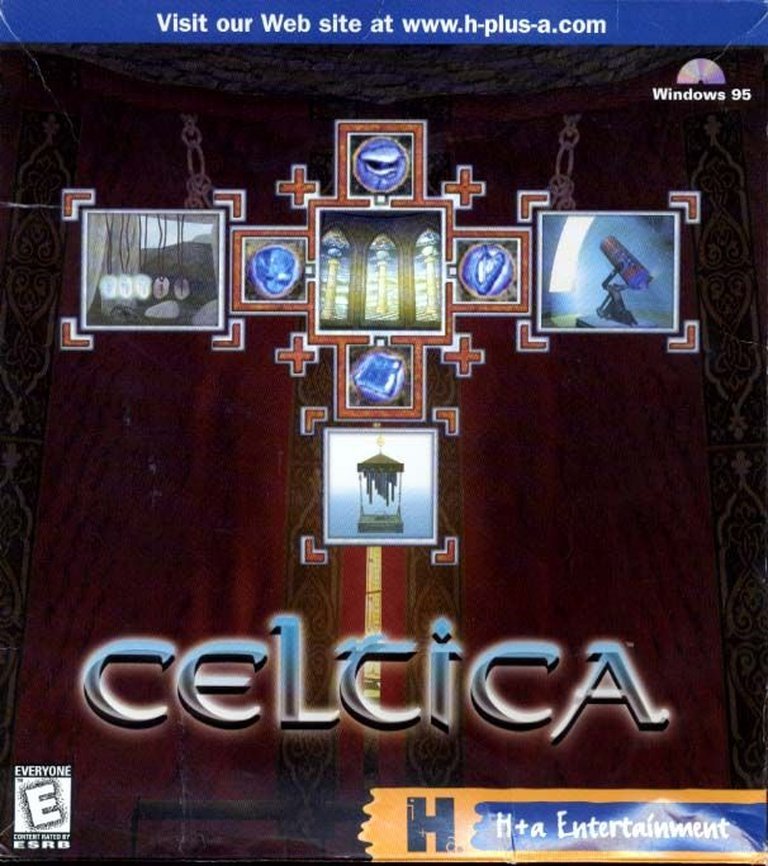
Description
Celtica is a first-person point-and-click adventure game set on a mysterious, lush green island off the west coast of Ireland. Players explore a hauntingly beautiful landscape filled with Celtic symbols, stone circles, and abandoned structures like a lighthouse, church, and cemetery, unraveling the island’s secrets through puzzles and discovery. The game emphasizes atmospheric exploration and puzzle-solving in a solitary, dreamlike environment.
Celtica Guides & Walkthroughs
Celtica Reviews & Reception
mobygames.com (60/100): A point and click adventure set on a tiny, mysterious, beautiful and extremely green island off the west Irish coast.
gameboomers.com : Celtica was lonelier for me than Myst. Even before I found the girl’s diary and learned of the tragedy that had struck the little artist’s colony, I had that sense of loss just by moving around the gameworld.
adventuregamers.com : Celtica is a handsome and fun rip-off of a classic.
Celtica: A Myst Clone’s Journey Through Time and Myth
Introduction
In the late 1990s, the shadow of Myst loomed large over the adventure game genre. Its success spawned a wave of imitators, each attempting to capture the magic of its enigmatic world and cerebral puzzles. Among these, Celtica (1998) stands as a fascinating artifact—a game that is both a product of its time and a testament to the enduring appeal of first-person exploration. Developed by Artech Digital Entertainment and published by H+A Entertainment, Celtica is a point-and-click adventure that transports players to a lush, mysterious island off the west coast of Ireland, steeped in Celtic mythology and brimming with secrets.
At its core, Celtica is a love letter to the Myst formula, but it carves out its own identity through its rich thematic tapestry and meticulous world-building. The game’s narrative revolves around the search for three ancient artifacts—the Ascension Amulet, the Ascension Harp, and the Book of Ascension—left behind by an alien race in a bygone era. These relics promise ascension to a higher plane of existence, and the island’s history is littered with the remnants of those who sought them, from utopian artists to Nazi soldiers.
This review will delve deep into Celtica’s development history, narrative intricacies, gameplay mechanics, and artistic achievements, while also examining its critical reception and legacy. Through this analysis, we will explore how Celtica fits into the broader context of adventure gaming and why it remains a compelling, if flawed, entry in the genre.
Development History & Context
The Studio and the Vision
Artech Digital Entertainment, the studio behind Celtica, was no stranger to the adventure game genre. Founded in the early 1990s, Artech had already made a name for itself with titles like U.F.O.s and Guess Who?, but Celtica represented a more ambitious undertaking. The game was directed by Paul Butler, with Richard Cooper serving as creative director and writer. Cooper’s vision for Celtica was deeply rooted in Celtic mythology and New Age spirituality, blending elements of astrology, alchemy, and occultism into a cohesive narrative framework.
The development team was a mix of seasoned veterans and fresh talent, with Daniele Tosti leading the 3D art direction and Kyle Mac Dougall overseeing the 2D art. The game’s visual style was a departure from the more abstract, surreal aesthetics of Myst, opting instead for a grounded, almost pastoral beauty. The island’s rolling green hills, ancient stone circles, and crumbling ruins were rendered with a level of detail that was impressive for its time, even if the game’s slideshow-style presentation felt somewhat dated by 1998 standards.
Technological Constraints and Innovations
Celtica was developed during a transitional period in gaming technology. The mid-to-late 1990s saw the rise of 3D acceleration and real-time rendering, but many adventure games, including Celtica, still relied on pre-rendered 2D backgrounds. This choice was partly due to the genre’s emphasis on atmosphere and artistic direction, but it also reflected the technical limitations of the era. The game’s engine, while capable of delivering stunning visuals, lacked the fluidity of more modern titles, resulting in a somewhat static experience.
One of the game’s most notable technical achievements was its use of real-world data to influence gameplay. Certain puzzles, such as those involving zodiac signs and planetary alignments, were designed to adapt based on the player’s system date. This dynamic element added a layer of immersion, making the island feel like a living, breathing entity rather than a static backdrop. However, this feature also introduced potential frustrations, as players who lacked knowledge of astrology or alchemy might find themselves stuck without external guidance.
The Gaming Landscape of 1998
By the time Celtica was released in 1998, the adventure game genre was in a state of flux. Myst had already cemented its legacy, but the market was becoming saturated with clones, many of which failed to capture the original’s magic. Games like Riven (1997) had raised the bar for narrative depth and puzzle design, while titles like Grim Fandango (1998) were pushing the genre in new, more cinematic directions.
In this context, Celtica faced an uphill battle. It was neither as groundbreaking as Myst nor as innovative as Grim Fandango, but it offered a unique blend of Celtic mysticism and New Age spirituality that set it apart from its peers. The game’s marketing leaned heavily into its Myst-like qualities, promising players a similar experience of exploration and discovery. However, this also meant that Celtica was often judged against the high standards set by its predecessors, a comparison that would ultimately shape its critical reception.
Narrative & Thematic Deep Dive
The Plot: A Tale of Ascension and Obsession
Celtica’s narrative is a tapestry of interconnected stories, each revealing a piece of the island’s dark history. The game begins with the player arriving on the island, tasked with uncovering the secrets of the Ascension Amulet, Harp, and Book. These artifacts were left behind by an alien race known as the Otherworld gods, who deemed humanity too primitive to receive their gifts directly. Instead, they hid the relics on the island, waiting for a worthy individual to claim them.
As the player explores the island, they encounter the remnants of past expeditions. The most prominent of these is the story of the “Children of Kerry,” a utopian artist colony that settled on the island in the late 19th century. Led by the charismatic but unstable Dominic, the group sought to harness the island’s mystical energies, only to be torn apart by greed and obsession. The colony’s tragic fate is chronicled in the diary of Bernadette O’Donnell, a young woman whose love for Dominic was overshadowed by his descent into madness.
Another layer of the narrative involves a secret Nazi outpost established on the island during World War II. The Nazis, drawn by the island’s rumors of ancient power, attempted to exploit its secrets for their own ends. Their presence is felt most strongly in the game’s underground cave system, where the remnants of their bunker and a crippled U-boat serve as eerie reminders of their failed ambitions.
Themes: Myth, Madness, and the Search for Meaning
Celtica’s narrative is steeped in themes of myth and legend, drawing heavily from Celtic folklore and New Age spirituality. The game’s central premise—the idea of ascension to a higher plane of existence—reflects a broader cultural fascination with transcendence and enlightenment. The island itself is a liminal space, a threshold between the mundane and the divine, where the boundaries between past and present, myth and reality, blur.
One of the game’s most compelling themes is the corrupting influence of obsession. Both the Children of Kerry and the Nazis are driven to ruin by their single-minded pursuit of the island’s secrets. Dominic’s descent into madness mirrors the broader human tendency to be consumed by ambition, while the Nazis’ exploitation of the island’s power serves as a cautionary tale about the dangers of unchecked greed. These themes are reinforced by the game’s puzzles, many of which require the player to decipher ancient symbols and align celestial bodies, reinforcing the idea that knowledge is both a gift and a burden.
Characters and Dialogue: A Silent Journey
Unlike many adventure games of its era, Celtica features no live characters or dialogue. The island is a desolate, abandoned place, and the player’s only companions are the ghosts of the past, revealed through diaries, journals, and environmental storytelling. This absence of direct interaction lends the game a haunting, melancholic atmosphere, but it also means that character development is limited to what can be gleaned from written texts.
Bernadette O’Donnell’s diary is the most significant source of narrative depth, offering a firsthand account of the Children of Kerry’s rise and fall. Her entries are poignant and introspective, revealing her love for Dominic and her growing disillusionment with his obsession. The diary serves as both a historical record and a emotional anchor, grounding the player’s experience in a tangible human story.
The Nazis’ presence is similarly conveyed through environmental details and written records. The journal of Karl Schramm, a German sailor, provides insight into the Nazis’ motivations and their ultimate downfall. His writings are tinged with a sense of dread, hinting at the supernatural forces that ultimately consumed his comrades.
The Celtic Mythos: A Rich Tapestry
Celtica’s world is steeped in Celtic mythology, from its stone circles and crucifixes to its references to the Otherworld and the Tuatha Dé Danann. The game’s puzzles often draw from real-world Celtic symbols and astrological concepts, requiring players to engage with the island’s lore on a deeper level. This integration of myth and gameplay creates a sense of immersion, making the island feel like a living, breathing entity rather than a mere backdrop.
However, the game’s reliance on obscure knowledge can also be a double-edged sword. While some players may appreciate the opportunity to learn about Celtic mythology and astrology, others may find the puzzles overly esoteric and frustrating. The lack of in-game guidance for these more complex puzzles means that players without prior knowledge may need to consult external resources, breaking the immersion and highlighting one of the game’s key flaws.
Gameplay Mechanics & Systems
Core Gameplay Loop: Exploration and Discovery
At its heart, Celtica is a game about exploration. The player begins on a small hill near the tip of the island, with several paths leading to key locations such as a lighthouse, an abandoned church, and a cemetery. The game’s structure is nonlinear, allowing players to tackle puzzles in a variety of orders, though certain areas are gated behind the completion of specific tasks.
The core gameplay loop involves moving between locations, examining objects, and solving puzzles to unlock new areas and collect artifacts. The game’s point-and-click interface is intuitive, with players using the mouse to navigate and interact with the environment. The inventory system is straightforward, with items collected along the way used to solve puzzles or unlock new paths.
Puzzle Design: A Mix of Brilliance and Frustration
Celtica’s puzzles are a mixed bag, ranging from clever and engaging to overly obscure and frustrating. The game features a total of 24 main puzzles, each tied to the island’s lore and the player’s quest for the Ascension artifacts. Some puzzles are self-contained, such as the wind chime puzzle in the gazebo, while others require cross-referencing multiple sources of information, such as the alchemy puzzle in the greenhouse.
One of the game’s strengths is its integration of real-world knowledge into its puzzles. For example, the zodiac puzzle in the stone hut requires players to align planetary symbols based on the current month, a task that demands familiarity with astrological concepts. Similarly, the prism puzzle in the mansion challenges players to manipulate light beams using principles of optics. These puzzles are rewarding for players who enjoy intellectual challenges, but they can also be alienating for those who lack the necessary background knowledge.
On the other hand, some puzzles feel overly derivative of Myst and other adventure games. The sliding tile puzzle in the library, for instance, is a staple of the genre but offers little in the way of innovation. Similarly, the gear puzzle in the windmill, while thematically appropriate, is a straightforward exercise in trial and error.
Character Progression and Inventory Management
Celtica features a minimalist approach to character progression. There are no skill trees or experience points; instead, progression is tied to the collection of artifacts and the completion of puzzles. The game’s inventory system is similarly streamlined, with items collected along the way used to solve puzzles or unlock new areas.
The status screen, accessible via a rune at the top of the interface, allows players to track their progress in collecting the Ascension Amulet, Harp, and Book. This visual representation of progress is a nice touch, providing a sense of accomplishment as players inch closer to their goal. However, the lack of more substantive character development means that the player’s avatar remains a cipher, a silent observer rather than an active participant in the island’s story.
UI and Navigation: A Study in Simplicity
Celtica’s user interface is clean and unobtrusive, with a minimalist design that keeps the focus on the game’s visuals. The point-and-click navigation is intuitive, with players using the mouse to move between locations and interact with objects. The game’s slideshow-style presentation, while dated, is effective in conveying the island’s beauty and mystery.
One of the game’s few navigational quirks is the occasional ambiguity of path hotspots. Some areas, particularly the underground cave system, can be confusing to navigate, with unclear pathways and hidden exits. This can lead to frustration, especially for players who prefer a more guided experience. However, the game’s nonlinear structure means that players can often find alternative routes if they become stuck.
Innovative and Flawed Systems
Celtica’s most innovative feature is its use of real-world data to influence gameplay. The zodiac puzzle, for instance, adapts based on the player’s system date, requiring them to align planetary symbols according to the current month. This dynamic element adds a layer of immersion, making the island feel like a living, breathing entity. However, it also introduces potential frustrations, as players who lack knowledge of astrology may find themselves stuck without external guidance.
Another notable feature is the game’s integration of multiple languages and symbols. The alchemy puzzle, for example, requires players to decipher Greek letters and planetary symbols, while the Viking rune puzzle demands familiarity with Norse mythology. These elements are thematically appropriate but can be alienating for players who are not well-versed in these areas.
On the flip side, Celtica suffers from a number of technical flaws. The game’s slideshow-style presentation, while visually impressive, can feel static and lifeless compared to more modern titles. The lack of animations and interactive elements means that the island often feels like a series of still images rather than a living world. Additionally, the game’s puzzles occasionally suffer from bugs and glitches, with some puzzles becoming unsolvable without restarting the game.
World-Building, Art & Sound
Setting and Atmosphere: A Hauntingly Beautiful Island
Celtica’s greatest strength lies in its world-building. The island is a meticulously crafted space, filled with rolling green hills, ancient stone circles, and crumbling ruins. The game’s visual design is heavily influenced by Celtic mythology, with symbols like the triskelion and the Celtic knot appearing throughout the environment. The island’s various locations—from the serene gazebo to the eerie Nazi bunker—each contribute to the game’s haunting, melancholic atmosphere.
The game’s slideshow-style presentation, while dated, is effective in conveying the island’s beauty. The pre-rendered backgrounds are richly detailed, with a color palette dominated by lush greens and muted blues. The lack of animations and interactive elements means that the island often feels static, but this also contributes to its dreamlike quality, making it feel like a place frozen in time.
Visual Direction: A Study in Celtic Aesthetics
Celtica’s visual direction is a testament to the power of Celtic aesthetics. The game’s environments are filled with symbols and motifs drawn from Celtic mythology, from the intricate knotwork adorning the mansion’s walls to the standing stones scattered across the island. The game’s color palette is dominated by earthy tones, with occasional bursts of color—such as the stained-glass windows in the chapel—adding visual interest.
The game’s character designs, while minimal, are effective in conveying the island’s history. The gravestones in the cemetery, for example, are adorned with Celtic crosses and inscriptions, while the Nazi bunker is filled with German military paraphernalia. These details help to ground the game’s narrative in a tangible, historical context, making the island feel like a real place rather than a mere fantasy.
Sound Design: A Haunting Soundtrack
Celtica’s sound design is one of its most underrated aspects. The game’s soundtrack, composed by Mark Mitchell, is a haunting blend of Celtic folk music and ambient soundscapes. The use of traditional instruments like the harp and flute creates a sense of authenticity, while the ambient tracks—such as the sound of the wind and the ocean—enhance the game’s immersive atmosphere.
The game’s sound effects are similarly effective. The creaking of the windmill, the dripping of water in the caves, and the distant sound of the ocean all contribute to the island’s eerie, melancholic mood. The lack of voice acting means that the game’s narrative is conveyed primarily through text, but the sound design helps to fill the void, creating a rich, atmospheric experience.
The Role of Music in World-Building
Music plays a crucial role in Celtica’s world-building. The game’s soundtrack is not merely background noise but an integral part of the island’s identity. The Celtic folk music, with its haunting melodies and traditional instrumentation, reinforces the game’s themes of myth and legend. The ambient tracks, meanwhile, create a sense of isolation and mystery, making the island feel like a place untouched by time.
One of the game’s most memorable musical moments occurs in the windmill, where players can play organ rolls to unlock new areas. The music played here is a mix of original compositions and traditional Celtic tunes, each contributing to the game’s immersive atmosphere. The ability to interact with the music in this way adds a layer of depth to the gameplay, making the island feel like a living, breathing entity.
Reception & Legacy
Critical Reception: A Mixed Bag
Celtica’s critical reception was decidedly mixed. Upon its release in 1998, the game was praised for its beautiful visuals and immersive atmosphere but criticized for its derivative gameplay and overly obscure puzzles. Reviewers noted that while Celtica offered a compelling experience for fans of Myst-style adventures, it failed to innovate in meaningful ways, making it feel like a pale imitation of its predecessors.
One of the game’s most vocal critics was Steve Metzler of Games Domain, whose scathing review lambasted Celtica for its lack of originality and frustrating puzzle design. Metzler’s review, while harsh, reflected a broader sentiment among critics that Celtica was a missed opportunity—a game that could have been great but ultimately fell short of its potential.
However, not all reviews were negative. Some critics, such as those at Tap-Repeatedly/Four Fat Chicks, praised Celtica for its haunting atmosphere and beautiful visuals, arguing that it offered a worthwhile experience for fans of the genre. These reviewers acknowledged the game’s flaws but ultimately found it to be a enjoyable diversion, particularly for those who appreciated its Celtic themes and New Age spirituality.
Commercial Performance and Rarity
Celtica’s commercial performance was similarly lackluster. The game’s high price tag and niche appeal meant that it struggled to find a wide audience, and it quickly faded into obscurity. Today, Celtica is a rare find, with copies fetching high prices on eBay and other secondary markets. Its status as a cult classic has only grown in the years since its release, with fans of the genre often citing it as an underrated gem.
Influence on Subsequent Games
While Celtica did not have a significant impact on the broader gaming industry, its influence can be seen in later adventure games that sought to blend mythology and exploration. Titles like The Longest Journey (1999) and Syberia (2002) share Celtica’s emphasis on atmospheric world-building and narrative depth, though they ultimately surpassed it in terms of innovation and critical acclaim.
Celtica’s legacy is perhaps best understood as a footnote in the history of adventure gaming—a game that, while flawed, offered a unique and compelling experience for those willing to engage with its mysteries. Its blend of Celtic mythology, New Age spirituality, and Myst-style gameplay makes it a fascinating artifact of its time, and its haunting atmosphere continues to resonate with fans of the genre.
Conclusion
Celtica is a game that defies easy categorization. It is neither a masterpiece nor a failure but rather a fascinating artifact of its time—a game that captures the essence of Myst-style adventures while carving out its own identity through its rich thematic tapestry and meticulous world-building. Its haunting atmosphere, beautiful visuals, and immersive soundtrack make it a compelling experience for fans of the genre, even as its derivative gameplay and overly obscure puzzles hold it back from true greatness.
In the pantheon of adventure games, Celtica occupies a unique niche. It is a game that rewards patience and perseverance, offering a journey through a world steeped in myth and mystery. While it may not have achieved the critical or commercial success of its predecessors, it remains a testament to the enduring appeal of exploration and discovery—a reminder that sometimes, the journey is just as important as the destination.
For those willing to embrace its flaws and immerse themselves in its world, Celtica offers a hauntingly beautiful experience, one that lingers in the memory long after the final puzzle has been solved. It is, in the end, a game that is both a product of its time and a timeless exploration of the human quest for meaning—a journey through the ageless secrets of Celtica.