
- Release Year: 2002
- Platforms: Windows
- Publisher: Xing Interactive C.V.
- Developer: Guardian Light Studios
- Genre: Card, Mahjongg solitaire, Puzzle, Shanghai, Tile game
- Perspective: Top-down
- Game Mode: Single-player
- Gameplay: Tile matching puzzle, Turn-based
Description
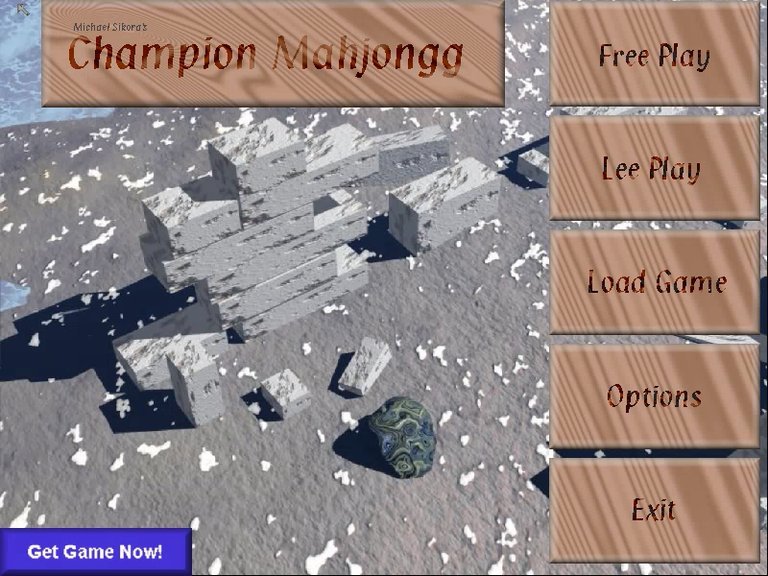
Champion Mahjongg is a classic single-player tile-matching puzzle game based on the traditional Chinese game of Mahjongg. Players eliminate tiles by clicking on matching pairs from a stacked layout, with the goal of clearing the entire board. The game features three distinct background locations and customizable tile sets, allowing players to personalize their experience. Additional features include a save/load system for board states, a shuffle function to rearrange tiles when no moves are available, and a built-in timer to track progress. Released in 2002 for Windows, this shareware version offers a straightforward yet engaging take on the timeless Mahjongg solitaire genre.
Champion Mahjongg Patches & Updates
Champion Mahjongg: A Digital Relic of the Early 2000s Mahjong Boom
Introduction: The Unassuming Charm of a Shareware Classic
In the vast ocean of digital Mahjong adaptations, Champion Mahjongg (2002) emerges as a modest yet intriguing artifact of the early 2000s puzzle game landscape. Developed by Guardian Light Studios and published by Xing Interactive C.V., this Windows-based title is a straightforward implementation of the Shanghai-style Mahjong solitaire, a genre that had already cemented its place in casual gaming by the turn of the millennium. While it lacks the narrative depth or innovative mechanics of its contemporaries, Champion Mahjongg serves as a fascinating case study in the evolution of digital Mahjong, reflecting both the limitations and aspirations of shareware puzzle games during this era.
This review will dissect Champion Mahjongg through multiple lenses—historical context, gameplay design, aesthetic presentation, and cultural impact—to determine its significance in the broader tapestry of Mahjong’s digital journey. Though often overshadowed by more polished or commercially successful titles, Champion Mahjongg offers a snapshot of how traditional tile-matching games were adapted for the burgeoning PC gaming market of the early 2000s.
Development History & Context: The Shareware Puzzle Renaissance
The Studio Behind the Tiles
Guardian Light Studios, the developer of Champion Mahjongg, was a relatively obscure player in the early 2000s puzzle game scene. Little is known about the studio’s broader catalog, but its inclusion in the Champion Board Games compilation (2003)—alongside Champion Chess, Champion Backgammon, and other classic board game adaptations—suggests a focus on digitizing traditional games for casual audiences. The studio’s approach was utilitarian rather than revolutionary, prioritizing accessibility and simplicity over innovation.
Xing Interactive C.V., the publisher, operated within the shareware model, a distribution strategy that thrived in the late 1990s and early 2000s. Shareware allowed players to try a limited version of a game (in this case, one location and one tileset) before purchasing the full product. This model was particularly well-suited to puzzle games like Champion Mahjongg, which relied on repetitive, addictive gameplay loops to hook players.
Technological Constraints and Design Philosophy
Released in 2002, Champion Mahjongg was constrained by the technological standards of its time. The game’s fixed/flip-screen perspective and top-down viewpoint were typical of early digital Mahjong adaptations, which prioritized clarity and functionality over visual flair. The turn-based, point-and-select interface was intuitive for Windows users, aligning with the operating system’s growing dominance in casual gaming.
The early 2000s were a transitional period for Mahjong video games. While console adaptations in Japan were experimenting with narrative-driven Mahjong experiences (e.g., Mahjong Fight Club’s arcade-style competitions), Western developers like Guardian Light Studios focused on solitary, puzzle-based iterations. Champion Mahjongg exemplifies this trend, offering a no-frills, single-player experience that catered to the growing demand for digital time-killers.
The Gaming Landscape of 2002
By 2002, Mahjong solitaire had already undergone significant evolution. The genre’s digital roots stretched back to Brodie Lockard’s 1981 PLATO adaptation and Activision’s 1986 Shanghai, which popularized the tile-matching mechanic. Microsoft’s Taipei (1990) and Mahjong Titans (2006) further cemented Mahjong’s place in Windows gaming culture, making it a staple of office downtime and home computing.
Champion Mahjongg entered this crowded market as a shareware alternative, competing with commercial titles like MahJongg Master 4 (2002) and Mahjongg Variety Pack (2002). Its simplicity was both a strength and a weakness: while it lacked the polish of its competitors, its lightweight design made it accessible to a broad audience.
Narrative & Thematic Deep Dive: The Absence of Story in a Tile-Matching World
The Minimalist Approach
Champion Mahjongg is devoid of narrative or thematic depth, a common trait among early Mahjong solitaire games. Unlike its four-player, strategy-driven counterpart (traditional Mahjong), which is steeped in cultural symbolism and social interaction, Champion Mahjongg reduces the experience to its most basic mechanical elements: matching tiles to clear the board.
This minimalism is not inherently flawed; indeed, it aligns with the genre’s core appeal. However, it raises questions about the game’s identity. Without narrative context or thematic cohesion, Champion Mahjongg relies entirely on its gameplay mechanics to sustain player engagement. The inclusion of three background locations and customizable tilesets (in the full version) attempts to inject variety, but these features feel superficial rather than meaningful.
The Cultural Disconnect
Mahjong’s rich history—rooted in 19th-century China and shaped by global migration, gambling culture, and social rituals—is entirely absent from Champion Mahjongg. The game makes no attempt to educate players about the tiles’ symbolism (e.g., the Dragons representing Confucian virtues or the Winds symbolizing cardinal directions) or the game’s evolution from card-based predecessors like Madiao.
This omission is particularly striking when contrasted with contemporary titles like Mahjong Mysteries: Ancient Egypt (2010), which wove historical themes into its gameplay. Champion Mahjongg’s failure to engage with Mahjong’s cultural legacy reduces it to a generic tile-matching puzzle, stripping away the layers of meaning that make the game fascinating beyond its mechanics.
The Shareware Aesthetic
The shareware version’s limitations—one location, one tileset—further emphasize the game’s utilitarian design. The full version’s promise of customization (e.g., loading custom tiles from the main menu) hints at a desire to cater to player creativity, but this feature feels underdeveloped. Unlike modern Mahjong games that offer themed tile sets (e.g., seasonal, fantasy, or pop culture-inspired designs), Champion Mahjongg’s customization options are rudimentary, reflecting the technological and creative constraints of its era.
Gameplay Mechanics & Systems: The Core Loop and Its Limitations
The Tile-Matching Formula
At its heart, Champion Mahjongg adheres to the Shanghai-style Mahjong solitaire formula:
1. Board Setup: Tiles are arranged in a stacked, overlapping layout (e.g., the classic “turtle” formation).
2. Matching Mechanics: Players click on pairs of identical, unobstructed tiles to remove them from the board.
3. Completion Goal: The objective is to clear the entire board by matching all tiles.
The game’s turn-based, point-and-select interface is intuitive, requiring no prior knowledge of traditional Mahjong rules. This accessibility is a double-edged sword: while it lowers the barrier to entry, it also removes the strategic depth of four-player Mahjong, where players must balance offense, defense, and tile discards.
Innovations and Flaws
Champion Mahjongg introduces a few mechanical tweaks to the standard formula:
– Shuffle Button: If no legal moves remain, players can shuffle the tiles to unlock new pairs. This feature, while practical, can feel like a crutch, undermining the puzzle’s challenge.
– Save/Load Functionality: The ability to save and load board states is a welcome addition, allowing players to pause and resume games at their leisure.
– Timer: A timer in the bottom-left corner adds a light competitive element, though it serves no functional purpose beyond tracking playtime.
The game’s most significant flaw is its lack of variety in board layouts. Unlike later titles that offered dozens of unique tile arrangements (e.g., Mahjongg Dimensions’ 3D layouts), Champion Mahjongg relies on a handful of static designs. This repetition can lead to monotony, especially for experienced players.
UI and UX Considerations
The UI is functional but uninspired. The main menu is sparse, offering basic options (e.g., selecting backgrounds, loading custom tiles) without the polish of contemporary games. The absence of animations or visual feedback when matching tiles—beyond the tiles’ disappearance—makes the experience feel sterile.
The game’s shareware origins are evident in its barebones presentation. While this simplicity aligns with the era’s casual gaming standards, it also highlights the limitations of early 2000s indie development.
World-Building, Art & Sound: The Aesthetic of Simplicity
Visual Design: A Study in Minimalism
Champion Mahjongg’s visual design is minimalist to a fault. The fixed/flip-screen perspective and top-down viewpoint prioritize functionality over aesthetics, ensuring that tiles are clearly visible but offering little in terms of atmosphere. The three background locations (available in the full version) attempt to add variety, but their static, low-resolution designs fail to immerse the player.
The ability to load custom tilesets is the game’s most ambitious visual feature, but it feels underutilized. Unlike modern Mahjong games that leverage high-resolution artwork and thematic consistency, Champion Mahjongg’s customization options are limited by the technological constraints of 2002.
Sound Design: The Silence of the Tiles
The game’s sound design is equally sparse. The absence of background music in the shareware version (and the likely inclusion of generic tunes in the full version) underscores the game’s utilitarian approach. The only auditory feedback comes from the tiles’ disappearance, which lacks the satisfying “clack” of physical Mahjong tiles or the melodic chimes of later digital adaptations.
This minimalist sound design is a missed opportunity. Mahjong’s tactile and auditory appeal—from the shuffle of tiles to the rhythmic discourse of players—is a core part of its charm. Champion Mahjongg’s silence strips away this sensory richness, reducing the experience to a visual puzzle.
Atmosphere: The Absence of Place
Without narrative context or thematic cohesion, Champion Mahjongg fails to create a distinct atmosphere. The backgrounds and tilesets feel interchangeable, lacking the cultural or environmental storytelling of games like Mahjong Trails (which incorporated travel themes) or Mahjongg Mysteries (which tied gameplay to historical settings).
This absence of atmosphere is perhaps the game’s greatest weakness. While Mahjong solitaire is inherently abstract, the best adaptations use art and sound to evoke a sense of place—whether it’s a bustling Shanghai teahouse or a serene Japanese garden. Champion Mahjongg offers none of this, leaving players in a void of mechanical repetition.
Reception & Legacy: The Forgotten Shareware Title
Critical and Commercial Reception
Champion Mahjongg’s reception is difficult to gauge due to its shareware status and the lack of archived reviews. MobyGames, the most comprehensive database for the title, lists no critic or player reviews, suggesting that the game failed to make a significant impact upon release. Its inclusion in the Champion Board Games compilation (2003) indicates that it was part of a broader strategy to bundle casual games, but it never achieved the mainstream success of titles like Mahjong Titans or Shanghai.
The game’s obscurity is further evidenced by its absence from contemporary discussions of Mahjong solitaire. While titles like Taipei and Mahjongg Dimensions are frequently cited in retrospectives, Champion Mahjongg is rarely mentioned, even in niche gaming circles.
Influence and Evolution
Champion Mahjongg’s legacy is minimal, but it serves as a reminder of the shareware era’s role in shaping casual gaming. Its mechanical simplicity and lack of innovation mean it had little direct influence on subsequent Mahjong adaptations. However, its existence reflects the broader trend of digitizing traditional games for PC audiences—a trend that continues today with mobile and browser-based Mahjong games.
The game’s most enduring contribution may be its representation of early 2000s shareware culture. As a product of its time, Champion Mahjongg embodies the limitations and aspirations of indie developers working within tight technological and financial constraints.
Conclusion: A Modest Footnote in Mahjong’s Digital History
Champion Mahjongg is not a great game, nor is it a particularly memorable one. It lacks the polish of commercial titles, the innovation of genre pioneers, and the cultural depth of traditional Mahjong. Yet, its very ordinariness makes it a fascinating artifact—a snapshot of a time when digital puzzle games were still finding their footing.
In the grand tapestry of Mahjong’s digital evolution, Champion Mahjongg is a modest footnote. It neither redefines the genre nor elevates it to new heights. Instead, it serves as a reminder of the shareware era’s role in democratizing casual gaming, offering a simple, accessible diversion for players seeking a quick mental challenge.
For historians and enthusiasts, Champion Mahjongg is worth examining not for its gameplay or aesthetics, but for what it represents: the unassuming, utilitarian side of early 2000s puzzle games. It is a relic of a time when Mahjong solitaire was transitioning from a niche curiosity to a mainstream pastime—a transition that would eventually lead to the polished, thematically rich adaptations we enjoy today.
Final Verdict: 5/10 – A functional but forgettable entry in the Mahjong solitaire canon, best appreciated as a historical curiosity rather than a must-play experience.