
- Release Year: 2000
- Platforms: Windows
- Publisher: Midas Interactive Entertainment Ltd.
- Developer: Waywardxs Entertainment S.R.L.
- Genre: Simulation, Sports
- Perspective: Managerial
- Game Mode: Single-player
- Gameplay: Business simulation, Managerial
- Setting: Rugby
- Average Score: 59/100
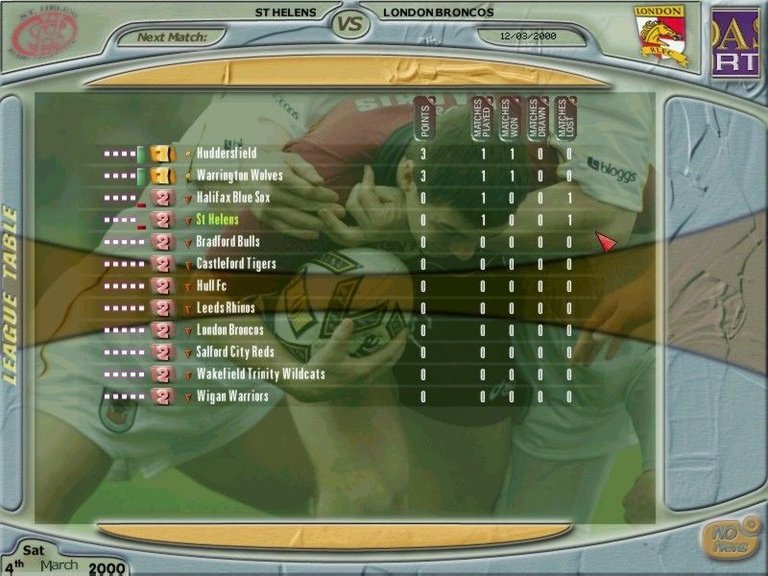
Description
Championship Rugby Manager is the official game of the European Super League Rugby, released in 2000. It features all the clubs from the league, complete with official logos, and includes real player names and photos updated to the 2000 season. As a managerial simulation, players take on the role of a rugby team manager, making tactical decisions and handling business aspects of the club. Despite its licensed content, the game received mixed reviews, with critics citing a lack of features and a poorly executed match engine.
Championship Rugby Manager Reviews & Reception
mobygames.com (28/100): A deeply engaging management experience that will appeal to both rugby aficionados and strategy game enthusiasts.
retro-replay.com : Championship Rugby Manager delivers a deeply engaging management experience that will appeal to both rugby aficionados and strategy game enthusiasts.
gamearchives.net (70/100): LMA Manager 2001 definitely offers Championship Manager a challenge!
Championship Rugby Manager Cheats & Codes
PC
Enter codes as a name or during specific actions.
| Code | Effect |
|---|---|
| JIMMY RULES | Infinite money |
| champions | Improves team performance |
| * | Exit without saving |
Championship Rugby Manager: A Forgotten Gem of Early 2000s Sports Management
Introduction
In the annals of sports management simulations, Championship Rugby Manager (2000) occupies a curious niche—a game that arrived at the tail end of the 20th century, just as the genre was beginning to crystallize into the form we recognize today. Developed by the relatively obscure Waywardxs Entertainment S.R.L. and published by Midas Interactive Entertainment Ltd., this title was an ambitious attempt to bring the depth and tactical nuance of rugby union to the managerial simulation space. While it may not have achieved the commercial success or critical acclaim of its football-focused contemporaries like Championship Manager, Championship Rugby Manager remains a fascinating artifact of its time, offering a glimpse into the challenges and innovations of early sports management games.
This review will dissect Championship Rugby Manager in exhaustive detail, exploring its development history, gameplay mechanics, narrative and thematic elements, and its lasting legacy. By examining the game through the lens of its era, we can better understand its strengths, flaws, and the unique place it holds in the evolution of sports simulations.
Development History & Context
The Studio and the Vision
Waywardxs Entertainment S.R.L. was a relatively small development studio based in Italy, with a portfolio that included a mix of sports management titles and other simulation games. The studio’s work on Championship Rugby Manager was part of a broader effort to capitalize on the growing popularity of managerial simulations in the late 1990s and early 2000s. The game was developed under the leadership of Claudio Giacopazzi, who served as both producer and lead designer, alongside Agostino Simonetta, who acted as executive producer and designer. The team also included Maurizio Maffei as lead programmer and Daniele Debernardi as lead artist, with contributions from a total of 39 individuals.
The vision for Championship Rugby Manager was clear: to create the first officially licensed rugby management simulator that could stand alongside the dominant football management games of the era. The game was designed to be the official title of the European Super League Rugby, featuring all the clubs, official logos, and real player names and photos updated to the 2000 season. This licensing was a significant selling point, as it provided a level of authenticity that was rare in sports management games at the time.
Technological Constraints of the Era
Released in 2000, Championship Rugby Manager was developed during a transitional period in gaming technology. The late 1990s and early 2000s saw the shift from DOS-based systems to Windows, and while the game was built for Windows, it still bore the hallmarks of its era. The hardware limitations of the time meant that the game relied heavily on 2D graphics and text-based interfaces, with minimal animation and sound design. The match engine, while functional, was far from the fluid, real-time simulations that modern sports games offer.
The game’s system requirements were modest by today’s standards but typical for the time:
– CPU: Intel Pentium
– RAM: 32 MB
– OS: Windows 95
– DirectX: DirectX 6.1
These specifications reflect the technological constraints of the era, where developers had to balance depth of gameplay with the limitations of consumer hardware.
The Gaming Landscape of 2000
The early 2000s were a golden age for sports management simulations, particularly in the realm of football (soccer). The Championship Manager series, developed by Sports Interactive, was the undisputed king of the genre, with its deep tactical options, extensive databases, and immersive career modes. Other notable titles included LMA Manager and Premier Manager, each vying for a share of the market.
In this competitive landscape, Championship Rugby Manager faced an uphill battle. Rugby union, while popular in certain regions, did not have the same global appeal as football, and the market for rugby management games was significantly smaller. Additionally, the game was released alongside Football Masters + Championship Rugby Manager, a compilation that bundled Championship Rugby Manager with Football Masters 99, a budget-friendly football management game. This compilation was an attempt to broaden the game’s appeal by offering two distinct management experiences in one package.
Despite these challenges, Championship Rugby Manager carved out a niche for itself, appealing to rugby enthusiasts and management simulation fans who were looking for something different from the football-centric titles dominating the market.
Narrative & Thematic Deep Dive
The Absence of a Traditional Narrative
Unlike many modern sports games, which often feature scripted storylines or cinematic cutscenes, Championship Rugby Manager does not have a traditional narrative. Instead, it tasks players with creating their own stories through the career mode, where they take on the role of a rugby manager and guide their team through multiple seasons. The game’s narrative emerges from the player’s decisions, the outcomes of matches, and the dynamic events that unfold over the course of a career.
This emergent storytelling is a hallmark of the management simulation genre, where the player’s actions and the game’s systems combine to create a unique experience. Whether you’re leading an underdog team to an unlikely championship or struggling to keep a struggling club afloat, the narrative is shaped by your choices and the game’s responses to them.
Themes of Strategy, Leadership, and Perseverance
At its core, Championship Rugby Manager explores themes of strategy, leadership, and perseverance. The game challenges players to balance the demands of team management—such as player transfers, tactical planning, and financial constraints—with the pressures of achieving success on the pitch. The themes are reinforced through the game’s mechanics, which require careful planning, adaptability, and long-term thinking.
The game also touches on the business side of sports, with players needing to manage budgets, negotiate contracts, and deal with the expectations of the club’s board and fans. These elements add a layer of realism to the experience, grounding the gameplay in the realities of professional sports management.
Dialogue and Player Interaction
While Championship Rugby Manager lacks voiced dialogue or cinematic cutscenes, it does feature text-based interactions that provide feedback on the player’s decisions. Match reports, press conferences, and boardroom meetings are all conveyed through written text, which helps to immerse the player in the world of rugby management. The dialogue is functional rather than elaborate, but it serves its purpose by keeping the player informed and engaged.
The game’s news system also plays a role in shaping the narrative, with updates on player injuries, transfer rumors, and league standings adding context to the player’s decisions. These elements combine to create a sense of progression and consequence, where every action has a ripple effect on the team’s performance and the player’s career.
Gameplay Mechanics & Systems
Core Gameplay Loop
The core gameplay loop of Championship Rugby Manager revolves around team management, tactical planning, and match simulation. Players begin by selecting a team from the European Super League Rugby, each with its own strengths, weaknesses, and financial constraints. From there, the game unfolds over a series of seasons, with the player making decisions that affect the team’s performance both on and off the pitch.
The gameplay can be broken down into several key systems:
-
Team Management:
- Player Transfers: Players can buy and sell players to build their ideal squad. The transfer market is dynamic, with player values fluctuating based on performance, age, and demand.
- Contract Negotiations: Managing player contracts is a crucial aspect of the game, as players demand higher wages and better terms as they develop.
- Youth Development: The game includes a youth scouting system, allowing players to discover and nurture young talent.
-
Tactical Planning:
- Formations and Strategies: Players can customize their team’s formation and tactical approach, adjusting strategies based on the opposition and match conditions.
- Set-Piece Selection: The game allows for detailed control over set-piece plays, such as lineouts and scrums, adding a layer of tactical depth.
- Substitutions and In-Game Adjustments: During matches, players can make real-time adjustments to their tactics, including substitutions and changes to defensive or offensive strategies.
-
Financial Management:
- Budgeting: Players must manage the club’s finances, balancing income from ticket sales, sponsorships, and merchandise with expenses like player wages and facility upgrades.
- Facility Upgrades: The game includes a stadium editor, allowing players to customize their team’s home ground, which can impact fan satisfaction and revenue.
-
Match Simulation:
- The game’s match engine simulates matches in real-time, with players able to watch the action unfold or skip to the results. The engine uses statistical calculations to determine outcomes, with player attributes, team tactics, and match conditions all playing a role.
- Real-Time Commentary: During matches, the game provides text-based commentary that describes key moments, such as tries, conversions, and penalties.
User Interface and Controls
The user interface of Championship Rugby Manager is designed to be intuitive and functional, with a focus on clarity and ease of use. The game’s menus are organized logically, with separate screens for team management, tactics, finances, and match simulation. The interface is mouse-driven, with players clicking through menus to make decisions and adjust settings.
The match simulation screen is particularly noteworthy, as it provides a top-down view of the action, with player models represented as 2D sprites. While the graphics are simplistic by modern standards, they are effective in conveying the flow of the game and the positions of the players. The screen also includes statistical overlays, such as possession percentages and scoring opportunities, which help players assess their team’s performance.
Innovations and Flaws
Championship Rugby Manager introduced several innovative features for its time, including:
– Official Licensing: The game’s use of real team logos, player names, and photos added a level of authenticity that was rare in sports management games at the time.
– Dynamic Team Morale: The game included a morale system that affected player performance, adding a layer of realism to the management experience.
– Stadium Editor: The ability to customize the team’s home ground was a unique feature that allowed players to tailor the experience to their preferences.
However, the game also had its flaws, many of which were a result of the technological limitations of the era:
– Limited Graphics: The 2D match engine and simplistic player models lacked the visual polish of modern sports games.
– Text-Heavy Interface: The game relied heavily on text-based feedback, which could be overwhelming for some players.
– Lack of Depth in Some Systems: While the game offered a robust management experience, certain aspects, such as the transfer market and youth scouting, lacked the depth of more established titles like Championship Manager.
Despite these limitations, Championship Rugby Manager provided a solid foundation for future rugby management games, demonstrating the potential of the genre and paving the way for more sophisticated titles.
World-Building, Art & Sound
Setting and Atmosphere
Championship Rugby Manager is set in the world of European Super League Rugby, with players taking on the role of a manager in one of the league’s clubs. The game’s setting is grounded in reality, with real teams, players, and stadiums providing a sense of authenticity. The atmosphere is one of strategic depth and tactical challenge, with the game emphasizing the managerial aspects of rugby over the on-field action.
The game’s stadium editor allows players to customize their team’s home ground, adding a personal touch to the experience. While the graphics are simplistic, the inclusion of floodlights, banners, and club logos helps to create a sense of place and immersion.
Visual Design
The visual design of Championship Rugby Manager is functional rather than flashy. The game’s menus are clean and intuitive, with a focus on clarity and ease of navigation. The match engine uses 2D sprites to represent players, with basic animations for key actions like passing, tackling, and scoring. While the graphics are not on par with modern sports games, they are effective in conveying the flow of the match and the positions of the players.
The game’s user interface is designed to be user-friendly, with clear icons, legible fonts, and a consistent color palette. The inclusion of club crests and player photos adds a layer of authenticity, helping to immerse the player in the world of rugby management.
Sound Design
The sound design of Championship Rugby Manager is minimal but effective. The game features crowd noises, such as cheers and chants, which help to create a sense of atmosphere during matches. The match commentary is text-based, but the inclusion of sound effects for key moments, such as tries and conversions, adds to the immersion.
The game’s music is limited to a brief intro theme, with the focus primarily on the sound effects and ambient noises. While the sound design is not a standout feature, it serves its purpose by enhancing the overall experience without distracting from the gameplay.
Reception & Legacy
Critical and Commercial Reception
Championship Rugby Manager received mixed reviews upon its release. The game’s official licensing and authentic roster were praised for adding a level of realism to the experience, but the simplistic graphics and text-heavy interface were criticized for feeling outdated. The game’s match engine was also a point of contention, with some reviewers finding it lacking in depth and excitement.
The game’s commercial performance was similarly mixed. While it found a niche audience among rugby fans and management simulation enthusiasts, it struggled to compete with the more established football management titles of the era. The game’s inclusion in the Football Masters + Championship Rugby Manager compilation helped to broaden its appeal, but it remained a cult classic rather than a mainstream success.
Evolution of the Genre
Despite its modest reception, Championship Rugby Manager played a role in the evolution of the sports management genre. The game’s focus on authenticity and licensing set a precedent for future titles, demonstrating the importance of real-world data and official partnerships in creating immersive experiences. The game’s tactical depth and managerial systems also influenced later rugby management games, such as Pro Rugby Manager (2004) and National Rugby Manager (2018).
The game’s legacy is perhaps best understood in the context of the broader sports management genre. While Championship Rugby Manager may not have achieved the same level of success as Championship Manager or Football Manager, it helped to expand the genre beyond football, proving that there was an audience for management simulations in other sports.
Influence on Subsequent Games
Championship Rugby Manager’s influence can be seen in several subsequent rugby management games, including:
– Pro Rugby Manager (2004): This title built on the foundation laid by Championship Rugby Manager, offering a more polished and visually impressive experience.
– National Rugby Manager (2018): This modern take on rugby management includes many of the features introduced in Championship Rugby Manager, such as detailed tactical options and a dynamic transfer market.
– Blackout Rugby Manager (2022): This title continues the tradition of rugby management simulations, with a focus on realism and strategic depth.
While these games have evolved significantly from their predecessor, they owe a debt to Championship Rugby Manager for helping to establish the genre and prove its viability.
Conclusion
Championship Rugby Manager is a game that defies easy categorization. It is neither a masterpiece nor a failure but rather a flawed yet ambitious attempt to bring the depth and tactical nuance of rugby union to the world of sports management simulations. Released at a time when the genre was dominated by football-focused titles, Championship Rugby Manager carved out a niche for itself, appealing to rugby enthusiasts and management simulation fans who were looking for something different.
The game’s strengths lie in its authentic licensing, tactical depth, and emergent storytelling, which combine to create a uniquely immersive experience. The weaknesses, such as the simplistic graphics and text-heavy interface, are a product of the technological limitations of the era and do little to detract from the game’s core appeal.
Ultimately, Championship Rugby Manager is a forgotten gem of the early 2000s, a game that deserves to be remembered for its innovations and its role in expanding the sports management genre beyond football. While it may not have achieved the same level of success as its contemporaries, it remains a fascinating artifact of its time and a testament to the creativity and ambition of its developers.
For fans of rugby and management simulations, Championship Rugby Manager is a must-play, offering a glimpse into the challenges and rewards of guiding a team to glory in one of the world’s most physically demanding sports. For historians of the genre, it is a valuable case study, demonstrating the potential and pitfalls of early sports management games.
In the grand tapestry of video game history, Championship Rugby Manager may be a small thread, but it is one that helped to weave the fabric of the sports management genre as we know it today.