
- Release Year: 2020
- Platforms: Macintosh, Nintendo Switch, Windows
- Publisher: Salt Castle Studio GmbH
- Developer: Salt Castle Studio GmbH
- Genre: Action
- Perspective: 3rd-person
- Game Mode: Single-player
- Gameplay: Party game
- Average Score: 54/100
Description
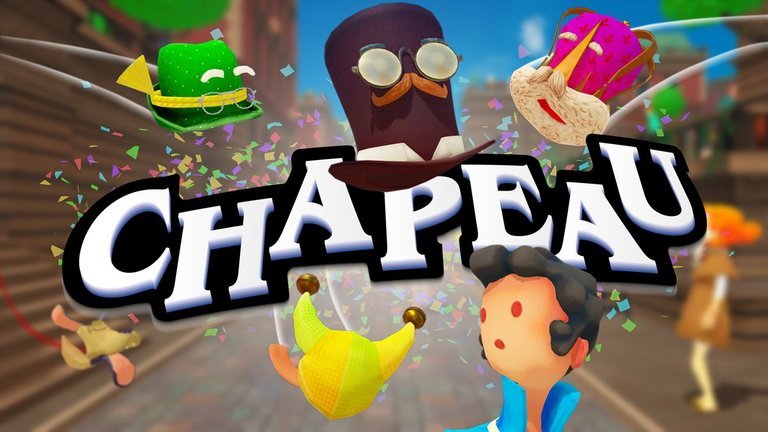
Chapeau is a 3D party game where players control anthropomorphic hats in competitive split-screen challenges, featuring modes like avoiding rising lava in ‘The Floor is Lava’, hunting a specific NPC in ‘Where is Wilhelm’, and coloring people in ‘Color Craze’. Using momentum-based movement such as dashing and flipping, players land on opponents to steal coins, utilize power-ups like a dog-shaped thief hat, and attack rivals across vibrant but minimally textured environments. Designed for up to four players via local multiplayer or solo against bots, the game combines chaotic action with accessible controls and a playful art style geared toward younger audiences.
Where to Buy Chapeau
PC
Chapeau Cracks & Fixes
Chapeau Guides & Walkthroughs
Chapeau Reviews & Reception
metacritic.com (50/100): It’s a chaotic game that takes a bit of getting used to, and even when you’ve mastered its clunky controls, the game modes simply aren’t compelling enough to keep you invested.
opencritic.com (50/100): It certainly feels like it’s geared more towards youngsters, and we’re certain they’ll get a kick out of it for a little while, but unfortunately for the rest of us, these hats are just a bit too frayed to recommend.
monstercritic.com (63/100): It certainly feels like it’s geared more towards youngsters, and we’re certain they’ll get a kick out of it for a little while, but unfortunately for the rest of us, these hats are just a bit too frayed to recommend.
rapidreviewsuk.com : Chapeau is a unique concept that sees its players playing as a bunch of hats, that are battling for gold coins by sitting on unsuspecting people’s heads in one of seven 3D locations. While this is taking place, the general public walk around oblivious to the ongoing hat royale that is happening over their very own heads! The concept is marvellous and quite ridiculous, but I just love it!
Chapeau: Review
Introduction
In the ever-expanding pantheon of video game concepts, few are as delightfully absurd as controlling sentient hats in a competitive multiplayer chaos. Released on March 31, 2020, Chapeau—developed and published by Austrian indie studio Salt Castle Studio—promises a whimsical blend of 3D platforming and frenetic party gameplay. Inspired by the French word for “hat,” the game tasks players with bouncing, dashing, and stomping atop oblivious civilians’ heads to claim victory across three distinct modes. Yet, beneath this charming premise lies a product of ambition constrained by execution. Chapeau is a fascinating artifact of pandemic-era indie development—a game born from a student project that aimed to revive couch-coop spirit but ultimately faltered in its technical polish and accessibility. While its core concept brims with potential, Chapeau remains a niche curiosity, a frayed cap in a market saturated with more polished alternatives. This review deconstructs its legacy, dissecting how its unique mechanics, art direction, and context culminate in an experience that is intermittently delightful but ultimately forgettable.
Development History & Context
Salt Castle Studio emerged from the fertile grounds of the University of Applied Science Salzburg, where Chapeau began life in 2018 as a master’s degree graduation project. Founded by student developers, the studio’s vision was to create a fast-paced, physics-driven party game centered on movement and local camaraderie. Using the Unity engine—a pragmatic choice for small teams—Chapeau sought to emulate the chaotic joy of classics like Super Monkey Ball while infusing it with a surreal, millinery-based twist. The developers drew inspiration from Austria’s cultural landmarks, mapping levels after iconic sites such as the Salzburg Fortress and Vienna’s Prater Ferris Wheel to ground the absurdity in tangible geography.
Technologically, Chapeau operated within typical indie constraints: limited resources, a small team, and a development cycle compressed by the pressures of academic deadlines. This context is critical, as the game’s rough edges—from unexplained mechanics to simplistic visuals—stem directly from these limitations. Released across Windows, macOS, and Nintendo Switch in early 2020, Chapeau arrived amid a gaming landscape dominated by online multiplayer trends (e.g., Fall Guys) and AAA releases like Animal Crossing: New Horizons. Its absence of online play—a glaring omission—made it an anachronism, prioritizing local co-op at a time when digital connectivity was becoming the norm. Yet, this choice also reflected a nostalgic idealism, aiming to recapture the “good old days” of split-screen gaming. Salt Castle Studio’s journey from academia to commercial release is a microcosm of modern indie challenges: executing a bold concept without the budget to refine it, resulting in a title that feels simultaneously innovative and incomplete.
Narrative & Thematic Deep Dive
Chapeau dispenses with traditional narrative in favor of pure gameplay-driven storytelling—a deliberate choice for a party game. The “plot” is a loop of competitive chaos: players, as sentient hats, scramble across maps to dominate oblivious humans, turning public spaces into battlegrounds. This abstraction allows the game to focus on mechanics, but it also robs it of thematic depth. The lack of lore or character development reduces the hats to avatars of competition, their personalities confined to cosmetic unlocks (e.g., “Duke Hattringham” the top hat or “Sir Clong Clong” the knight’s helmet).
The narrative themes, however, emerge indirectly through gameplay. Competition is the central ethos, amplified by modes like Where is Wilhelm, where players hunt a specific NPC among crowds, or Color Craze, which mirrors territorial battles in games like Splatoon. Yet, the game’s true thematic core lies in its absurdity: the juxtaposition of formal headwear (chapeaux) with reckless, slapstick violence. This humor is underscored by the faceless, oblivious NPCs, who serve as passive platforms—symbolizing humanity as a backdrop for trivial rivalries. The absence of dialogue or story reinforces the game’s identity as a distilled experience, where meaning is derived from emergent chaos rather than scripted narrative. While this approach streamlines gameplay, it also limits emotional resonance, leaving Chapeau feeling more like a technical demo than a fully realized world.
Gameplay Mechanics & Systems
At its heart, Chapeau revolves around mastery of momentum-based movement. Hats crawl slowly on the ground but soar through the air via ZR-powered leaps and ZL-dashes, with gravity and physics dictating trajectories. Wall traversal and ground-pound stomp moves add verticality, but the learning curve is steep. Controls feel “clunky” initially, requiring players to chain movements fluidly to navigate maps efficiently—a skill that separates novices from veterans.
The game’s structure hinges on three core modes, each with distinct objectives:
– The Floor is Lava: A twist on the childhood classic, players collect coins from humans while avoiding rising lava. Knocking opponents into the lava to steal their coins adds a predatory layer.
– Where is Wilhelm: Players identify and land on a specific NPC (shown in a portrait) to score points. Combat is crucial here, as rivals can dislodge you mid-tag.
– Color Craze: Teams (or free-for-all players) “paint” humans by landing on them while holding color orbs. Map control—dominating the most people—determines victory.
A 24-challenge single-player mode unlocks hats, skins, trails, and maps, offering progression for solo players. Hats are categorized into three weight classes: light (eager flyers, slow ground speed), medium (balanced), and heavy (fast but hard to control). This system encourages diverse playstyles but can feel imbalanced, as heavy hats dominate combat while light ones excel in movement.
Power-ups—like dog-shaped hats that steal coins or screen-blackening items—add chaos but suffer from a critical flaw: no in-game tutorials explain their functions. This oversight forces trial-and-error, especially frustrating against AI opponents. The AI itself is inconsistent, excelling in Where is Wilhelm by instantly identifying NPCs but lagging in other modes. Ultimately, Chapeau’s gameplay is a double-edged sword: its momentum-based mechanics create moments of euphoric flow, yet systemic flaws and a lack of depth prevent sustained engagement.
World-Building, Art & Sound
Chapeau’s world-building is intentionally minimalist, prioritizing function over narrative depth. Maps, inspired by Austrian locales, feature generic urban plazas, parks, and landmarks stripped of cultural specificity. The Salzburg Fortress, for instance, is reduced to a colorful backdrop with little contextual detail. Humans roam these spaces as faceless, indistinguishable NPCs, their sole purpose being platforms for hat-based antics. This abstraction streamlines gameplay but sacrifices immersion, making environments feel sterile and repetitive.
Artistically, Chapeau walks a tightrope between charm and crudeness. The hats themselves are vibrantly designed, with unlockable skins and trails offering visual flair. NPCs, however, are simplistic “block color” figures with minimal textures, and lava effects are notably “poor looking.” The overall aesthetic leans into cartoonish exaggeration, with bright primary colors and exaggerated physics, but environments suffer from blandness and a lack of polish. Performance is relatively stable, even in split-screen, but visual inconsistencies—like flat textures and generic layouts—undermine cohesion.
Sound design fares better, with an “upbeat” and “catchy” soundtrack that complements the game’s comedic tone. The main menu theme, in particular, is praised as one of the year’s most earwormy tunes. Sound effects are functional—satisfying thuds for landings, comical yelps from NPCs—but rarely remarkable. Music and audio coalesce to create a lighthearted atmosphere, one that feels geared toward younger audiences but lacks the dynamism to elevate the experience. Together, art and sound establish a whimsical, if unpolished, world where the hats’ personalities outshine their surroundings.
Reception & Legacy
Upon release, Chapeau received muted critical and commercial reception, reflecting its niche appeal and technical shortcomings. Metacritic compiled a score of 50% based on a single review (Nintendo Life’s 5/10), which critiqued its “clunky controls” and “uncompelling” modes. OpenCritic placed it in the bottom percentile, with only two reviews: Nintendo Life’s lukewarm take and LadiesGamers.com’s positive-but-qualified endorsement for local play with siblings. Players echoed these sentiments, with common complaints about the lack of online multiplayer and unexplained mechanics.
Despite this, Chapeau found a small, dedicated audience among families and young gamers. LadiesGamers.com noted its appeal for children, calling it “one of the few review games my little sister has willingly played with me more than once.” However, its legacy remains limited. The game did not spawn sequels or imitators, nor did it influence the broader indie party game scene. Instead, it is remembered as a curiosity—a student project that dared to be different but couldn’t overcome the “hats are just a bit too frayed to recommend” verdict of critics. Salt Castle Studio’s follow-up, Alpaca Ball: Allstars, shifted focus to sports, signaling Chapeau’s status as a stepping stone rather than a landmark. Its true legacy lies in its authenticity: an unapologetically quirky product of pandemic-era indie development, preserved in gaming archives as a testament to ambition outpacing resources.
Conclusion
Chapeau is a paradox: a game bursting with creative potential yet undermined by its own limitations. Its core concept—controlling hats in chaotic, physics-based battles—is a stroke of genius, evoking the joy of local multiplayer classics while carving out a unique identity. The weight-class system, momentum-based movement, and diverse modes offer moments of genuine fun, especially when played with friends or family. Yet, these strengths are consistently sabotaged by technical flaws: the absence of online play relegates it to niche couch-coop sessions, while clunky controls and unexplained mechanics create barriers to entry. Its art style, charming in parts, is marred by visual blandness, and the lack of narrative depth leaves players adrift in a world of purposeless chaos.
Ultimately, Chapeau’s place in video game history is that of a footnote—a fascinating but flawed artifact of 2020’s indie scene. It serves as a cautionary tale about the challenges of translating academic ambition into commercial polish, yet also as a reminder of the joy inherent in local multiplayer. For players seeking a lighthearted, short-lived diversion with children or siblings, Chapeau might offer fleeting delight. For everyone else, it remains a frayed cap—oddly endearing but ultimately unworthy of recommendation. In a market saturated with polished party games, Chapeau’s legacy is not innovation, but authenticity: a quirky, imperfect love letter to a bygone era of shared screens.