
- Release Year: 2024
- Platforms: Macintosh, Windows
- Publisher: Meowgical Games
- Developer: Meowgical Games
- Genre: Adventure
- Perspective: 1st-person
- Gameplay: Visual novel
- Setting: Fantasy
Description
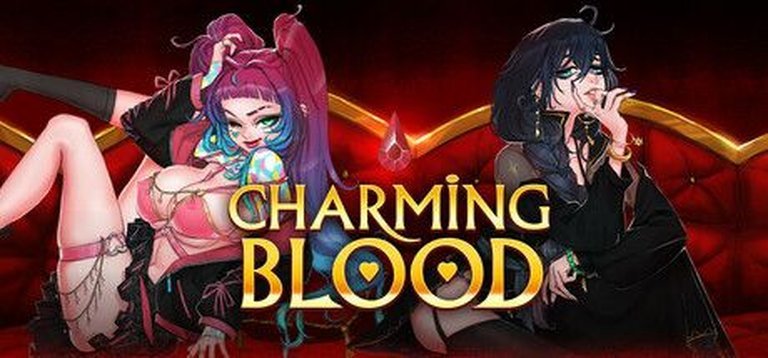
Charming Blood is a fantasy adventure visual novel presented in first-person with fixed screen transitions, where players take on the role of an ordinary young man forcibly transformed into a vampire. Set in a world where vampires have secretly coexisted with humanity, the game focuses on navigating complex romantic relationships with four distinct vampire women—Victoria, Mina, Alex, and Erika—while adapting to supernatural life and facing the threat of war among vampire factions.
Where to Buy Charming Blood
PC
Charming Blood: A Nocturnal Narrative in the Making
Introduction: A Spark in the Shadows
In the vast ecosystem of the visual novel, where tropes are as common as dialogue choices, Charming Blood arrives not with a thunderclap, but with a patient, deliberate stirring of the shadows. Released into early access in November 2024 by the petite indie studio Meowgical Games, this title represents a calculated return to a classic—and often oversaturated—genre: the vampire romance. Yet, where many would merely competently adorn the familiar skeleton of “human turned vampire navigates supernatural politics and harem dynamics,” Charming Blood demonstrates, even in its incomplete state, a keen understanding of what makes such narratives resonate: character-driven subtext, atmospheric buildup, and the potency of a well-executed genre twist. This review posits that Charming Blood is not necessarily a revolutionary landmark, but a meticulously crafted exemplar of modern indie visual novel development, one whose current value lies in its potent promise and foundational strengths, even as its ultimate historical significance remains tethered to the success of its forthcoming completion. It is a game about the terrifying, exhilarating moment of transformation, and it mirrors that very state: caught between the human world it knows and the vampire world it is becoming, holding immense potential that has yet to fully crystallize.
Development History & Context: The Meowgical spark
Meowgical Games, the singular entity behind Charming Blood, enters the scene with the quiet confidence of a specialist. Little is publicly known about the studio’s prior history, suggesting this is either a new venture or a pseudonym for a small, dedicated team. Their chosen engine, Unity, is the contemporary indie workhorse—accessible, versatile, but requiring savvy to transcend generic asset usage. The title’s development is explicitly framed as a community-journey, a common and often beneficial model for story-heavy visual novels where player feedback can refine narrative pacing and character appeal before the final “1.0” lock.
The game emerged into a 2024 landscape saturated with both major studio titles and a thriving indie visual novel scene on Steam. Its direct thematic ancestors are myriad, from the moody Gothic romance of Castlevania: Symphony of the Night‘s Alucard to the political supernatural drama of The Vampire Chronicles. Within its own medium, it directly competes with and echoes the structure of successful romance VNs like Hakuoki or Code: Realize, but with a distinctly modern, Western indie sensibility. The decision to launch into Early Access, with a stated progress of “7/12 GAME DAYS COMPLETED” as of early 2025, is a critical part of its context. This isn’t a tech demo but a narrative beta, allowing the developers to gauge reactions to its core cast and central mystery—a mystery that, as we’ll explore, is the game’s primary engine beyond the romance. The pricing strategy ($11.99, with a planned increase post-launch) and the promise of “36 unique endings” and a “CG gallery” signal a commitment to a substantial, replayable experience typical of the genre’s best offerings.
Narrative & Thematic Deep Dive: The Weight of the First Night
The ad blurb provides the skeletal premise: an unnamed, ordinary young man (an art student and photographer, per previews) in a gloomy new city is turned into a vampire against his will by his neighbor, Victoria. He is then thrust into a hidden supernatural world on the brink of civil war. However, the preview from Witch’s Review Corner fleshes out this premise with invaluable texture, revealing the narrative’s true strength: its grounded, character-first approach.
The protagonist is a standout. Eschewing the “blank slate” or the “pervy everyman” common to the genre, he is given a specific, relatable melancholy. He is a pessimist and a complainer, but one with a self-deprecating wit and a genuine artistic passion. His failure to “make it” in his new city provides a relatable parallel to his forced transformation—both are unwanted, destabilizing changes. His personality is malleable enough for player projection but strong enough to have clear reasons for why the vampires would be drawn to him. Crucially, his initial reaction to vampirism is not facile excitement but panic and a desperate desire to return to his mortal life, a psychological realism that grounds the fantastic premise.
The four love interests (LIs) are not merely archetypes but are defined by their roles within the vampire socio-political landscape, and their dynamics with each other are as important as their dynamics with the player.
- Victoria is the linchpin. The “seemingly gentle neighbor” with a chunky orange cat named Sheri, she embodies the subversion of the “mysterious goth” trope. Her helpfu nature is genuine, but her secrecy is a burden born of both her neutral factional ties and a deep, anxious care for the protagonist. The preview notes her “dark sense of humor” and the profound guilt she feels for turning him, a act born not of predatory hunger but panicked reluctance to let him die. Her route is fundamentally about breaking through her self-sacrificing reserve and the protective lies she tells. Her visual design (noted as the reviewer’s favorite) reinforces this: a goth aesthetic that is less performative edge and more a comfortable, personal uniform.
- Mina represents the antithesis of Victoria’s caution. As a worker at “Club Tears,” a front for the radical “Society of Freedoms” (the “Wild Ones”), she is the avatar of vampire hedonism and autonomy. Her character is a masterclass in balancing carefree exuberance with underlying depth. Her “Cinderella” jokes and “succubus-fairy godmother” self-identification provide lightness, but the preview hints at “jealousy” and a “sneaky” determination, suggesting her freedom is a hard-won philosophy, not mere flightiness. She introduces the protagonist (and player) to the visceral, sensory realities of vampire existence—the taste of different blood types—making the world’s lore tangible.
- Alex provides the crucial external conflict. A vampire hunter from the ruling “Children of Darkness” clan who is also friends with the neutral Victoria, she is a walking contradiction. Her “tsundere” exterior—quick to bare fangs, dismissive of the protagonist as an “outsider”—masks a complex loyalty and a hurt stemming from Victoria’s secrecy. She is the narrative conduit to the central political mystery, acting as the “reluctant ally” who pulls the protagonist into the looming clan war. Her presence forces the protagonist (and player) to engage with the world’s power structures, not just its interpersonal ones.
- Erika, the leader of the Children of Darkness, is the looming figure—”The Erika.” Her absence from the current early access build is a potent narrative tease. The preview wonders how the other LIs will react to her route, implying her authority is absolute and her interest in the protagonist would be a seismic event in the established dynamic. She represents the apex of vampire power and the stern, inscrutable law of their society, a theme of “what secrets lie behind her stern façade” that promises a route of political intrigue as much as romance.
Thematically, the game explores transformation and agency. The protagonist’s change is imposed, but his subsequent journey is about claiming agency within that new form. The vampire world is not a monolithic evil but a fractured society with ideologies: Victoria’s cautious neutrality, Mina’s liberated anarchism, Alex’s institutional loyalism. The brewing war provides a crucible for these ideologies to clash, and the player’s choices will determine whether they become a pawn, a catalyst, or a power broker. The preview also notes intriguing hints about the protagonist potentially having a unique “gift” or “talent” (the terminology varies by character, a subtle world-building touch), which could elevate him from observer to pivotal figure. The mystery surrounding texts from “Nick, S.R., and Lily” adds a layer of personal intrigue that may connect the protagonist’s past to the supernatural present.
Gameplay Mechanics & Systems: The Architecture of Choice
As a visual novel with “menu structures” and “fixed/flip-screen” visuals, Charming Blood operates within a well-established framework. Its innovation, therefore, lies not in interface revolution but in the architecture and consequence of its choices—a critical aspect only partially observable in the early access build.
The core loop is classic: read narrative text, encounter illustrated character sprites and backgrounds, and make selections at decision points. The preview distinguishes two primary choice types: reaction choices (dialogue responses: truth/lie, silent/interject) and action choices (scene selections: e.g., “meet Mina early”). The latter are the primary drivers of branching paths, determining which character’s route and specific scenes are accessed. The preview observes that choices have clear short-term effects on character affection (“you can tell when a love interest likes or doesn’t like a response”) and scene variation, but the long-term, plot-altering consequences are still opaque—a natural state for a 7/12-day build.
The system appears to employ a hidden affection meter for each LI, influenced by dialogue choices and scene participation. This is not explicitly shown to the player (a common “mystery” element in such games), relying instead on narrative cues and character dialogue to signal standing. The potential for multiple, divergent endings (promised at 36) suggests these meters, combined with key plot decisions (likely related to the clan war and the protagonist’s own embrace or rejection of vampirism), will culminate in a complex web of conclusions.
Two technical pain points are highlighted in the preview: a clunky skip function that stops on scene changes or load points (frustrating for replays), and initial Save/Load functionality issues where saves from a previous session could block progress (seemingly patched). These are significant quality-of-life concerns for a genre where players routinely create dozens of saves to manage branching paths. A robust backlog system and reliable, fast skipping are non-negotiable for a modern VN aiming for a “finished” release. Their absence or imperfection in early access is a red flag that must be addressed for the full experience to be seamless.
World-Building, Art & Sound: The Gothic Palette
The setting is a contemporary, unnamed city where vampires live “in the neighborhood.” This modern-day integration is a smart, relatable choice. The lore is delivered organically through character dialogue: Victoria’s “neutral” stance, Mina’s “Society of Freedoms” vs. the ruling “Children of Darkness” clan, and the concept of vampire “talents” or “gifts.” This avoid info-dumps, making the world feel discovered.
The visual direction is a major strength, per the preview. The art style is described as beautiful and unique for each LI, directly reflecting their personalities: Victoria’s goth elegance, Mina’s vibrant, free-spirited fashion, Alex’s rebellious teen aesthetic. The backgrounds successfully establish mood—the “gloomy” apartment, the atmospheric Club Tears—and character rooms tell a story. The update from the old demo, where characters like Victoria and Mina received “updated looks” and “added poses” (notably Victoria holding her cat Sheri), shows a developer committed to polish. The use of CG scenes (special illustrated moments) for key plot and romantic beats is a vital genre convention, and their quality and integration are paramount. The preview’s audible gasp at a pivotal CG reveal demonstrates their effectiveness.
The sound design is noted as “pretty nice,” with short loops—a common cost-saving measure in indie VNs that can become repetitive. The true test will be the longevity of the soundtrack and the use of sound effects to heighten tension (a sudden crash, a whisper, the clink of a glass). The interface and text box have been refined from the demo to be “more stylized and cleaner,” which is a subtle but important touch for immersion.
Reception & Legacy: A Waiting Verdict
At the time of writing, Charming Blood exists in a curious critical limbo. It has no official Metascore on Metacritic (“Critic reviews are not available yet”), and major outlets like Kotaku or Game Informer have not published reviews (their included links are generic site searches). Its legacy is therefore being written in real-time by its early access player base.
Steam data, aggregated by Steambase, shows a Player Score of 80/100 from approximately 10 reviews as of early 2026—a “Positive” rating. This is a strong, but small-sample, indicator of initial satisfaction. The Steam store page user tags are revealing and accurate: “Story Rich,” “Choices Matter,” “Lore-Rich,” “Vampire,” “Dating Sim,” “Mature,” “Early Access.” The audience it attracts is precisely the niche it targets.
The Wiitch’s Review Corner preview serves as the de facto critical analysis to date. Its praise is substantive: for the protagonist’s likable voice, the believable development of relationships (especially Victoria’s guilt-driven care), the effective mystery hook, and the strong visual art. Its criticisms are the standard Early Access caveats: inconsistent terminology (“Lillush” vs. “Lilush”), functional skip/backlog issues, and the fundamental uncertainty of whether the narrative quality will be sustained across all 12 days and 36 endings.
Its potential influence on the industry is likely to be modest but meaningful. If Meowgical Games delivers on its promises—a coherent, politically nuanced vampire narrative with consistently strong character writing and technical polish—it will stand as a benchmark for what focused indie teams can achieve in the crowded romance VN space. It proves that success doesn’t require a massive budget but rather a clear vision, compelling character archetypes subverted with care, and a commitment to community feedback during development. It may inspire more small studios to tackle genre fiction with a serious, literary approach. However, if it stumbles in its final act—if the branching paths feel shallow, the mystery resolution unsatisfying, or the technical issues persist—it risks being remembered as another promising early access title that never quite ignited.
Conclusion: The Dawn of Something Promising?
Charming Blood is, in its current form, a compelling proposition filtered through a necessary caveat. It is not a finished masterpiece to be placed among the pantheon of great visual novels like The House in Fata Morgana or Steins;Gate. Instead, it is a masterclass in foundational setup. It presents a protagonist with a grounded pathos, four distinct and thematically rich love interests whose conflicts are inherently political, and a central mystery that leverages the vampire mythos for intrigue rather than just horror or titillation. The writing demonstrates a rare confidence in letting relationships develop through quiet moments and shared humor, not just dramatic confessions.
Its place in video game history, therefore, is provisional. It is a testament to the vitality of the Early Access model for narrative-driven games, allowing a small team to build a community and iterate on what matters most: character and story. If Meowgical Games can navigate the treacherous final stretch—polishing the QoL systems, ensuring the 36 endings feel meaningful and distinct, and delivering a climax that satisfies both the romantic and political plots—Charming Blood will be remembered as a standout indie success of the mid-2020s. It will be cited as an example of how to refresh a tired genre with smart writing and cohesive world-building.
If it fails to capitalize on its superb beginning, it will be a poignant case study in the perils of narrative scope and the difficulties of maintaining quality over a long developmental arc.
Final Verdict: 8/10 (Based on Current Early Access Build & Potential)
Charming Blood earns a provisional score reflecting its extraordinary promise and its present, incomplete state. For $11.99, a player is investing in a narrative journey that is already engaging, stylish, and emotionally intelligent, but with the clear understanding that the most critical chapters are yet to come. It is a game for the patient, the genre enthusiast, and the player who values character chemistry over combat complexity. The night has fallen, the protagonist has been turned, and the story has begun with captivating vigor. Now, the world waits to see if he—and the game—can survive the dawn.