
- Release Year: 2022
- Platforms: Nintendo Switch, PlayStation 4, PlayStation 5, Windows Apps, Windows, Xbox One, Xbox Series
- Publisher: Soedesco B.V.
- Developer: Indigo Studios
- Genre: Adventure
- Perspective: First-person
- Game Mode: Single-player
- Gameplay: Puzzle elements
- Setting: Europe, Fantasy
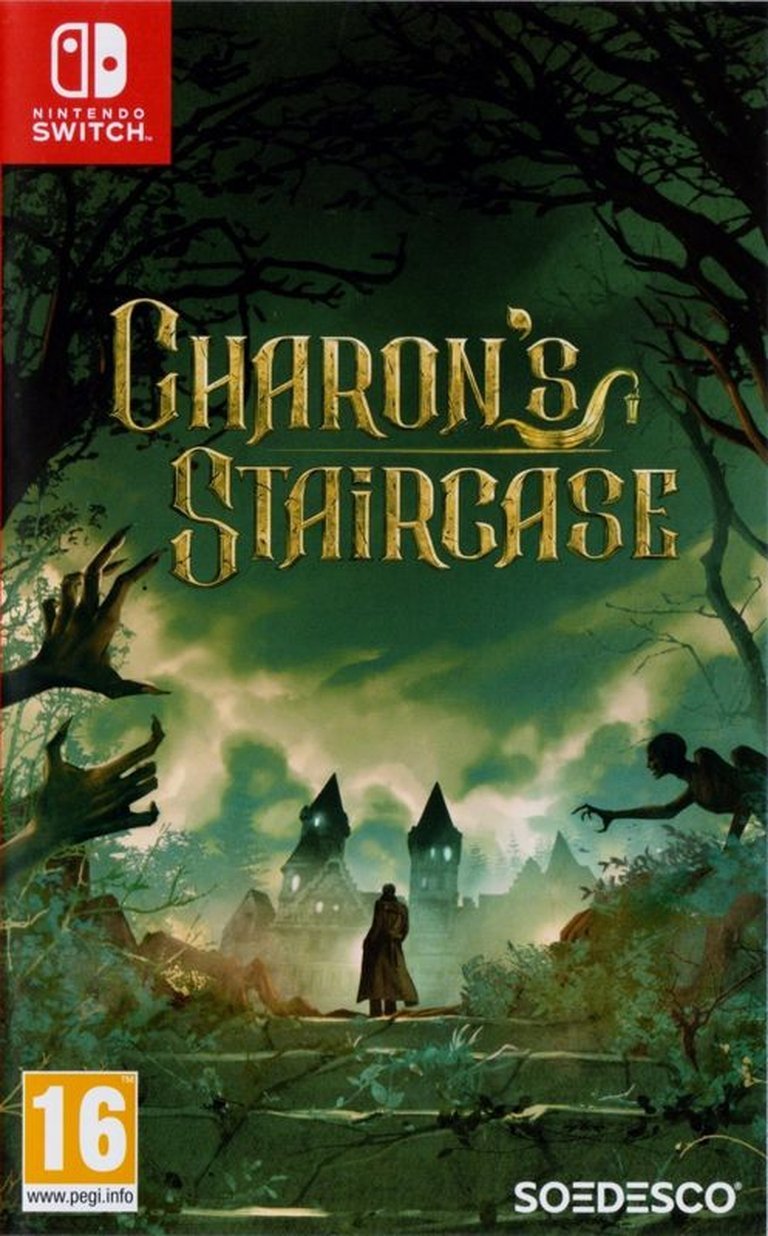
Description
Charon’s Staircase is a first-person horror adventure game set in 1970s Europe, where players assume the role of Desmond, an agent of the mysterious Ministry, tasked with investigating a supernatural mystery. Blending puzzle-solving with detective work, the game explores dark fantasy elements and a gripping narrative as players navigate eerie environments to uncover the truth.
Gameplay Videos
Where to Buy Charon’s Staircase
PC
Charon’s Staircase Free Download
Charon’s Staircase Cracks & Fixes
Charon’s Staircase Guides & Walkthroughs
Charon’s Staircase Reviews & Reception
indiegamesdevel.com : the game stands out for its dense narrative, unrelenting atmosphere of oppression, and ability to provoke profound unease
gamingtrend.com : The storytelling of Charon’s Staircase is the real star in this game.
Charon’s Staircase: A Descent into Bureaucratic Horror and Familial Madness
Introduction
In the vast, often-overcrowded cemetery of first-person horror games, Charon’s Staircase emerges not as a screaming ghoul but as a quiet, meticulously folded note slipped under the door—a message imbued with the chill of institutional rot and biological blasphemy. Released in October 2022 by the Spanish indie studio Indigo Studios and published by Soedesco, the game arrived with little fanfare but a profound sense of purpose. It is a title that confounds simple genre categorization, offering less in the way of visceral, jumpscare-laden terror and more in sustained, atmospheric dread rooted in history, conspiracy, and the spectral weight of familial sin. This review argues that Charon’s Staircase is a significant, if flawed, artifact of the early 2020s indie horror renaissance—a game that prioritizes narrative cohesion and thematic ambition over technical polish, ultimately forging a deeply unsettling experience that lingers in the mind long after its short runtime concludes. Its legacy may be that of a cult ruminative piece, a touchstone for narrative-driven horror that dares to intertwine political thriller with psychological ghost story.
Development History & Context
The Studio and Its Vision
Indigo Studios, a small team based in Spain, operated with a clear auteurist vision for Charon’s Staircase. The game represents a natural evolution from their previous work, notably Saint Kotar, sharing a commitment to “environment-driven horror” and psychological tension. The core creative team, prominently featuring Judit Hierro and Kim Planella (credited as artists, programmers, musicians, and voice actors), wore multiple hats, a hallmark of constrained indie development. Their stated goal, as gleaned from industry analysis and promotional material, was to create an experience where “horror [is] not as an event, but as a psychological condition,” prioritizing suggestion over exposition and atmosphere over spectacle.
Technological Constraints and Aesthetic Choice
Built in Unreal Engine 4, the game’s technical profile is a study in making artistic virtue of budgetary necessity. The developers leveraged dynamic lighting and volumetric effects to craft a “theatrically composed” world, but texture fidelity and character animation betray its indie roots. This technical roughness is not merely a flaw but, in many ways, a stylistic asset: the slightly stiff animations and dated graphics contribute to an uncanny, hyper-real yet artificial feel that enhances the game’s themes of bureaucratic horror and experimental unreality. The decision to forgo a brightness slider, criticized in several reviews, was likely a conscious (if questionable) artistic choice to enforce oppressive, near-pitch-black environments, directly tying player vulnerability to the game’s thematic core of navigating hidden, horrific truths.
The 2022 Gaming Landscape
Charon’s Staircase entered a market saturated with first-person narrative horror and “walking simulator” titles. In 2022, games like Layers of Fear had already established a template for story-heavy, puzzle-based horror. Charon’s Staircase distinguished itself by attempting a more politically engaged narrative, weaving a tale of totalitarian crimes and historical revisionism, which aligned with a broader trend in indie horror toward socially conscious storytelling (e.g., Signalis). Its release across all major platforms (PC, PS4/5, Xbox One/Series, Switch) via Soedesco, a publisher known for championing auteur-driven indies, was a strategic move to reach a niche audience hungry for mature, contemplative horror outside the AAA blockbuster cycle.
Narrative & Thematic Deep Dive
Plot Structure and the “Tomato in the Mirror”
The narrative is deceptively simple on the surface: Desmond, an agent of the shadowy “Ministry” (a thinly veiled allegory for 20th-century Eastern European authoritarian regimes), is sent to the remote Oack Grove estate—comprising the Lewelin Mansion and an adjacent hospital—to retrieve and destroy documents detailing the regime’s past atrocities, specifically “Project Alpha.” What follows is a descent into a layered mystery. The estate, abandoned for forty years, is haunted by the spectral remnants of Dr. Lewelin’s experiments on human subjects, particularly twins, to create psychic, obedient beings (the “Delta” and “Omega” projects).
The plot’s masterstroke is its final, recontextualizing twist. After navigating the mansion’s secrets, the hospital’s grotesque “Omega” monsters, and a frantic race against a radiation-fueled timer in an underground bunker, Desmond discovers the “Charon’s Staircase”—the egress. His final narration delivers the bombshell: he is the third triplet, the long-lost brother to the twins Dara and Devon, separated at birth. He was the successful, unaltered control subject given up for adoption, while Dara survived as a “Delta” and Devon was a failed experiment. His visions of Dara were a psychic link, and his entire mission was a perverse twist of fate, returning him to the scene of his family’s destruction. This “Tomato in the Mirror” moment reframes the entire journey from a mission of erasure to one of tragic, unconscious homecoming.
Character and Thematic Resonance
Desmond is a cipher, a “faceless” protagonist (his face is always obscured by his hat in cutscenes), intentionally designed as an avatar of blind bureaucratic obedience. His first-person narration is chillingly calm, analytical, and gradually unraveling. The other characters exist primarily through found documents: the tyrannical Dr. Lewelin, the tormented twin Devon, the surviving “Delta” Dara (raised by the groundskeeper Seth), and the various victims. The narrative is told through environmental storytelling—letters, scientific reports, diary entries—which paint a picture of scientific hubris, state-sanctioned cruelty, and the commodification of human life in the name of “purity.”
Themes coalesce powerfully:
* Collective Guilt and Historical Erasure: The Ministry’s desire to join the European Union by destroying evidence mirrors real-world struggles with historical accountability. The game asks if the past can ever truly be buried.
* Twin Telepathy and Fractured Identity: The psychic bond between Dara and Devon, and Desmond’s latent connection, frames the horror as both supernatural and a metaphor for the indelible, inescapable nature of family and genetic legacy.
* The Banality of Evil: The horror is perpetrated not by mustache-twirling villains but by scientists and bureaucrats following procedures. The setting—a blend of “Big Fancy House” and brutalist institutional architecture—feels like a physical manifestation of this bureaucratic madness.
* Obedience vs. Complicity: Desmond’s arc is from loyal functionary to horrified witness. His final act of destruction is rendered ambiguous; is it compliance or a futile attempt at closure?
The use of Greek mythology (Charon, the ferryman of the underworld) is the game’s central metaphor. The staircase is not a path to an afterlife but a passage through the underworld of one’s own history and genetic origin. It is a descent into a personal and political Hades.
Gameplay Mechanics & Systems
Core Loop and Exploration
Charon’s Staircase is a first-person adventure game with heavy puzzle elements. The core loop is investigative: explore a location (starting in a guard cabin, then the Lewelin Mansion, then the Hospital), find keys/codes/cards, unlock new areas, collect narrative documents, and advance the plot. Movement is deliberately slow—a “brisk walk” rather than a sprint—which several critics noted as tedious but which can be interpreted as reinforcing the game’s deliberate, oppressive tempo and Desmond’s methodical, duty-bound mindset.
Puzzle Design: A Mixed Blessing
Puzzles are the primary gameplay mechanic and the most divisive element.
* Environmental & Code-Based: Many puzzles involve finding 4-digit codes from notes, matching symbols, or using keys to access new wings of the mansion. These are generally logical and well-integrated into the story.
* Complex and Ambiguous Puzzles: Some puzzles are notably obtuse. A prominent example is a statue-matching puzzle where a cryptic one-line riddle must be matched to a statue, but the statues are visually similar and lack sufficient distinguishing detail. Another involves a tarot card sequence. Critics like Game Hoard and GamingTrend highlighted these as “unnecessarily ambiguous” and “frustratingly esoteric,” with hundreds of possible solutions due to poor clue presentation. The failure to provide clear feedback or a hint system exacerbates this, leading to “rage-quitting.”
* Skill-Based Moments: A memorable puzzle requires using X-ray specs and turning down lights for exactly one minute to distract “Omega” monsters in a corridor. The climax involves a timed mission with a seven-minute countdown in the radiation bunker to find the staircase, injecting a rare moment of pure panic.
Progression, UI, and “Survival” Elements
Progression is entirely linear and narrative-driven. The UI is minimalist: a journal that updates with summaries (but cannot be reviewed for past entries), and a simple interaction prompt. Collectibles are strictly documents and key items; there is no inventory management. Notably, for most of the game, there are no antagonists to evade or fight. The horror is environmental and psychological. This changes in the final hospital sequence and the bunker, where slow, monstrous “Omega” entities appear. Here, the game introduces a survival element: you cannot fight them. You must avoid their line of sight and run, a shift that some reviews found jarring but effective in raising stakes. The final escape sequence is a pure timed puzzle amidst these threats.
Innovation and Flaws
The game’s innovation lies in its unwavering commitment to a singular, bleak atmosphere and its willingness to let narrative complexity drive the experience. Its primary flaws are technical (stiff animations, dated textures, problematic hit boxes for item pickup) and design-based (the pacing can be sluggish, some puzzle logic is opaque, the lack of a brightness option renders crucial areas almost invisible). It does not innovate on core adventure game mechanics but executes them with varying degrees of success in service of its story.
World-Building, Art & Sound
Setting as Character: Oack Grove
The estate is not just a backdrop; it is the game’s true protagonist. Indigo Studios excels in environmental storytelling.
* The Lewelin Mansion: Imposing, “Big Fancy House” with ornate statues, dusty tapestries, and grand staircases. It represents the façade of order, wealth, and “civilized” science. Its upper floors are relatively tidy, while the attic and basement reveal decay and hidden labs.
* The Hospital: The game’s pinnacle of horror. A derelict, institutional maze of corridors, iron beds, and abandoned medical equipment. The upper floors are the domain of the emaciated, monstrous “Omega” rejects, creating a devastatingly grotesque final zone. The architecture shifts from the mansion’s faux-opulence to brutalist, oppressive confinement.
* The Groundskeeper’s Hut & Outdoor Areas: A small, rustic contrast that tells the story of Dara’s upbringing and hints at the outside world’s ignorance of Oack Grove’s secrets.
The geography is labyrinthine but coherent. The journey from the orderly mansion, through the clinical hospital, down into the industrial, radiation-blasted bunker, mirrors Desmond’s psychological descent and the surgical nature of the crimes committed there.
Art Direction and Visuals
The art direction is a consistent strength. It employs a desaturated, sombre palette dominated by browns, deep greens, greys, and grimy yellows. Occasional flares of red (a warning light, blood) or orange (radiation) punctuate the gloom. The style evokes “dirty realism” and Central European 1970s industrial decay, rooting the fantasy in a recognizably historical and unsettling aesthetic. The lighting is the star: dramatic chiaroscuro, shafts of light through dirty windows, and pools of emergency lighting create constant, theatrical unease. However, texture quality and character models are undeniably low-fidelity, a source of criticism but also, perversely, part of the game’s uncanny, artificial charm.
Sound Design: The Soul of Dread
The audio is universally acclaimed as the game’s most remarkable achievement. It masterfully employs restraint.
* Ambient Score: A shifting, near-imperceptible carpet of metallic hums, electronic drones, and sparse, melancholic piano phrases. It rarely swells into a traditional theme, instead existing as a continuous, unsettling part of the environment.
* Spatial Audio and Silence: Sound is diegetic and non-diegetic blurred. Creaks, distant thuds, and labored breathing are precisely located, disorienting and orienting the player simultaneously. Silence is used as a potent weapon—long stretches of quiet make every subsequent noise a jolt.
* Voice Acting: Sparse but effective. Desmond’s narration (by Ian Russell in English) is cool, measured, and gradually cracking. Other voices are filtered, cold, and bureaucratic (Ministry agents), or fragile and tragic (victim recordings).
* Acoustic Identity: Each location has a distinct soundscape: the mansion’s groaning wood and wind, the hospital’s metallic echoes and dripping water, the bunker’s industrial hum and radiation crackle. Sound doesn’t just accompany the horror; it is the horror, insinuating itself into the player’s psyche through accumulation.
Reception & Legacy
Critical Reception at Launch
Charon’s Staircase received mixed to average reviews upon release. Its Metacritic (PS5) and OpenCritic scores hover around 60-63.
* Praised: Nearly all critics lauded its story, atmosphere, and sound design. The plot twists, environmental storytelling, and oppressive mood were consistently highlighted as major strengths. Reviews from Video Chums (80%), GamingTrend (70%), and GameSpew (60/100) specifically called out the “intriguing story,” “tense atmosphere,” and “masterful sound.”
* Criticized: The technical presentation (dated graphics, stiff animations) and puzzle design (ambiguity, lack of clarity) were frequent points of contention. Hobby Consolas (48/100) and Cubed3 (50/100) were particularly harsh, citing graphical errors and frustrating puzzles. The pacing was also noted as deliberately slow, potentially alienating players seeking more action.
* The “thriller vs. horror” debate was central: most agreed the horror was more psychological and conceptual than visceral, with only the final act delivering sustained, monster-based terror.
Commercial Performance and Player Reception
Commercial data is scarce, but its wide platform release suggests publisher confidence. Steam user reviews are Mixed (57% positive). Common player praises mirror critic strengths (story, atmosphere). Common complaints echo the technical and puzzle issues, with some users (like on IMDb) calling it “very dated” and criticizing its linearity and control issues. Its short runtime (2-4 hours) and low replayability (no branching, fixed puzzles) are frequently noted.
Legacy and Influence
As of 2025, Charon’s Staircase lacks a widespread cultural footprint but has carved a niche within the narrative horror and walking simulator community. Its legacy is likely twofold:
1. A Case Study in Ambition vs. Means: It serves as an example of how a small studio can achieve significant thematic depth and atmospheric cohesion despite technical limitations. Its success in creating a unified, oppressive mood on a budget is instructive.
2. A Niche Recommendation: It is frequently cited in discussions of “underrated psychological horror” or “horror with great stories.” Its specific blend of political thriller, twin-based body horror, and bureaucratic dread remains relatively unique. It has not significantly influenced major trends but validates a path for horror games that prioritize slow-burn, literature-inspired storytelling over gameplay innovation or graphical fidelity.
3. Part of a Pair: Its association with Saint Kotar (developed by the same core team) links it to a small, recognizable sub-brand of moody, story-intensive European indie horror.
Conclusion
Charon’s Staircase is not a great game by conventional metrics of polish, innovation, or scares-per-minute. It is, however, a compelling and often-successful piece of interactive storytelling. Its greatest triumph is its unwavering artistic vision: every environmental detail, every creak of the floorboards, every faded document serves a singular purpose of building a world steeped in culpability and decay. The narrative, anchored by its devastating third-act twist, is rich and thematically resonant, exploring guilt, history, and identity with a maturity rare in the genre.
Its flaws are significant and undeniable. The obtuse puzzle design can halt progress dead, the technical presentation reminds you of its budget every few minutes, and the slow movement may try the patience of the uninitiated. Yet, for the player willing to surrender to its deliberate pace and delve into its archives, Charon’s Staircase offers a haunting, philosophically weighty experience. It understands that the deepest horror often lies not in what jumps out from the dark, but in the documents we read, the history we uncover, and the unsettling realization that we might be a part of the story we are trying to escape.
Final Verdict: A flawed gem. Charon’s Staircase is a must-play for connoisseurs of narrative-driven psychological horror who value atmosphere and theme over mechanical perfection. It is a stark reminder that in video games, as in any medium, a powerful story and a cohesive, oppressive atmosphere can transcend a multitude of technical shortcomings. Its place in history is secure as a poignant, intellectually satisfying, and quietly devastating descent into a staircase built from the bones of the past.