
- Release Year: 2022
- Platforms: Linux, Windows
- Genre: Action, Horde survival
- Perspective: Top-down
- Game Mode: Single-player
- Gameplay: Chess, Direct control, Timed input
- Average Score: 80/100
Description
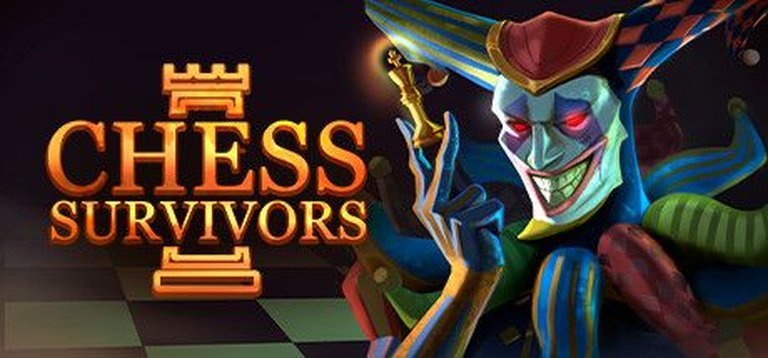
Chess Survivors is a top-down 2D scrolling action rogue-lite where players select from a variety of unique characters to survive relentless waves of killer chess pieces across three distinct worlds. By collecting powerups, leveling up, and upgrading abilities, players must endure increasingly difficult enemy spawns while unlocking new playable characters through skilled gameplay.
Gameplay Videos
Where to Buy Chess Survivors
PC
Chess Survivors Patches & Updates
Chess Survivors Guides & Walkthroughs
Chess Survivors Reviews & Reception
metacritic.com (75/100): Refreshing experience.
keengamer.com : Decent experience.
reddit.com : Incredible mix of chess and vampire survivors.
steambase.io (85/100): Very Positive rating.
Chess Survivors: Review
Introduction
In the ever-expanding pantheon of indie roguelites, few games dare to fuse strategy with the sheer chaos of survival action. Chess Survivors, a 2023 release from solo developer Aarimous, stands as a bold experiment in this hybrid space. By marrying the turn-based logic of chess with the frantic, “bullet hell” mechanics of games like Vampire Survivors, it creates a niche yet compelling experience. This review will dissect the game’s innovative design, its place in the roguelike zeitgeist, and its strengths as a flawed but fascinating artifact of modern indie game development. Our thesis is that Chess Survivors succeeds as a brilliantly executed concept, limited only by its repetition and technical quirks, yet it exemplifies the creative potential of genre-blending in an overcrowded market.
Development History & Context
Aarimous, a solo developer leveraging the Godot engine, crafted Chess Survivors as a labor of passion. Announced via a Reddit post in August 2023, the game spent nearly a year in Early Access (November 2022–August 2023), with the developer actively refining mechanics based on community feedback—a rare feat in solo development. The project emerged during a surge in “survivor-like” games (e.g., Vampire Survivors clones), yet Aarimous carved a distinct identity by integrating chess mechanics. This timing is crucial: the game capitalized on the genre’s popularity but differentiated itself through its strategic depth. Technically, Godot’s lightweight nature allowed for rapid iteration, though some sources note UI and performance quirks (e.g., soundtrack loading stutters) that hint at resource constraints. Culturally, Chess Survivors reflects a broader trend of indie developers reinterpreting classic games—here, chess—as dynamic, player-driven experiences. Its modest $4.99 price point and solo origins align with the accessible ethos of the “hyper-casual” roguelike subgenre, positioning it as an accessible yet challenging entry.
Narrative & Thematic Deep Dive
Chess Survivors deliberately eschews traditional narrative in favor of atmospheric ambiguity. There is no overarching plot, cutscenes, or dialogue; instead, the game’s “story” is conveyed through its world-building. Players control a roster of eccentric characters—from a koala to a samurai—plucked into a surreal chessboard realm where chess pieces are lethal, sentient foes. This setup evokes themes of alienation and survival against incomprehensible rules. The characters themselves serve as blank slates, their unlockable backstories implied through cosmetics and abilities rather than explicit lore. Thematically, the game explores deterministic chaos: chess’s rigid rules are weaponized against players, forcing adaptation within a system designed to be “solved.” The absence of narrative is not a flaw but a design choice, emphasizing gameplay over exposition. As KeenGamer noted, a story would “get in the way” of the core loop. Yet, the visual dissonance—realistic characters battling abstract chess pieces—creates an uncanny tension, hinting at deeper themes of existential conflict in a game world devoid of context. This minimalism encourages players to project their own narratives onto the relentless, turn-by-turn struggle.
Gameplay Mechanics & Systems
At its core, Chess Survivors is a grid-based roguelite where players outmaneuver enemies while upgrading abilities. Combat is “quick-turn”: each enemy move triggers a timer, demanding split-second positioning. Players select from 12+ unlockable characters, each with unique movement patterns (e.g., diagonal jumps for the knight, long-range dashes for the queen) and starter abilities. Enemies—pawns, bishops, knights, etc.—move according to chess rules, adding strategic depth. For instance, pawns advance linearly, while knights jump in L-shapes, creating spatial puzzles amidst bullet-hell chaos.
Progression Systems:
– Abilities & Powerups: Found randomly during runs, these include screen-clearing attacks (e.g., “Yo-yo” projectiles) and passive buffs. Critically, they stack multiplicatively, enabling late-game “game-breaking” builds (e.g., a character with rapid-fire, screen-filling attacks).
– Relics: Equippable modifiers that alter gameplay (e.g., “Pawn Gambit” buffs enemies for higher risk/reward).
– Unlockables: Characters, cosmetics, and relics are unlocked through cumulative playtime, encouraging repeat runs.
Flaws & Innovations:
– Controls: Mouse offers precision, while controllers work but feel less optimal for tight dodges.
– UI Issues: Health and stats are tucked into the top-left corner, risking invisibility during chaotic battles.
– Depth vs. Accessibility: Chess knowledge isn’t required but enhances strategy, as elite enemies (larger, more durable) force tactical positioning.
– Repetition: Three identical worlds and a 10–21 minute run length limit longevity, though the “Gambit” mode (optional enemy buffs) adds challenge.
The game’s genius lies in merging chess’s spatial logic with roguelike unpredictability. As one Reddit reviewer noted, it “teases your brain while demanding ‘One More Run’,” with character unlocks revealing new strategic possibilities (e.g., a bishop character’s diagonal attacks synergize with pawn-heavy levels).
World-Building, Art & Sound
The game’s world is a minimalist chessboard battlefield, devoid of lore but rich in atmosphere. The art style blends stark contrast: chess pieces are rendered in clean, digital aesthetics, while player characters adopt pixel-art sprites, creating an “uncanny” juxtaposition. This functional design prioritizes clarity—enemies are instantly recognizable—yet the lack of environmental detail (static grids, uniform backgrounds) underscores the game’s focus on mechanics over immersion. Sound design, however, elevates the atmosphere. The soundtrack blends “mystical” and “sinister” tones, with tracks that evoke a dark fairy tale. Yet, as KeenGamer noted, audio bugs cause freezes during track changes, disrupting immersion.
Visuals use top-down isometry to emphasize spatial positioning, a critical chess element. Particle effects for attacks (e.g., fizzling deaths) add flair without cluttering the screen. The overall aesthetic is “pleasant yet functional,” aligning with the game’s arcade-like accessibility. Notably, the lack of narrative world-building shifts focus to the tactile satisfaction of manipulating the grid—a chessboard as both arena and puzzle.
Reception & Legacy
Upon full release, Chess Survivors garnered a “Very Positive” Steam rating (84%, 148 reviews) and a 75/100 Metacritic score (from KeenGamer). Critics praised its innovative fusion of chess and roguelike mechanics, calling it a “refreshing experience” and a “great twist on chess.” Players lauded its replayability, character variety, and responsive developer (e.g., rapid implementation of community-requested features like pure turn-based mode). However, criticism centered on repetition, UI clutter, and niche appeal—non-chess fans may find the learning curve steep.
Commercially, the game remains a cult hit, with 155 total reviews and modest sales. Its legacy lies in its influence on the “survivor-like” genre: it popularized chess-based mechanics, inspiring titles like Time Survivors (2024). Aarimous’s transparent development (via Reddit and Steam) also set a benchmark for solo dev-player collaboration. Yet, its brevity and technical quirks prevent it from being a genre-defining classic. Instead, it occupies a unique space—a “niche within a niche”—as a testament to how constraints can spark creativity. As one Steam reviewer summarized, it’s “criminal it has so few players” given its ingenuity.
Conclusion
Chess Survivors is a triumph of concept over execution. Aarimous has crafted a roguelite that is as intellectually stimulating as it is viscerally satisfying, leveraging chess’s strategic depth to create a novel survival experience. Its strengths—innovative mechanics, tight controls, and addictive progression—far outweigh its flaws of repetition and UI hiccups. While it may not displace genre titans like Vampire Survivors, its legacy as a bold, genre-blending indie darling is secure. For players seeking a “smashing challenge” that rewards both reflexes and wit, Chess Survivors is an essential, if imperfect, entry. It stands as a reminder that in the world of indie games, the most enduring contributions often come not from grand epics, but from brilliantly distilled ideas.
Final Verdict: A flawed but fascinating gem, Chess Survivors earns its place in video game history as a pioneering fusion of strategy and action. It’s a must-play for roguelite enthusiasts and chess fans alike, even if its brevity limits its replayability for some.