
- Release Year: 2013
- Platforms: Macintosh, Windows
- Publisher: TopWare Interactive AG
- Genre: Compilation
- Game Mode: LAN, Online Co-op, Single-player
- Gameplay: Shooting, Timed
- Average Score: 90/100
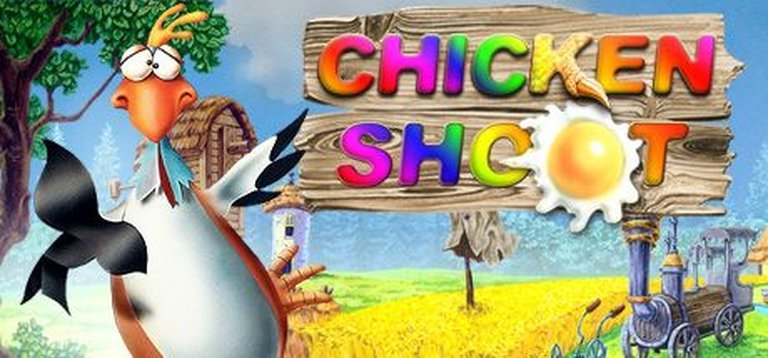
Description
Chicken Shoot: Gold is a compilation that includes the classic light gun shooter games Chicken Shoot (2002) and Chicken Shoot 2 (2003). In these fast-paced arcade titles, players shoot mischievous chickens that throw eggs, with game modes such as timed challenges and multiplayer hunts supporting up to four participants online or via LAN, set in playful hunting gallery environments.
Where to Buy Chicken Shoot: Gold
PC
Chicken Shoot: Gold Reviews & Reception
store.steampowered.com (90/100): Chicken Shoot means great fun for both hardcore and casual gamers and is definitely good value for money.
howlongtobeat.com : Awful controls, very sluggish feeling.
Chicken Shoot: Gold: A Postmortem in Poultry
Introduction: The Unkillable Chicken
In the vast, overcrowded museum of video game history, certain titles achieve a peculiar form of immortality not through genius, but through sheer, baffling persistence. Chicken Shoot: Gold is one such artifact. A compilation bundling the 2002 original and its 2003 sequel, this game represents the zenith of a very specific, now-dated design philosophy: that a single, relentlessly simple core loop—shoot cartoon chickens, avoid their eggs—could be spun into a multi-level, multi-mode franchise spanning PC and consoles. Released by ToonTRAXX Studios and TopWare Interactive in 2003 (and re-released on Steam in 2013), it arrived not with a bang, but with the soft thump of a poultry projectile hitting a barn wall. My thesis is this: Chicken Shoot: Gold is not a game to be judged by traditional metrics of innovation or narrative depth. Instead, it stands as a pristine, unadulterated case study in the casual arcade shooter of the early 2000s—a testament to the power of hyper-accessible mechanics, a victim of its own repetitive design, and a stark lesson in the perils of cross-platform adaptation. Its legacy is a paradox: critically panned yet commercially stubborn, dismissed as shovelware yet fondly remembered by a niche of players for its unpretentious, mindless fun.
Development History & Context: Born from a Moorhuhn Epidemic
To understand Chicken Shoot, one must first understand Moorhuhn (Crazy Chicken). This German browser-game-turned-phenomenon, released in 1999, sold millions and sparked a nationwide craze for simple, cartoonish shooting galleries. It created a gold rush for “chicken-shoot” clones, and Chicken Shoot was a direct, unapologetic participant. Developed by the small, independent Polish studio ToonTRAXX Studios (with key figures like President Manfred Morin, programmer Andrzej Postrzednik, and artist Bolesław Kasza), the game was spearheaded by Ralph Bürger of First Media Consulting Group, who envisioned a digitized carnival shooting gallery.
The technological context was the humbler side of the early 2000s PC landscape. While giants like Half-Life and Max Payne pushed 3D realism, Chicken Shoot opted for 2D hand-drawn sprites on static, parallax-scrolling backgrounds. This was a conscious choice for accessibility and development speed. Targeting Windows 98/Me with DirectX 8.1, it required a Pentium II 300 MHz and 64 MB RAM—specs that placed it firmly in the casual, budget-software aisle. The vision was pure, uncomplicated escapism: “blow the chickens away,” as marketing materials boasted. There was no narrative bloat, no complex systems, just immediate, visceral feedback. This context birthed a franchise, but the seeds of its later struggles were sown here: a design built for mouse-and-keyboard precision and short, replayable bursts was about to be stretched across the wildly different control schemes and hardware expectations of the Nintendo DS, Wii, and Game Boy Advance.
Narrative & Thematic Deep Dive: The Absurdist Uprising
Chicken Shoot presents a narrative framework so skeletal it’s almost an anti-narrative. The premise, as gleaned from manuals and promotional copy, is one of barnyard rebellion. You are an unnamed everyfarmer (later given the identity “Chicken Bill” in sequels) defending your property from “rampaging roosters” who are engaged in “hostile destruction.” There is no lore, no dialogue, no cutscenes. The story is told entirely through the environmental vignettes and the enemy’s actions.
Each of the five (original) or six (sequel) levels is a static diorama—a farmyard, a forest, a desert, the Frozen North, a massive tree—that serves as a stage for the avian insurgency. The chickens are not passive targets; they are aggressive, egg-bombing combatants. Some parachute, some use umbrellas to drift, some pilot hang gliders. The thematic core is a satire of hunting simulations. Where Deer Hunter and its ilk prized realistic ballistics and majestic prey, Chicken Shoot reduces the “sport” to cartoonish, consequence-free pandemonium. The violence is utterly meaningless and hilarious—chickens explode into feathers with a comical sproing, and the only “stakes” are a numerical score and a health meter.
This absurdist lens is the game’s most coherent thematic statement. It explores the pure, unadulterated joy of mindless target practice. The deeper, almost subconscious theme is one of futility and repetition. The player is locked in an endless cycle of defending against an inexhaustible horde. The chickens represent a chaotic, pointless force of nature, and the farmer’s struggle is a Sisyphean joke. There is no victory condition beyond a high score, no story resolution. In sequels, they attempted to graft on “adventure-lite” modes and missions, but the original’s genius lies in this thematic shallowness—a deliberate rejection of meaning, inviting the player to project their own story of fowl vengeance or simple stress relief onto the feathered canvas.
Gameplay Mechanics & Systems: Elegant Simplicity, Rough Edges
At its heart, Chicken Shoot is a first-person light-gun gallery shooter stripped to its essence. The loop is instantaneous: chickens appear on screen, you aim the crosshair with the mouse (or pointer on consoles), you click to shoot. That’s it. Yet, within this simplicity, the game constructs a surprisingly nuanced, if flawed, risk-reward system.
Core Loop & Arsenal: The player’s health is a shared, persistent “trophy shield” of 100 units across the entire game, a brutal design choice that demands flawless runs. Chickens attack by lobbing eggs; white eggs deduct 5%, brown 10%, and colored eggs a punishing 20%. Health can only be restored by shooting specific restorative items: drinks (+15%), fruit (+30%), or a roast chicken (+50%). This creates constant tension between aggressive scoring and defensive survival.
The three-weapon arsenal is the game’s foundational trinity:
1. Pistol: Unlimited ammo, slow fire, must reload after 8 shots. The workhorse for precision.
2. Shotgun: Wide spread, excellent for crowds but short range. Picked up from symbol-carrying chickens.
3. Bombs: A screen-clearing explosion triggered by shooting a bomb item. High risk, high reward, as it can hit non-targets for point penalties.
Modes & Progression:
* Arcade Mode: Shoot a set number of chickens per level. No time limit. Progression is about efficiency and survival.
* Classic Mode: A timed mode with escalating point thresholds (1,500 Easy, 2,500 Normal, 3,500 Hard) to advance. Time extensions are available via special chickens. This is the mode that truly tests skill and exposes the game’s difficulty spikes.
* Bonus “Chicken Shed” Level: A complex mini-game unlocked by destroying specific objects in earlier levels. Players shoot perching chickens to make them lay eggs, then must shoot the rolling eggs before they reach a central machine, all while preventing escapees. It’s a chaotic, high-scoring puzzle that showcases the game’s potential for depth.
Systems & Flaws: A “thermometer” meter fills with consecutive kills, granting double then triple point multipliers. However, shooting non-targets (like other animals) resets this and applies negative multipliers. This encourages precision. The three difficulty levels dramatically increase chicken speed, reduce health pickups, and raise requirements, with “Hard” being notoriously brutal due to the non-regenerating, carry-over health bar.
The game’s innovations are modest but telling for its era: custom background support allowed players to import their own images, a novel nod to modding culture. Its flaws are more pronounced: repetitive level layouts, a punishing and unforgiving health system with no checkpoints or saving (you fail, you start over), and, as noted in HowLongToBeat reviews, often atrocious hit detection where the crosshair could be perfectly on target yet register a miss, especially through foreground objects. The mouse-only control on PC was intuitive, but this core mechanic translated poorly to the imprecise touchscreens of the DS and the sometimes-jittery pointer of the Wii Remote, magnifying the game’s inherent frustrations on consoles.
World-Building, Art & Sound: Charming Dioramas of Absurdity
The world of Chicken Shoot is not a world at all; it is a series of exquisitely rendered, static 2.5D dioramas. The six levels of the original and seven of the sequel are postcards of rural and exotic locales, each a hand-painted backdrop layered with parallax scrolling to create a sense of depth. The art direction is firmly cartoonish, with vibrant, saturated colors—the lush greens of the forest, the scorching yellows of the desert, the icy blues of the Frozen North.
The true star of the visual presentation is the animation. The developers’ claim of “about 25,000 hand-drawn chicken animations” (across both games) is not an exaggeration. Chickens tumble, somersault, dive, and explode with a rubber-hose flexibility that is endlessly charming. Each level features unique “gimmicks”: chickens with umbrellas in the rain, penguins sliding on ice in the Antarctic level, or avalanches of birds in the mountain stage. This environmental interactivity, while shallow, sells the illusion of a lived-in, chaotic space.
The sound design is perfectly pitched to the game’s tone. Composer Gerd Günter Hoffman’s score is a collection of jaunty, idyllic acoustic guitar and banjo tunes, evoking a serene countryside that is hilariously under siege. The sound effects are the punchline: a cacophony of hysterical clucks, goofy boings on impact, splats for egg hits, and a triumphant, brassy fanfare for a stage clear. This auditory comedy consistently undercuts the “violence,” ensuring the experience remains light and playful, even when the difficulty induces frustration.
Together, these elements create a breezy, immersive atmosphere. It’s not the epic world-building of Zelda, but the cozy, repeatable charm of a Saturday morning cartoon come to life. The aesthetic is a key part of its addictive quality—you want to see the next ridiculous backdrop and the next absurd chicken death animation.
Reception & Legacy: From Budget PC Curiosity to Console Shovelware Pariah
The reception history of Chicken Shoot is a tale of two platforms, culminating in the curious fate of the Gold compilation.
Initial PC Release (2000-2003): The original games found a modest, if批评, audience in Europe. German and Polish reviews were mixed, often citing its simplicity as both a strength (addictive, casual fun) and a weakness (repetitive, shallow). It was seen as a successful execution of a niche idea—a digital version of a carnival game—priced for the shareware and budget PC market. Its success was enough to warrant a sequel and console ports.
Console Ports & The Shovelware Stigma (2005-2007): This is where the franchise’s reputation curdled. Ports to Game Boy Advance (2005), Nintendo DS (2007), and Wii (2007) were universally panned. Metacritic scores tell the story: Wii (27/100), DS (19/100). Critics were scathing. IGN’s 2/10 review for the Wii version called it having “less meat than a McNugget” and a “monumental waste of time.” The core issues—repetitive gameplay, short length (completable in under 30 minutes), and basic graphics—were exposed under the scrutiny of console pricing ($30) and the comparative richness of other library titles. The control adaptations were frequently cited as clumsy; the Wii’s pointer, meant to emulate a light gun, often felt jittery and imprecise compared to a mouse, exacerbating the already questionable hit detection. These ports cemented Chicken Shoot as a textbook example of shovelware: low-effort, budget-priced adaptations cynically targeting unsuspecting consumers, particularly families.
Chicken Shoot: Gold & The Steam Era (2013-Present): The 2013 Steam release of Chicken Shoot: Gold represents a fascinating rehabilitation attempt and a demographic shift. Bundling both games for a low price (often on sale for under $4), it found a new audience of nostalgic PC gamers and bargain-hunters. Its Steam user reviews are “Mostly Positive” (67% positive from 1,044 reviews), a stark contrast to its console critical reception. This divergence highlights a crucial truth: the game’s design, for all its flaws, is perfectly suited for its original environment—a PC, played in short, crack-like sessions by someone who knows exactly what they’re getting (a silly chicken shooter). The Steam version also introduced modern amenities like online leaderboards and cloud saves, but could not fix the core gameplay issues.
Legacy and Influence: Chicken Shoot did not innovate; it exploited and epitomized a trend. It rode and reinforced the Moorhuhn clone wave of the early 2000s, proving there was a market for absurdly simple casual shooters. Its direct influence is seen in countless browser and mobile games that followed the “shoot the thing” template. More broadly, it serves as a cautionary tale about franchise expansion and platform adaptation. It demonstrated that a gameplay loop built for one control scheme and price point could become critically toxic when shoehorned onto other platforms without fundamental reworking. Culturally, it’s a footnote in German and Eastern European gaming history—a piece of the casual gaming zeitgeist that coexisted with The Sims and Bejeweled on PC racks. Its preservation on sites like MyAbandonware and its continued availability on Steam ensure it remains a playable artifact.
Conclusion: The Featherweight Contender
Chicken Shoot: Gold is a game that fundamentally cannot be separated from its context. Judged by the standards of a premium console release in 2007, it is an abject failure—a shallow, repetitive, frustrating cash-in that barely justifies its budget-bin status. Its controls are sloppy, its difficulty often feels unfair due to carry-over health, and its content is exhaustingly repetitive.
Yet, judged as a pure, distilled artifact of early-2000s PC casual gaming, it possesses a strange, enduring integrity. It delivers exactly on its promise: a mindless, score-chasing, cartoon-violence simulator. Its hand-drawn art and sound are bursting with charming, comedic personality. Its mechanics, while simple, create a genuine risk-reward tension with its health and weapon systems. For a player seeking 20 minutes of unthinking, reflexive fun, it can—in its PC iteration—still provide a flicker of that original, absurd joy.
In the grand tapestry of video game history, Chicken Shoot: Gold is not a masterpiece. It is not an innovator. It is, however, a perfect specimen. It exemplifies a brief moment when a simple Flash-game concept could become a boxed product, a successful franchise, and a lesson in the dangers of overextension. It is a game that asks nothing of the player but their trigger finger and a tolerance for poultry-based chaos, and in that specificity, it finds a tiny, permanent niche. Its final verdict is a bifurcated one: as a cultural artifact and a piece of design history, it is a fascinating 7/10—essential viewing for scholars of casual gaming and shovelware. As a game to be played for enjoyment in 2025, it is a 5/10—only recommendable to the nostalgically inclined or those with a profound curiosity for gaming’s more feather-brained detours. It is, ultimately, the gaming equivalent of a McNugget: chemically engineered for immediate, guilty satisfaction, nutritionally void, and oddly, inexplicably compelling in the moment.