
- Release Year: 2004
- Platforms: Windows
- Publisher: Jaguar Entertainment AB
- Developer: Habitat North AB
- Genre: Action, Educational
- Perspective: 3rd-person (Other)
- Game Mode: Single-player
- Gameplay: Mini-games, Puzzle elements
- Setting: Egyptian pyramide
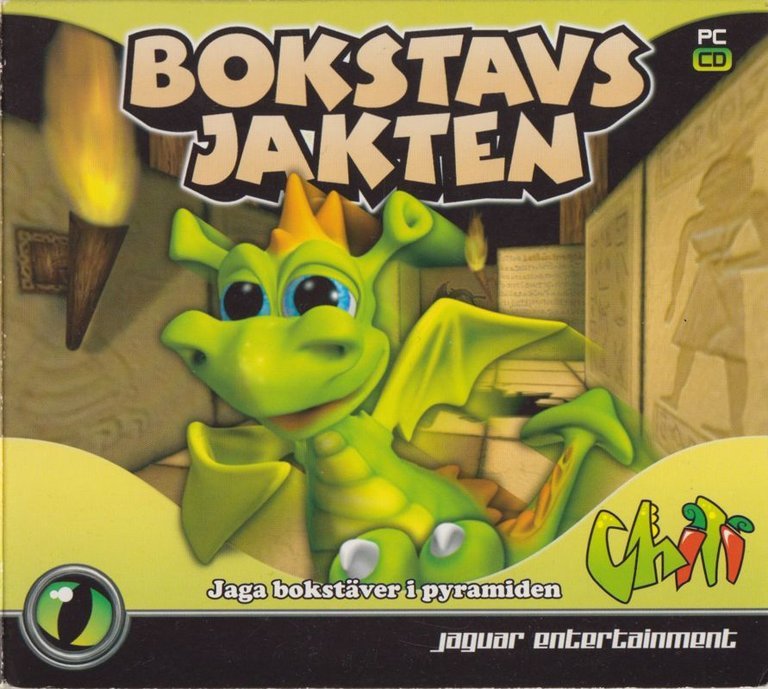
Description
Chili: Bokstavsjakten (The Letter Hunt) is an educational adventure game where players guide a little dragon named Chili through Egyptian pyramid mazes to retrieve alphabet letters and numbers stolen by ancient Egyptians. Competing with three dragon friends, players fill a code wheel to unlock elevators to new levels while avoiding non-violent dangers like fireballs and pits, using chili-powered fire breath as a power-up to navigate challenges. The game combines learning with exploration in a pyramid setting.
Chili: Bokstavsjakten: Review
Introduction
In the annals of educational gaming, few titles encapsulate the whimsical ambition of early 2000s edutainment as vividly as Chili: Bokstavsjakten (The Letter Hunt). Released in 2004 by Habitat North AB and published by Jaguar Entertainment AB, this Windows-exclusive gem tasked players with guiding a plucky dragon named Chili through a labyrinthine Egyptian pyramid to recover the alphabet, pilfered by enigmatic ancient scribes. Yet, beneath its charming premise lies a fascinating artifact of a bygone era—a time when educational games strived to balance pedagogy with playfulness in an industry increasingly dominated by graphical spectacle. This review delves into Chili: Bokstavsjakten not merely as a product, but as a cultural touchstone, examining how its simplicity, thematic ingenuity, and technical constraints reflect the broader evolution of gaming and education in the early 2000s. The thesis is clear: Chili: Bokstavsjakten stands as a poignant, if flawed, testament to the ingenuity of small studios aiming to make learning an adventure, embodying the experimental spirit of an era before standardized testing and gamified microtransactions reshaped educational software.
Development History & Context
Chili: Bokstavsjakten emerged from the Swedish studio Habitat North AB, a developer operating in a niche ecosystem dedicated to PC-based educational games. In 2004, the gaming landscape was dominated by the sixth console generation (PlayStation 2, Xbox, GameCube) and the rise of 3D graphics, but the PC retained a stronghold for edutainment due to its flexibility and accessibility. Technologically constrained by CD-ROM distribution and modest system requirements (typical of titles targeting low-end hardware), Habitat North crafted a world built on sprite-based 2D graphics and straightforward mechanics—a deliberate choice to ensure compatibility with classroom computers and home PCs alike.
The creators’ vision, as hinted by the game’s premise, was to transform rote learning into a treasure hunt. By framing alphabet acquisition as a quest through an ancient pyramid, they tapped into children’s fascination with history and mystery, using the Egyptian setting as a narrative scaffold for phonics and numeracy. This reflected a broader trend in 2000s edutainment, which sought to contextualize academic skills within engaging stories. However, the industry was shifting: major publishers like Electronic Arts were pivoting toward high-budget “triple-A” titles, leaving smaller studios like Habitat North to innovate within tighter budgets and smaller audiences. Chili: Bokstavsjakten thus survives as a relic of a transitional period—a time when educational games had not yet been commoditized by mobile platforms or algorithm-driven adaptive learning, but faced pressure to justify their existence against more visually dazzling entertainment software.
Narrative & Thematic Deep Dive
The narrative of Chili: Bokstavsjakten is deceptively simple yet rich in metaphorical depth. The plot centers on a cataclysmic event: the disappearance of all letters and numbers, stolen by an unspecified “old Egyptian” entity (the game cheekily speculates a labor dispute between alphabet users and hieroglyph painters). As Chili—a small, endearing dragon—players must navigate the pyramid’s multi-tiered mazes, competing against three dragon companions to collect the missing characters. Each recovered letter or number populates a “code wheel,” which, once filled, grants access to new levels via an elevator. This structure transforms literacy into a tangible, goal-oriented achievement, framing education as a collaborative yet competitive race.
The characters are archetypes serving dual purposes: as companions, they foster social learning (even if AI-driven), while as rivals, they introduce gentle stakes. Chili’s design—a non-threatening, fire-breathing creature—melds fantasy with empowerment, allowing children to identify with a character who overcomes challenges without resorting to violence. The dialogue, minimal and functional, focuses on encouragement and progress updates, reinforcing positive reinforcement loops. Thematically, the game excels in its allegorical treatment of literacy. The pyramid symbolizes the “hiding” of knowledge, while the act of “collecting” letters mirrors archaeological discovery, subtly framing learning as an adventure rather than a chore. The Egyptian setting adds a layer of cultural exposure, introducing young players to ancient history through a playful lens. However, the narrative’s brevity and lack of deeper lore limit its replayability, reducing the story to a framework for gameplay rather than an immersive experience.
Gameplay Mechanics & Systems
Chili: Bokstavsjakten’s core gameplay loop is a masterclass in minimalist design. Players guide Chili through maze-like levels, avoiding environmental hazards (fireballs, bottomless pits) while collecting letters and numbers scattered across the pyramid. The non-violent ethos is upheld entirely: threats are navigated or circumvented, not destroyed. The primary mechanic is exploration, with the code wheel acting as both a progress tracker and a puzzle element—requiring players to prioritize which letters to gather based on their position in the alphabet. This subtly reinforces numerical and alphabetical sequencing without overt instruction.
Chili’s ability to spit fire—unlocked by consuming “chili fruits” as power-ups—adds a layer of strategy. The fire can briefly stun hazards or illuminate dark paths, but its use is limited, preventing it from trivializing challenges. This mechanic cleverly ties the game’s title and protagonist to a memorable ability, reinforcing character identity. The UI is stripped-down and functional, displaying the code wheel prominently and offering clear visual cues for hazards and collectibles.
However, the gameplay suffers from repetition. With no variation in maze layouts beyond increasing complexity, levels feel like reskins rather than evolved challenges. The competitive element—racing against AI dragons—lacks depth, as companions follow predictable paths and offer no dynamic interaction. Additionally, the absence of save points or a pause function in a single-player game feels archaic by 2004 standards, penalizing young players who might need to step away. Despite these flaws, the game excels in its educational integration: collecting letters requires visual scanning and pattern recognition, while fire-fruit management introduces basic resource allocation, subtly teaching planning and consequence.
World-Building, Art & Sound
The Egyptian pyramid setting is vividly realized, albeit through a stylized, low-resolution lens. Levels are divided into distinct thematic zones—sandy corridors, treasure rooms, hieroglyphic chambers—each with consistent visual motifs that aid navigation. The art direction prioritizes clarity over realism: characters are large and expressive, hazards are color-coded (e.g., glowing fireballs), and letters/numbers stand out against backgrounds. This functional design ensures educational focus remains uncluttered, though it sacrifices the atmospheric detail that could have elevated the pyramid’s mystique.
Sound design is equally utilitarian. Ambient effects—dripping water, distant dragon roars—create a sense of place but are repetitive, while the fire-spitting mechanic emits a satisfying whoosh that rewards player actions. The soundtrack is a looping, upbeat melody that maintains energy without distraction, aligning with the game’s goal of sustaining attention during learning sessions. Collecting letters triggers cheerful audio cues, reinforcing positive reinforcement.
The world-building, while sparse, cleverly weaves educational elements into its texture. Hieroglyphs on walls occasionally depict letters, bridging the gap between ancient symbols and the alphabet Chili seeks. This subtle integration transforms the pyramid into a living classroom, where history and language intersect. Yet, the static environments and limited animations (e.g., dragons moving in rigid patterns) hinder immersion, making the world feel more like a diorama than a living space.
Reception & Legacy
Upon release, Chili: Bokstavsjakten received no documented critical reviews, a fate common to niche educational titles overshadowed by mainstream blockbusters. Its commercial performance remains unrecorded, reflecting the obscurity of small-scale edutainment in an industry fixated on AAA releases. However, its legacy endures in its design philosophy: as a precursor to games like ABCmouse and Khan Academy Kids, it emphasized play-based learning decades before the term “gamification” entered the lexicon. The game’s core loop—collecting letters to unlock progression—resonates in modern titles like Sky: Children of the Light, where exploration rewards discovery.
Influence is most evident in the realm of early educational software, where Chili’s blend of maze exploration and literacy tasks inspired studios to embed learning goals within adventure frameworks. Its non-violent ethos also predates trends toward “calm games” like Stardew Valley, proving that engaging mechanics need not rely on conflict. Yet, the game’s limitations—repetitive design, lack of adaptive difficulty—also serve as cautionary tales for aspiring edutainment creators, highlighting the difficulty of balancing pedagogy with entertainment without modern tools like AI-driven personalization.
Conclusion
Chili: Bokstavsjakten is a time capsule of ambition and simplicity. In an era of escalating graphical fidelity, Habitat North AB crafted a game where educational integrity trumped technical spectacle. Its Egyptian pyramid, dragon protagonist, and letter-hunting premise remain charmingly inventive, transforming the mechanics of literacy into a tactile adventure. While marred by repetition and dated design, the game’s legacy lies in its unwavering focus on making learning joyful—a philosophy that feels increasingly radical today.
Ultimately, Chili: Bokstavsjakten earns its place in gaming history not as a masterpiece, but as a heartfelt experiment. It reminds us that the most innovative games are not always the flashiest, but those that dare to reimagine education as play. For historians and educators, it offers a blueprint for blending fun and fundamentals—a lesson as timeless as the alphabet itself. Verdict: A flawed but fascinating artifact of edutainment’s golden age, worthy of preservation for its bold vision and enduring charm.