
- Release Year: 2009
- Platforms: Windows
- Publisher: magnussoft Deutschland GmbH
- Developer: magnussoft Deutschland GmbH
- Genre: Action
- Perspective: Behind view
- Game Mode: Single-player
- Gameplay: Shooter, Vehicular
- Setting: Helicopter
Description
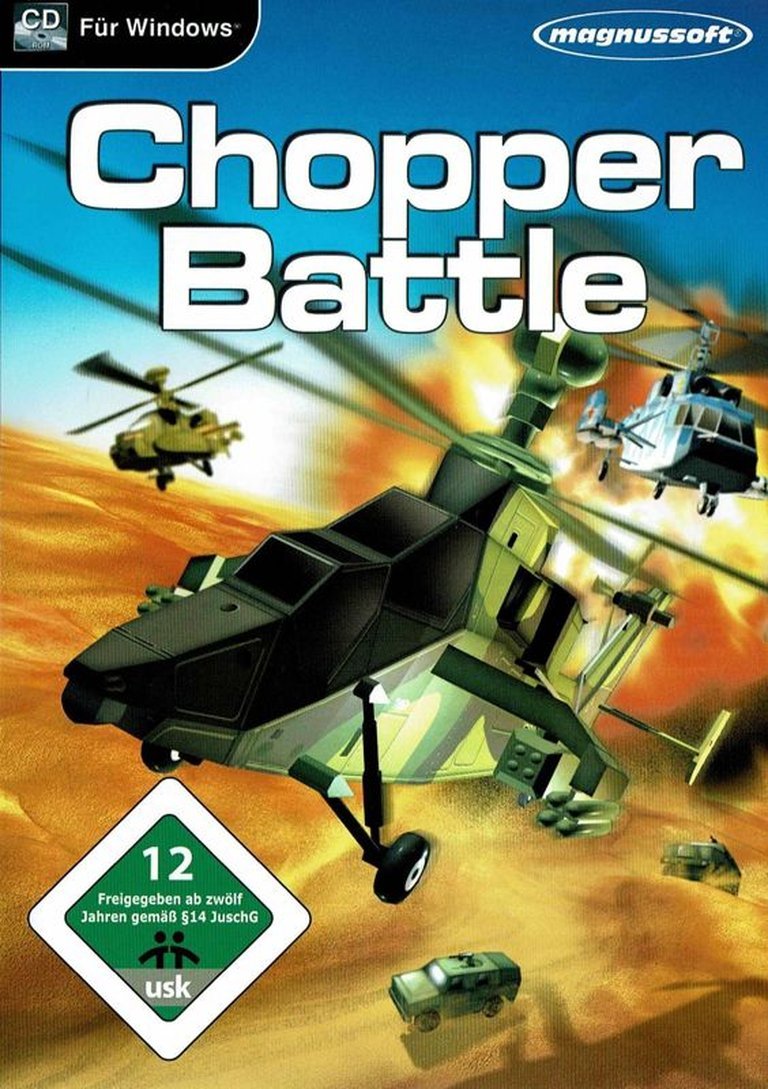
Chopper Battle is a fast-paced action game where players pilot one of five different helicopters through various missions, engaging in combat against enemy helicopters, planes, ships, and ground targets. The game features a behind-view perspective with cinematic camera angles, offering an immersive experience as players navigate through dynamic environments to complete objectives.
Where to Buy Chopper Battle
PC
Chopper Battle Cheats & Codes
Nintendo 64 (GameShark)
Enter codes using a GameShark device.
| Code | Effect |
|---|---|
| 8012943B 0063 | Infinite Weapon 1st Position |
| 8012943F 0063 | Infinite Weapon 2nd Position |
| 80129443 0063 | Infinite Weapon 3rd Position |
| 80129723 0004 | Gun 4-Way Shot |
| 81129726 FFFF | Infinite Fuel |
| 801296C8 0320 | Infinite Shield |
| 80129723 00xx | Gun Weapon Modifier (Replace xx with 00-04 for different weapon types) |
| 81129426 ???? | Score Modifier (Replace ???? with desired score) |
| 8012945B 0005 | Opens All 5 Item Slots |
| 80129439 00YY | Weapon Modifier 1st Position (Replace YY with 00-08 for different weapons) |
| 8012943D 00YY | Weapon Modifier 2nd Position (Replace YY with 00-08 for different weapons) |
| 801294F1 00YY | Weapon Modifier 3rd Position (Replace YY with 00-08 for different weapons) |
| 801294F5 00YY | Weapon Modifier 4th Position (Replace YY with 00-08 for different weapons) |
| 801294F9 00YY | Weapon Modifier 5th Position (Replace YY with 00-08 for different weapons) |
Nintendo 64 (Action Replay)
Enter codes using an Action Replay device.
| Code | Effect |
|---|---|
| 81129726ffff | Infinite Fuel |
| 8012943b0063 | Infinite Weapon First Position |
| 8012943f0063 | Infinite Weapon Second Position |
| 801294430063 | Infinite Weapon Third Position |
| 8112942600ff | Score |
| 811296c80045 | Infinite Armor |
| 801297230004 | Gun Four-Way Shot |
Nintendo 64 (Console Commands)
Enter button sequences at the specified screen.
| Code | Effect |
|---|---|
| C-Up x7 | Level Select (Press at ‘Press Start’ screen) |
| Hold Z + Right, Left, Up, Down, A, B, Start | Debug Mode (Press at ‘Press Start’ screen) |
| Hold L + R + Z + Start | Power Chopper (Press at main menu before selecting a chopper) |
| Z + C-Up + C-Down | Shoot Down the President (Press during gameplay, then fire a homing cluster at an enemy plane) |
Chopper Battle: A Forgotten Skirmish in the Aerial Combat Genre
Introduction
In the vast, turbulent skies of video game history, Chopper Battle (2009) remains a largely overlooked relic—a title that soared briefly before crashing into obscurity. Developed by the German studio magnussoft Deutschland GmbH, this helicopter combat game emerged during a period when the genre was already overshadowed by more ambitious simulators and blockbuster shooters. While it promised “dramatic 3D air battles” and “thrilling missions,” Chopper Battle ultimately failed to carve out a lasting legacy. This review dissects its ambitions, execution, and the reasons behind its fade into obscurity, positioning it as a flawed yet intriguing footnote in the annals of military action gaming.
Development History & Context
Studio Vision & Constraints
Magnussoft Deutschland GmbH, a studio known for producing low-to-mid-budget titles like Woody Chopper (2021), positioned Chopper Battle as an accessible, arcade-style helicopter combat experience. The game was designed to appeal to casual players rather than hardcore flight simulation enthusiasts, emphasizing straightforward mechanics over complex realism. However, the studio’s modest resources and limited scope constrained its potential. The game’s development was led by a small team of just four individuals:
– Maik Heinzig (Project Lead, Idea)
– Matthias Feind (Programming)
– Chie Kimoto and Jeanette Tutzschky (Graphics)
This lean team size reflects the budgetary limitations that would ultimately shape the game’s final form.
Technological Landscape
Released on January 9, 2009, Chopper Battle targeted aging hardware with minimum system requirements that included an Intel Core Duo 2 processor and an ATI Radeon HD 4800 graphics card—specifications that were already outdated by the time of its launch. While the game boasted “elaborate 3D graphic design” with high-resolution textures and particle effects, these claims felt hollow when compared to contemporary titles like Battlefield: Bad Company (2008) or Ace Combat 6: Fires of Liberation (2007), which leveraged more advanced engines and visual fidelity.
The game’s “cinematic camera” was marketed as a dynamic feature, but in practice, it often disoriented players rather than enhancing immersion. The technical limitations of the era, combined with magnussoft’s lack of cutting-edge tools, resulted in a product that struggled to compete visually or mechanically with its peers.
Gaming Climate of the Late 2000s
The late 2000s were a transitional period for aerial combat games. The genre was dominated by two extremes:
1. Hardcore Simulators – Titles like DCS World and IL-2 Sturmovik catered to enthusiasts demanding hyper-realistic flight models and intricate systems.
2. Arcade Shooters – Games like Blazing Angels (2006) and HAWX (2009) offered accessible, fast-paced action with streamlined controls.
Chopper Battle attempted to occupy a middle ground but lacked the polish or innovation to stand out. Its release coincided with the rise of digital distribution platforms like Steam, where indie developers were beginning to experiment with more ambitious designs. Unfortunately, Chopper Battle failed to capitalize on this shift, offering little beyond its basic premise.
Narrative & Thematic Deep Dive
Plot & Characters
Chopper Battle eschews narrative depth entirely, opting instead for a mission-based structure devoid of any overarching story. Players assume the role of an unnamed pilot tasked with completing a series of combat objectives across varied environments. There are no named characters, no dialogue-driven cutscenes, and no contextual storytelling to speak of. The game reduces its experience to a string of disconnected skirmishes, each introduced with a perfunctory mission briefing that lacks personality or urgency.
Themes
The game’s thematic core revolves around militaristic triumph, reinforcing a simplistic “might makes right” ethos. Missions typically involve obliterating enemy forces—whether they be helicopters, tanks, or ground troops—with little regard for moral ambiguity or consequence. The inclusion of helicopters from Germany, the USA, and Russia nods to global military power but does so without any ideological or political commentary. The game’s portrayal of conflict is sanitized, devoid of the emotional weight or ethical dilemmas present in more narrative-driven military games like Spec Ops: The Line (2012).
Dialogue & Writing
Voice acting and scripted dialogue are virtually nonexistent in Chopper Battle. Mission briefings are delivered via text, written in a sterile, functional tone reminiscent of early 2000s budget shooters. This austerity underscores the game’s identity as a gameplay-first product, albeit one that feels emotionally hollow. The absence of any attempt at world-building or character development further isolates the player from the experience, reducing the game to a mechanical exercise rather than an engaging adventure.
Gameplay Mechanics & Systems
Core Gameplay Loop
Chopper Battle offers two primary modes:
1. Campaign Mode – A linear progression through 18 levels of escalating difficulty, ranging from aerial dogfights to ground assaults.
2. Free Play Mode – Seven maps with three randomized objectives each, offering limited replayability.
The campaign mode is structured around a series of combat scenarios, each with a clear objective: destroy a set number of enemies, protect allied units, or rescue civilians. While the objectives are varied on paper, the execution feels repetitive. Missions blend together due to the lack of distinctive level design or narrative context.
Combat & Controls
The game features five different helicopters, each with unique handling characteristics and weapon loadouts. However, the differences between them are superficial at best. The controls are weighty but unrefined, with a noticeable lack of precision that makes dogfighting feel clumsy rather than exhilarating.
The “cinematic camera” attempts to dynamically shift angles during combat, but it often results in disorienting perspective changes that hinder rather than help gameplay. Combat itself is simplistic, prioritizing spray-and-pray rocket barrages over tactical maneuvering. Enemy AI is inconsistent, oscillating between mindless aggression and baffling passivity, which further undermines the game’s attempt at creating tense aerial battles.
Progression & Customization
Chopper Battle employs a medal-based progression system, awarding players for their performance in each mission. However, these medals serve no functional purpose beyond bragging rights. There are no unlockable upgrades, no meaningful customization options, and no persistent progression to incentivize continued play. This lack of depth makes the game feel shallow, especially when compared to contemporaries like HAWX, which offered upgradeable aircraft and a more robust progression system.
UI & Technical Flaws
The game’s user interface is minimalist to a fault, suffering from dated typography, poor scaling, and a lack of intuitiveness. Players have reported issues with erratic hit detection, where bullets and rockets seemingly pass through enemies without registering damage. Frame rate drops are also common, even on hardware that meets or exceeds the recommended specifications. These technical shortcomings further erode the game’s already fragile foundation.
World-Building, Art & Sound
Visual Design
Chopper Battle attempts to create a varied and immersive world through its seven distinct environments, including lush forests, arid deserts, and coastal zones. However, the execution falls short of its ambitions. The 3D models are competent but lifeless, lacking the detail and vibrancy of contemporary titles. The game’s claim of “realistic water” and “3D vegetation” is technically accurate but fails to deliver the visual spectacle promised.
Explosions and particle effects are underwhelming, lacking the impact and scale necessary to sell the chaos of battle. The game’s environments feel static and sterile, with little environmental storytelling or dynamic elements to heighten immersion. The absence of weather effects or day-night cycles further contributes to the game’s flat presentation.
Sound Design
The soundtrack leans heavily on generic military march compositions, which quickly become repetitive and forgettable. The sound effects—engine roars, gunfire, and explosions—lack spatial depth, making it difficult to gauge the direction of incoming threats. The absence of cockpit voice chatter or ambient battlefield noise further isolates the player from the action, reinforcing the game’s mechanical, detached feel.
Atmosphere
Despite its ambitions, Chopper Battle fails to evoke the tension or grandeur of aerial warfare. Missions feel sterile and disconnected, with little to no environmental storytelling to draw the player in. The game’s lack of dynamic elements—such as changing weather, destructible environments, or civilian interactions—robs it of the immersive qualities that define the best entries in the genre.
Reception & Legacy
Launch Reception
Chopper Battle garnered minimal attention upon its release. Its Steam page features only three user reviews, all of which are negative, citing “clunky controls” and “boring missions.” The game received no critic reviews on Metacritic or MobyGames, underscoring its obscurity. The few players who did engage with the game found it to be a forgettable and flawed experience, lacking the polish or innovation necessary to stand out in a crowded market.
Long-Term Impact
Chopper Battle left no discernible mark on the aerial combat genre. Its legacy, if it can be called that, lies in exemplifying the challenges faced by budget developers in an increasingly competitive industry. While the Chopper Battle series would see a sequel in Chopper Battle: New Horizon (2017), neither title achieved the cult status of classics like Apache Air Assault (2010) or Comanche (1992).
The game’s failure to resonate with players or critics serves as a cautionary tale about the importance of execution over ambition. In an era where indie developers were pushing the boundaries of what small teams could achieve, Chopper Battle remained firmly rooted in the past, offering little to justify its existence beyond a fleeting diversion for the morbidly curious.
Conclusion
Chopper Battle is a game of unfulfilled potential, a title that might have thrived in the early 2000s but floundered in the late 2000s. Its modest scope, technical limitations, and lack of innovation render it a relic of a bygone era—a forgettable skirmish in the vast battlefield of aerial combat games.
For helicopter combat enthusiasts, Chopper Battle offers fleeting moments of enjoyment amid its janky systems and repetitive missions. For most players, however, it serves as a cautionary tale: ambition without execution is a recipe for obscurity. In the grand tapestry of video game history, Chopper Battle remains a footnote—a game that soared briefly before crashing into the annals of forgotten titles.
Final Verdict:
5.5/10 – A flawed and forgettable experience, worth a look only for the most dedicated fans of niche aerial combat games.