
- Release Year: 1982
- Platforms: Atari 2600, Windows, Xbox 360
- Publisher: Activision, Inc., Großversandhaus Quelle, Gustav Schickedanz KG, Microsoft Corporation
- Developer: Activision, Inc.
- Genre: Action, Arcade, Shooter
- Perspective: Side view
- Game Mode: Hotseat, Single-player
- Gameplay: 2D scrolling, Helicopter Combat, Shooter, Side scrolling
- Setting: Helicopter, Vehicular
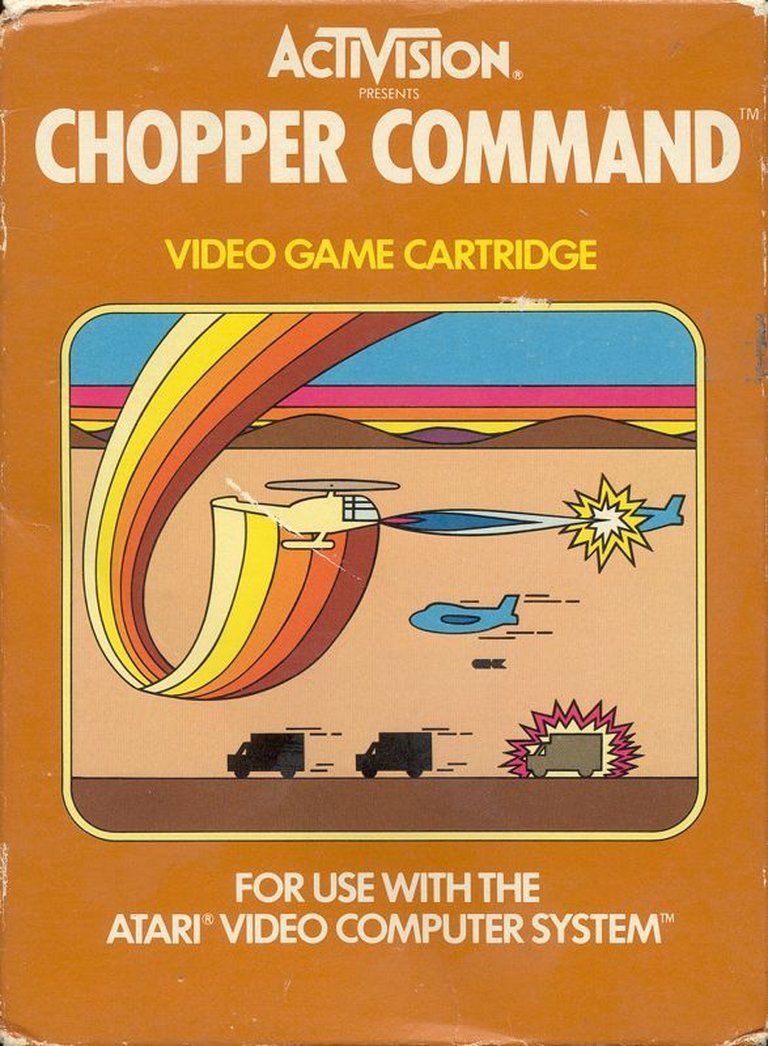
Description
Chopper Command is a classic side-scrolling shooter game where you pilot a helicopter gunship to protect a convoy of trucks from waves of enemy aircraft. The game features 2D scrolling graphics and can be played by one or two players at varying difficulty levels. Your mission is to destroy all enemies in each wave while using a long-range scanner to locate both friendly trucks and hostile aircraft. The game was initially released in 1982 for the Atari 2600 and has since been ported to other platforms.
Gameplay Videos
Chopper Command Free Download
Atari 2600
Chopper Command Guides & Walkthroughs
Chopper Command Reviews & Reception
honestgamers.com : If you’re familiar with the classic game for the Atari 2600 called Defender, then you’ll pretty much know what to expect from the semi-clone, Chopper Command. Just don’t expect it to be half as great of a game.
mybrainongames.com : I thought it played fantastically; it’s reportedly much better than the Atari 2600 port of Defender.
Chopper Command: A Desert-Set Defender for the Ages
Introduction
In the scorching heat of 1982’s video game landscape, Activision deployed Chopper Command, a desert-bound aerial shooter that defied the Atari 2600’s technical limitations to become a timeless classic. Designed by industry luminary Bob Whitehead, this relentless side-scroller distilled arcade intensity into a living-room experience, tasking players with safeguarding a convoy of trucks against waves of enemy aircraft. While often dubbed “Defender in the desert,” Chopper Command carved its own legacy through refined mechanics, striking visuals, and Activision’s trademark polish. This review argues that the game stands as a pinnacle of early console shooters—a masterclass in balancing accessibility, challenge, and technical ingenuity.
Development History & Context
The Studio & Vision: Activision, founded by disgruntled ex-Atari programmers seeking recognition, positioned itself as a developer of premium 2600 titles. Chopper Command emerged from this ethos, spearheaded by Bob Whitehead—a veteran behind classics like Stampede and Video Chess. His goal was clear: adapt Defender’s frantic scrolling shooter formula for the 2600 while optimizing it for home play.
Technological Constraints: The 2600’s 1.19 MHz processor and 128 bytes of RAM demanded ruthless efficiency. Whitehead sidestepped hardware limitations by prioritizing clean sprite work, minimal flicker, and smooth scrolling, leveraging Activision’s expertise in coaxing performance from the system. The result was a game that surpassed Atari’s own Defender port in fluidity and visual clarity.
The 1982 Landscape: Amid a glut of simplistic arcade ports, Chopper Command stood out for its depth. Released alongside groundbreaking titles like Pitfall!, it reflected Activision’s commitment to elevating home gaming beyond quarter-munching repetition. The game’s two difficulty settings (“Cadet” and “Commander”) and hot-seat multiplayer extended its lifespan, a rarity in an era of disposable experiences.
Narrative & Thematic Deep Dive
Chopper Command’s premise is ruthlessly utilitarian: Protect a convoy of medical supply trucks traversing a desert warzone. No characters, dialogue, or cutscenes adorn this mission—just a lone helicopter against squadrons of enemy copters and jets. Thematic resonance lies in its minimalist tension: You are the last line of defense.
The game’s narrative is emergent, woven through escalating waves and the player’s growing attachment to pixelated trucks. Each lost vehicle feels like a failure of duty, while surviving a barrage evokes genuine triumph. This abstraction of wartime heroism resonated with Cold War-era audiences, mirroring the era’s militaristic pop culture.
Gameplay Mechanics & Systems
Core Loop: The player’s helicopter scrolls horizontally across a wraparound desert, firing at enemies while monitoring a radar (“Long Range Scanner”) to track off-screen threats. Destroy all enemies in a wave to advance, earning bonus points for surviving trucks.
Combat & Progression: Enemy types are sparse but distinct—helicopters (100 points) and faster jets (200 points)—each requiring tailored strategies. Bullets split into dual projectiles, demanding evasive maneuvers. The “Commander” difficulty amplifies speed and aggression, while the “Cadet” mode offers a gentler introduction.
Innovations & Flaws:
– Radar System: A pioneering UI element, the scanner allowed strategic planning uncommon in 1982.
– Lives & Rewards: Extra lives every 10,000 points (up to six) and Activision’s legendary “Chopper Commandos” patch for high-score submissions incentivized mastery.
– Flaws: Repetitive enemy patterns and a lack of environmental variety drew criticism, though these were tempered by the game’s arcade-style intent.
World-Building, Art & Sound
Visual Design: Activision’s signature aesthetic flair shines—a golden desert backdrop contrasts with crisp sprite work. The helicopter and jets are unmistakable, while the sunset-drenched horizon evokes a stark beauty. The scrolling landscape, though sparse, creates a hypnotic sense of motion.
Sound Design: Engine roars and explosion blips are rudimentary yet effective, with the helicopter’s rhythmic hum lending auditory feedback to movement. The absence of music focuses attention on the action, heightening tension.
Atmosphere: The game’s harsh desert setting and relentless enemies foster a lonely, pressurized mood—a stark departure from the psychedelic backdrops of contemporaries like Yars’ Revenge.
Reception & Legacy
Critical Reception:
– Praised for its technical prowess (75% average on MobyGames), with outlets like The Video Game Critic hailing its “challenging, addictive” design.
– Won “Best Action Video Game” at the 1983 Arkie Awards.
– Critics noted its superiority to Atari’s Defender port, though some lamented its derivative core.
Commercial Success: A staple of 2600 libraries, its affordability and Activision’s marketing (including high-score patches) ensured broad appeal.
Legacy:
– Influenced later shooters with its radar system and wraparound scrolling.
– Preserved in compilations like Activision Anthology (2002), introducing it to new generations.
– Remembered as a benchmark for how to adapt arcade concepts to consoles without compromise.
Conclusion
Chopper Command is more than a Defender clone—it’s a refinement. Bob Whitehead’s design marries accessibility and depth, while Activision’s technical mastery elevates it above most 2600 titles. Its legacy endures not just through nostalgia, but through its foundational role in the shooter genre. For historians, it exemplifies early console innovation; for players, it remains a white-knuckle test of skill. In the pantheon of Atari classics, Chopper Command soars as a desert mirage made real—a fleeting glimpse of perfection in an era of experimentation.