
- Release Year: 2009
- Platforms: Windows
- Developer: Arvi Teikari
- Genre: Adventure
- Perspective: Side view
- Game Mode: Single-player
- Gameplay: Graphic adventure
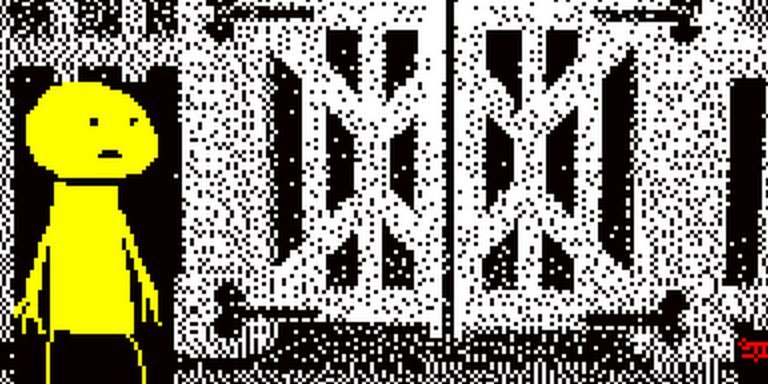
Description
Church Adventure is a graphic adventure game developed by Arvi Teikari and released for Windows in April 2009. Featuring a side-view perspective and a text parser interface, players explore a church setting by typing commands to solve puzzles and interact with the environment, embodying classic adventure gameplay mechanics.
Church Adventure: A Ghost in the Archive — Reviewing an Absentee
Introduction: The Challenge of the Unplayable
In the sprawling museum of video game history, some artifacts are grand, well-lit halls—The Legend of Zelda, Final Fantasy, Elden Ring. Others are whisper-thin dust motes caught in a sunbeam, known only through a single catalog entry, a faded screenshot, or a name on a contributor list. Church Adventure (2009) is one such mote. With a MobyGames page that contains more placeholder text than information, and no known public release, critical reception, or surviving copies, it exists more as a concept of a game than a game itself. This review, therefore, is an exercise in archaeology with a nearly empty site. It is an analysis of a void, a meditation on a missing artifact, and a lament for the countless tiny experiments in game design that vanish without a trace. My thesis is this: Church Adventure is significant not for what it was, but for what its absence represents—the fragility of digital culture and the silent erasure of creative labor in the independent and experimental scenes.
Development History & Context: A Skeleton in the Closet
The only concrete facts are sparse, drawn from the MobyGames entry and the common knowledge of its creator:
* Creator: Arvi Teikari. This is the sole, crucial piece of data. Teikari is a prolific Finnish developer, better known online as “Arvi” or “Hempuli,” with a vast portfolio of experimental, often bizarre, and technically ingenuous games created primarily for game jams and personal projects. His work is a cornerstone of the “hardcore” indie scene, characterized by dense mechanics, minimalist aesthetics, and a preoccupation with systemic interaction over narrative exposition.
* Engine & Context: Created with Clickteam Multimedia Fusion 2.5 (later Clickteam Fusion), the engine of choice for countless 2000s-era indie developers and hobbyists due to its accessible event-based system. The game was made for an “1-hour compo” (Competition), explicitly mentioned in the official blurb: “This mystery is another game made for an 1-hour compo, at around the same time as SIGNS-READ. Can you get to the church?”
* The 1-Hour Compo: This context is everything. A 1-hour development competition is an extreme constraint. It forces a focus on a single, core mechanic or idea, stripping away all cosmetics, tutorials, and narrative padding. Games from such events are pure procedural kernels. The title Church Adventure suggests a simple goal-oriented structure: navigate to a destination (“the church”) within a constrained, likely abstract or puzzle-based environment. It was not intended as a commercial product or a narrative experience, but as a rapid-fire creative exercise.
* Technological & Cultural Landscape (2009): 2009 was a pivotal year. The indie boom fueled by Xbox Live Arcade and Steam was in full swing, but the “game jam” culture (Ludum Dare, etc.) was a parallel, less-visible universe of rapid prototyping. Tools like MMF made this accessible. Teikari’s own work from this era (like the infamous “Miegakure”-inspired 4D prototype or countless “Sokoban”-esque puzzlers) exemplifies this ethos: complex ideas executed with brutal simplicity. Church Adventure fits squarely into this milieu—a fleeting experiment, likely shared only within tight-knit online communities or on Teikari’s personal site (the blurb links to hempuli.com).
Narrative & Thematic Deep Dive: The Narrative is the Constraint
To analyze the narrative of Church Adventure is to analyze a negative space. The official description provides the entire lore: a mystery exists, and the objective is to get to a church. Any further narrative must be inferred from the title and the development context.
- Plot as Verb: The plot is an imperative verb: “Get to the church.” This is not a story; it is a task. It rejects the paradigm discussed in the supplied Amherst Student article, where video game narrative evolved from simplistic justification (“Go right to save the princess”) to an inseparable feature (Heavy Rain, Alan Wake). Church Adventure, by its very nature as a 1-hour compo entry, is a living fossil of the earliest paradigm. The “mystery” is not a plot but a design challenge: How does one architecturally or mechanically represent “getting to the church” within extreme constraints?
- Thematic Resonance in Absence: The title evokes a rich, unintended thematic field. “Church” suggests sanctuary, end-point, ritual, or perhaps an institution to be infiltrated (foreshadowing later, more narrative-heavy titles like The Church in the Darkness). But with zero exposition, the theme is pure player projection. Is the journey penitent? Desperate? Ironic? The game’s minimalism forces the player to generate narrative meaning from mechanical action, a process the article identifies as a unique strength of games (“games can place you right in the middle of a fantasy universe”). Here, the universe is a blank slate.
- Dialogue & Characters: Nonexistent. The player character is an invisible avatar. The church is a monolithic symbol, not a character. Any “dialogue” would be internal, between player and puzzle.
Gameplay Mechanics & Systems: The Essence in the Kernel
This is the only realm where we can make educated, albeit speculative, assertions based on Teikari’s design MO and the compo format.
- Core Loop: The loop is a perfect, closed circle: Attempt -> Fail/Succeed -> Understand Rule -> Apply Rule -> Attempt Again. It is pure ludic engagement, the “game” stripped bare.
- Likely Mechanics: Given Teikari’s portfolio, the “adventure” is almost certainly a top-down or side-view puzzle (as per the Moby “Perspective: Side view” and “Gameplay: Graphic adventure” tags). The “mystery” is the puzzle’s rule set. The player must deduce the interaction model: perhaps moving obstacles, toggling switches, or navigating a grid under specific movement constraints to reach the goal tile (the church). The parser interface mentioned is not a text parser but likely refers to the game’s literal command: “Can you get to the church?” presented as the sole instruction.
- Innovation or Flaw? The “innovation” is its brutal purity. There is no hand-holding, no extraneous systems. Its “flaw” is its utter lack of context or reward beyond the solution itself—a feature, not a bug, for the jam format. It would likely feel impenetrable and unrewarding to a modern audience accustomed to signposting and progression hooks. It is a pure logic toy.
- UI & Progression: UI would be minimal to nonexistent. Progress is binary: not at the church / at the church. Character progression is irrelevant; the only progression is the player’s cognitive model of the game’s rules.
World-Building, Art & Sound: The Aesthetics of Nothing
Here, we confront the void. There are no screenshots, no videos, no descriptions beyond the title.
- Visual Direction: Given MMF’s capabilities and Teikari’s style, it would be abstract and functional. Likely a simple color palette (perhaps stark black/white or a limited 16-color set), blocky sprites or geometric shapes representing the player and obstacles. The “church” might be a distinctive tile, a cross symbol, or a simple building sprite. Atmosphere is generated entirely through the tension of the puzzle, not aesthetic cues.
- Sound Design: In a 1-hour compo, sound is a luxury. It may have none, or a single, generated “beep” for success/failure. Any musical element would be a short, looping chiptune module, if included at all. The silence would be part of the experience, focusing all attention on the mental model.
- Contribution to Experience: The lack of art and sound is the contribution. It forces a focus on pure systemic meaning. The “world” is the rule set. The “church” is a symbolic node within that system. The aesthetic is one of essentialism.
Reception & Legacy: A Name on a List
- At Launch: There was no launch. There was a submission to a compo, likely judged by peers in that tiny community. Its “reception” was probably a handful of votes, maybe a brief comment on a forum thread about the compo results. It had zero commercial or critical impact.
- Evolving Reputation: It has no reputation to evolve. It is a ghost. Its only legacy is the line on Teikari’s MobyGames profile, linking him to 115 other games. It serves as a data point in his personal history, a testament to his prolific output in the jam scene. If any legacy exists, it is as a curio for completists studying Teikari’s evolution or the history of 1-hour game jams.
- Influence on the Industry: None that can be measured. It did not influence The Church in the Darkness (a 2019 narrative-heavy infiltration game). That title, as per its own documentation, is a deliberate, years-long project by Paranoid Productions exploring cults with a mutable story—the antithesis of a 1-hour puzzle kernel. The shared “church” motif is a cosmic coincidence, highlighting how vast and uncorrelated the space of game design ideas truly is. Church Adventure represents the micro-scale, systems-first approach to a theme; The Church in the Darkness represents the macro-scale, narrative-first approach. Both can coexist, but one left no mark.
Conclusion: On the Importance of the Trivial
To write a definitive verdict on Church Adventure is to write a verdict on a shadow. It is not a good or bad game by any conventional metric. It is, by all evidence, unplayable to the public and its design philosophy completely inaccessible without playing it.
Its place in video game history is not as a classic, a milestone, or even a curiosity. Its place is as a data point in the ontology of creation. It represents the vast, submerged iceberg of game development: the thousands of tiny prototypes, jam entries, and personal experiments that never see the light of a Steam page but are the true grist of the creative mill. They are where designers hone their internal voice, test bizarre mechanics, and engage in pure, uncommercialized play.
Church Adventure is a testament to Arvi Teikari’s journey from jam participant to renowned indie designer. It is a reminder that the history of the medium is not just written in blockbuster releases and acclaimed indies, but also in the fleeting, file-deleted, memory-fading exercises that serve as creative calisthenics. To preserve its name, its engine, its compo origin—this is the victory. The game itself may be lost, but the fact of its creation, a single line in a database, is a small act of resistance against the total erasure of digital ephemera. It is a ghost, but a named ghost. And in the silent archives of the internet, that is a kind of life.